

Let’s be honest, labor arbitrage is just a stuffy corporate phrase for a simple, street-smart idea: hiring killer talent in a cheaper city or country to do a job you’d pay a fortune for locally.
For decades, this was the secret weapon for big companies looking to slash costs. Think of it as geographic bargain hunting for skilled professionals. Turns out there’s more than one way to hire elite developers without mortgaging your office ping-pong table.
At its core, labor arbitrage is the strategy of capitalizing on wage differences between two locations. It’s the reason a company might hire a brilliant software developer in São Paulo instead of Silicon Valley—same elite skills, completely different price tag.
The classic model was built on a single, powerful idea: find the same work for less money somewhere else.
For instance, giants like Google and IBM have long outsourced IT support and development to places like India and Eastern Europe. Why? To chop down operational costs. This move quickly became the standard playbook for any company that wasn't allergic to making money.
But this strategy was never just about shipping jobs overseas; it was about finding and exploiting an economic imbalance for a competitive edge.
The old playbook was brutally simple: find a region with lower living costs, hire skilled workers there, and pocket the difference. It was a numbers game, plain and simple.
But let’s be real—the game has changed. The world is smaller, and the talent pools are deeper and more connected than ever. This massive shift is forcing us to look beyond simple geography.
If you're only thinking about where your talent is, you're already behind. The modern approach is way more nuanced, blending location with skills, technology, and market demand. For a deeper dive, our guide on the key differences between offshore and nearshore models breaks down how location still matters, but in a totally different way.
The concept of labor arbitrage has evolved. Dramatically. What used to be a simple cost-saving tactic based on geography has morphed into a sophisticated strategy that balances cost, skill, and technology. Here’s a quick look at how things have shifted.
| Aspect | The Old Way (Geographic Arbitrage) | The New Way (Skill & Tech Arbitrage) |
|---|---|---|
| Primary Driver | Lower labor costs in a different country | Access to specialized skills, time zone alignment, and tech infrastructure |
| Talent Pool | Broad, often focused on generalist roles (e.g., call centers, basic IT) | Highly specialized and niche talent (e.g., AI/ML engineers, cybersecurity experts) |
| Key Metric | Purely cost savings (dollars saved per hire) | Return on investment (ROI), speed to market, innovation capabilities |
| Technology's Role | A simple enabler for communication | A core strategic component (cloud platforms, collaboration tools, AI) |
| Business Goal | Reduce operational expenses | Drive innovation, gain a competitive edge, and build resilient global teams |
The takeaway? While the fundamental idea of finding value remains, the definition of "value" itself has expanded far beyond a lower salary. The new era is about strategically building a global workforce that gives you a genuine competitive advantage.
Remember when you could hire a senior developer for the price of a local intern? Those were the days. For a solid decade or two, labor arbitrage wasn't just a strategy; it was a gold rush.
This wasn't just about saving a buck, although the savings were massive. It was about accessing a huge, untapped global talent pool that gave early adopters an almost unfair advantage. If you were a scrappy startup, this was your ticket to compete with the big dogs without having to sell the office ping-pong table.

Early movers built empires on this model. They scaled customer support teams in the Philippines or spun up entire engineering hubs in Ukraine, all while their local competitors were still paying astronomical salaries for the same talent.
It was a beautiful, chaotic time. I remember managing teams across a dozen time zones, fueled by coffee and the thrill of building something huge on a shoestring budget. The playbook was brutally simple:
The cost savings were undeniable, but the real prize was speed. You could build, test, and ship faster than anyone else because you had a global team working around the clock.
The golden age of outsourcing was defined by this simple truth: talent is universal, but opportunity wasn't. For a while, smart companies could turn that imbalance into pure competitive fuel.
This period fundamentally shaped what we now call IT offshoring, creating a global workforce that's more connected than ever. The lessons learned back then are still relevant, even if the pure cost-play is fading. To see what's next, you can explore our analysis on the future of IT offshoring for the US. But that initial gold rush set the stage for everything that followed, proving that great teams could be built anywhere.
So, that gold rush we talked about? It's over. The party’s wound down, and anyone still clinging to the old playbook is in for a rude awakening. The massive cost advantage that fueled the first wave of labor arbitrage is evaporating, and fast.
Turns out, brilliant developers in Bangalore and São Paulo want to get paid, too. Shocking, I know. Wages in these global tech hubs are skyrocketing, and that once-juicy 80% cost gap is shrinking faster than your runway during a down round. What used to be a clear financial win is now a rounding error, once you factor in all the hidden headaches.
And oh, the headaches. If the wage gap doesn't get you, the red tape will. We’re talking about a minefield of new outsourcing taxes, shaky trade agreements, and compliance laws that change with the political winds. It's a full-time job just to stay out of legal trouble, making you wish you’d just paid the higher local salary in the first place.
The traditional model is hitting its limits as these wage gaps narrow. Proposed legislation like the Halting International Relocation of Employment (HIRE) Act even threatens to slap a 25% excise tax on outsourcing, making the whole model prohibitively expensive. Dig into the details of the shifting global labor market to see just how shaky this ground has become.
But the real killer isn't just the obvious stuff. It’s the death by a thousand paper cuts—the hidden costs and productivity drains the "gurus" conveniently forget to mention.
Hope you enjoy spending your afternoons fact-checking resumes and running technical interviews—because that’s now your full-time job.
Suddenly, you’re not just a founder; you’re a cross-cultural HR manager, a time-zone coordinator, and an amateur detective trying to figure out if that "senior engineer" has ever actually written a line of code. It's a battlefield of:
The old model promised efficiency but delivered complexity. It’s time for a smarter way.
If geographic bargain hunting is a dying game, what's next? The answer isn't about where you hire anymore, but what you hire. Instead of chasing a cheaper human across the globe, the smartest founders are looking for a smarter, faster, and infinitely scalable non-human.
Enter AI agents and automation—the new frontier of cost efficiency. This isn’t just another buzzword; it’s a fundamental shift from outsourcing tasks to automating entire workflows. Think about it: you can replace a sprawling call center with a chatbot that never sleeps, or an entire data entry team with an AI that works 24/7 without needing a single coffee break.
This infographic really breaks down why the old model is becoming obsolete.
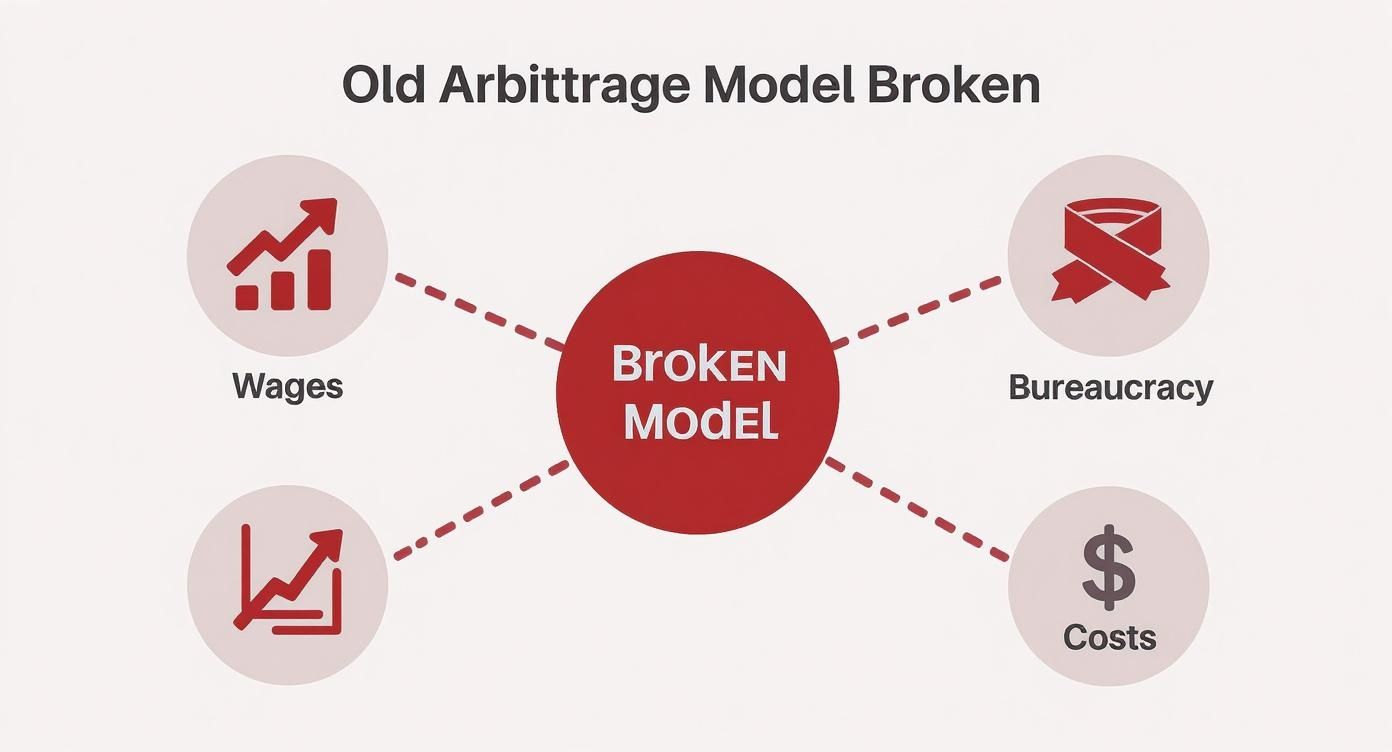
As you can see, rising wages, bureaucratic headaches, and a pile of hidden costs are a triple threat to the old way of thinking.
This isn't sci-fi anymore; it’s the sharpest strategic play on the market. The rise of AI is completely reshaping what labor arbitrage means, moving from geographic wage gaps to technology differentials. The new game involves strategies like AI workflow automation to streamline operations and sidestep all the geopolitical drama and time zone chaos of traditional outsourcing.
The question is no longer "Where should we move this work?" but "How can we automate this process?"
Unlike offshore teams, AI-driven automation provides 24/7 scalability and consistency. It’s a new kind of cost efficiency that relies on technology, not geography.
The smartest companies are sidestepping the entire global hiring mess. They're not looking for a cheaper developer in another country; they're deploying an AI agent that can do the work of ten developers, instantly.
This shift allows you to build a leaner, more powerful operation. Instead of managing a complex global payroll, you’re managing a clean, efficient tech stack. It's not about replacing humans entirely, but about automating the grunt work so you can afford to hire truly elite talent for the roles that actually matter.
Alright, enough theory. Let's talk about what actually works. You still need to build an elite team without auctioning off the office furniture. The old labor arbitrage playbook—chasing the lowest possible hourly rate—is finished. But that doesn't mean you're stuck paying inflated local salaries for every single role.
The modern playbook is a hybrid model built on ruthless strategy. It’s no longer about finding the cheapest human; it’s about being smarter with your resources than everyone else.
The new strategy is a simple, two-step dance. First, you automate everything that can possibly be automated. Second, for the roles that demand real human brilliance, you practice skill arbitrage, not labor arbitrage. You find the absolute best person for the job, wherever they are, and you pay them what they’re worth.
The money you saved on automation is what allows you to afford top-tier talent without breaking the bank. This lets you build a lean, powerful core team supported by a hyper-efficient operational backbone. As companies get used to new realities, figuring out the pros and cons of different work models like hybrid or fully remote is a critical piece of the puzzle.
You stop asking, "Where can I find cheap labor?" and start asking, "What tasks don't need a human in the first place?" This mindset shift is the entire game.
So, what should you automate? Here's a quick checklist of the low-hanging fruit:
Once you’ve handed off the grunt work to your new robot army, you can focus your budget on what really matters: hiring killers. For a deep dive, check out our guide on how to build a high-performance remote team in LatAm without falling into the old outsourcing traps.
This is how you win today—not by chasing the lowest bidder, but by investing in top talent for the roles that actually drive growth.
Let’s be honest. The moment you bring up labor arbitrage, a few eyebrows shoot up. It sounds complicated, maybe even a little shady.
It’s time to clear the air. Here are the tough questions everyone’s thinking but nobody’s asking, with straight, no-fluff answers.
It absolutely can be. If your game plan is to find the cheapest possible labor, pay rock-bottom wages, and exploit economic desperation, then yes—you’re standing on very shaky ethical ground. That’s the old, predatory model, and frankly, it’s just bad business.
The modern, ethical approach isn't about finding the cheapest person. It’s about finding the best talent for a role in a particular region and paying them a top-tier, competitive salary for that market. It’s a shift from pure cost-cutting to what I call “skill arbitrage”—paying for premium skills, wherever they exist. This is a sustainable model built on respect and value.
This one’s simple. Labor arbitrage is the why; outsourcing is the how.
Think of it this way: labor arbitrage is the financial strategy of taking advantage of wage differences between markets. Outsourcing, on the other hand, is one of the actions you take to put that strategy into practice—like hiring a third-party firm in another country to manage your customer service. You outsource because labor arbitrage makes it financially viable.
Yes, but the playbook has completely changed. Small businesses can no longer win by trying to find the cheapest offshore team. The big corporations will always beat you on sheer volume and scale. It's a game you’re guaranteed to lose.
For small businesses, the new arbitrage isn't geographic; it's technological. The smart move is to automate routine tasks with affordable AI tools. Then, you reinvest those savings into hiring one or two highly skilled remote freelancers for critical, high-impact work.
You can't outspend the giants, but you can definitely outsmart them by building a leaner, more efficient, and tech-forward operation.
It's a five-alarm fire for them. AI is a tidal wave of disruption, now capable of handling many of the routine tasks that were once the bread and butter of Business Process Outsourcing (BPO) centers. We're talking about data entry, basic customer queries, and even simple coding tasks.
The smarter outsourcing firms are scrambling to pivot, trying to bake AI-integrated services into their offerings. But let's be brutally honest: the ones who don't adapt are going to get flattened. They simply cannot compete with the raw efficiency, scalability, and 24/7 work ethic of pure automation. Their entire business model is teetering on the edge of obsolescence.

