

A job requisition is a fancy term for an internal permission slip. It's the formal, internal document you create to get the green light—and the budget—for a new hire. Think of it as the business case you have to make before you're allowed to go shopping for talent.
It gets everyone from HR to finance to sign off so you don't waste three months interviewing candidates for a role that was never going to happen anyway.
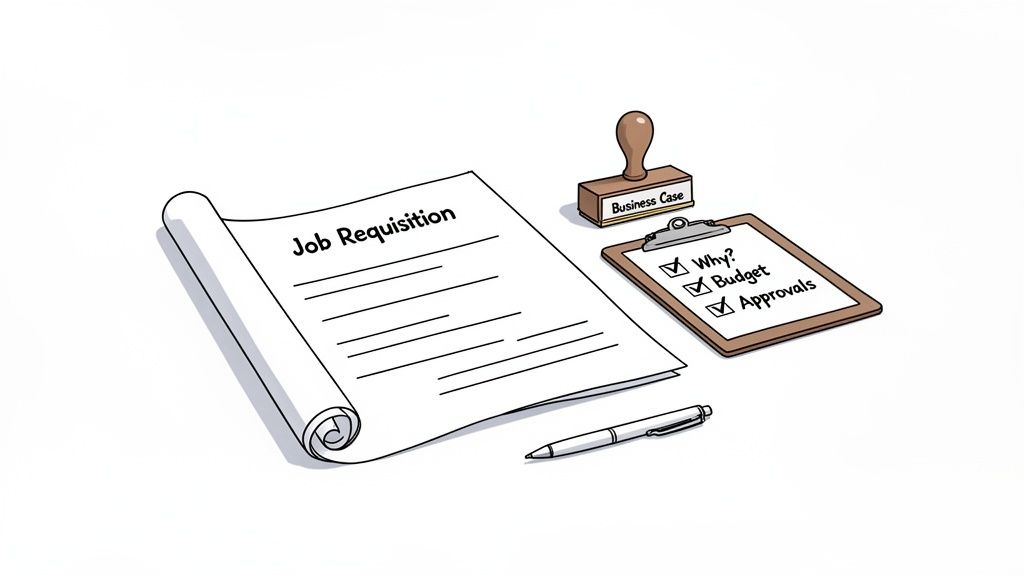
Let's be honest, "job requisition" sounds like something an intern invented to justify their MBA. But ignoring it is a classic rookie mistake, and it will bite you. Hard.
This isn't just more corporate red tape designed to kill your momentum. It’s the blueprint, the budget approval, and the business justification for your next hire, all rolled into one. It’s the first—and most critical—step in any hiring process that isn’t a complete dumpster fire.
Before you get all excited about writing a job description, the requisition forces you to answer the questions that actually matter:
Getting this document right saves you from endless budget battles, angry emails from the CFO, and the classic startup sin of hiring someone to solve a problem you don't actually have. It’s the guardrail that keeps your hiring strategy from flying off a cliff.
This foresight is non-negotiable right now. U.S. employers are juggling nearly 7.7 million open roles, and it takes a median of 42 days to fill one. You don't have time for unforced errors. You can read more on the latest global recruitment trends if you enjoy terrifying data.
A job requisition isn't about adding friction; it's about adding clarity. It's the internal alignment that makes sure everyone agrees on the 'what,' 'why,' and 'how much' before the chaos begins.
A sloppy requisition is the original sin of a bad hire. Get it wrong, and you're not just wasting time—you're actively sabotaging your team. A smart move? Learn how to build a talent pipeline so you're not always starting from scratch.
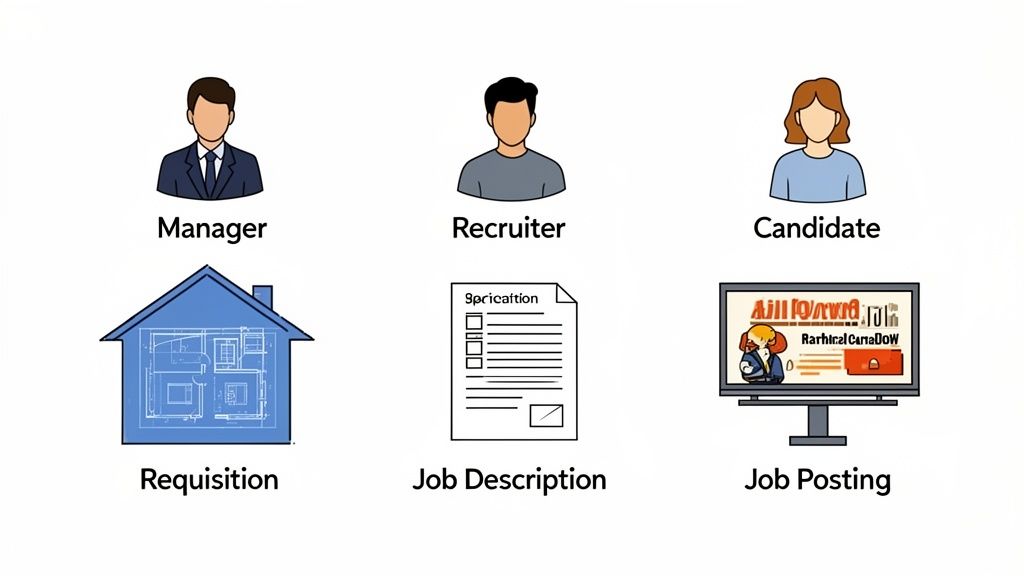
Confusing a job requisition, a job description, and a job posting is a rite of passage for new managers. It's also a recipe for total chaos. It’s like trying to build a house by showing the plumber a real estate ad. It just doesn't work.
Let’s end the confusion once and for all.
Each document is for a different audience. The requisition is for your finance team and leadership; it's all about justification and budget.
The job description is for your hiring team and the candidate. It's about the work. (We have a guide on how to create job descriptions that don’t suck, by the way.)
The job posting is pure marketing. A posting without an approved req is just wishful thinking. And sending a req to a candidate? Awkward.
You wouldn't show a homebuyer the electrical wiring schematics, right? Then don't show a candidate your internal budget approval form. Keep your audiences straight.
Candidates are already facing an average of 5.5 interviews per hire. The last thing they need is to get pulled into a process for a job that isn't even real yet. As you craft these external-facing documents, it's also worth learning how to write AI-friendly job descriptions to make sure they're actually seen.
A great job requisition isn't a novel. It’s a strategic document designed to do one thing: get a signature. Forget those seven-page templates from your last corporate gig.
We’re talking about a lean, mean, approval-getting machine. This isn’t a generic checklist. This is the ‘why’ behind each field—the stuff that actually gets a signature from the people holding the purse strings.
Let's cut the fluff. A requisition that flies through approvals has a few core elements. Miss one, and you’re basically sending an invitation for it to die in someone’s inbox.
Your document absolutely must include:
Now for the parts that really matter. Most requisitions get stuck in limbo for two reasons: a wishy-washy salary and a weak justification.
1. Salary Range (The Reality Check)
Don't you dare write "Competitive." That’s a cop-out, and your CFO will laugh you out of the room. Provide a specific, researched salary band. It proves you’ve done your homework and aren’t just pulling numbers from thin air. A tight, defensible range is the difference between a quick approval and a month-long debate.
2. Justification (The Secret Weapon)
This is your sales pitch. Connect this hire to actual business goals. Instead of "We need more help," try "Hiring a Mid-Market Account Executive will let us service the inbound leads we're currently dropping, adding a projected $250k in new ARR this year." See the difference? One is a complaint; the other is an investment.
A job requisition is an internal business case disguised as an HR form. Treat it like one. Frame the need in terms of revenue, efficiency, or risk reduction, and watch how fast it gets signed.
For a masterclass in building a hiring engine (which starts here), check out a proven playbook for hiring remote developers. Get this foundational document right, and everything else gets easier.
You’ve crafted the perfect requisition. Now for the fun part: getting everyone to sign off. The approval workflow can feel like a labyrinth designed by a sadist, where every turn leads to another stakeholder with an opinion.
It usually starts with you, travels to your manager, detours through HR, gets scrutinized by finance, and maybe—just maybe—lands in front of the CEO. Each stop is a potential black hole where your request can disappear forever.
The trick is to grease the wheels. Anticipate what each person cares about before they even ask.
This diagram breaks down the thinking you need to do before you even hit "submit."
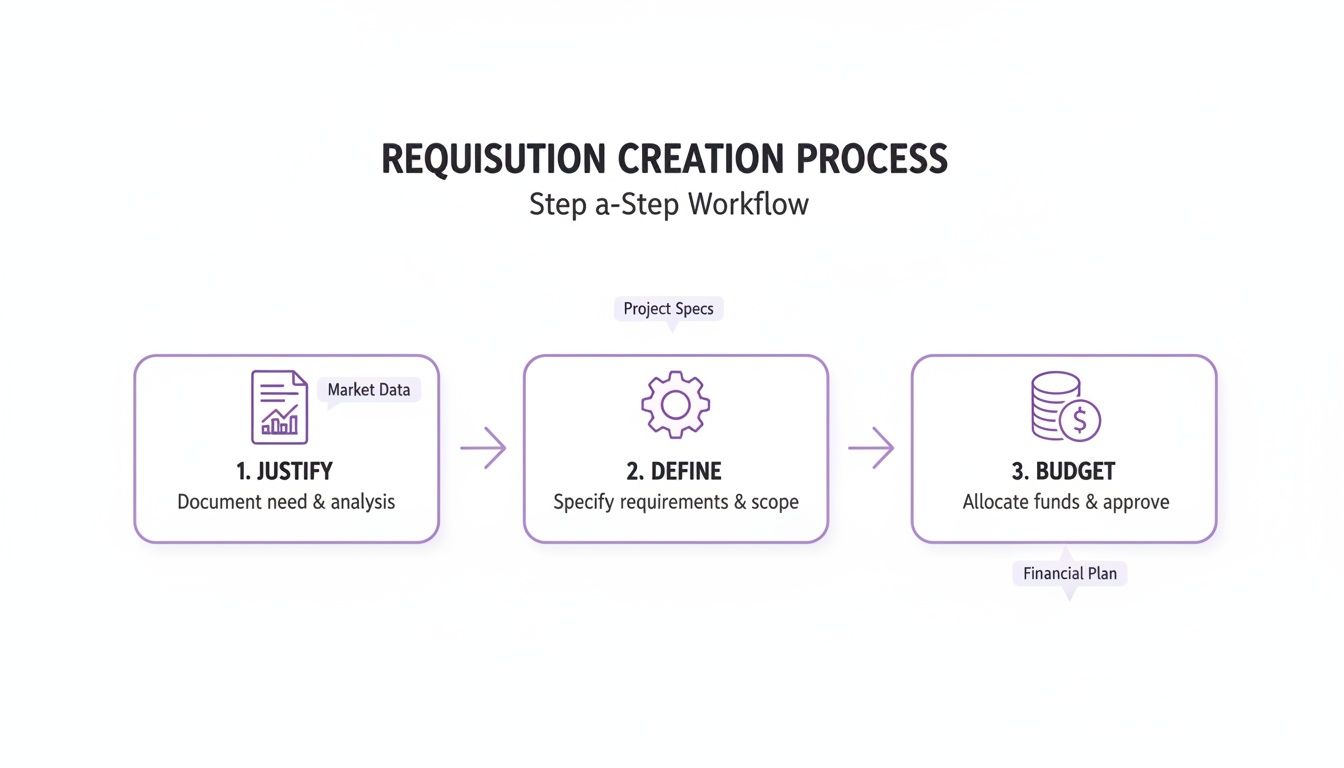
Each of these steps—Justify, Define, and Budget—is a checkpoint designed to prevent you from looking like an amateur.
To get through the gauntlet, you have to think like them. Your manager wants to know how this role helps them hit their targets. HR needs to confirm the salary is fair and compliant. And finance? They just want to see a clear ROI.
A slow approval process isn't just an annoyance; it's a competitive disadvantage. It’s the silent killer of great hiring pipelines.
This isn't just an internal problem. A staggering 76% of employers globally say they can't find the talent they need. With a talent shortage this bad, a clunky internal process means you lose the best candidates before you even start looking. You can discover more insights about the hiring reality check to see just how screwed you are if you're slow.
Modern hiring software can turn this multi-week email nightmare into a one-click process. But even if you're stuck with spreadsheets, the principle is the same: give each approver the data they need, in the language they speak. Do that, and you’ll fly right through.
Remember all that stuff about crafting the perfect requisition? The justification, the salary research, the endless back-and-forth?
What if you could just… skip most of it?
Manually filling out forms feels like using a flip phone in 2024. It’s archaic, especially when top candidates are getting snapped up in days. This is where the magic happens. Instead of staring at a blank template, you can generate a data-backed requisition in seconds. This isn’t about replacing your brain; it’s about giving it a massive head start.
Imagine this: you type in "Senior Product Manager, FinTech, Remote" and an AI drafts the whole thing. It doesn't just fill in fields; it builds a strategic case for you.
This isn't about letting a robot do your thinking. It’s about getting a strategic first draft in seconds so you can focus your energy on what really matters—finding the right person.
This approach crushes that painful "time-to-approve" metric, taking it from weeks to days. You move faster, armed with better data, and free from the soul-crushing admin work that kills everyone's buzz. If you're not using AI-powered recruitment tools yet, you're already behind.
Stop wrestling with documents and start building your team.
Alright, let's tackle the questions that always pop up. No fluff, just the answers you actually need.
The hiring manager. Always. They’re the one who feels the pain of the empty seat, so they own the request. It's their job to have the clearest vision for the role and its impact.
But they don’t do it alone. They should be working with HR to nail the salary band and with finance to make sure the budget actually exists. It's a team sport, but the hiring manager is the quarterback.
Technically, yes. But you really, really don't want to. Changing an approved requisition usually means you go right back to the start of the approval process. A tiny typo? Fine. Anything else? Prepare for pain.
Need to bump the salary or change the job title? Get ready to go back to finance and leadership, hat in hand, and plead your case all over again. This is precisely why you sweat the details the first time.
Think of an approved requisition like a signed contract. You can amend it, but it means getting everyone back to the table. It’s a total momentum killer.
From approval to a signed offer, the goal is to keep this window as short as humanly possible. Time kills all deals, especially in hiring.
There’s no magic number, but if you're consistently taking more than 30 to 60 days to fill a role, something is broken. If a req is still open after 90 days, it’s a giant red flag. Either your salary is a joke, your expectations are a fantasy, or your process is a disaster. Fix it.

