

Let's be honest, most HR terms sound like they were invented to make conference speakers sound smart. Full cycle recruiting isn't one of them. It's a ridiculously simple idea: one person or team owns the entire hiring journey, from the first spark of "we need someone" to that person's first day and beyond. It’s a start-to-finish ownership model for finding and keeping great people.
No handoffs. No dropped balls. Just one accountable owner.
Remember playing "telephone" as a kid? That game where a message gets whispered from person to person, only to come out completely mangled at the end? That’s what traditional, fragmented recruiting feels like.
A sourcer finds a resume, a coordinator schedules a call, a junior recruiter does a screen, and a hiring manager finally talks to a candidate who might be a terrible fit. Every handoff is a chance for context to get lost, for urgency to die, and for a great candidate to ghost you.
Full cycle recruiting cuts through that chaos.
Think of it like a master home builder who doesn't just lay bricks. They find the land, draft the blueprints, manage the plumbing, and personally hand you the keys. This 'soup-to-nuts' approach prevents the screw-ups that plague old-school hiring.
This single point of contact—whether it's an in-house recruiter, a busy founder, or a dedicated partner like LatHire—is responsible for everything. This isn’t about piling work onto one person; it’s about making one person accountable for the result.
The outcome? A seamless, coherent experience for both the candidate and the hiring manager. No more "let me check with so-and-so" and no more candidates wondering who they’re supposed to email. This consistency builds trust and momentum—two things that are pure gold in a competitive hiring market.
The gains aren't just a feeling, either. Companies that switch to a full-cycle recruiting model have reported a 30% or greater reduction in hiring duration. This speed translates directly into faster team growth and less productivity lost to unfilled roles. For a deeper dive, you can explore the full findings on hiring efficiency.
The difference is painfully obvious when you put the two models side-by-side. One looks like a well-oiled machine; the other looks like a factory assembly line where half the workers have called in sick.
Here’s a side-by-side look at how a unified approach stacks up against the old-school assembly line. It highlights the shift from chaotic handoffs to streamlined ownership, which is the core of what full cycle recruiting is.
| Stage | Full Cycle Recruiting (One Owner) | Traditional Recruiting (Multiple Handoffs) |
|---|---|---|
| Sourcing | The owner finds candidates with deep knowledge of the role’s real needs. | A sourcer finds keywords on a resume, often missing crucial context. |
| Screening | Conversations are strategic, building on a consistent narrative. | Candidates repeat their story to multiple people, losing enthusiasm. |
| Interviewing | The owner ensures feedback is consistent and drives toward a clear decision. | Conflicting feedback from siloed interviewers leads to hiring paralysis. |
| Offer | The owner leverages the relationship built over weeks to close the candidate. | An offer comes from a stranger, feeling transactional and impersonal. |
Ultimately, the full cycle approach ensures that the person who understands the role's true needs is the same person building the relationship with the candidate. This continuity is what makes the whole process faster, more effective, and far more human.
So, you’re sold on the "one owner" approach. Great. But what does that person actually do? This isn't just about having a single point of contact; it's about mastering a six-stage process that turns a job description into a high-performing teammate.
Think of it as a series of connected missions. Drop the ball on one, and the entire campaign falls apart. This isn't a textbook list—it's a field guide from the trenches.
Here’s a quick visual of how these stages flow, from finding the right person to making sure they stick around.
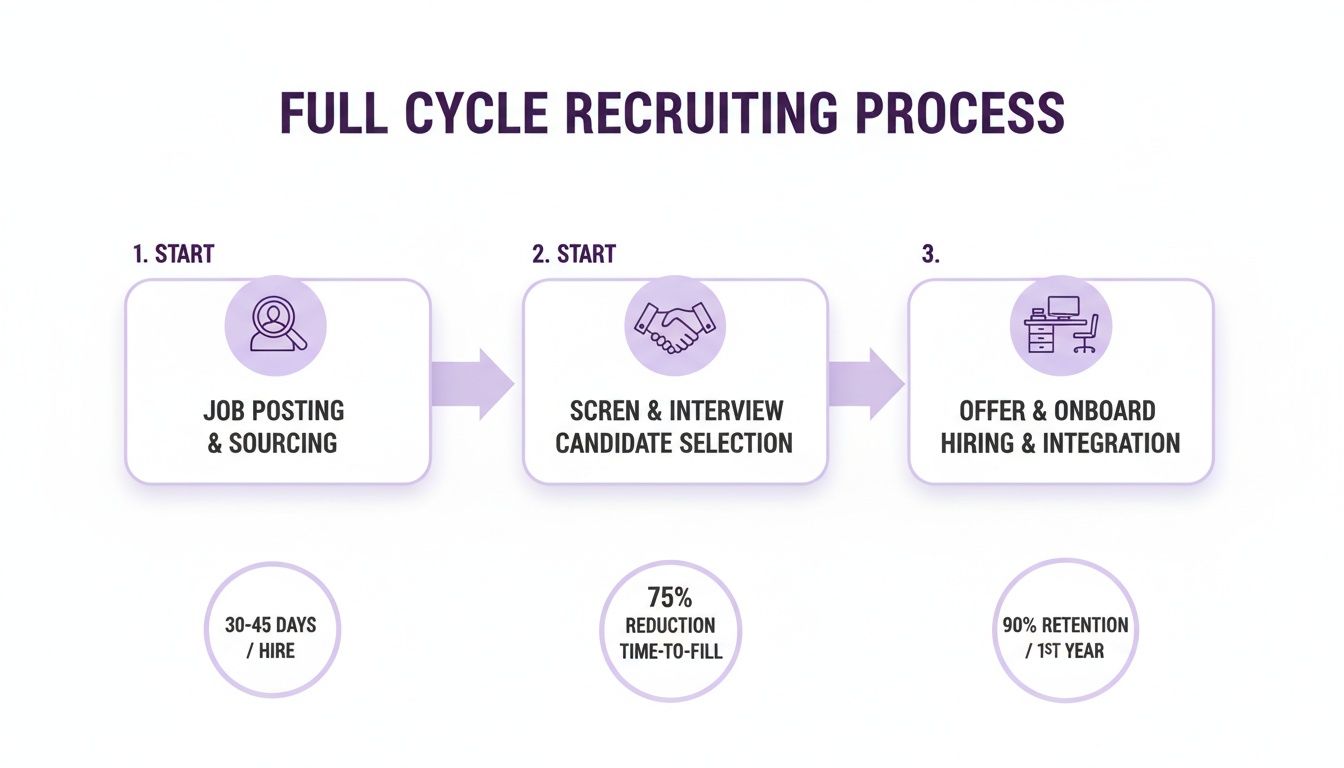
The journey clearly starts with sourcing and ends with onboarding, but the real magic is in the connections between each step. A seamless handover from one stage to the next is what separates a good hire from a great one.
This is where most companies completely miss the mark. They post a job on LinkedIn, cross their fingers, and then complain about a shallow talent pool. Sourcing isn't posting; it's hunting.
A true full-cycle recruiter doesn’t wait for candidates to show up. They go find them.
Forget "post and pray." You need to be a talent detective, finding the best person for the job, not just the best person who happened to be browsing job boards that week.
Alright, you have a pile of resumes. Now what? The goal is ruthless efficiency: spotting genuine talent and obvious red flags in minutes, not hours. This is your first line of defense against wasting your team's valuable time.
A skilled full-cycle recruiter isn’t just checking boxes. They’re digging for motivation. Why this role? Why our company? Why now? A simple 15-minute phone screen can reveal more than a two-page resume ever could.
Let's be blunt: most interviews are useless. They devolve into unstructured chats that only measure how well someone can talk, not how well they’ll actually perform. A full-cycle recruiter builds a structured process designed to predict future success.
This means asking sharp, behavioral questions like, "Tell me about a time you had to deliver a project under an impossible deadline," instead of fluff like, "What's your biggest weakness?" One reveals character; the other reveals how well they prepared for a generic interview.
You need a consistent scorecard, clear criteria, and interviewers who are trained to look for evidence, not just a "good vibe." For more on this, check out our guide on best practice recruitment processes to build a system that works.
You’ve found your perfect candidate. The finish line is in sight. Don’t fumble now. The offer stage isn’t just sending a number; it’s the culmination of the relationship you’ve built throughout the process.
A savvy recruiter knows the candidate's motivations, concerns, and what it will take to get a confident "yes." They don't get into bidding wars; they sell the opportunity. To seal the deal, modern employment agreements are used to formalize the role and clarify expectations on both sides.
The cycle doesn't end when the contract is signed. In fact, one of the most critical phases is just beginning. A terrible onboarding experience is the fastest way to turn a star hire into a flight risk.
Research shows that around 30% of new hires leave within the first 90 days, often due to a chaotic start. Great onboarding isn’t a swag bag and a welcome lunch; it's a structured 30-60-90 day plan that sets your new team member up to win from day one.
And finally, the part everyone forgets. A great recruiter doesn't just disappear after the hire. They check in. They talk to the hiring manager a month later. Is the new hire meeting expectations? Are they integrating well?
This feedback loop is pure gold. It’s how you refine your process for the next hire, ensuring your recruiting engine gets smarter and more effective over time.
Think your fragmented hiring process is "good enough"? That feeling of comfort is probably costing you a fortune. Most companies leak cash through hiring inefficiencies they don't even track, chalking it up to the "cost of doing business." It's not. It's the cost of doing business badly.
The damage starts with prolonged vacancies. Every day a critical role sits empty isn’t just a gap on an org chart; it’s a productivity black hole. Projects stall, deadlines get pushed, and your existing team gets burned out picking up the slack.
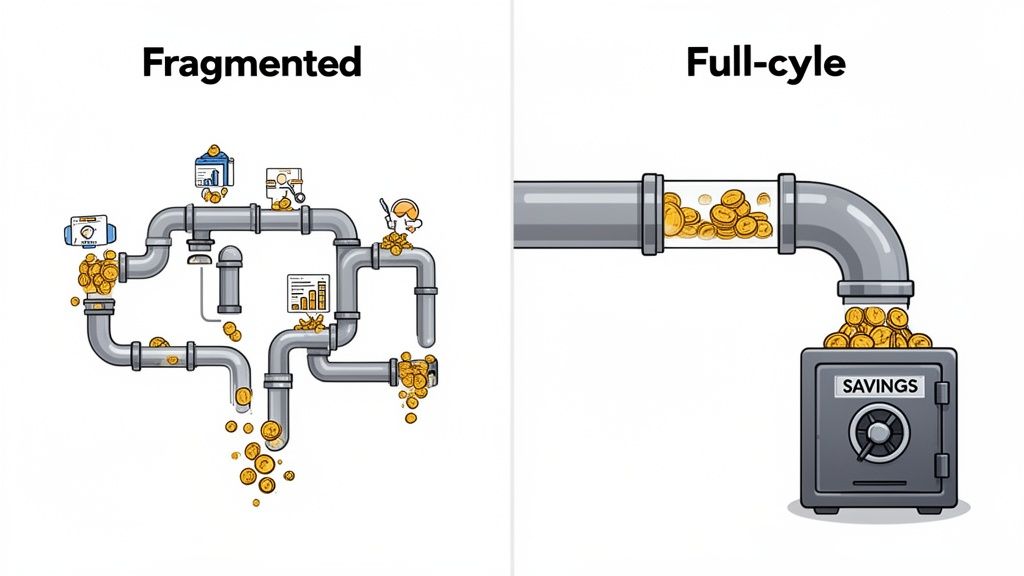
The most expensive drain isn't some external agency—it's the internal chaos. Hope you enjoy having your $150,000-a-year senior engineer spend their afternoons fact-checking resumes, because in a fragmented model, that's their part-time job now.
When you spread hiring duties across people who aren't recruiters, you’re paying hidden salaries for work they aren’t even good at. It’s a classic case of death by a thousand paper cuts.
Let’s break down the cast of characters in this expensive little play:
Each of these moments represents thousands in lost productivity, all because nobody owns the process. A single point of ownership—the core of what full cycle recruiting is—eliminates this waste.
A bad hire isn't just a mismatch; it's a financial grenade. The U.S. Department of Labor estimates the cost of a bad hire can reach up to 30% of their first-year earnings. For a $100k role, that’s a $30,000 mistake you can’t afford to make.
Here’s the part that stings long-term. Every clumsy handoff, rescheduled call, and delayed response creates a terrible candidate experience. Top talent has options; they aren't going to stick around for a company that seems disorganized.
This isn’t just about losing one good candidate. It’s about them telling their network about their awful experience. Your reputation erodes, and suddenly, every future hire becomes harder and more expensive. You're forced to pay a premium to attract talent that, a year ago, would have been excited to join.
The contrast is stark when you look at the all-in costs. A fragmented model looks like this: agency fees, partial salaries of everyone involved, multiple software subscriptions, and the unquantifiable cost of brand damage.
A streamlined full-cycle system consolidates these expenses. It transforms hiring from a chaotic scramble into a strategic function. You stop paying for inefficiency and start investing in a process that delivers better talent, faster.
If you’re only tracking "time-to-hire," you're flying blind. It's a classic vanity metric—useful for making managers feel busy, but terrible for measuring business impact. A great full-cycle process is driven by data, but only if you're measuring the things that move the needle.
Let's ditch the fluff. You don't need a dozen KPIs on a fancy dashboard. You need a handful of ruthless metrics that tell you if your hiring machine is building value or just spinning its wheels.
First up: Cost-per-Hire. Most companies get this totally wrong. They tally up job board fees, maybe a recruiter’s salary, and call it a day. That’s not the real picture.
The true cost includes the hourly rate of every single person who touches the process. Your senior engineer's time screening resumes? Cost. Your head of product’s four hours in interviews? Huge cost. Your own time chasing feedback? You bet it's a cost.
A simple, honest formula looks like this:
(Total Internal Costs + Total External Costs) / Total Number of Hires = True Cost-per-Hire
This number will probably feel uncomfortably high. Good. It’s the wake-up call you need to stop wasting your team's time.
What's the point of hiring faster or cheaper if the people you bring on can't do the job? Quality-of-Hire is the single most important metric, yet most companies avoid it because it feels "too subjective." Nonsense.
You can absolutely put a number on it. Here’s a pragmatic way:
Average those scores, and you have a tangible Quality-of-Hire score. It’s not about finding a perfect formula; it’s about consistently measuring outcomes. For a deeper look, our guide on quality of hire metrics breaks down more ways to turn this concept into hard data.
Your Offer Acceptance Rate is a direct grade on your candidate experience and competitiveness. If top candidates are consistently turning you down, it’s a blaring alarm that something is broken. Maybe your comp is off, your interviews are a mess, or your company vision isn’t coming across.
A rate below 85% is a major red flag. It means you’re doing all the hard work of sourcing and interviewing, only to lose your top choice at the final step. It's like running a marathon and tripping one foot before the finish line.
Finally, there's First-Year Attrition. This is the metric that tells the unvarnished truth. If new hires are walking out the door within 12 months, you either hired the wrong person or you failed them after they joined. There’s no third option.
A high attrition rate means you're not just losing an employee; you're throwing their salary, training costs, and the original cost-to-hire straight into a bonfire. It’s the ultimate report card on your hiring, onboarding, and culture.
While focusing on key time to hire metrics is important for efficiency, it must be balanced with these quality-focused KPIs. After all, hiring the wrong person quickly is just a fast track to failure.
So, you're sold. You see how a full-cycle approach plugs the leaks in your process, but the thought of managing all six stages yourself just gave you a mild panic attack.
I get it. Your day is already a chaotic mix of putting out fires and trying to build something; you don't have time to become a full-time recruiter on top of it all.
This is where you think smarter, not harder.
The old way was to either hire a massive internal recruiting team you can't afford or pay a fortune for headhunters who vanish the second an offer is signed. Good luck figuring out international payroll on your own!
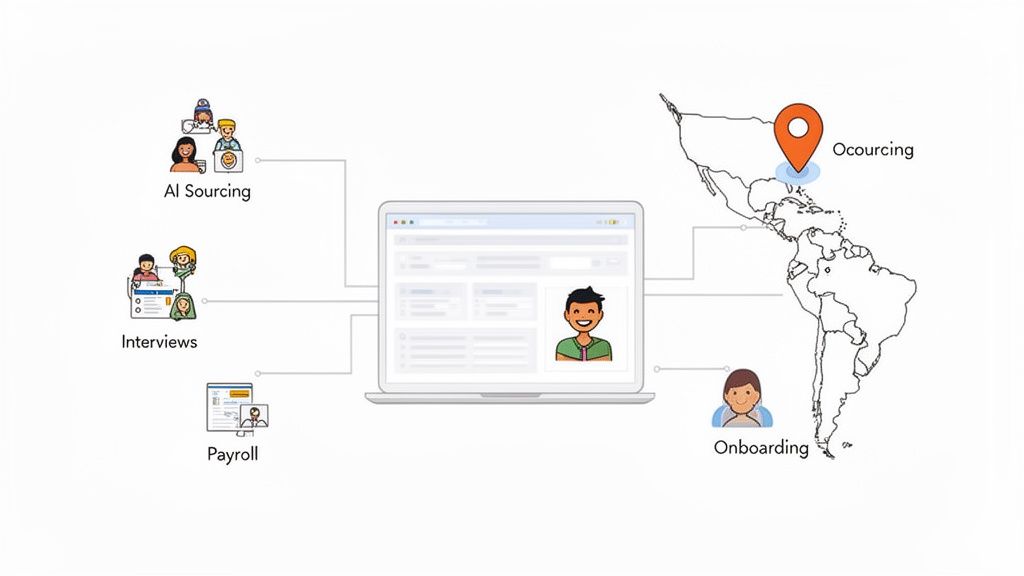
There’s a new way: getting the benefits of a full-cycle model without having to build the entire machine from scratch. It’s about leveraging a partner that acts as your dedicated, end-to-end recruiting engine.
Think of it as “Recruiting-as-a-Service.” You get the strategic ownership of an in-house expert without having to mortgage your office ping-pong table to pay for another senior-level salary.
This isn't just about finding candidates; it’s a complete system designed to handle the entire messy, time-sucking process for you.
Let’s use our own model at LatHire as a real-world example (toot, toot!). We didn't build our platform to be another job board. We built it to solve the exact pain points we’ve been talking about, especially for companies tapping into the incredible talent in Latin America.
Here’s how a modern, service-based approach tackles the cycle:
This isn't a sales pitch; it's a strategic look at how to get the outcome you want—a fantastic hire who sticks around—without the operational headache. It’s about outsourcing the process, not the strategy.
This approach fundamentally changes the recruiting equation. You’re no longer just buying a list of names from an agency. You're investing in a complete system that covers the entire journey, from job description to first payday.
This is especially critical when hiring internationally.
The logistical hurdles of cross-border recruiting can sink even the most organized teams. A partner that manages the full cycle becomes your shield against compliance nightmares. While this helps fill roles quickly, it’s also crucial for long-term growth. If you want to proactively find talent, check out our guide on how to build a talent pipeline.
Ultimately, implementing full-cycle recruiting the smart way means recognizing what you do best—running your business—and finding a partner who does this one thing exceptionally well.
Alright, let's tackle some of the common questions from founders and hiring managers. No fluff, just straight answers for people in the trenches who need to make smart decisions, fast.
Absolutely not. In fact, it's often more critical for startups where you can't afford any dropped balls.
In a small team, you don’t have the luxury of miscommunication between a sourcer, a coordinator, and a hiring manager. A single point of ownership ensures a consistent candidate experience and faster decision-making when speed is your only advantage.
While a big corporation might have specialized teams, a full-cycle mindset helps any company move faster. The "owner" could be a dedicated recruiter, an HR generalist, or—let’s be real—the founder in the early days.
Think of it as a general contractor versus a plumber. A "standard" recruiter is the plumber—they focus on one piece, like sourcing candidates. They find potential fits and pass them on. Job done.
A full-cycle recruiter is the general contractor for the entire hiring project.
They don’t just find the materials (source candidates); they draw up the blueprints (job description), manage the subcontractors (coordinate with hiring managers), inspect the work (interview and screen), and see the project through to completion (offer and onboarding). They own the final outcome, not just a single step.
This holistic view means they understand the why behind the hire, which makes them far more effective at selling the role and closing top talent. It’s the difference between a task-doer and a strategic partner.
Yes, and you probably should. The core of full-cycle recruiting is a process and a mindset, not a collection of expensive tools. The biggest costs in most hiring models are wasted time and bad hires—both of which this approach is designed to cut.
By streamlining your process under a single owner, you inherently reduce those costs. It’s about efficiency.
Here’s how a lean company can make it work:
It’s not just a good idea for international hiring; it’s a necessity. When you’re juggling different time zones, cultural nuances, and ridiculously complex legal and payroll requirements, a fragmented process is a recipe for disaster.
A full-cycle approach, especially when managed through a platform built for it like LatHire, ensures nothing falls through the cracks. It turns a logistical nightmare into a streamlined, repeatable process.
One system manages sourcing in the right talent pools, coordinates interviews across continents, and handles the cross-border contracts and payroll that would otherwise give your finance team a massive headache. It’s the only sane way to scale a global team without scaling your administrative burden at the same rate.

