

Let's be blunt: candidate sourcing is the proactive hunt for qualified professionals, especially the high-performers who aren't even looking for a new job. It’s the difference between putting up a "Now Hiring" sign and hoping for the best versus actively identifying and pursuing the exact talent you need to win.
Turns out there’s more than one way to hire elite developers without mortgaging your office ping-pong table.
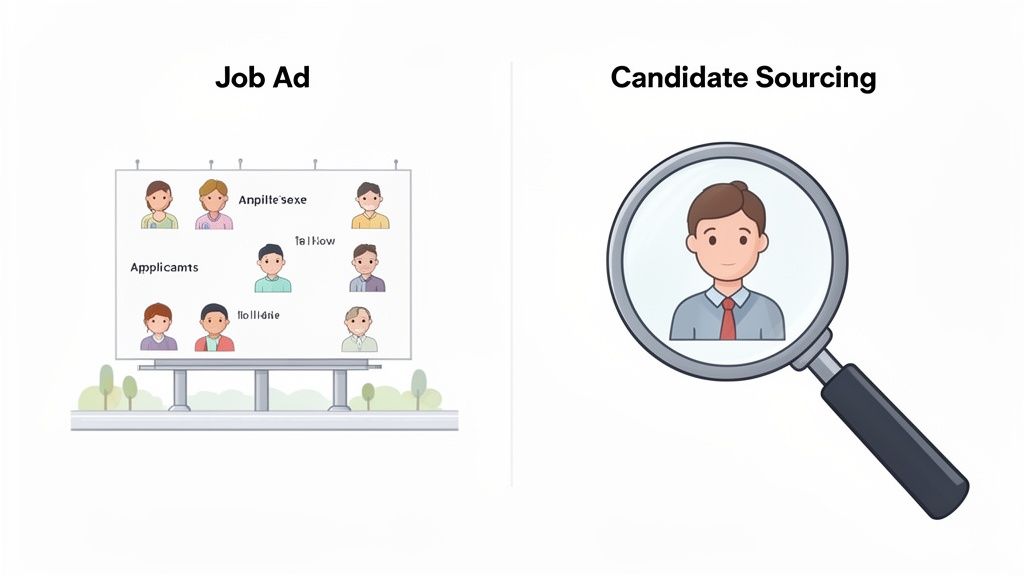
Most companies are stuck in a passive hiring loop. They post a job, cross their fingers, and then spend weeks drowning in a sea of mismatched resumes. Hope you enjoy spending your afternoons fact-checking resumes and running technical interviews—because that’s now your full-time job.
Candidate sourcing flips that script entirely. Instead of waiting for talent to come to you, you go out and find them.
It’s the art of building a pipeline of potential hires before you desperately need one. It's about identifying, engaging, and nurturing relationships with top-tier professionals so that when a role opens up, you already have a shortlist of A-players ready to go.
This proactive approach is a game-changer for a few key reasons:
The process is remarkably similar to a well-oiled sales machine. In fact, learning about what is lead generation in sales provides a perfect framework for understanding it—you're essentially generating "candidate leads."
The numbers back this up, showing that sourced candidates are a staggering 8 times more likely to get hired than inbound applicants. Top teams are obsessed with this strategy for a reason.
People often use "sourcing" and "recruiting" interchangeably, but they're two distinct—though complementary—parts of the hiring process. Think of it as the difference between hunting for prospects and closing the deal.
Sourcing is the specialized, front-end work of finding and engaging potential candidates. Recruiting takes over once a candidate shows interest, guiding them through interviews, offers, and onboarding.
Here’s a simple breakdown to clarify the roles:
| Aspect | Candidate Sourcing (The Hunt) | Traditional Recruiting (The Net) |
|---|---|---|
| Primary Goal | Identify and engage potential candidates, building a talent pipeline. | Guide interested candidates through the hiring process to fill an open role. |
| Timing | Proactive; often happens before a specific job is open. | Reactive; begins when a job requisition is approved. |
| Candidate Type | Focuses on passive candidates—those not actively looking for a job. | Manages active candidates who have applied for a job. |
| Key Activities | Research, Boolean search, social media outreach, building talent pools. | Screening resumes, conducting interviews, negotiating offers, onboarding. |
| Core Skillset | Investigation, sales, marketing, and relationship-building. | Evaluation, process management, negotiation, and closing. |
Ultimately, great sourcing makes a recruiter’s job infinitely easier. By handing over a pre-qualified, interested candidate, the sourcer ensures the recruiter can focus on what they do best: finding the perfect fit for the team. You need both to build a world-class hiring machine.
Okay, you get the ‘what’. Now for the much more important ‘why’. If your hiring plan is still just “post a job and pray,” you’re not just falling behind—you're actively setting cash and morale on fire. Get ready to spend your afternoons fact-checking résumés and running screening calls, because that’s your new full-time job.
Relying solely on whoever happens to apply is a massive time sink. You'll waste weeks sifting through candidates whose résumés look like they were written by a bored bot, only to find the one who seems "perfect" on paper is a disastrous culture fit. It's a slow, painful grind that almost never lands you the A-player you actually need.
The real cost of a bad hire goes way beyond the wasted salary. It's the lost productivity, the stalled projects, the great employees who get demoralized, and the priceless time you, as a founder or manager, can never reclaim. For a lean company, one bad hire can be a torpedo to the hull.
Here’s the unfiltered truth: the best people are rarely looking for a new job. They’re too busy killing it in their current one. This is the "passive candidate" market, and it makes up a staggering 70% of the global workforce. These are the elite performers who will never see your job board post because, well, they aren't looking at job boards.
Proactive candidate sourcing is your all-access pass to this hidden market. It’s how you start conversations with the engineers, marketers, and operators your competitors would kill for—the ones who will only move for a truly exceptional opportunity.
This isn’t about just filling a seat anymore. It's about strategically upgrading your entire team, one person at a time. Passive candidates often end up being more engaged and perform better because they were hand-picked for a specific reason, not just because they were the best of whoever happened to apply that week.
The single biggest edge sourcing gives you is the ability to build a talent pipeline before you have an urgent, fire-drill of an opening. Think about it. When a key employee resigns, most companies hit the panic button. They rush the process, settle for a "good enough" hire, and inevitably pay the price down the line.
Sourcing eliminates that chaos. By consistently identifying and nurturing relationships with top talent in your field, you create a living, breathing database of pre-vetted professionals. When a role finally opens up, you’re not starting from scratch. You’re starting with a warm shortlist.
This flips hiring from a reactive, chaotic scramble into a strategic, proactive part of the business. You’re always ready. For a startup, this isn't some "nice-to-have" HR function; it’s a core survival strategy. It’s how you build an unfair advantage, one great hire at a time. Forget hoping for the best—it's time to hunt for the best.
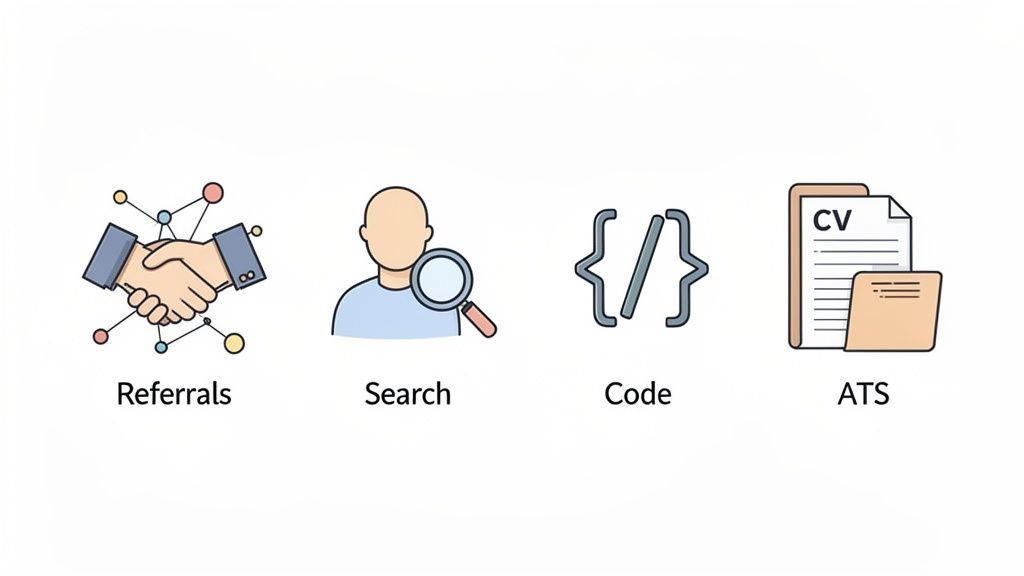
Alright, enough with the theory. Let's get our hands dirty. Where do you actually find these amazing, high-performing candidates you keep hearing about?
This is your field guide to the sourcing channels that deliver real results, not just a mountain of résumés. We’re going to skip the fluff and focus on the gritty, tactical plays I’ve seen work time and time again.
Forget everything you’ve heard about casting a wide net. True sourcing is about precision hunting, and that means choosing the right weapon for the right target.
Before you spend a single dollar on a premium LinkedIn account, look around. Your strongest potential hires are often just one degree of separation away, hiding in plain sight within your existing network.
Your team, your investors, your advisors—they all know talented people. The problem is, most referral programs are garbage. A lazy email blast asking "who do you know?" is a one-way ticket to the spam folder.
A great referral program is built on three pillars:
Your team’s network is pre-vetted for culture fit. If your best engineer recommends someone, that’s a signal worth its weight in gold. Don't waste it.
This is where the real hunt begins. Mastering Boolean search is the single most valuable skill in a modern sourcer's toolkit. It’s how you turn platforms like LinkedIn, GitHub, and even Twitter into a surgical database of talent.
Boolean search uses simple commands—AND, OR, NOT, parentheses (), and quotation marks ""—to build hyper-specific search queries. It looks intimidating, but it’s just logic. When you're building a sourcing strategy, knowing how to generate leads from LinkedIn is a huge advantage, and the principles are nearly identical.
Here’s a practical example for finding a Senior Python Developer in Austin who has experience with AWS, but not at a massive corporation like Amazon or Google:
("Senior Python Developer" OR "Senior Python Engineer") AND ("AWS" OR "Amazon Web Services") AND "Austin" NOT ("Amazon" OR "Google")
Copy, paste, and tweak that string. You’ve just filtered out thousands of irrelevant profiles in seconds. This is your new superpower.
I’m going to let you in on a secret: one of the most valuable sourcing channels you have is your own Applicant Tracking System (ATS). It’s a digital graveyard of "almosts"—great candidates who were the runner-up for a previous role.
These aren't cold leads. They already know your company, they made it through multiple interview rounds, and they were compelling enough to be a finalist. Yet most companies just let these profiles gather digital dust.
The game is shifting from volume to value. Recent data shows that hires sourced from rediscovered talent in existing databases jumped to 46% (up from 26% in 2021). That’s a massive leap, proving your ATS is an untapped treasure trove.
Re-engaging past candidates is one of the highest-ROI activities you can do. A simple, personalized "Hey, we have another role that might be an even better fit" can reactivate a fantastic candidate who is already warmed up to your brand.
It's efficient, cost-effective, and just plain smart. While you’re out hunting for new talent, don’t forget the gems you’ve already found. Building a process to tag and revisit these silver medalists is a core part of learning how to build a talent pipeline that constantly delivers. Your next great hire might just be someone you’ve already met.
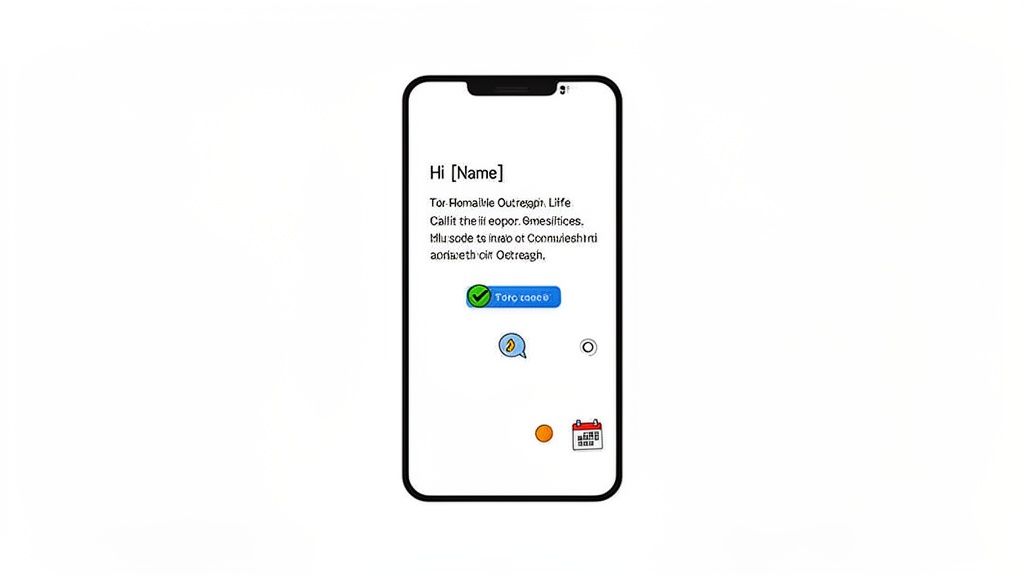
So you’ve done the hard work. You mastered the search strings, mined your network, and found the perfect candidate. Their profile practically glows.
Now what?
This is the moment where 90% of sourcing efforts die a quiet death. A generic, copy-pasted "I'd like to connect" request or a lazy "I have an opportunity for you" message is the fastest way to get ignored, archived, and forgotten. For a top-tier professional, that kind of outreach is just digital noise.
Let’s be clear: a great first message is an investment. It’s the difference between starting a valuable conversation and getting blocked. A single, well-crafted email can be worth thousands in saved recruiting fees. This isn't about spamming inboxes; it's about making a connection that matters.
I’ve sent my fair share of terrible outreach emails. Trust me, I’ve made all the mistakes. Over time, I’ve learned that the best messages—the ones that actually get replies from busy, talented people—all share a few core components.
It’s a simple formula, but it works.
Templates are a necessary evil for scaling, but they should be a starting point, not a crutch. The key is to leave big, obvious blanks for personalization so you're forced to do the research.
Here’s a framework you can adapt.
The "I Admire Your Work" Angle
Subject: Your recent work on [Project Name]
Hi [Candidate Name],
I was seriously impressed with the [specific feature or outcome] you achieved on [Project Name]. The way you handled [technical detail] was brilliant.
We're tackling a similar challenge here at [Your Company] as we build out our [product/feature], and your expertise is exactly what we need.
Are you open to a quick 15-minute chat next week to share a bit about what we’re building?
This works because it leads with genuine, specific praise. It shows you’re not just looking for a "Senior Developer" but for their specific skill set.
Here’s a hard truth: most replies come from the follow-up. People are busy. Inboxes are chaotic. Your first email might get buried. Not following up is like giving up after one knock on the door.
My rule is simple: follow up twice, three days apart. Keep it short, polite, and add a little extra value if you can. A simple "Hey, just bumping this to the top of your inbox" is perfectly fine for the first one.
Your second follow-up can be a graceful exit. Something like, "Assuming the timing isn't right, but I'll keep following your work. Best of luck with everything at [Their Current Company]." It’s professional, leaves the door open, and doesn’t burn any bridges. This whole dance is a crucial part of what candidate sourcing really is: building relationships, not just filling roles.
Look, we didn't build LatHire on a whim. We built it because we were tired of the old way of hiring. We’ve lived the pain of posting a job and getting buried under a mountain of unqualified, irrelevant resumes. We know the unique chaos of trying to hire great international talent.
This is our story of solving our own massive headache. We knew there had to be a better way than spending countless hours hunting for candidates, only to find they were in the wrong timezone, lacked the right skills, or came with a mountain of compliance paperwork.
So, we decided to rebuild the entire sourcing engine from the ground up.
Forget everything you know about the traditional sourcing grind. Our platform acts as your sourcing team on overdrive, automating the tedious parts so you can focus on what actually matters—talking to great candidates.
The old way meant you, or someone on your team, would spend an average of 26 hours per hire just hunting for talent. That’s more than half a workweek spent scrolling through profiles and sending messages into the void.
Our AI does that heavy lifting for you. Just feed it your job description—or let our AI generate one for you—and it instantly gets to work, matching your needs against our pre-vetted talent pool of over 800,000 professionals across Latin America. No more guesswork, no more praying for the right applicant to magically appear.
The result? A shortlist of top-tier, timezone-aligned, and deeply vetted candidates lands on your desk in as little as 24 hours. We’re not saying we’re perfect. Just more accurate more often.
The single biggest flaw in traditional candidate sourcing is the skills validation—or lack thereof. A resume is a marketing document, not a statement of fact. You spend hours interviewing, only to discover a candidate’s "expertise" is purely theoretical.
We replaced that guesswork with proof. Every single candidate in our pool goes through a rigorous vetting process that includes:
This is what modern candidate sourcing should be. The global recruiting market is exploding, projected to hit USD 989.32 billion by 2031, precisely because of this shift toward smarter, data-driven strategies. With 90% of hiring managers calling the hunt for skilled candidates their biggest hurdle, you can't afford to keep doing things the old way.
Finding the right person is only half the battle, especially when hiring across borders. The real nightmare often begins with international payroll, benefits, and local compliance laws. It’s a minefield of paperwork and legal risk that can stop even the most determined founder in their tracks.
That’s where we step in.
Once you’ve found your perfect hire through our platform, we take care of the entire administrative backend. We manage the contracts, process payments in local currencies, and ensure full compliance with regional labor laws. You get all the benefits of a global team without any of the logistical headaches. Our AI-powered recruitment tools are designed to manage this entire workflow seamlessly.
To see the difference, here’s a quick breakdown of how our approach stacks up against the DIY method.
A side-by-side comparison showing how LatHire streamlines each step of the sourcing process, saving you time, money, and sanity.
| Sourcing Step | The Old Way (DIY) | The LatHire Way |
|---|---|---|
| Talent Discovery | Hours posting jobs, manual searching on LinkedIn, cold outreach. | Instant access to a pre-vetted pool of 800,000+ LATAM professionals. |
| Candidate Screening | Manually reviewing hundreds of resumes, hoping for a match. | AI-powered matching delivers a shortlist of top candidates in 24 hours. |
| Skills Validation | Guesswork based on resumes, long interview cycles to verify skills. | Proprietary AI assessments and human vetting prove skills upfront. |
| Compliance & Payroll | Navigating complex international labor laws and payment systems. | Fully managed contracts, payroll, and compliance handled for you. |
| Time to Hire | Weeks, or even months, to find and onboard a single candidate. | Hire a top-tier, fully vetted candidate in a matter of days. |
Ultimately, we built the platform we always wished we had—one that makes finding and hiring elite global talent not just possible, but easy.
"If you can’t measure it, you can’t improve it." It’s a classic business mantra for a reason.
But let’s be honest, most recruiting metrics are pure vanity. Who cares about your “time-to-fill” if you rush to fill the role with the wrong person? That’s not a win; it’s a future headache you just put on the payroll.
Sourcing isn't about looking busy; it's about generating real, tangible ROI. That means tracking the Key Performance Indicators (KPIs) that actually tell you if your hunt for talent is working. Forget the fluff. We're talking about the numbers that connect your sourcing efforts directly to business outcomes.
To get a real signal on your sourcing effectiveness, you have to move past the surface-level numbers. Stop obsessing over how many emails you sent and start tracking what actually happens after you hit send.
Here are the metrics that should live on your dashboard:
Tracking these numbers doesn’t require a complicated, expensive system. A simple spreadsheet is all you need to start. The goal is to see patterns, understand what’s working, and double down on the channels and messages that deliver A-players. For a deeper dive into evaluating talent, check out our guide on the best candidate assessment tools.
This diagram shows the difference between the old way of sourcing—based on guesswork—versus a modern, data-driven approach.
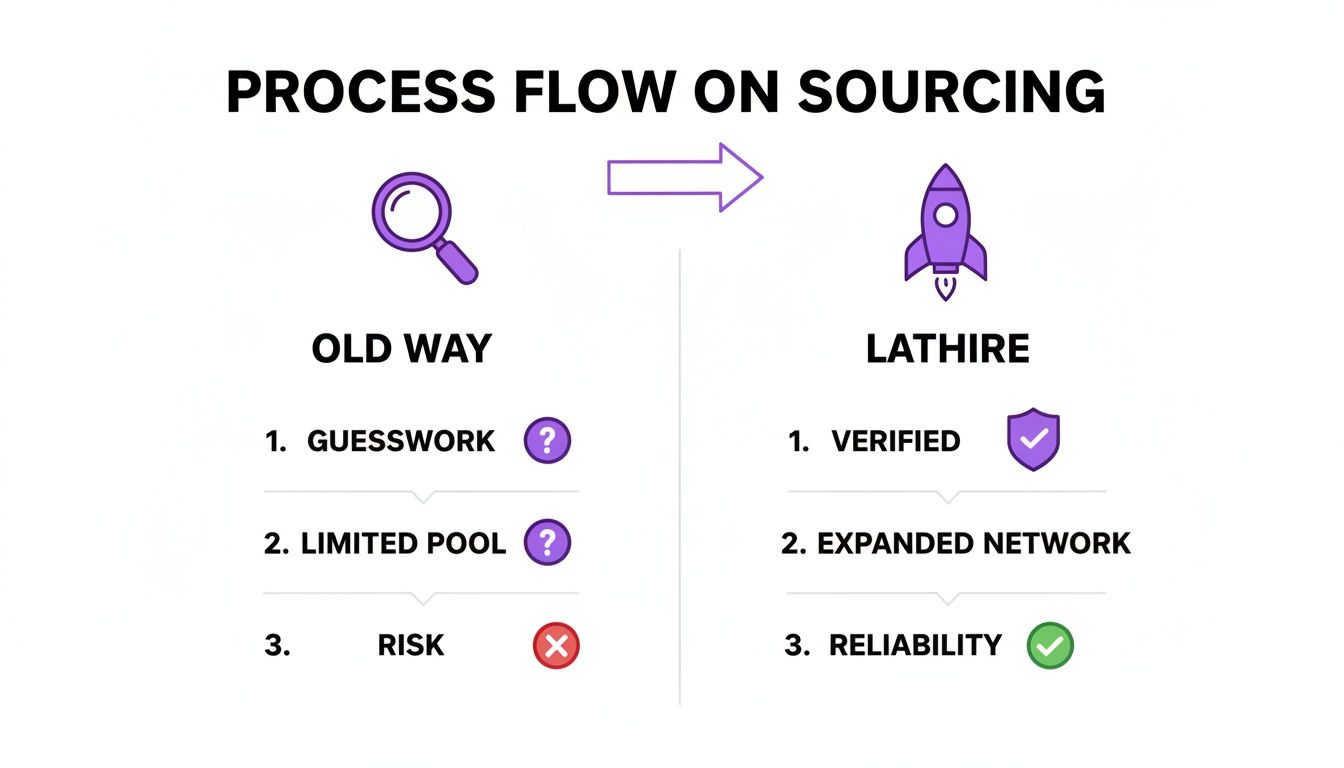
The key takeaway is clear: moving from a reactive, limited pool to a verified, expanded network fundamentally de-risks the entire hiring process.
Here’s the metric that truly matters, yet it's the hardest one to track: Quality of Hire. All the other KPIs are just leading indicators for this one.
Quality of Hire asks the simple, brutal question: Six months down the line, was this a great hire? Are they hitting their goals? Are they making their team better?
This isn’t a number you can find in your ATS. It requires getting feedback from hiring managers on performance, team contribution, and overall impact. It’s qualitative, it takes effort, but it’s the only way to know if your sourcing strategy is actually translating into a stronger company.
Because at the end of the day, that’s the only metric that really counts.
Alright, let's cut to the chase and tackle the questions I always hear from founders and hiring managers. No fluff, just direct answers to help you figure out what candidate sourcing actually means for your business.
Absolutely not. In fact, it's even more critical for startups and small businesses where a single bad hire can be a torpedo to the hull. Big companies can absorb the cost of a mediocre employee; you probably can't.
Sourcing gives you surgical precision, which is a lean operation's best friend. It’s all about quality over quantity—a startup's secret weapon. You don't need a huge team; you just need a smart, repeatable process to find the A-players who will actually move the needle for you.
If you're just starting out, block out 3-5 hours per week. The key here isn't the total volume of time; it's consistency. Trying to cram it all into one frantic day a month just doesn't build the momentum you need.
Use that dedicated time to focus on one or two critical roles. Do your homework, write outreach that doesn't sound like it was generated by a robot, and always follow up. This proactive time will save you dozens of hours of reactive screening later. Think of it as an investment that pays for itself almost immediately.
I’ve made them all, so you can learn from my scar tissue. The biggest mistakes usually fall into one of three buckets. Avoiding them is half the battle.
At its core, understanding what is candidate sourcing comes down to this: it’s a disciplined, proactive hunt for the talent that will build your future. It's not easy, but it's the only way to win.

