

Let's get one thing straight: a job requisition isn't just another piece of HR paperwork. It’s the official, budget-approved green light that says, "Yes, we are actually spending money to hire someone for this role." It's the internal, confidential business case that separates wishful thinking from a funded, urgent priority. And if you're skipping this step, you're not just being inefficient—you're lighting money on fire.
So, what is a job requisition, really? Think of it as the blueprint for a new hire. Before you ever dream of writing a snappy job description or scheduling a single interview, the requisition is the document that makes it all real. It’s the internal handshake between the hiring manager, HR, and—most importantly—the finance department.
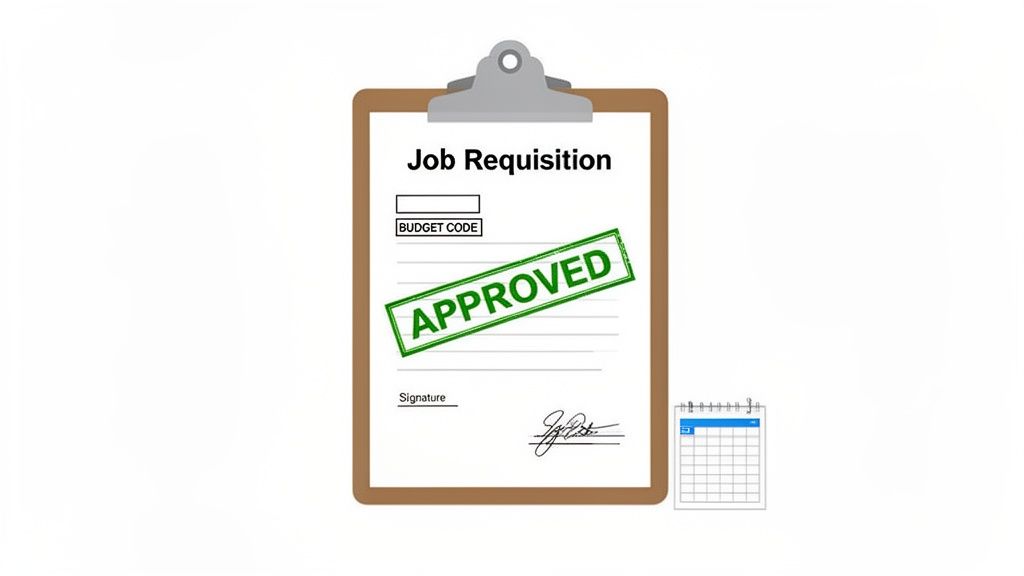
This isn’t some bureaucratic fluff. We’ve all seen what happens without one. A manager gets excited, starts interviewing, finds the perfect candidate, and then has to sheepishly explain that the role "isn't technically approved yet." It’s a fantastic way to burn bridges with top talent and look completely disorganized.
The job requisition prevents that chaos.
To quickly break it down, here’s a simple table. No fluff, just facts.
At its core, a job requisition is an internal form a manager completes to request approval for a new hire. It formally documents the business need and financial justification for the position. It’s your permission slip to spend.
| Key Component | What It Does | Why It's Critical |
|---|---|---|
| Position Details | Defines the job title, department, and reporting structure. | Creates a clear organizational slot for the new role. |
| Business Justification | Explains why the hire is needed now. | Links the role directly to company goals and ROI. |
| Budget & Compensation | Specifies the salary range and confirms funding source. | Prevents budget overruns and financial surprises. |
| Approval Signatures | Gathers sign-offs from key stakeholders (Finance, HR, etc.). | Ensures everyone is aligned before the search begins. |
This formal process ensures every hire is a strategic, well-vetted decision, not just a knee-jerk reaction.
I've learned the hard way that a solid hiring process starts with a rock-solid requisition. It’s the moment your hiring strategy meets the spreadsheet, forcing you to answer the tough questions before you start spending time and money.
This document is the true starting line for any serious recruitment effort. It forces clarity and commitment from everyone involved, turning a vague "we need someone" into a strategic, budgeted decision.
Essentially, the requisition process ensures you’ve thought through the fundamentals. It’s less about filling a seat and more about making a sound business investment. It acts as an internal control, confirming that every new hire aligns with the company's goals and financial plans.
It serves a few critical, non-negotiable functions:
Without it, you’re just hoping for the best. And as any founder knows, hope is not a strategy. The requisition is your strategy, written down and signed off. It’s the most important step you're probably overlooking.
Alright, let's clear this up, because confusing a job requisition with a job description is one of the most common mistakes that clogs up hiring pipelines. It’s like trying to use your internal budget spreadsheet as a marketing brochure. It’s awkward, ineffective, and makes you look like you don’t know what you’re doing.
One is for your CFO. The other is for your future star developer. Get it straight.
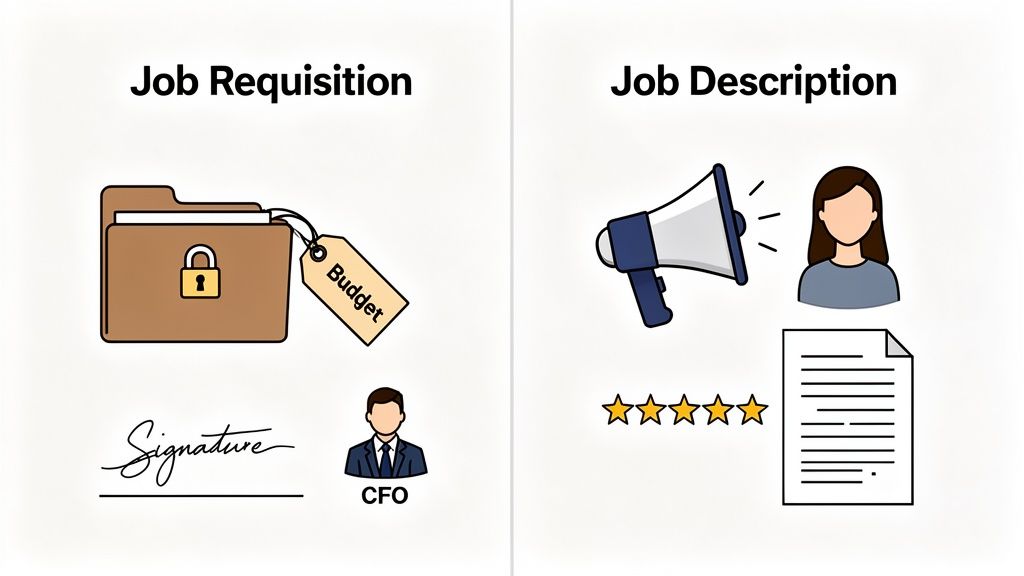
A job requisition is the confidential, internal document that gets the green light for the hire. It’s packed with budget codes, salary bands, and the cold, hard business case for why this role needs to exist in the first place. This is the why.
On the flip side, a job description is the public-facing sales pitch designed to attract top-tier talent. It sells your company culture, the exciting challenges of the role, and the real impact a candidate can make. This is the what.
Here’s another way to think about it: a job requisition is the architectural blueprint for a new room in your house. It details all the costs, specifies the structural requirements, and gets the necessary permits signed off before a single nail is hammered. You wouldn't hand this to potential homebuyers, would you?
The job description is the glossy real estate listing. It highlights the beautiful new sunlit room, talks up the great neighborhood, and explains why someone would be absolutely thrilled to live there. One is purely operational; the other is pure marketing.
This distinction isn't just some modern HR jargon, either. The need for these formal internal requests exploded during the post-World War II economic boom as corporations scaled at an incredible rate. By the 1950s, over 60% of Fortune 500 companies were using structured requisition systems to manage their massive workforce expansions, neatly separating the financial approval from the public job ad.
Sending a candidate a document with the requisition number and salary grade is a masterclass in how to kill their excitement. It screams "corporate cog" before they’ve even applied.
To settle this once and for all, here’s a head-to-head comparison that breaks it down.
This side-by-side breakdown highlights the key differences between the two documents, making it clear what each is for and who it's for.
| Attribute | Job Requisition (The 'Why') | Job Description (The 'What') |
|---|---|---|
| Audience | Internal stakeholders—Finance, HR, Leadership. | External candidates on job boards, your career page. |
| Purpose | To gain internal approval and secure a budget. | To attract, excite, and inform qualified applicants. |
| Content | Justification, salary band, budget code, requisition ID. | Responsibilities, qualifications, company culture, perks. |
| Tone | Formal, financial, and strictly operational. | Persuasive, engaging, and candidate-focused. |
| Timing | Created first, before the job is ever made public. | Created second, after the requisition is approved. |
Understanding this difference is the first step toward a hiring process that doesn't feel like you're running in circles. Once you have that approved requisition, you can finally focus on the art of the sell. For a deeper dive into that, check out our guide on how to create job descriptions that actually attract the right people.
A weak job requisition leads to a weak hire. Period. It's the classic case of ‘garbage in, garbage out,’ and I’ve seen it cripple growth more times than I can count. A great requisition isn’t just a job title and a prayer; it’s a non-negotiable blueprint that forces clarity before you spend a single dollar or minute on recruiting.
So, what does a killer requisition actually contain? It’s a checklist that leaves no room for confusion, making sure everyone from finance to the final interviewer is perfectly aligned.
Think of these components as your pre-flight check. Skipping any one of them is like trying to take off without checking your fuel—a disaster waiting to happen.
These basics are table stakes. The real magic, though, happens in the justification.
The single most critical part of any job requisition is the business justification. This is where you sell the role internally and prove it’s not just a "nice-to-have."
Vague justifications like "we need more help" are the reason requisitions get stuck in approval limbo for weeks. A sharp justification ties the role directly to a business outcome, making it almost impossible for your CFO to ignore.
Is this a backfill for a departing team member? Say so, and explain the risk of leaving the position open. Is it a brand-new role designed to capture a new market opportunity? Quantify that opportunity. Show the math. A strong justification is your internal sales pitch, and it needs to be bulletproof.
This structured approach isn't just a modern trend. Its importance boomed with the rise of Applicant Tracking Systems (ATS) in the 1990s, which digitized hiring to handle the flood of candidates from internet job boards. To see more on how the job market has evolved, you can explore this global data analysis. Today, that evolution continues, transforming the requisition from a bureaucratic hurdle into a true competitive advantage for companies that get it right.
Ever had a dream hire get stuck in 'approval limbo' for weeks on end? You can probably thank a broken job requisition workflow. This is where a company’s internal processes either help it fly or cause it to stumble. The whole thing should be a clean relay race, not a messy game of telephone where every handoff loses a crucial piece of information.
A slow approval process is a gift to your competitors. Let's be real—top talent isn't going to wait around while your CFO finds a spare 15 minutes to sign a form. They'll just accept another offer. To win, you have to move fast.
The key is to treat the workflow like a well-oiled machine, not just a series of disconnected emails and shoulder taps.
Forget the endless back-and-forth that kills momentum. The ideal workflow is a simple, four-part sequence where everyone knows their exact role. Get this right, and you can get from a request to an approved requisition in days, not weeks.
This simple process outlines the core steps needed to turn a clear need into an approved, actionable hiring plan.
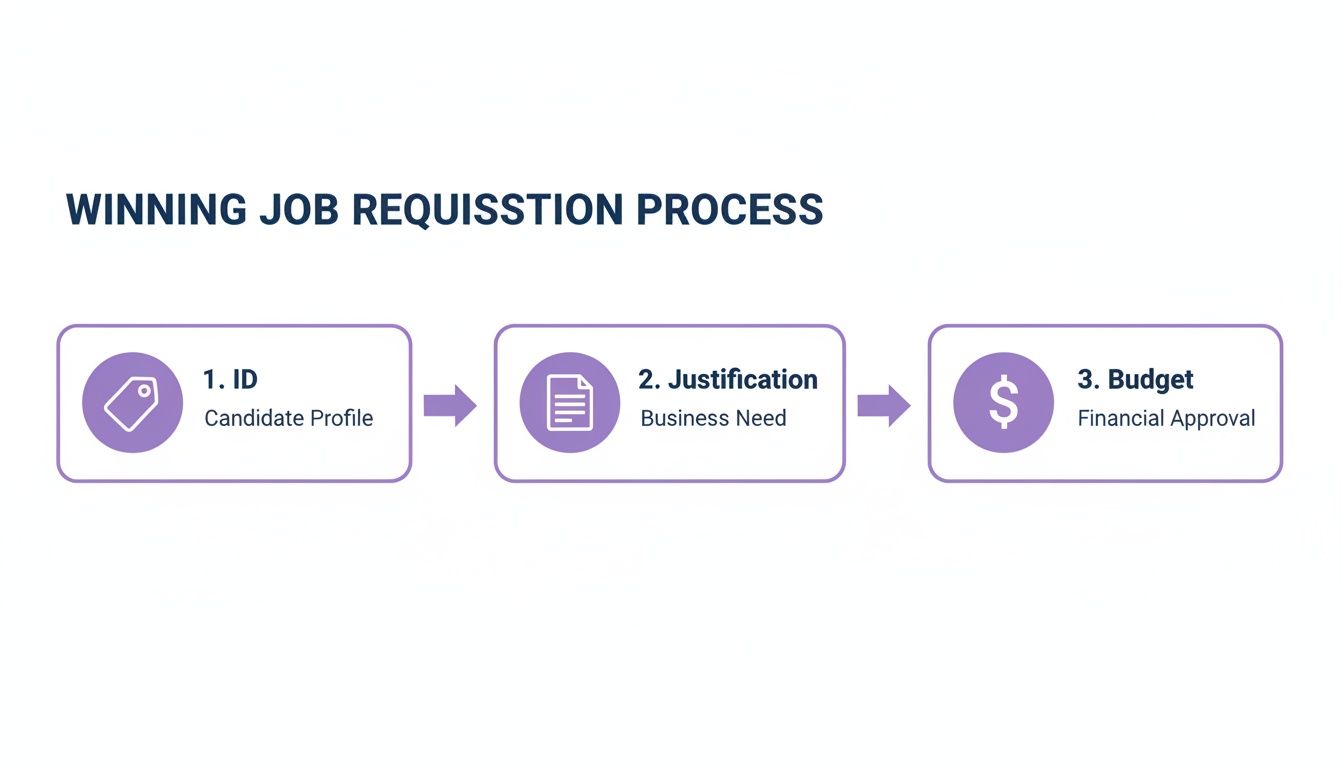
This workflow visualizes the three non-negotiable pillars of any winning job requisition: a clear ID for easy tracking, a solid justification, and confirmed budget approval.
The common bottlenecks are painfully predictable. You’ll see requisitions stall because the CFO doesn't understand the role's ROI (thanks to a weak justification), or because a department head goes MIA for a week, holding up the entire chain.
The moment a requisition sits in someone's inbox for more than 48 hours, you're losing. Every day of delay dramatically increases the odds that another company will snatch your perfect candidate.
These delays aren't just inconvenient; they're expensive. They signal to your team—and to the market—that you're disorganized. By defining a clear, time-bound approval workflow, you turn your requisition process from a liability into a competitive advantage that lets you hire smarter and faster. No more excuses.
Alright, let's have an honest chat. Your job requisitions might be the reason you're losing great candidates, wasting time, and pulling your hair out. I’ve been there, made most of these mistakes myself, and can now spot them from a mile away.
The biggest offender? The Vague Justification.
Scribbling "We need a marketer" on a requisition form is the business equivalent of putting "Food" on a grocery list. It’s useless. It tells your CFO nothing about the why and all but guarantees a slow, painful approval process.
A killer justification is specific: "We need a B2B SaaS content marketer to increase MQLs by 20% this quarter by overhauling our blog strategy." See the difference? One is a wish; the other is a rock-solid business case.
Another classic blunder is setting an unrealistic salary band. Pulling a number out of thin air that was relevant six months ago is a fantastic way to frustrate everyone involved. Hope you enjoy interviewing incredible people you have absolutely no chance of affording.
This isn't just about money, either. The mistakes are often more subtle but just as damaging. Globally, job requisitions are holding steady even as hiring dips, and in talent hotspots like Brazil, the demand for skilled remote teams is surging. You're competing on a global stage now; you can't afford these amateur mistakes. To get a better sense of the market, read the full recruitment snapshot for what lies ahead.
Here are a few other screw-ups we see founders and hiring managers make time and time again:
Each one of these mistakes is a delay. And in the world of recruiting, delays are how you lose your top candidate to a competitor who has their act together.
These errors turn your hiring process into a slow, leaky pipeline. A sloppy requisition signals to your entire organization that this hire isn't a priority, bogging everything down in bureaucracy. The good news? These are all fixable. Cleaning up your requisition process is one of the fastest ways to reduce your time to hire and start winning the talent you actually need.
Okay, so you've nailed the perfect job requisition. It's a thing of beauty—clear, justified, and approved. High five. Now what? You still have to actually find the person, which is where most companies completely drop the ball.
This is the part where you post the job and pray, then spend the next three weeks drowning in a mountain of mediocre, irrelevant resumes. Hope you enjoy your afternoons, because they’re now fully booked with interviews that go nowhere.
Frankly, that whole song and dance is insane.
After a job requisition gets the green light, the real work begins: implementing effective talent sourcing strategies to find qualified candidates. This is what we call the "messy middle"—that painful gap between a great plan and a great hire. It’s where momentum dies, costs spiral, and your best-laid plans fall apart.
This isn't just about filling a role; it's about building a global team without having to mortgage your office ping-pong table. It's about turning that pristine, approved job requisition into a hired, productive team member.
At LatHire, we connect your approved requisition directly to our talent pool of over 800,000 pre-vetted professionals in Latin America. You can import your job details or generate them with our AI and get matched with qualified candidates in as little as 24 hours. No more posting and praying. (Toot, toot!)
We handle that messy middle for you:
We turn your strategic plan into an actual hire. Our goal is to make the entire journey from requisition to onboarding so seamless you'll wonder why you ever did it the old way. This isn't just about writing smarter requisitions; it's about following through with a best-practice recruitment process that actually delivers results.
Still have some questions? Good. That’s a sign you’re thinking this through. Here are the answers to a few things we hear all the time from founders who are done with old-school hiring.
The hiring manager almost always gets the ball rolling. It makes sense, right? They’re the ones on the ground who feel the pain of a missing team member, so they’re in the best position to justify the business need.
From there, HR usually steps in to make sure everything is compliant and consistent. The final stop is the finance department, which gives the ultimate thumbs-up on the budget.
In a word: no. That’s like using your confidential internal financial report as a marketing brochure. They serve completely different purposes.
A job requisition is a behind-the-scenes approval document that’s all about budget and business justification. A job description is your public-facing advertisement designed to get candidates excited about the role.
Think of it this way: the job requisition is the why. The job description is the what. Mixing them up is a classic mistake that slows down the whole process and just makes you look disorganized.
In a well-oiled company, this shouldn’t take more than a few business days. If it’s dragging on any longer, you’ve got a massive red flag that your internal workflow is broken.
With millions of open jobs in the U.S. market, speed is everything. In fact, platforms that automate this step for remote hires can slash costs and time-to-hire by over 80%. You can learn more about recent job market trends to see why efficiency isn’t just a nice-to-have anymore. Long delays are how you lose your best candidates to the competition.

