
A talent acquisition consultant is the strategic expert you bring in to fix how you hire, not just to fill another empty seat. Forget traditional recruiters who focus on a single role. A consultant dissects your entire hiring system—from a non-existent employer brand to your chaotic final interviews—and rebuilds it to actually serve your business goals. They’re here to stop the cycle of bad hires. For good.
Let's be real. You didn't start a company to become a full-time, amateur recruiter. You started it to build something great, but now your calendar is a graveyard of screening calls, endless resume reviews, and awkward interviews that go absolutely nowhere. The "post and pray" method has officially failed you.
This is that painful stage where hiring feels less like a strategy and more like a high-stakes guessing game you can’t afford to lose. Every bad hire costs a fortune in wasted salary, lost productivity, and sinking team morale. Turns out there’s more than one way to hire elite talent without mortgaging your office ping-pong table.
This is where you need to understand the critical difference between a talent acquisition consultant and a standard recruiter. A recruiter is a firefighter; you call them when there’s a blaze (an open role), and they rush in to put it out. It’s tactical, immediate, and often necessary.
A talent acquisition consultant, on the other hand, is the architect who redesigns your building to be fireproof. They don't just fill your current vacancy; they diagnose why your hiring engine is sputtering and stalling out in the first place.
They're the fractional Chief Talent Officer you bring in when you realize you’re treating a systemic disease with single-dose bandaids. Their job isn't just to find people; it's to build a machine that consistently attracts and retains A-players.
This strategic shift is fundamental. Instead of just getting more fuel (candidates), the consultant rebuilds your engine. They focus on fixing the root causes of your hiring headaches, such as:
Hiring a consultant is an admission that what got you here won't get you there. It’s for founders who are tired of playing recruiter and are ready to build a scalable, repeatable system for finding the people who will actually drive their business forward. For those exploring different ways to build their teams, understanding the nuances of flexible staffing solutions can also provide valuable context.
Forget the generic job descriptions you see on LinkedIn. A great talent acquisition consultant isn’t just another vendor you manage; they become a temporary, deeply embedded extension of your leadership team. They don’t just ask for a list of open roles. Instead, they start by asking about your P&L, your three-year business goals, and why your last star engineer rage-quit.
Their real job is to connect your chaotic, reactive hiring efforts to a genuine business strategy. This isn’t about finding a few more candidates for the pipeline; it’s about building a repeatable, scalable hiring machine so you can finally get back to, you know, running your company.
This flowchart shows exactly where a consultant sits in the strategic hiring hierarchy—they're the critical link between the CEO's vision and the recruiter's day-to-day execution.
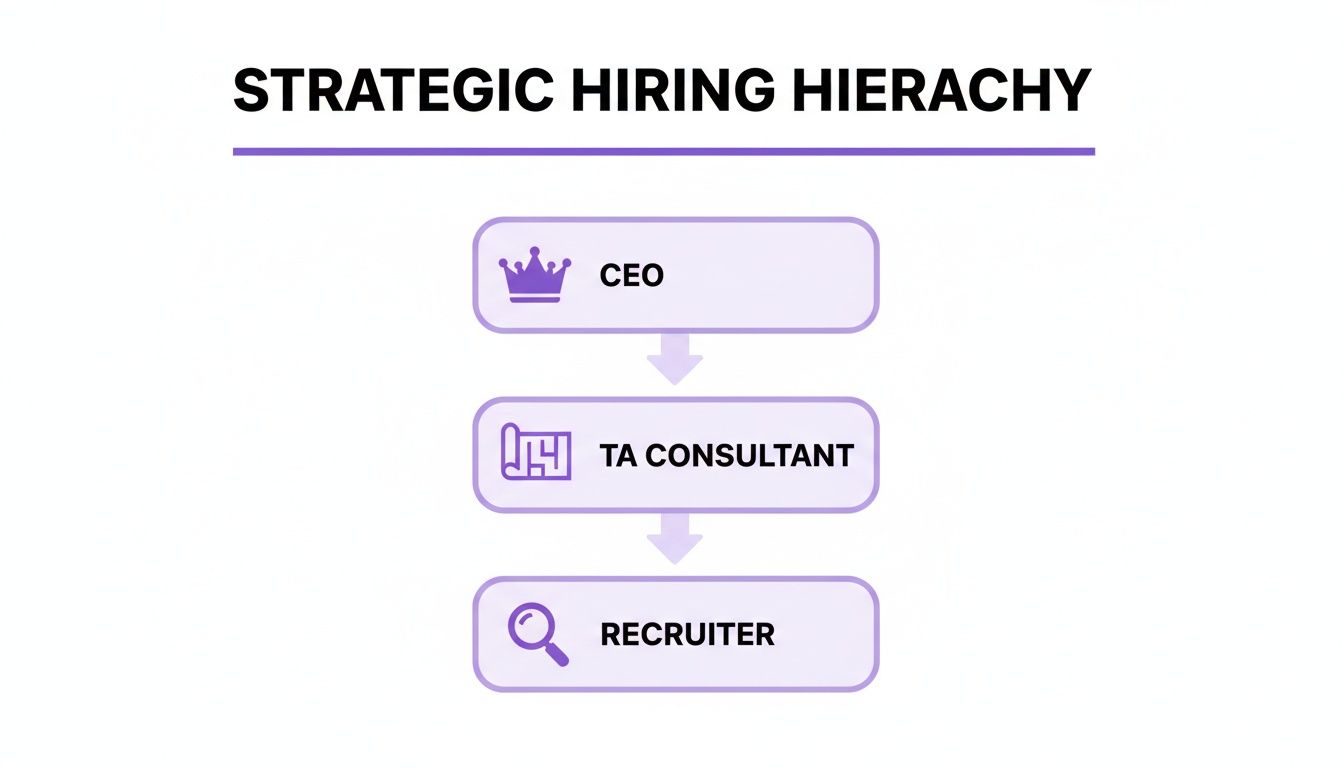
As you can see, the consultant is the one who translates high-level business goals into a practical hiring blueprint that recruiters can actually follow.
So, what does this look like day-to-day? It’s far less glamorous than their slick proposals might suggest. A good consultant rolls up their sleeves and dives into the messy parts of your business that no one else wants to own.
They aren't afraid to tell you your baby is ugly. They’ll audit your chaotic hiring tech stack, rip apart your employer value proposition (that probably sounds like every other startup), and train your hiring managers to stop asking those terrible, biased interview questions.
Their core responsibilities tend to fall into three main buckets:
This is the fundamental difference. Recruiters fill roles. Consultants fix the system that fills roles.
The sad reality is that very few companies have this figured out. A shocking 5% of organizations consider their talent acquisition strategy world-class, while a concerning 51% still rely on reactive, just-in-time hiring. A consultant's entire job is to pull you out of that reactive 51% category for good.
Their ultimate goal is to make themselves obsolete. They build a hiring engine so effective that you no longer need them to run it—a stark contrast to agencies that profit from your perpetual hiring needs.
One of their most critical responsibilities is ensuring your process is fair and equitable. A core part of their work is making sure hiring processes are free from discrimination in the workplace. They are your first line of defense against legal risks and brand damage, building objective, merit-based evaluation systems. This isn’t just about compliance; it's about making sure you're actually hiring the best person for the job, period.
Hiring a talent acquisition consultant isn't a line item you can just tuck into the marketing budget. It’s a strategic investment. And like any big move, timing is everything. Jump the gun, and you're burning cash you don’t have. Wait too long, and you're trying to douse a five-alarm fire with a water pistol.
So, when is the right time to make that call? It’s not about filling one or two open roles. It’s when the very act of hiring has become a bottleneck, actively strangling your company's growth.
You’ve hit an inflection point—a moment where the old, scrappy methods are simply guaranteed to fail against your future ambitions.
Remember when hiring was kind of fun? You’d chat with a few interesting people, find someone sharp, and seal the deal over coffee. Now, it's a mess. You’re scaling so fast that your process is a jumble of frantic Slack DMs, lost résumés, and interview feedback that just says, “good vibe.”
This is the classic trigger. Growth is a fantastic problem to have right up until it shatters every manual system you’ve built.
It might be time to bring in a consultant if this sounds familiar:
When your process can't keep up with your headcount goals, you’re not just moving slowly. You're actively damaging your brand and turning away the very people you need to escape the chaos.
Let's imagine you're a US-based fintech company and you've decided to open your first engineering hub in Brazil. You know your product inside and out, but you know absolutely nothing about the local talent market. What's a competitive salary? Where do the best developers congregate online? What are the cultural interview norms?
Guessing is a recipe for expensive mistakes. This is a perfect scenario for a talent acquisition consultant. They bring the market intelligence and strategic roadmap you're missing, preventing you from stumbling into costly and embarrassing blunders.
This is about more than just sourcing candidates. It’s about deeply understanding the entire talent ecosystem you're entering. A consultant is your local guide, helping you build a location-specific strategy that actually works—not just a copy-paste of what you did back home.
The same logic applies if you're hiring for a totally new function, like building your first-ever data science team. You don't know what great looks like, and that’s a dangerous blind spot to have.
High employee turnover is the silent killer of growing companies. It's a leaky bucket draining your capital, morale, and institutional knowledge. If you're losing people almost as fast as you're hiring them, you’ve got a systemic issue on your hands—and it often starts with who you’re bringing through the door.
A consultant connects the dots between your hiring misses and your retention disasters. They'll dig into exit interview data, audit your hiring criteria, and help you redefine your ideal candidate profile to prioritize long-term fit over short-term skills.
Many companies are caught in this exact bind. While 56% of organizations expect their hiring needs to climb, their resources are lagging. In fact, only 30% see their talent acquisition budgets increasing to match. You can read more on these hiring trends here. This resource crunch makes every single bad hire even more painful and magnifies the need for a strategic fix.
When your investors start asking pointed questions about your churn rate, it’s well past time to call for backup. A consultant can help you build a hiring engine designed for retention, which is a hell of a lot cheaper than constantly backfilling roles.
Let’s be honest. The market is flooded with self-proclaimed "experts" whose only real skill is crafting a slick slide deck. They talk a big game about "strategic paradigms" but can't give you a straight answer on how they actually measure success.
Hiring the wrong talent acquisition consultant is like hiring a contractor who shows up with a shiny new hammer but doesn't know how to build a house—it's an expensive, frustrating waste of time.
So, how do you spot the real deal? You have to dig deeper than their LinkedIn recommendations and canned case studies. You need to pressure-test their experience and see if they flinch.
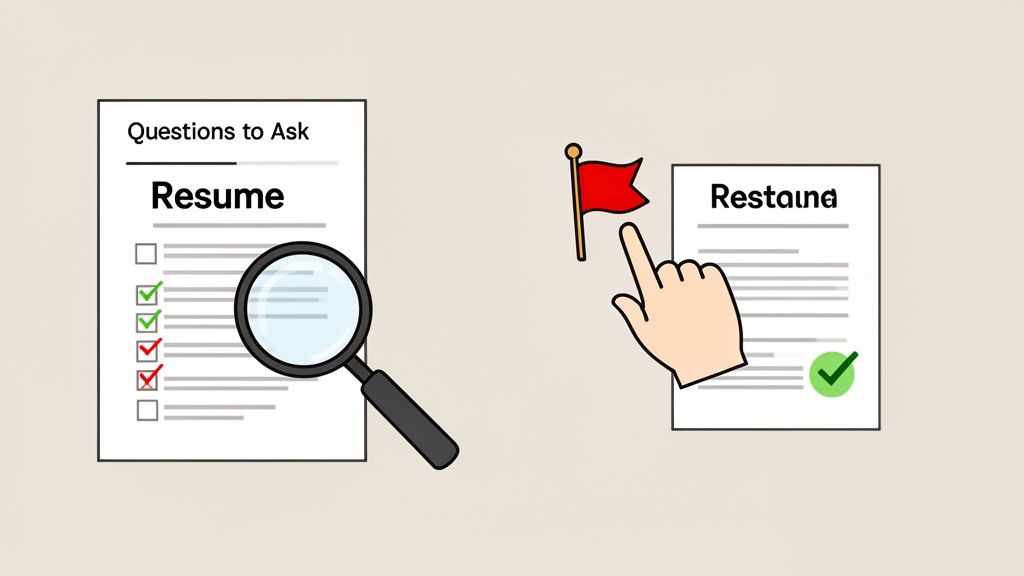
A great consultant is a partner; a bad one is just a pricey order-taker. Your job is to figure out which one is sitting across from you before you sign a single document.
Forget the softball questions. You need to ask questions that force them to talk about failure, data, and difficult situations. Their answers will tell you everything you need to know about their depth and integrity.
Here are a few of my go-to’s:
"Walk me through a time a hiring process you designed failed. What went wrong, and what did you do about it?"
"How do you measure the ROI of your strategic recommendations? Give me a concrete example."
"A hiring manager is insisting on an unrealistic list of 'must-have' skills for a role. How do you handle that?"
Don't settle for consultants who just tell you what you want to hear. The best ones are willing to have the tough conversations—the ones that push your organization to be smarter about how it hires.
Just as important as asking the right questions is knowing what warning signs to look for. Some consultants have perfected the art of looking busy while accomplishing nothing.
Be wary of anyone who:
Finding a great consultant isn't just about avoiding a bad hire; it's about finding a strategic partner who can fundamentally change your company's trajectory. This level of partnership is distinct from other talent models. For instance, if you're exploring ways to expand your team with dedicated remote professionals, it’s worth understanding the different approaches of a top staff augmentation company versus a strategic consultant. Both solve talent problems, but in very different ways.
Finally, how you frame the opportunity matters. To attract a strategic thinker, you need to post a job description that speaks their language. Ditch the corporate jargon and focus on the problems you need them to solve.
Here's a simple, no-fluff template you can adapt:
Title: Strategic Talent Acquisition Consultant (Project-Based)
About Us: We're a [Your Industry] company with an audacious goal to [Your Mission]. We’re growing fast, and our current hiring process is bursting at the seams. We’re looking for a seasoned consultant to help us build a scalable, world-class hiring engine that attracts and retains the talent we need to win.
The Challenge:
What You'll Do:
This approach filters out the fluff and attracts consultants who are hungry to sink their teeth into a real challenge. Vetting is a two-way street; show them you're a serious client, and the serious experts will find you.
Alright, let's talk about the money. This is usually where everyone starts squirming in their seats. Hiring a top-tier talent acquisition consultant isn't like buying a new software subscription; there's no neat little pricing page. It feels expensive because you’re not buying a task-doer—you’re buying strategic leverage.
Think of it like this: you can hire a junior dev to write code, or you can hire a principal engineer to design the system that lets ten junior devs ship code three times faster. The consultant is the principal engineer for your hiring process. The sticker price can feel jarring until you realize what you're actually paying for.
So, how much is this going to set you back? It usually breaks down into one of three models.
There’s no one-size-fits-all answer, but consultants typically structure their fees in a few predictable ways. Each model is built for a different kind of problem, so understanding them helps you avoid paying for a sledgehammer when you just need a screwdriver.
Here’s the breakdown from my experience:
The Project Fee: This is for a specific, well-defined outcome. You need a new interview process designed and rolled out? That’s a project. Expect to pay anywhere from $10,000 to $40,000+ depending on the scope. It’s a fixed price for a fixed deliverable—clean and simple.
The Hourly Rate: This is for advisory work or when the scope is a bit fuzzy. You want someone on call to coach your hiring managers and troubleshoot problems as they arise. Rates can range from $150 to over $400 per hour. It's flexible but can get pricey if you don’t manage the hours carefully.
The Retainer Model: This is for a long-term, embedded partnership. The consultant becomes a fractional part of your team for several months, guiding strategy and execution. Retainers often fall between $5,000 and $15,000 per month. This is the most expensive option, but it's also the most impactful for a full system overhaul.
Now for the important part. A great consultant doesn't cost money; they make you money by plugging the leaks that are quietly sinking your ship. You need to frame this as an investment, not an expense.
Let’s build a quick, back-of-the-napkin business case. Don't just show your CFO the consultant's invoice; show them the cost of doing nothing.
A consultant's value isn't measured by the hours they bill, but by the expensive mistakes you stop making. They don't just reduce your time-to-hire; they eliminate the hidden taxes you're paying on a broken system.
Consider these three areas:
Lower Cost-Per-Hire: A consultant helps you build an employer brand and referral program that attracts talent organically, reducing your reliance on expensive agencies that charge 20-30% of a first-year salary. If they save you from just two agency fees on senior hires, they’ve often paid for themselves.
Improved New Hire Retention: Bad hires are brutally expensive. The cost of replacing an employee is often estimated at 50-200% of their annual salary. A consultant who revamps your assessment process to screen for long-term fit can dramatically cut your first-year turnover rate. Preventing one bad senior hire from walking out the door can save you six figures.
Reclaimed Executive Time: How many hours do you and your leadership team waste on pointless interviews and screening candidates who were never a fit? Let's be conservative and say it’s 10 hours a week. A consultant who builds a functional process gives you that time back to run the actual business. What's that worth? A hell of a lot more than their monthly retainer.
When you add it all up, the right talent acquisition consultant is a profit center, not a cost center. They stop the bleeding so you can focus on growth.
Let's be honest for a moment. A talent acquisition consultant can hand you a brilliant, color-coded playbook for fixing your hiring mess. But at the end of the day, you're still the one who has to run the plays. What if you could get the strategic sourcing, the rigorous vetting, and the operational heavy lifting done for you—without the hefty consulting price tag?
Welcome to the modern alternative. This isn't about getting another slide deck; it's about getting keys to a curated, pre-vetted talent pool that’s ready to go. Think of it as skipping the architect and walking straight into a fully built house.
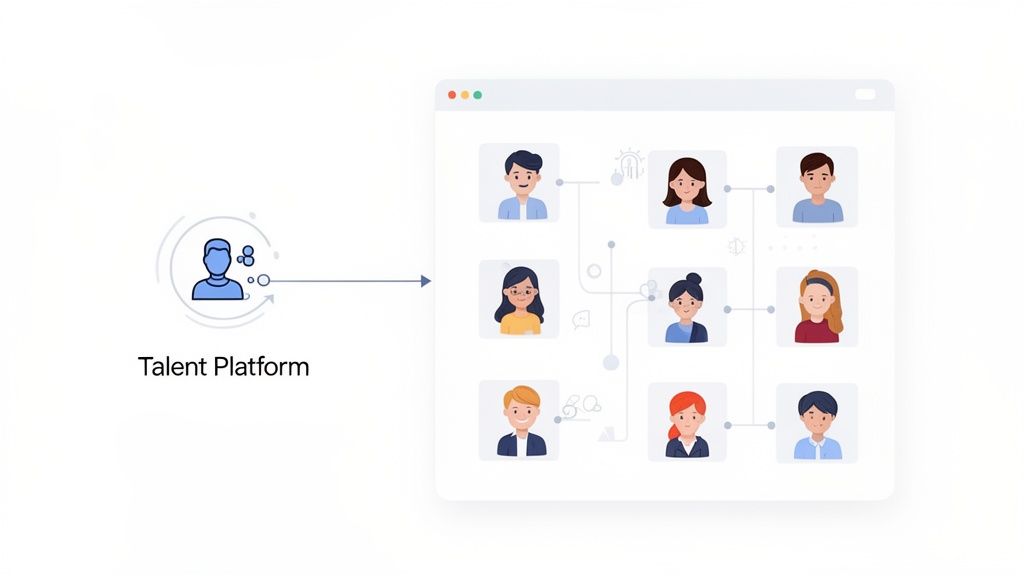
This shift from advisory to execution is a game-changer for companies that need to move fast and hire smart.
A consultant helps you design a better fishing rod. A modern talent platform hands you a net full of fish. Instead of just getting strategic advice, you get a direct pipeline to qualified professionals who have already cleared multiple hurdles.
This "done-for-you" model bakes the best parts of consulting—strategic matching and quality control—into a seamless platform. It’s about replacing months of process redesign with days of actual hiring.
The stakes for getting this right are incredibly high. Global talent shortages are projected to hit 85 million people by 2030, potentially costing companies $8.5 trillion in unrealized annual revenue. As 76% of employers already struggle to fill roles, the traditional, slower methods are becoming a massive liability. You can discover more insights about these talent acquisition trends and see just how urgent this problem is.
This isn't just a different flavor of recruiting; it's a fundamentally different operating system. Modern hiring platforms combine technology with a full-service approach to deliver results that often eclipse what a lone consultant can achieve.
Here’s where they pull ahead:
This model delivers the strategic outcome of a top-tier consultant—high-quality talent, faster—but wraps it in an operational service that actually gets the work done. It’s the difference between being told how to win and being handed the winning team.
Choosing between these two approaches depends entirely on your core problem. If your internal team has the bandwidth to execute a new strategy, a consultant can be a fantastic guide. But if you need to build your team with specialized talent now and don't have the internal infrastructure, a platform is almost certainly the smarter, faster move.
If you’re still weighing your options, our guide on staff augmentation vs consulting breaks down the specific scenarios where each model shines. It's a must-read before you commit your budget.
Still have questions? Good. A healthy dose of skepticism is exactly what you need before you write a big check. Here are the straight-up answers to the questions we hear most often from founders in the trenches.
Think of it like this: a recruiter is a firefighter. You call them when there's an active blaze—an open role—and their entire job is to put it out as quickly as possible. It’s a tactical, necessary role.
A talent acquisition consultant, on the other hand, is the architect who redesigns your building to be fireproof. They aren't there just to fill one empty seat. They’re there to fix the broken system that created the vacancy in the first place, making sure you hire better people, more consistently, long after they're gone.
It really depends on the size of the mess you need cleaned up. A tightly focused project, like fixing your broken interview process, might take 4-8 weeks.
But a full-blown strategic partnership—where they’re rebuilding your employer brand from the ground up, optimizing your tech stack, and training your hiring managers—could easily last anywhere from 3 to 9 months. A good consultant won't lock you into an open-ended contract that just drains your bank account; they'll define clear milestones and deliverables from the start.
The best consultants work to make themselves obsolete. Their goal isn't to stay on your payroll forever; it's to build you a hiring machine so effective that you no longer need them to run it.
Absolutely. In fact, if they can't, you should run for the hills. This is a non-negotiable, core competency for any modern talent consultant worth their salt.
They go way beyond buzzwords and implement real, structural change. Here’s what that looks like in practice:
Ultimately, they install the systems and metrics to make diversity and inclusion a measurable outcome, not just a well-intentioned talking point on your careers page.

