
Let’s be real. Traditional hiring is a soul-crushing, resource-draining marathon. You post a job, get buried under a mountain of resumes, and spend weeks interviewing—only to have your top candidate accept a counteroffer at the last second. Sound familiar?
Staff augmentation services are your way out of this circus. It’s a model that lets you plug elite, pre-vetted specialists directly into your team, exactly when you need them, without all the usual HR baggage.
That sinking feeling when you realize you've burned the better part of a quarter trying to fill one critical role? Yeah, that’s your project timeline slipping away. Turns out there’s more than one way to hire elite developers without mortgaging your office ping-pong table.
The old model of posting, praying, and paying exorbitant recruiter fees is a massive gamble. You're betting that the perfect person not only exists in your local talent pool but also happens to see your job ad and is willing to wait through your soul-sucking interview process. It’s slow, expensive, and frankly, an outdated way to build a modern team.
This isn't just a hunch; it's a massive market shift. The global IT staff augmentation market is exploding, valued at a whopping USD 383.5 billion and projected to skyrocket to USD 1243.4 billion by 2035. That kind of growth is a direct signal that businesses everywhere are ditching rigid hiring for flexible, on-demand talent. You can dig into the numbers in this comprehensive market report.
The problem isn't just how long it takes to hire. It's the opportunity cost. While you're fact-checking resumes and running technical interviews, your competitors are shipping features. Every single day a key role sits empty, you're losing momentum.
Staff augmentation flips this script entirely. Instead of a months-long search, you get a curated shortlist of qualified professionals ready to integrate into your team almost immediately. Think of it less like hiring and more like activating a specific skill set on demand.
This isn't just about finding temporary help. It’s a strategic move to inject critical skills, accelerate projects, and fill gaps instantly. You get the agility of a freelancer with the deep integration of a full-time hire.
It’s time to move beyond the limitations of traditional recruitment. By exploring flexible staffing solutions, you can build a powerful, adaptable workforce on your own terms. The goal is to stop gambling on hires and start making strategic talent investments that pay off from day one.
So, you need to grow your team. Welcome to the club. The market is a noisy mess of buzzwords: outsourcing, freelancers, managed services, and our favorite, staff augmentation services. Let's cut through that noise, founder-to-founder. Choosing the right model isn't just an HR line item; it's a strategic move that dictates your control, budget, and sanity.
Forget the dry definitions. Think of it in terms of building a restaurant.
The fundamental difference boils down to one simple question: who's in charge? With outsourcing, a project manager at the vendor company is calling the shots. With a freelancer, they're an independent entity working on a defined deliverable. You manage the outcome, not the person.
Staff augmentation is entirely different. The talent you bring on board reports directly to you or your managers. They join your daily stand-ups, use your Slack channels, and become a genuine part of your team's workflow. That direct oversight is non-negotiable when you’re building a core product or navigating a complex project.
This decision tree breaks down the core questions to ask when figuring out your hiring path.
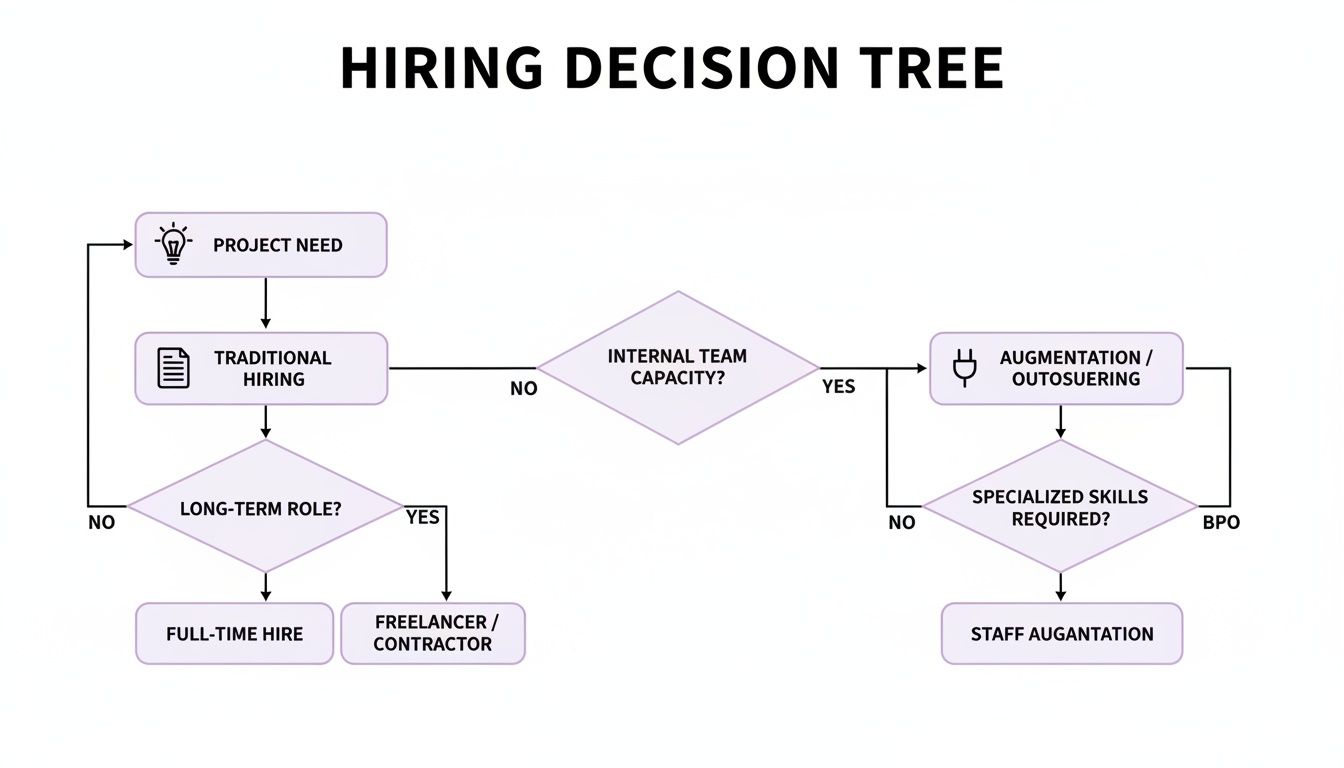
As you can see, when direct management and team integration are priorities, augmentation is the logical path forward.
Let’s talk money and integration, because that's where the rubber meets the road. Freelancers can seem cheap upfront, but trying to herd a dozen of them for a cohesive project is a full-time job in itself. Outsourcing might offer a fixed price, but you pay a hefty premium for the vendor's management layer and lose all influence over your team's culture.
To really get it, you need to see the models side-by-side. Forget the marketing fluff; here’s the real story.
| Factor | Staff Augmentation | Outsourcing | Freelancers |
|---|---|---|---|
| Control | You have 100% direct control. They're your team. | You have zero direct control. You manage a contract. | You control the deliverable, not the person. |
| Integration | Seamless. They join your tools, culture, and meetings. | None. They're a black box operating separately. | Minimal. They're external contractors for a specific task. |
| Cost Structure | Predictable monthly cost per person. No overhead. | Fixed project price, but high management fees baked in. | Per-hour or per-project. Can get expensive fast. |
| Best For | Scaling your core team with specific skills. | Non-core, well-defined projects you can hand off. | Short-term, isolated tasks like design or bug fixes. |
| Hidden Risk | Onboarding takes effort. You're responsible for management. | Quality issues, missed deadlines, cultural mismatch. | Lack of long-term commitment. Juggling multiple clients. |
Ultimately, each model has its place. But for a founder who needs to maintain quality, culture, and control, the choice becomes pretty clear.
Staff augmentation gives you the cost-efficiency of global talent without sacrificing cultural fit. You’re not just hiring a skill set; you're integrating a person who aligns with your team’s rhythm and goals.
This model is about strategic addition, not delegation. For startups, the right talent partner can even help you understand how to turn blockers into accelerators, a key concept explored in A Startup's Guide to SOC 2 Type 2 Compliance as a Business Accelerator. It's about building a resilient, integrated team.
For an even deeper dive into how this compares to other models, check out our guide on staff augmentation vs consulting. At the end of the day, it's about finding the right balance of expertise and control for your specific needs.
Let's cut through the noise. You’ve probably seen a dozen articles listing the "Top 5 Benefits" of just about everything. This isn't that. We’re going to talk about what staff augmentation services actually do for a company that needs to move fast without setting its budget on fire.
The most immediate win? Raw speed. Think about your last traditional hire. You posted the job, waited for applications, spent weeks filtering, interviewing, and negotiating… then waited another two weeks for them to start. Staff augmentation flips that entire timeline on its head. Instead of waiting months, you can be meeting vetted, top-tier candidates in as little as 24 hours.
This isn't some fringe tactic anymore; it's a core strategy for building modern tech teams. The market is projected to hit USD 857.2 billion on the back of a 13.2% CAGR. Why? Because blended teams are the new normal, with over 65% of enterprises now mixing full-time staff, augmented specialists, and freelancers to get work done faster. You can discover more insights on these blended workforce trends on codewave.com.
Next, let's talk money. Hiring top-tier talent in North America is brutally expensive. You aren't just paying a salary. You're covering benefits, payroll taxes, office space, new equipment, and all the hidden costs of a month-long recruitment cycle.
Staff augmentation lets you sidestep a huge chunk of that. By tapping into a global talent pool, you get to dramatically lower your hiring costs without compromising on quality. This isn't about finding the "cheapest" developers; it's about finding incredible value. You can bring on senior-level engineers from places like Latin America who are just as skilled, work in your time zone, but don’t command a Silicon Valley salary.
The real win here isn't just a lower hourly rate. It's about what you do with the capital you save. That money can be funneled back into growth—more marketing spend, better tooling for your team, or even funding another critical role.
Modern business doesn't run on neat, predictable annual plans. Projects pop up unexpectedly. Market opportunities appear overnight. You have to be able to pivot, and traditional hiring is just too slow and rigid for that reality.
This is where augmentation really shines.
You bring on the exact skills you need, for precisely how long you need them. Once the project wraps up, you can scale back down instantly, without the legal headaches and morale-crushing drama of layoffs. It makes your team completely elastic.
Finally, let’s talk about the one benefit no one ever puts on a feature list: focus. As a founder, CTO, or manager, your time and attention are your most precious resources. Every hour you spend sifting through LinkedIn profiles, scheduling interviews, or chasing down recruiters is an hour you’re not spending on product, strategy, or talking to customers.
Unless you truly enjoy spending your afternoons trying to fact-check resumes and run technical screens, traditional hiring is a massive drain.
When you use staff augmentation services, you hand that entire operational headache over to a partner whose sole job is to find and vet world-class talent. You get to stop being a part-time recruiter and get back to doing the work that actually grows the business. That reclaimed focus is priceless.
Let's be honest. Staff augmentation services aren't a magic bullet. Get it wrong, and you’ll end up with a glorified, expensive freelancer who never quite clicks with your team, drains your managers' time, and delivers so-so work.
It’s a painful, costly lesson. I’ve seen it happen more than once. But the good news is, these mistakes are entirely avoidable if you know what to watch out for. Let's walk through the common landmines and how to sidestep them.
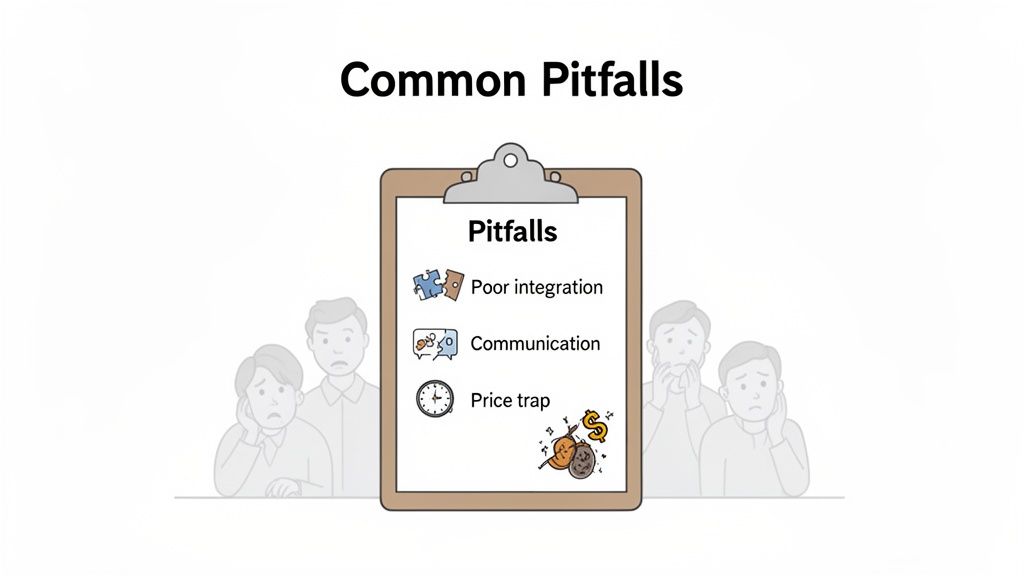
This is the single biggest killer of a staff augmentation engagement. You bring on a brilliant developer, give them a login, and say, "Good luck." You treat them like a temporary outsider, so they act like one. They stay quiet in meetings, hesitate to ask questions, and never truly feel connected to the project's mission.
A real onboarding process is non-negotiable. It’s not just about system access; it’s about culture.
Integration isn't a one-day event; it's a continuous process. If you want them to act like a core team member, you have to treat them like one from the moment they sign the contract.
Another classic mistake is trying to save a few bucks by choosing the absolute cheapest vendor. You see a low hourly rate and think you’ve struck gold. What you've actually done is signed yourself up for a side hustle as a private investigator.
Hope you enjoy spending your afternoons fact-checking resumes and re-running technical interviews, because that’s now your job. A rock-bottom price often means the vendor is just a resume mill. They do zero vetting, have no quality control, and simply forward you whatever they can find on LinkedIn.
You get what you pay for. A quality partner invests heavily in a rigorous vetting process—technical assessments, background checks, and cultural interviews—so you don't have to. The slightly higher rate you pay for a premium staff augmentation services partner is really an insurance policy against wasting months on the wrong hire.
"We'll just figure it out," is not a communication strategy. When your team is split across time zones and cultures, ambiguity is your worst enemy. Without clear protocols, you get chaos.
Missed deadlines, duplicated work, and endless email chains trying to clarify a simple request become the norm. The problem isn’t a lack of effort; it's a lack of structure. You need to be ruthlessly explicit about how your blended team will communicate.
Avoiding these pitfalls isn't complicated. It just requires being intentional. Treat integration as a priority, invest in a quality partner, and build a rock-solid communication framework. Do that, and you'll get the powerhouse team member you were promised, not just another freelancer.
The market for staff augmentation services is flooded with vendors, and frankly, a lot of them look the same. Every site has the same smiling stock photos and vague promises of "top-tier talent." So, how do you cut through the fluff and find a partner who actually delivers?
I’ve been burned by this before. You sign with a vendor, they throw a few resumes your way, and suddenly you’re on your own. You’re left trying to figure out international payroll, navigate confusing local tax laws, and basically do all the heavy lifting you thought you were paying them for. It’s a total nightmare.
A great partner is more than just a resume factory. They’re a true operational extension of your team. Choosing the right one comes down to grilling them on a few key, non-negotiable areas.
First, you need to get surgical about their vetting process. This is where the pretenders are immediately exposed. Don’t be shy—ask them to walk you through it, step by step.
Is their "process" just scraping LinkedIn profiles and running a keyword search? If so, run for the hills. A legitimate partner has a rigorous, multi-stage system that weeds out the unqualified candidates long before their resume ever lands in your inbox.
Look for a process that includes:
A top-tier staff augmentation company like LatHire doesn't just match keywords; our AI-powered assessments and human-led checks ensure you're only meeting candidates who are technically sound and ready to integrate from day one. Toot, toot!
This is the billion-dollar question. You’re looking into staff augmentation to reduce your workload, not accidentally create a new full-time job for yourself as an international HR manager.
Ask them directly: "Who handles payroll, benefits, and local legal compliance?" If you get even a hint of hesitation in their answer, that’s a massive red flag. A true partner takes all of that off your plate. They are the employer of record, which means they manage the entire administrative and legal backend.
You’re not just hiring a person; you’re buying a service. That service should include end-to-end operational support. If they don't handle the messy stuff, you will.
Current trends in staff augmentation highlight just how critical this support is, especially as remote work drives demand. One report notes that platforms handling full HR and payroll are essential for eliminating cross-border headaches.
Finally, where are they getting their talent, and how transparent are they about it? A generic "global talent pool" is another red flag. The best partners often specialize in specific, high-value regions where they have deep networks and cultural expertise.
Ask them about their access to talent in specific regions, like Latin America, which offers incredible skill and time-zone alignment for US companies.
Then, demand transparency. Can you see comprehensive candidate profiles with validated skills, English proficiency scores, and real-time availability? A good partner gives you a clear window into their talent, letting you make an informed decision quickly. For detailed guidance on selecting your collaborators, consider reading about how to choose the right outsourcing partner for your business. Choosing the right partner isn't a gamble; it's a strategic decision based on diligence.
Alright, you're sold on the idea. Now what? Let’s map out the exact steps to roll out staff augmentation services smoothly, so you don’t end up in a management nightmare.
This isn't just about sending a welcome email. It's about a deliberate process that turns a contractor into a genuine, high-impact team member.
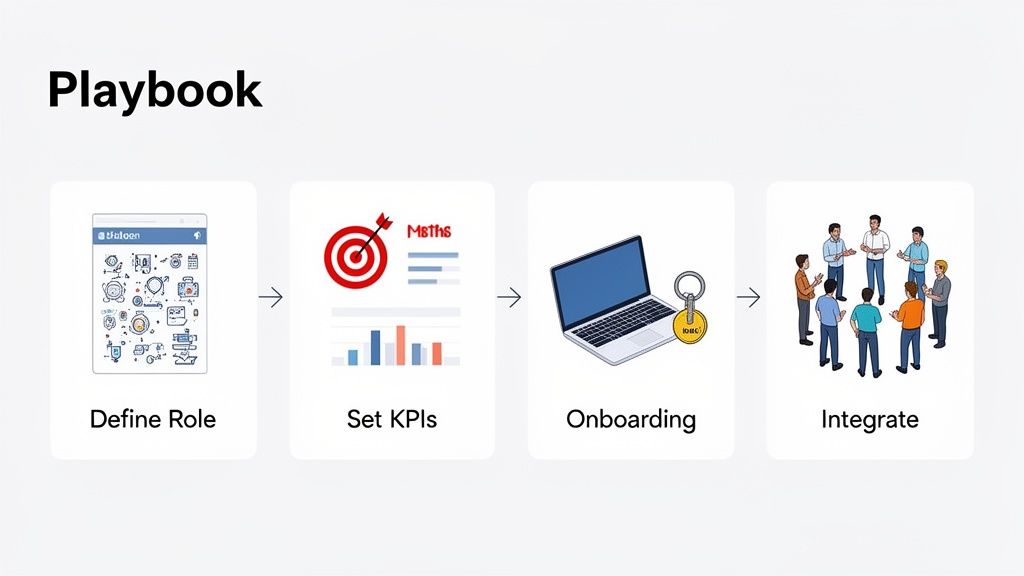
Executing this correctly from the start separates the teams that thrive from those that just muddle through. Let’s get tactical.
"We need a developer" is not a job description; it's a cry for help. Hope is not a strategy. You need to get ruthlessly specific about what you’re looking for before you even think about talking to a vendor.
Vagueness is your enemy here. It leads to mismatched candidates, wasted interview cycles, and endless frustration. Before you do anything else, document the following:
How will you know if this engagement is a success? If you can't answer that question upfront, you're flying blind.
Setting clear Key Performance Indicators (KPIs) isn't about micromanaging; it's about creating alignment and defining what "done" looks like. These shouldn't be generic corporate metrics. They need to be tied directly to the role's mission.
Don’t just track hours logged. Measure what matters: code quality, features shipped, ticket velocity, or customer issues resolved. Define success before they write a single line of code.
A terrible first week can poison the entire engagement. Your new team member is excited to contribute, but they can't do anything if they spend three days begging for access to your GitHub repo.
Onboarding isn't a task; it's a welcome ramp. Prepare everything they’ll need before their first day to make an immediate impact.
Finally, the most critical step. You didn’t hire a lone wolf; you hired a team member. The biggest mistake companies make is treating augmented staff like temporary outsiders.
To get their best work, you have to bring them into the fold completely.
Invite them to everything: the daily stand-ups, the project planning sessions, the virtual coffee breaks, and even the silly Slack channels. Make them feel like part of the crew, because for this project, they are. True integration is what unlocks the full power of the staff augmentation services model.
Here's a simple, actionable checklist to guide you through the process. Use it to ensure you cover all your bases from defining the role to full integration.
| Phase | Key Action | Why It Matters |
|---|---|---|
| 1. Definition | Draft a hyper-specific job description with tech stack, seniority, and project goals. | Attracts the right candidates and eliminates ambiguity from day one. |
| 1. Definition | Define 3-5 measurable KPIs directly tied to the project's business outcome. | Creates a clear, shared understanding of what success looks like. |
| 2. Hiring | Ask your vendor for candidates with proven experience in your specific industry. | Industry context shortens the learning curve and leads to better solutions. |
| 3. Onboarding | Prepare all system access (code repos, comms tools, PM software) before day one. | Prevents frustrating delays and allows the new hire to be productive immediately. |
| 3. Onboarding | Assign an internal "buddy" for informal questions and guidance. | Fosters a sense of belonging and helps navigate unwritten company rules. |
| 4. Integration | Add the new member to all relevant team meetings, including daily stand-ups. | Ensures they are fully looped into project progress, blockers, and decisions. |
| 4. Integration | Invite them to non-work-related communication channels (e.g., social Slack channels). | Builds personal rapport and makes them feel like part of the team, not just a resource. |
| 4. Integration | Schedule regular 1:1 check-ins with their direct manager or team lead. | Provides a dedicated space for feedback, alignment, and addressing concerns. |
Following this checklist doesn't just make the process smoother—it fundamentally changes the outcome. It transforms a simple staffing transaction into a strategic partnership that drives real results.
You’ve heard the term thrown around, but what does it actually mean for your business? Let's get straight to the point and answer the real questions you have—no jargon, just the insights you need to decide if staff augmentation services are right for you.
It all boils down to one simple word: integration.
A contractor is like a specialist you call in for a single, isolated job. Think of a plumber fixing a leak—they come in, solve that specific problem, and leave. They aren't part of your family's daily routine.
Staff augmentation, on the other hand, is about embedding an expert directly into your team. They don’t just work for you; they work with you. They’re in your daily stand-ups, contributing to your Slack channels, and becoming a genuine part of your project's DNA. It's the difference between renting a tool and adding a skilled member to your crew for the long haul.
The most painful "hidden" cost never shows up on an invoice. It's the productivity drain that comes from choosing a cheap, low-quality partner. If your vendor outsources the messy work like compliance, international payroll, or benefits administration back to you, guess what? That just became your problem to solve.
The real cost isn’t the hourly rate. It’s the time your managers burn babysitting a poorly matched hire or cleaning up the administrative chaos left behind by a cut-rate vendor.
Another killer is a botched onboarding. If you don't invest the time to properly bring your new team member into the fold, their ramp-up time will stretch from days into weeks, completely torching your project's momentum before it even gets going.
Absolutely. In fact, this is one of the most powerful—and most overlooked—benefits of the model. While it’s fantastic for plugging a short-term gap, staff augmentation is a killer strategy for long-term projects where you need consistent, specialized skills without adding a permanent headcount to your payroll.
We’ve seen companies build out entire core teams with augmented professionals who stay for years. They bring stability and deep institutional knowledge, all while giving the business the agility it needs to pivot. Think of it as building a resilient, expert team that can grow and adapt right alongside your goals.

