
Let's be honest. You've heard the promises of going remote: elite talent, lightning-fast hiring, and costs that don't make your CFO break out in a cold sweat. But you’ve also heard the horror stories—the 3 AM calls to fix a server, the communication blackouts, and the legal quicksand that can swallow your company whole.
This is where remote staffing services are supposed to ride in on a white horse. They're built to give you all the global-hiring glory with none of the gore, acting as your bridge to world-class talent while they handle the soul-crushing parts like international payroll and compliance.
You’ve probably stared at a spreadsheet, crunched the numbers on another eye-wateringly expensive local hire, and felt that familiar dread. The local talent pool is fished out, the salary demands are insane, and the entire process moves at the speed of government.
You know there’s a world of incredible talent out there. But the idea of navigating international hiring on your own feels like trying to assemble IKEA furniture in the dark. Blindfolded. With no instructions.
This isn’t just a feeling; it’s a tectonic shift in how work gets done. By 2025, over 36 million Americans will be working remotely—a full 22% of the workforce. This isn't a pandemic hangover; it's a permanent change. Companies that ignore this are willingly putting themselves at a disadvantage. Feel free to learn more about the rise of remote work if you enjoy a good "I told you so" moment down the road.
So, if everyone knows the talent is out there, why isn't every company hiring from Brazil to Budapest?
One word: Fear. Fear of the unknown. Fear of a catastrophic screw-up.
Every founder I talk to is hung up on the same handful of worries:
These aren't just valid concerns; they're the tripwires that detonate most DIY global hiring attempts. Hope you enjoy spending your afternoons fact-checking resumes and running technical interviews—because that’s now your full-time job.
This is where the idea of remote staffing services finally clicks. Think of them less like a traditional recruiter and more like a strategic partner who does the dirty work. A good service doesn't just lob a resume over the fence; it solves the entire operational problem of employing that person.
They become your outsourced HR, legal, and payroll department for your global team.
You're not just buying a list of names. You're buying a pre-built machine that handles the infuriatingly complex parts of international employment so you can focus on, you know, running your business.
Turns out there’s more than one way to hire elite developers without mortgaging your office ping-pong table. The goal of this guide is simple: to give you a founder-to-founder breakdown of how these services actually work. We’re not just going to list options; we’re going to dissect what works, what’s a waste of money, and how you can get it right the first time.
Let's get into it.
Alright, let's get into the weeds. Thinking all remote staffing services are the same is like assuming a shot of espresso and a lukewarm cup of instant coffee will have the same effect on your Monday morning. Both are technically "coffee," but one will get you building empires while the other might just get you to your inbox.
Picking the right model is everything. It defines your budget, your team's integration, and how much of a headache you're signing up for. The global staffing industry is set to hit a staggering $650 billion in 2025, with a 5-6% surge in demand from IT and healthcare. This isn't just a trend; it's a seismic shift.
So, let's cut through the noise. Here’s the field guide to the four main plays you can run.
This decision tree gives you a quick visual on whether you have the internal bandwidth to hire directly or if a service is the smarter path forward.
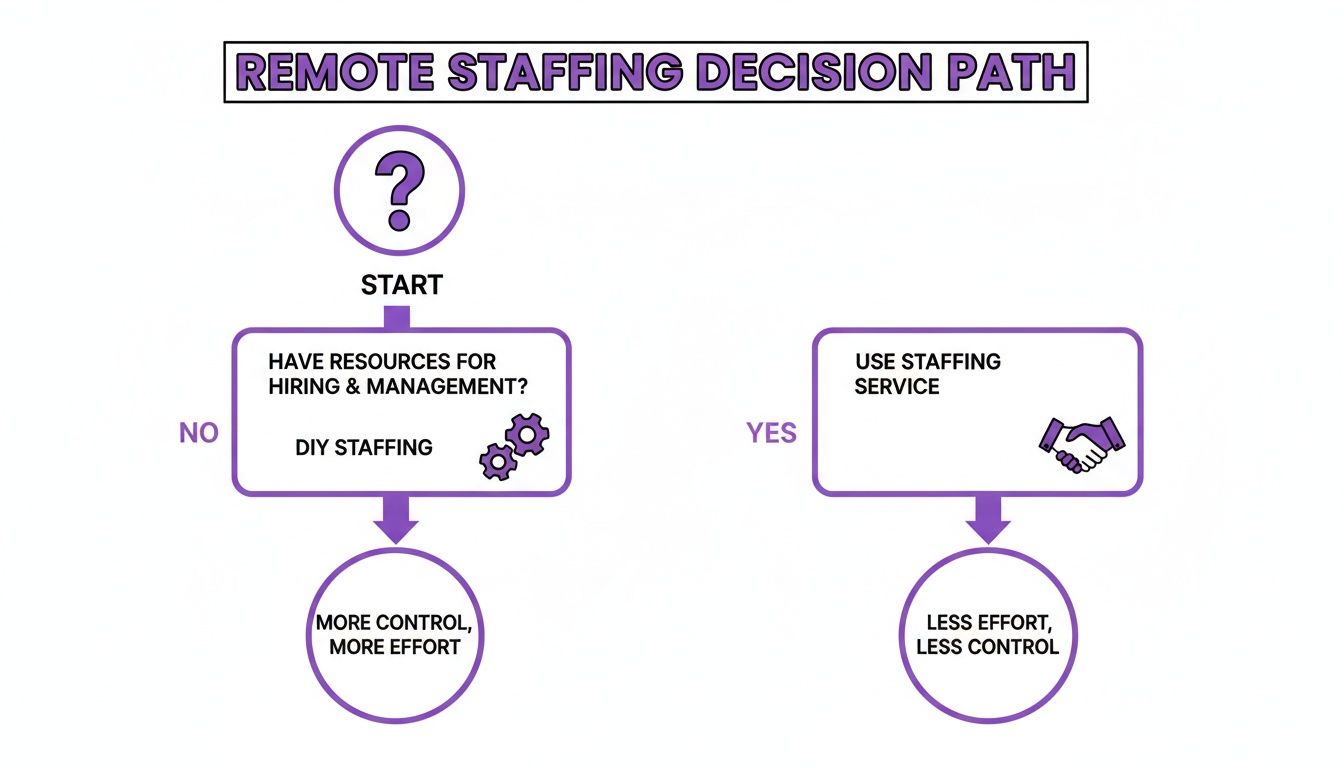
Ultimately, it comes down to a simple question: Do you want to build an international hiring machine, or just use one that's already running?
Think of this as hiring an entire remote department that works exclusively for you, like a SEAL team parachuted into your company. A remote staffing partner builds a team—say, three developers and a QA engineer—that is 100% dedicated to your company. They’re your employees in everything but the paperwork.
This model is killer for long-term, core projects where you need a cohesive unit that bleeds your company colors. They aren’t just temporary help; they are a genuine extension of your in-house team, just located elsewhere.
This is your surgical strike. You have a great team, but you’re missing one specific skillset—maybe a senior DevOps engineer who can actually explain Kubernetes or a UX designer who understands mobile. Staff augmentation lets you "rent" that specific expertise to plug a temporary gap.
You bring one or two specialists onto your existing team for a set period. They work under your management, on your projects, just like your other employees. It’s fast, flexible, and sidesteps the long-term commitment of a full-time hire. For a deeper dive, our guide on staff augmentation vs consulting breaks it down further.
The Takeaway: Dedicated teams are like a marriage; staff augmentation is more like strategic dating. Both have their place, but you better know what you’re getting into.
Ah, the freelancer route. The Wild West of hiring. This is where you directly hire independent contractors for specific, project-based work. You find them on a platform, agree on a scope, and they deliver. It offers maximum flexibility and is often the cheapest route—upfront.
But that low price tag comes with a hidden cost. You are now the project manager, the HR department, and the compliance officer. Misclassifying a contractor as an employee can lead to fines so big they'll make your eyes water.
With RPO, you’re not just hiring people; you’re outsourcing your entire recruitment function. An RPO provider becomes your external talent acquisition team. They handle everything from sourcing and screening to interviewing and onboarding, all under your company's banner.
This is a high-level strategic partnership. It’s for companies that need to hire at scale but lack the internal HR army to do it effectively.
The biggest lie about remote hiring is that it's just about finding someone on the other side of the planet. Spoiler alert: it’s not.
The reality is a minefield of compliance, payroll, and legal nightmares where most DIY approaches go to die. I'm not saying this to scare you; I'm saying it because I've seen the wreckage. Knowing what you're up against is half the battle.

So, you decide to hire everyone as a contractor. Brilliant! No benefits, no payroll taxes, just clean invoices. It feels like the perfect loophole… until it blows up in your face.
Governments worldwide are cracking down hard on worker misclassification. If your "contractor" in Brazil works your hours, uses your laptop, and is managed just like an employee, then guess what? They are an employee. The penalties aren't a slap on the wrist; we’re talking massive back-pay, crippling fines, and getting blacklisted from hiring in that country.
This is a classic case of being penny-wise and pound-foolish. You save a few bucks on benefits today only to hand it all back—and then some—in legal fees and fines tomorrow.
Suddenly, that "cheap" hire isn't so cheap. The administrative weight of tracking global regulations is precisely why smart businesses use remote staffing services as an employer of record.
Okay, let's say you've somehow navigated the legal minefield. Now you just have to pay your people. Easy, right? Wrong. Welcome to the global payroll gauntlet, a soul-crushing admin vortex designed to make your money slowly disappear.
Here’s a taste of the pain:
And don't forget the weird stuff. Things like specialized travel insurance for digital nomads can prevent unforeseen liabilities while actually supporting your remote talent.
This is the stuff nobody wants to deal with, and it's where the real cost of DIY global hiring hides. It's a full-time job for an entire department. We even put together a payroll and compliance checklist just to show how deep this rabbit hole goes.
Handing this whole mess off to a partner who lives and breathes this stuff is one of the biggest ROIs you'll ever see.
Every remote staffing platform promises you the “top 1% of talent.” It’s the biggest, most tired cliché in the industry. You’ll see it plastered on every homepage until the words lose all meaning.
So, how do you tell the contenders from the pretenders? How do you pick a partner that solves problems instead of creating new ones?
You need a battle-tested checklist. Your shield against slick sales pitches and hollow promises.
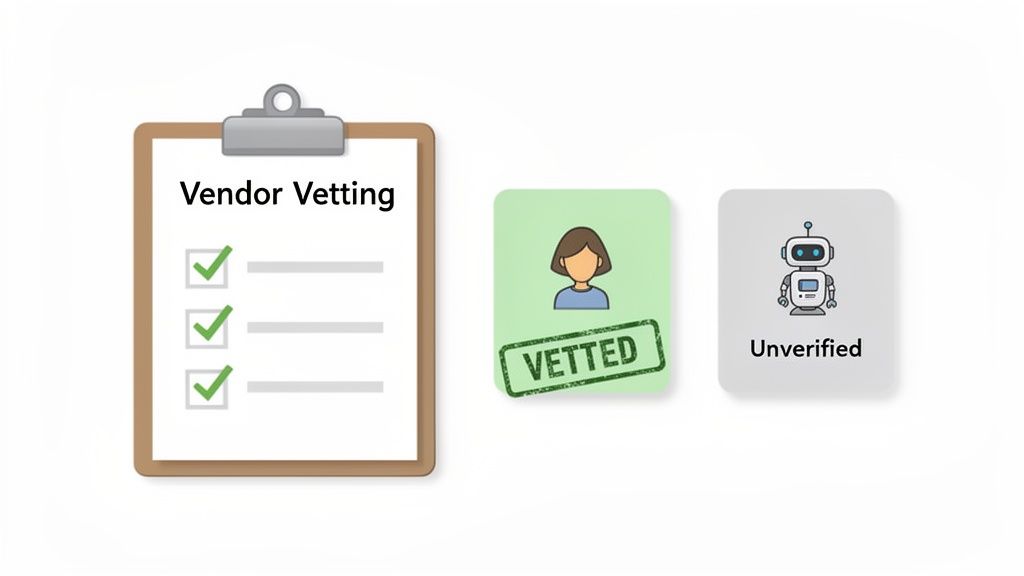
First things first: ask them to show their work. Don't just accept the "pre-vetted" label. Dig in and ask the hard questions.
A vague, hand-wavy response here is a giant red flag. A confident partner will be proud to show you how their validation engine works.
When something goes wrong—a missed deadline, a personality clash, a payroll question—who are you going to call? This is where many remote staffing services show their true colors.
Do you get a dedicated account manager who knows your business, or are you funneled into a generic support queue with a chatbot named "SupportBot 3000"? A good partner is an extension of your team. They should be proactive, not just reactive.
Pro tip: Ask about their replacement policy. If a candidate doesn't work out, what happens? A solid partner offers a swift, no-cost replacement. A shaky one will make you jump through hoops or, worse, charge you for their mistake.
"It's affordable!" they'll say. But what does that really mean? Demand absolute transparency. Watch for these traps:
Your final invoice should never be a surprise. If a vendor can’t give you a clear, all-in monthly number, they’re hiding something. It’s that simple. For more on this, our guide on vendor management best practices covers how to maintain control and transparency.
To make this easier, here's a quick checklist you can use.
| Criteria | What to Look For (The Good) | Red Flags (The Bad) |
|---|---|---|
| Talent Vetting | In-depth technical assessments (live coding, portfolio reviews) conducted by senior engineers. Clear process for soft skill evaluation. | Automated quizzes, keyword matching by non-technical staff, vague answers about the process. |
| Support Model | A dedicated, named account manager who understands your business. Proactive check-ins and a clear escalation path. | Generic support tickets, chatbot-first service, slow response times, no dedicated contact. |
| Replacement Policy | A clear, no-cost, and fast replacement guarantee if a candidate isn't a good fit within a specified trial period (e.g., 30 days). | Complicated replacement procedures, additional fees, or making you start the hiring process from scratch. |
| Pricing Transparency | All-inclusive pricing with a clear breakdown of the talent's rate versus the platform's margin. No hidden fees. | Vague quotes, unexpected administrative fees, refusal to disclose their margin, surprise currency conversion charges. |
| Client References | Eager to provide references from current clients of a similar size and industry. Positive, verifiable case studies. | Hesitation to provide references, only offering testimonials from anonymous "happy customers." |
Vetting a vendor is about cutting through the marketing fluff. Don't be wooed by promises of the "top 1%." Be impressed by a transparent process, a robust support system, and an honest pricing model. That’s how you find a real partner.
Okay, time to pull back the curtain. We didn’t build LatHire because the world needed another hiring platform. We built it because we were founders who were completely fed up with the existing ones.
Frankly, we got burned. We were tired of "AI-powered" matching that felt like a clunky keyword search. We got frustrated with "pre-vetted" talent who couldn't clear a basic coding challenge. And we nearly drowned in the administrative quicksand of managing a global team.
So we built the solution we wished we'd had from day one. This is where we show our cards.
The biggest myth in remote staffing is the phrase "top 1% of talent." It's a marketing slogan, not a metric. Top 1% of what? People who are good at online quizzes? Resume-stuffers who know the right buzzwords?
We knew that to build something that actually worked, we had to solve the validation problem first. Our approach isn't about matching keywords; it's about proving skills in a real-world context.
Our AI doesn't just scan for years of experience; it analyzes practical, on-the-job skills through multi-stage assessments:
We’re not saying we’re perfect. Just more accurate more often. It’s about replacing guesswork with verifiable proof.
Ever tried to get an urgent answer from a key developer who's fast asleep on the other side of the planet? It’s a special kind of startup chaos. That 12-hour wait for a simple code review can kill your momentum, turning a one-day task into a three-day ordeal.
This is exactly why we focus exclusively on Latin America.
It's not just about finding incredible talent—which the region has in abundance. It’s a pragmatic, strategic decision built on one game-changing factor: time-zone alignment. Having your remote team working the same hours as your US or Canadian team erases the communication lag that cripples so many global teams.
Collaboration isn’t a nice-to-have; it's the engine of a high-performing team. When your team is in sync, you move faster, solve problems quicker, and build a more cohesive culture. Time-zone alignment makes that possible.
The data backs this up. Latin America has seen a 156% jump in remote hiring adoption, and remote hires show better retention, with 62% staying longer than two years. You can discover more insights on global hiring trends to see the full picture.
Finding the right person is only half the battle. The other half is the soul-crushing admin: contracts, international payroll, benefits, and compliance. We’ve been there, trying to piece it all together with different tools and experts. It was a complete mess.
That's why we built LatHire as an end-to-end solution. It’s one platform where you can:
You don't need to become an expert in Brazilian labor law or Mexican tax codes. That's our job. Your job is to find the best person for the role and welcome them to your team. We handle the rest. Toot, toot!
We didn’t set out to reinvent the remote staffing industry. We just wanted to build a service that actually works the way a busy founder needs it to—fast, accurate, and with all the boring, complicated stuff handled.
Let's bring it all home. By now, you get it—remote staffing services aren't just some passing trend. They represent a fundamental shift in how smart companies are built. You know the different models, the legal traps to sidestep, and the right questions to grill a potential partner with.
The goal was never just to fill a seat, was it? It’s about gaining a strategic advantage. It's about tapping into an elite global talent pool that was previously out of reach and scaling your team without bloating your overhead.
Your next move isn’t to blindly click on the first flashy ad you see. It's to use the knowledge from this guide to make a deliberate, informed choice. The difference between the two approaches is night and day.
The right partner makes global hiring feel almost seamless, like a superpower you just unlocked. The wrong one will make you wish you’d just hired your cousin and called it a day.
It really boils down to one question: Are you looking for a simple resume-finder, or an operational partner? One gives you a list of candidates; the other gives you a complete system for hiring, paying, and managing a global team without all the soul-crushing admin.
Choosing a vendor is choosing your future headaches—or your future peace of mind.
Don't let analysis paralysis win. The biggest risk isn’t picking the wrong partner; it’s doing nothing and watching your competitors build stronger, more agile teams while you're still stuck fishing in the shallow end of the local talent pool.
Use the checklists. Ask the tough questions. Demand transparency. Your first remote hire shouldn’t feel like a roll of the dice. It should feel like a calculated, strategic move that sets you up for the win.
Make it count.
Alright, let's get straight to it. Here are the questions that come up all the time, answered without the usual fluff.
It's all over the map, and if a vendor is being vague, walk away. Some hit you with a massive upfront fee; others skim a percentage off the top. The only model worth your time is one built on total transparency.
You should always see a clear, all-in monthly rate. This number must cover the talent's salary, benefits, and the platform’s fee—no surprises. The real cost to watch for is the legal exposure if your provider botches compliance. A surprise fine from a foreign government is a cost nobody wants to pay.
Two words: time-zone alignment.
Trying to collaborate with a team that’s 12 hours ahead is a special kind of project management hell. But having your remote team working the same hours as your US or Canadian team? That's a game-changer for solving problems in real-time.
There's also strong cultural affinity in work ethics and communication styles, which makes integration feel natural, not forced. It’s never just about technical skills; it’s about finding people who can plug right into your team and contribute from day one.
The old way drags on for months. Hope you enjoy spending your afternoons fact-checking resumes and conducting endless technical interviews—because that’s now your full-time job.
A good platform with a pool of pre-vetted talent collapses that timeline. You can go from an empty seat to reviewing a shortlist of qualified candidates in as little as 24 hours.
From your first conversation to a signed offer, the whole process can shrink from a quarter to a couple of weeks. That speed isn't a minor perk; it’s one of the biggest ROIs you'll get from a modern remote staffing service.

