
Let's be real—you're not here by accident. You're probably here because local hiring has become a slow, expensive, and frankly, soul-crushing grind. The "talent pool" in your city feels more like a puddle, and you're tired of compromising on skill just to fill a seat. A top-tier remote staffing company is your way out, connecting you with elite global talent without mortgaging the office ping-pong table.
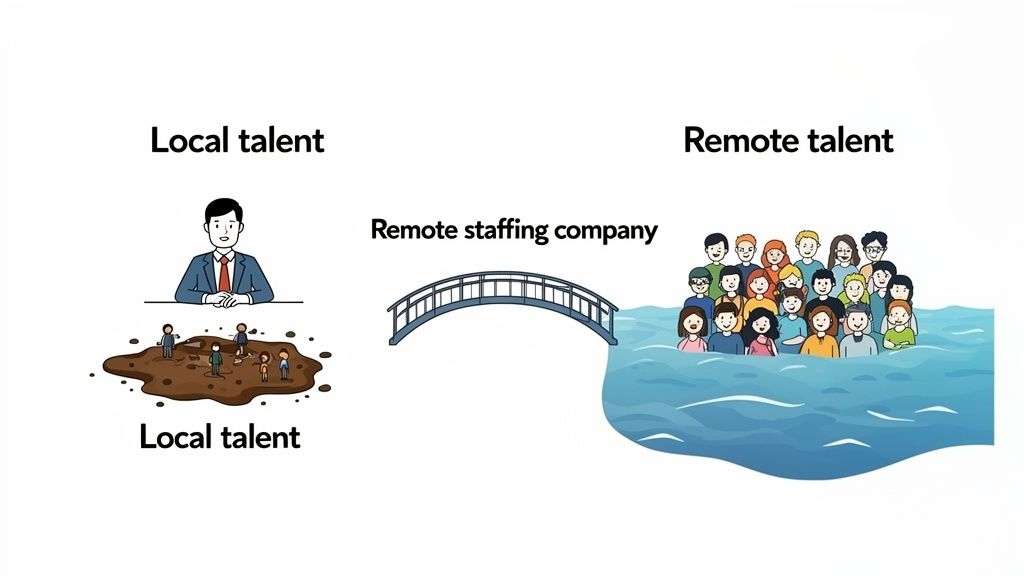
You’ve heard the whispers: a mythical land where elite developers and marketers work for a fraction of the cost, ready to start yesterday. The truth? It can be exactly that. Or it can be a compliance and communication dumpster fire waiting to happen.
The shift to remote isn't just about trimming the budget anymore; it's about survival. It’s about finding that Senior DevOps Engineer or AI specialist who simply doesn't exist in your zip code. It's about moving faster than competitors who are still paying recruiter fees the size of a down payment on a house.
Look, this isn't about finding cheap labor on some freelance site. If you enjoy spending your afternoons fact-checking resumes and running technical interviews, then by all means, that's your path. It quickly becomes your new full-time job.
A true remote staffing company makes a simple, powerful promise: we handle the chaos so you can focus on building your business. This almost always includes:
The whole point is to make hiring someone in Brazil as easy as hiring someone down the street. It’s a massive operational lift, which is why the global staffing industry is projected to grow to between $190 and $194 billion globally in 2026. This boom is fueled by efficiency and a focus on niches like tech and ops—exactly what modern remote staffing is built for.
Let’s get the obvious out of the way: yes, you can save a ton of money. But that’s table stakes. The real game-changer is the strategic advantage you gain.
The moment you stop thinking "how can I hire cheaper?" and start thinking "how can I access the best talent on the planet?" is the moment you understand the real power of global staffing. It's a complete upgrade to your entire talent strategy.
Ultimately, you’re here because the old model is broken. It’s too slow, too expensive, and far too limited. The new model promises speed, access, and efficiency. The trick is finding a partner who can actually deliver without creating a whole new set of headaches. And that's exactly what we're going to unpack.
Before you sign on the dotted line with a remote staffing company, let’s talk about what’s actually on the menu. Turns out, there’s more than one way to hire top-tier talent, and each path has its own special blend of pros, cons, and potential for disaster.
The upside is obvious: huge cost savings, access to a global talent pool that makes your local market look tiny, and hiring speeds that seem like witchcraft. The downside? That’s the classic stuff—painful time zone differences, cultural misfires, and the black hole of international compliance paperwork.
Then there's the truly ugly side: realizing the "pre-vetted" candidate you just paid a fortune for can't actually code their way out of a paper bag, and the company that placed them has suddenly gone silent. It’s a scenario nobody wants.
When you cut through all the marketing noise, you’re really looking at three main roads. Each one demands a different amount of your time, money, and sanity. Let's break them down, no sugarcoating.
This is the path for the brave, the bold, and anyone with way too much time on their hands. You post a job on a huge marketplace and immediately get buried under a mountain of proposals.
Hope you enjoy spending your days fact-checking resumes and running technical interviews—because that’s your new full-time job. Sure, you might find a diamond in the rough for a bargain, but you're just as likely to hire someone who outsources their own work. It's a high-risk game where you are the sole project manager, HR department, and international payroll expert.
Next up are the traditional recruiters who have simply tacked "remote" onto their business model. They have a network and can find people, no doubt. But their process is often slow, expensive, and completely out of touch with the realities of a distributed team.
Their value is saving you sourcing time, but you’re still on the hook for most of the interviewing, and you're definitely handling the messy parts of international contracts and compliance. Plus, that one-time placement fee—often 20-30% of the first-year salary—is a tough pill to swallow, especially when there’s no guarantee the hire will stick around.
Finally, there's the dedicated remote staffing company. This isn't just a database of resumes; it's a full-service hiring machine. The idea is simple: they act as the Employer of Record, handling everything from intense vetting and background checks to payroll, benefits, and local legal compliance.
A true partner doesn't just find you a candidate; they deliver a fully integrated team member. They absorb the administrative burden and hiring risk, freeing you up to actually run your business.
This model is built from the ground up for remote work. They understand time zones, cultural nuances, and the complexities of cross-border employment law. You get the speed and access of a global talent pool without becoming an unwilling expert in Brazilian labor law. For tech roles, getting specialized insights for hiring remote software developers can be a game-changer when exploring this approach.
The trade-off? You're paying for a complete service, not just a name on a list. But when you factor in the time saved, the risks avoided, and the quality of talent they surface, the math almost always works out in your favor.
To make it even clearer, let's put these three options side-by-side. Each approach has its place, but the right choice depends entirely on your resources, risk tolerance, and how quickly you need to scale.
| Factor | DIY Freelance Platforms | Traditional Recruiters | Remote Staffing Company |
|---|---|---|---|
| Talent Quality | Total crapshoot; requires extensive self-vetting. | Good, but often limited to their dusty Rolodex. | Consistently high; candidates are truly pre-vetted. |
| Hiring Speed | Painfully slow. You do all the heavy lifting. | Moderate. Can take weeks or even months. | Insanely fast. Often delivers candidates in days. |
| Cost Structure | Low fees, but high cost in your wasted time. | Huge one-time fee (20-30% of salary). | Ongoing service fee, but no large upfront cost. |
| Compliance & HR | It's all on you. Good luck with that. | None. You are the employer. Have fun. | Fully managed. They act as Employer of Record. |
| Risk | Extremely high. Scams and bad hires are common. | Moderate. Risk of a poor fit after that huge fee. | Low. They handle compliance and offer replacements. |
| Best For | Small, one-off projects with no budget. | Filling one specific, high-level role. | Building and scaling dedicated, long-term remote teams. |
Ultimately, the choice comes down to what you value most. If you have the time and expertise to manage a global hiring process yourself, DIY might work. If you need a single key hire and have the budget for a big hit, a recruiter could be the answer. But for building a reliable, scalable remote team without the administrative nightmare, a dedicated remote staffing company is the modern solution.
So, what does a real partnership actually look like, day in and day out?
Let’s get past the slick landing pages and vague promises. A top-tier remote staffing company doesn’t just forward you a list of names. It acts like an extension of your own team—if your team suddenly had global hiring superpowers.
Let's walk through the real process, from the moment you realize, "I need a senior DevOps engineer, like, yesterday," to their first day shipping code. This isn’t about just finding someone; it’s about activating a full-stack hiring machine that manages the entire lifecycle for you.
It all kicks off with what you need. Maybe you have a perfect job description, or maybe it's just a rough idea scribbled on a napkin. A modern partner takes that input and gets to work instantly.
Forget the old model of a recruiter scrolling through LinkedIn for days. Advanced platforms use AI to scan thousands—sometimes hundreds of thousands—of candidate profiles in minutes. The system isn't just matching keywords; it’s analyzing skill proficiency, years of experience, project history, and even the soft skills hinted at in past roles. This AI-powered triage shrinks a multi-week sourcing marathon into a few hours.
The result? You get a pre-qualified pool of candidates who genuinely fit your requirements, not a random collection of people who stuffed the right buzzword into their profile.
This is where a true partner proves their worth. That "pre-vetted" tag you see on a freelance profile? It often means next to nothing. A real remote staffing company puts every single candidate through a multi-stage gauntlet designed to weed out the pretenders.
Anyone can claim to be a senior developer. The real test isn't what their resume says; it's whether they can solve a complex problem under pressure when no one is watching. That’s what our vetting process is designed to uncover.
This process isn't optional. It typically includes several critical stages:
Only the candidates who survive this entire gauntlet—often just the top 1-3%—ever land in your inbox. You’re not just getting a resume; you’re getting a validated, battle-tested professional.
Finding the talent is just one half of the equation. The other half is the administrative nightmare of hiring them legally across borders. This is the part that can easily sink a company trying to manage it all on its own.
A genuine remote staffing company steps in here to act as your Employer of Record (EOR). In plain English, this means they handle all the soul-crushing complexities you definitely don't want to touch:
This end-to-end support turns a high-risk, complex headache into a simple, scalable operation. You focus on managing the talent's work, while the partner handles the entire administrative backend.
If you're still weighing your options, our brutally honest guide to remote staffing agencies dives even deeper into what separates a true partner from a simple resume-flipper.
I’ve seen it all. The flashy platforms with beautiful UIs but zero quality control. The agencies that promise the world and deliver a junior developer who apparently learned Python last Tuesday. Don't make the same mistakes I did.
Choosing a remote staffing company is a high-stakes decision. Pick the right one, and you unlock a global talent pool that can supercharge your growth. Pick the wrong one, and you’re stuck in a vortex of bad hires, compliance nightmares, and wasted cash.
This isn't just a checklist; it's a battle-tested interrogation script. Use it to cut through the marketing fluff and find a real partner, not just a glorified resume-flipper.
Forget asking about their "process." That’s a softball question, and they all have a polished answer. You need to dig deeper and ask the uncomfortable questions that reveal what’s really happening behind the curtain. With 74% of organizations planning to permanently shift more roles to remote models, the market is flooded with subpar providers, making this diligence crucial.
Start with these non-negotiables:
The diagram below shows the ideal, streamlined flow from a best-in-class remote staffing company.
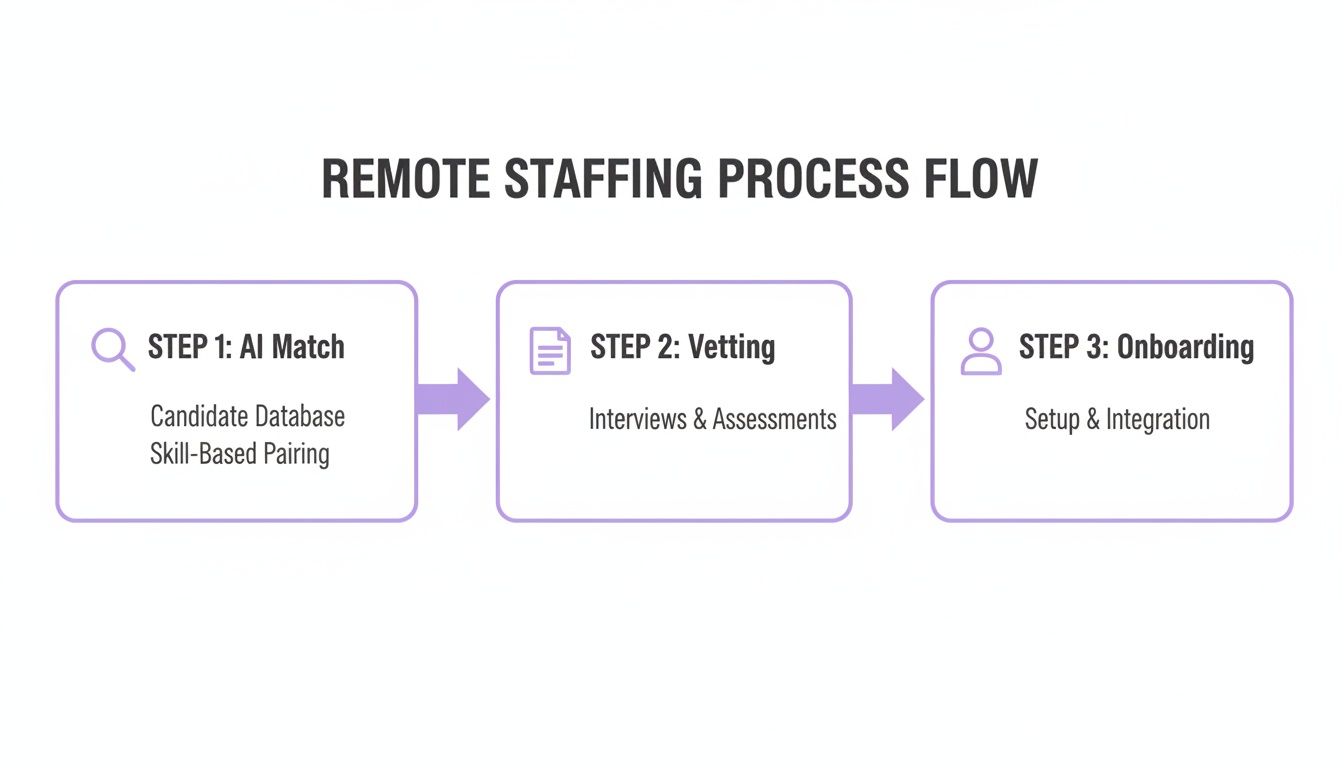
This simple three-step process—AI matching, rigorous vetting, and seamless onboarding—is what separates efficient partners from chaotic resume shops.
As you evaluate potential vendors, keep an eye out for these tell-tale signs. I learned to spot them the hard way so you don’t have to.
Red Flags (Walk away. No, run.)
Green Flags (You're on the right track.)
The ultimate green flag is a partner who asks you tough questions. They'll want to deeply understand your company culture, project goals, and team dynamics to ensure a perfect match. They aren't just selling a service; they're building a partnership.
Choosing the right partner is less about finding the cheapest option and more about finding the one that eliminates the most risk and saves you the most time. Use this checklist, trust your gut, and demand proof. Your future team depends on it.
Alright, let’s be honest for a second. This is the part where we tell you about us.
We didn't just stumble into building a hiring platform. We built it because we were incredibly frustrated with the status quo. We got tired of the "spray and pray" job boards that feel more like playing the lottery than building a team. We were done with the hidden fees, the compliance nightmares, and the candidates who looked perfect on a PDF but couldn't deliver in the real world.
So, we built the remote staffing company we always wanted to use. This isn't just about finding people; it's about creating a ridiculously efficient, end-to-end system for building a world-class remote team.
The first problem we had to solve was sourcing. Most platforms give you a decent-sized talent pool, but it still feels like you’re looking for a needle in a haystack. We knew we needed a bigger haystack—and a much, much smarter magnet.
Our solution was to get specific. We focused entirely on Latin America, a region overflowing with elite tech and operational talent that, critically, works in U.S. time zones. Our talent pool isn’t just large; it's a curated ecosystem of over 800,000 professionals.
But a huge talent pool is useless if you can't find anyone in it. That's where our proprietary AI comes in. It doesn’t just scan for keywords on a resume. It goes deeper, analyzing verified skills, past project successes, and even communication styles to find that small handful of candidates who are a perfect match for your role and your company culture. It turns a search that used to take weeks into a 24-hour match.
We’re not saying we’re perfect. Just more accurate more often. It’s the difference between guessing and knowing, and it’s the foundation of everything we do.
Have you ever gotten a candidate profile that was just a re-formatted resume? It’s basically useless. It tells you what a candidate claims they can do, not what they've actually proven.
We decided to get rid of that ambiguity. Our comprehensive profiles are built on proof, not promises. Here’s what you actually see:
Finding the right person is only half the battle. Then comes the administrative chaos of hiring them across borders. This is where most platforms wash their hands of the problem, leaving you to figure out contracts, payroll, and compliance on your own.
We built all of that right into the platform. Our dashboard is a single, unified command center that handles the entire lifecycle of your remote team member:
This isn't just a list of features. It’s our opinionated answer to a broken system. We took on the hard parts so you can get back to focusing on what you do best: growing your business.
So, you did it. You vetted the partners, picked a winner, and you’re about to pull the trigger on your first remote hire. Pop the champagne, right? Almost.
Finding the talent is just the opening act. The real magic—or the slow, painful unraveling—happens in the first 90 days. This isn't just about sending a welcome email and a laptop; it's about integrating a new way of working into your company's DNA. Mess this up, and that brilliant hire becomes an expensive, isolated mistake.
Success starts before Day One. It begins with the job description. Don’t just list responsibilities; sell the remote culture. Top remote talent isn’t just looking for a paycheck; they’re looking for autonomy, trust, and a team that gets how to work asynchronously.
Then comes the interview. A video call isn't just a face-to-face meeting with a screen in the middle. You need to actively probe for remote-specific soft skills.
Once the offer is signed, the clock starts. The goal isn't just to get them working; it's to make them feel like a genuine part of the team, even if they're thousands of miles away. Over-communication is your best friend here.
The biggest mistake you can make is assuming a new remote hire will just 'figure it out.' You have to be ruthlessly intentional about integration. Silence in a remote setting isn't golden; it's a warning sign.
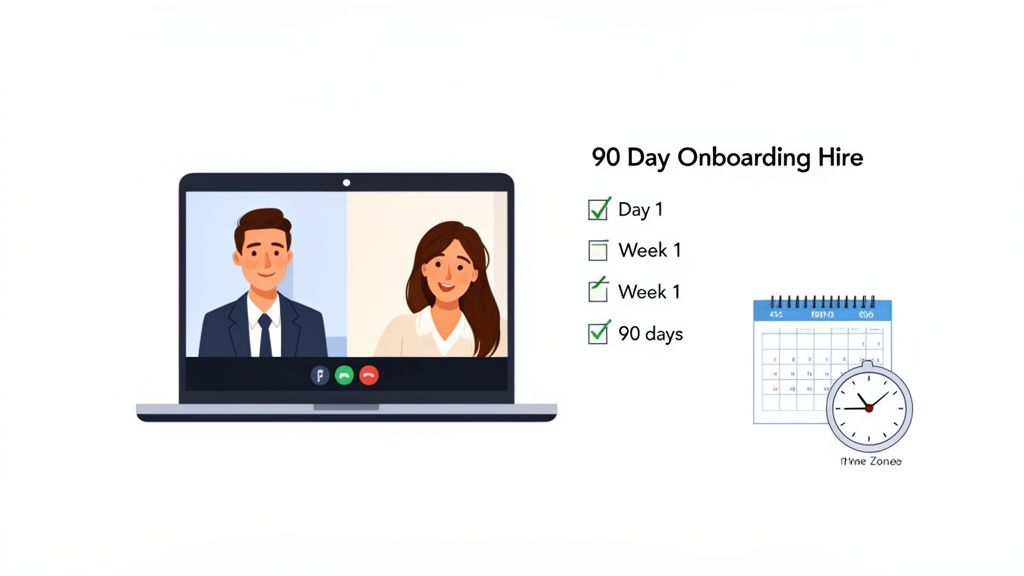
Your onboarding plan should be meticulously structured. Forget vague check-ins and create a concrete schedule. We've published a deep dive on how to structure this period, and you can get more details in our complete guide for onboarding remote workers.
Here’s a bare-bones framework to get you started:
This isn’t just about being nice; it's smart business. A killer onboarding process dramatically reduces ramp-up time and boosts retention. By partnering with a top remote staffing company and nailing the first 90 days, you’re not just filling a role—you’re building a scalable, global team that can outpace the competition.
Alright, let's get into the questions that always come up when I talk to founders and hiring managers about this stuff. No jargon, just the straight answers you're probably looking for.
Think of it like this: a freelance marketplace is a chaotic farmer's market. You have thousands of vendors, but you’re on your own to check the quality of the produce, figure out the recipe, cook the meal, and clean up afterward. You might find a gem, or you might get food poisoning.
A remote staffing company is your personal chef. They’re a true partner who handles the entire process—sourcing ingredients, taste-testing every single one, and presenting you with a perfectly prepared, five-star meal. They manage the sourcing, the intense vetting, the payroll, the compliance, and all the HR headaches. You just get to enjoy the final product: an elite, ready-to-work professional who fits seamlessly into your team.
Any good partner will be completely upfront about their pricing—it’s usually a clear margin on top of the talent’s salary. The real "hidden costs" only appear when you cheap out and go with a subpar vendor.
These costs won't show up on any invoice. They look like this:
The most expensive hire is always the wrong hire. The upfront fee you pay a good partner is an insurance policy against the catastrophic downstream costs of getting it wrong.
The takeaway? Grill any potential partner on their fee structure. Ask for a full breakdown of what’s included and, just as importantly, what isn't.
You manage them exactly like any other remote member of your team. Because that’s what they are—a full-time, dedicated member of your squad. They report directly to you and your managers, not the staffing company.
The staffing partner’s job is to handle the back-office administrative chaos (payroll, benefits, local taxes, compliance). Your new hire, meanwhile, is diving into your projects, joining your daily stand-ups, and becoming a part of your company culture on Slack. The partner gets them to your door; you welcome them into your house. The best approach is to over-communicate, especially at first, and use your existing project management tools to keep everyone perfectly in sync.

