
Let’s be honest: hiring is a soul-crushing, time-sucking disaster. You’re either mortgaging your office ping-pong table for local talent who might ghost you in six months, or you’re wading through freelance platforms hoping the five-star reviews aren’t fake. Remote staffing agencies are supposed to be the fix—the magic button for finding, vetting, and managing elite global talent.
But most of them aren't. Let's talk about how to find one that actually works.
Let's get real for a second. The old hiring playbook is a slow, expensive grind. You post a job, get swamped by a mountain of resumes, and waste weeks sifting through candidates who look great on paper but completely fizzle out in the first interview. It’s a full-time job you never actually signed up for.
You’ve probably been there. You're either stuck paying a premium for local developers in a hyper-competitive market or rolling the dice on freelance sites. The second option often feels like a crapshoot where you just have to hope the person on the other end is as good as their profile claims. Hope you enjoy spending your afternoons fact-checking resumes and running technical interviews—because that’s now your full-time job.
Trying to manage global hiring all by yourself seems smart at first. You find a great developer in another country who costs a fraction of a local hire. Big win, right? Not so fast. Suddenly, you're an amateur international labor lawyer, navigating a minefield of compliance, tax laws, and payroll rules you’ve never even heard of.
The DIY approach to global hiring isn't about saving money; it’s about trading one expensive problem (high local salaries) for another (crippling administrative and legal risks).
All of a sudden, you’re drowning in paperwork instead of shipping products. This is the hidden cost of building a remote team—the time, energy, and sanity you lose just trying to keep everything compliant and running smoothly. It’s a classic founder trap: trying to do everything yourself ends up costing you far more in the long run.
This isn't just about filling seats; it's about building a scalable, global team without burning through your runway. The pain points are all too real:
Turns out, there’s a much better way to hire elite developers. This is where remote staffing agencies completely change the game. They act as your specialized partner, built to handle all the heavy lifting and solve these exact problems, letting you get back to what you do best.
Let's kill a common misconception right now: a real remote staffing agency isn't just a glorified job board or a resume farm. Any intern can blast your job description across the internet and flood your inbox. A true partner does the heavy lifting you simply don't have the time, resources, or international legal expertise for.
Think of it like this: they’re the Amazon Web Services for talent. Instead of buying and managing your own physical servers—which is like setting up foreign legal entities, learning local labor laws, and processing international payroll—you just plug into their existing infrastructure. You get access to world-class resources on demand without the crippling upfront investment and operational headaches.
This is where you finally stop being a recruiter and start being a leader again.
The core job of these agencies is to build and maintain a curated, pre-vetted talent pool. They are constantly scouting, interviewing, and testing professionals in key regions so that when you have a need, you're not starting from absolute zero. You're tapping into a ready-made pipeline of talent that's already been vetted for the skills and experience you’re looking for.
This model sits at the intersection of two massive, growing markets. The global staffing industry is on track to hit $650 billion in 2025, while the broader remote work sector saw a 23% growth spurt in just the last year. This boom means thousands of remote staffing agencies are now competing to manage distributed teams and cross-border payroll for companies just like yours.
So, what does their process actually look like?
Here’s where things get really interesting. Many top-tier remote staffing agencies operate as an Employer of Record (EOR). In simple terms, they legally hire the talent in their home country and then "lease" them to your company.
This is the ultimate compliance hack. The agency handles all the local HR, taxes, benefits, and legal requirements. Your new team member works exclusively for you, reports to you, and integrates into your team, but the agency manages the messy administrative backend.
This isn't just about convenience; it's about de-risking your entire global expansion. Misclassifying an international contractor can lead to staggering fines and legal battles. You can learn more about how an Employer of Record works, but the key takeaway is that it allows you to hire the best person for the job, anywhere in the world, without becoming an expert in international labor law overnight. It’s the infrastructure that makes global teams not just possible, but practical.
Alright, so you’re sold on the idea of a remote staffing agency. Smart move. But now comes the part where most people get tripped up: not all agencies are built the same, and how they engage talent can make or break your experience. Choosing a model isn't just a small detail—it's the whole strategic foundation of your remote team.
Think of it like this: you can buy a car, lease one, or hire a full-service chauffeur. All three get you from point A to B, but the cost, commitment, and headaches involved are wildly different. Let's ditch the HR jargon and break down the three models you'll encounter in the wild.
This decision tree gives a high-level view of when to consider a remote staffing agency versus sticking with traditional hiring methods.
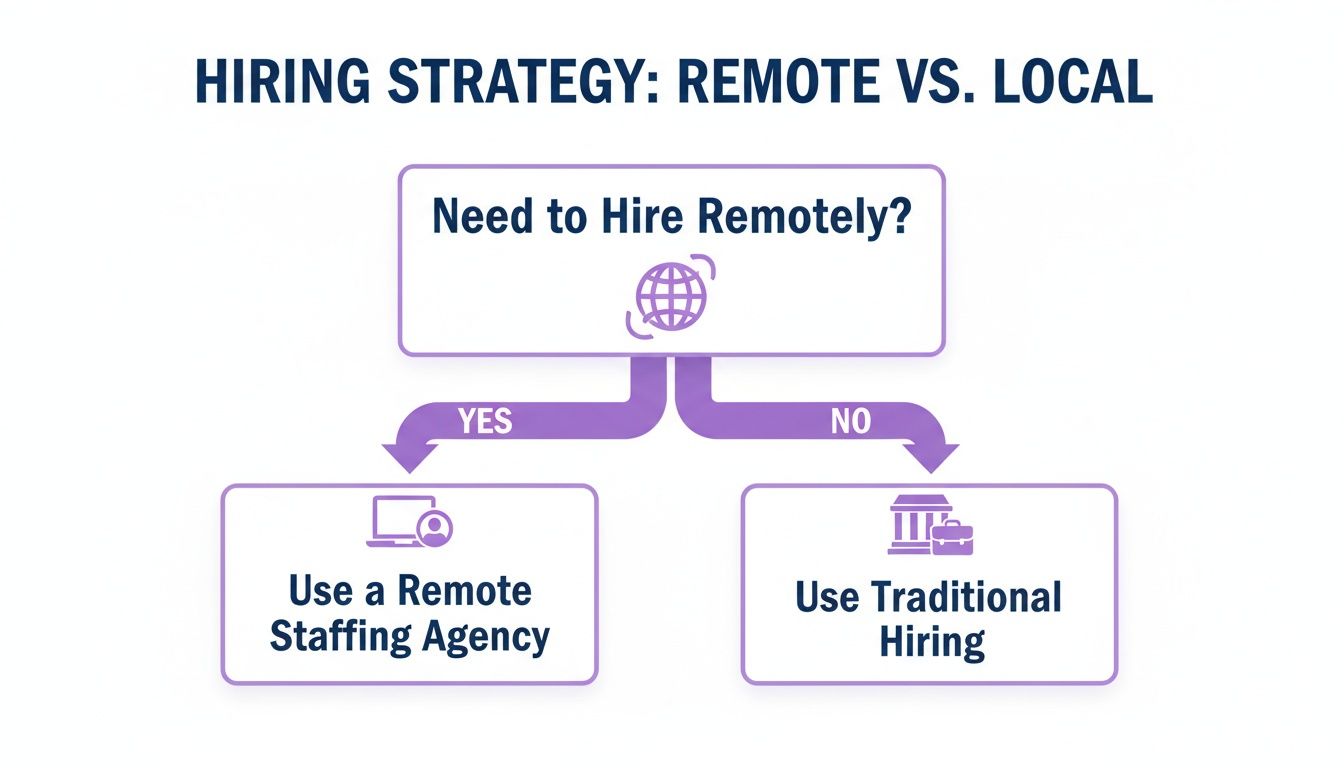
Ultimately, the choice hinges on whether your growth strategy requires tapping into a global talent pool for skills, speed, or cost-efficiency.
This is the Wild West of remote hiring. You find a talented freelancer, agree on a rate, and they get to work. On the surface, it’s fast, flexible, and seems cheap. An agency might help you find the person, but you're the one managing the contract and payments directly.
Sounds great, right? Here’s the catch: you’re walking through a legal minefield blindfolded. Misclassifying an employee as a contractor, even accidentally, can trigger brutal penalties, back taxes, and lawsuits. If you dictate their hours, provide their equipment, and treat them like a full-time employee, you're not hiring a contractor—you're just employing someone illegally.
It’s a massive risk that few startups can afford to take.
This is the most traditional approach, just applied remotely. The agency acts like a classic headhunter: they source, vet, and present candidates, and you hire your favorite one directly onto your company’s payroll. You then pay the agency a hefty one-time placement fee, often 15-30% of the candidate's first-year salary.
This model is fine if you already have legal entities and HR infrastructure set up in your candidate’s country. But for most companies looking to hire their first person in Brazil or Poland? Good luck. You’re now on the hook for figuring out local labor laws, benefits, and payroll taxes. It’s a ton of administrative work that completely defeats the purpose of using an agency for speed and simplicity.
Now for the full-service chauffeur. With the Employer of Record (EOR) model, the agency finds and vets the talent, but they also legally hire them on their own local payroll. The talent works exclusively for you, fully embedded in your team, while the agency handles all the messy stuff: HR, compliance, taxes, and benefits.
The EOR model isn't just a staffing solution; it's a compliance and operations engine. It lets you hire the best person on the planet as if they lived next door, without ever needing to open a foreign subsidiary or decipher a foreign tax code.
This is the safest, fastest, and most scalable way to build a global team. There's no risk of misclassification, and you get a single, predictable monthly invoice. For startups that need to move fast and stay lean, this model is a no-brainer. It combines the talent access of a global recruiting firm with the legal armor of an international HR department.
When comparing different options like staff augmentation versus consulting, the EOR model often provides the clearest path for true team integration. Aligning your hiring choices with your long-term business goals is critical, and understanding these models is a core part of that strategy. To dive deeper, check out these workforce planning best practices for agencies to see how everything fits together.
To make it even clearer, here’s a quick rundown of how these three models stack up against each other. Each has its place, but the differences in risk and operational overhead are significant.
| Model | Best For | Compliance Risk | Speed to Hire | Our Take |
|---|---|---|---|---|
| Contractor | Short-term, project-based tasks with true freelancers. | Very High | Fast | A dangerous game for anything resembling full-time work. The legal risks often outweigh the flexibility. |
| Direct-Hire | Companies with existing legal entities in the target country. | High (for you) | Slow | You take on all the HR and legal burdens. Only makes sense if you're already set up to hire internationally. |
| Employer of Record (EOR) | Building long-term, integrated remote teams without the legal hassle. | Very Low | Very Fast | The gold standard for global hiring. It's fast, safe, and lets you focus on building your product, not your legal team. |
As you can see, while the contractor model offers speed and direct-hire offers a traditional employment structure, the EOR model delivers the best of both worlds—speed and safety—without the administrative nightmare.
So, you’ve signed the contract. The agency promised a pipeline of A-players delivered right to your inbox, finally freeing you up to focus on strategy.
The reality? Well, that can be a different story. Partnering with a remote staffing agency can feel like a high-stakes bet, but once you know what to look for, you can spot the winners from the parasites.
Let’s be brutally honest about what you're walking into. Not all agencies are your strategic partner; some are just glorified resume farms with a slick sales deck. But when you find the right one, it's a genuine game-changer.
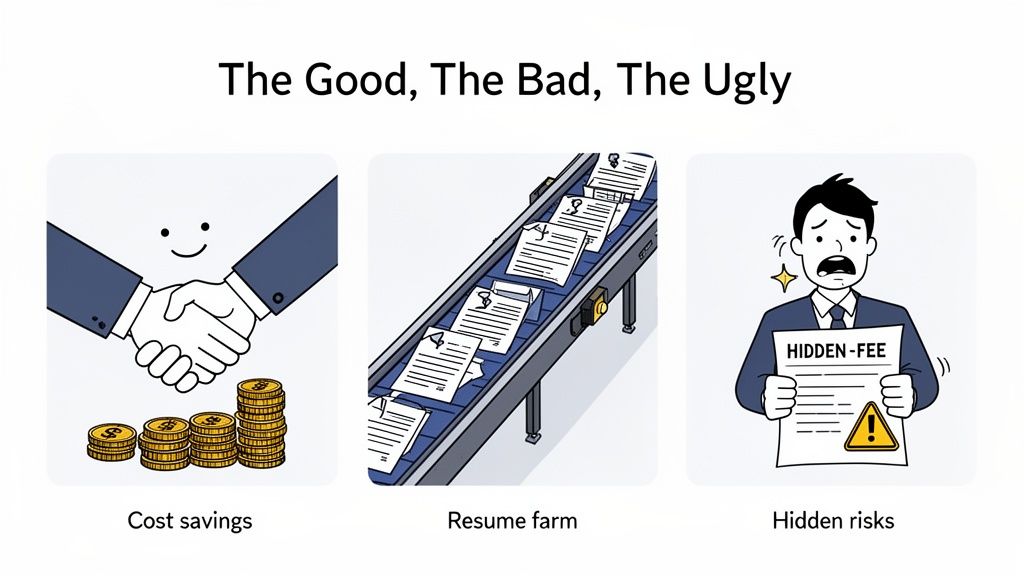
When a partnership clicks, the benefits are huge. We’re not just talking about filling an empty seat.
Radical Cost Savings: The most obvious win is financial. Hiring a senior developer in Latin America can cost 40-70% less than their equivalent in a major U.S. tech hub. This isn’t about finding "cheap" labor; it's about accessing a global market rate for elite skills. You get top-tier talent without having to mortgage the office ping-pong table.
The Global Talent Buffet: Think of your local talent pool as a puddle. The global talent pool is an ocean. A great agency gives you access to specialists you’d never find otherwise—engineers with niche skills, marketers with specific industry experience, you name it.
Sweet Relief from HR Hell: This is the unsung hero of agency partnerships. The right partner handles international payroll, benefits, and compliance. That whole mess of foreign tax forms and labor laws? It’s not your problem anymore. This alone can save your sanity.
Now for the not-so-great part. Many remote staffing agencies talk a big game but completely drop the ball where it counts. I’ve seen them all, and the warning signs are usually obvious if you know where to look.
The biggest offender is the resume black hole. These agencies just forward you a pile of barely-screened CVs, hoping one sticks. Suddenly, you’re back to being a full-time recruiter—the very job you paid them to take off your plate. Their "vetting process" is often little more than a keyword search on LinkedIn.
Then there’s the communication void. You sign up, get a friendly welcome email, and then… crickets. Good luck getting a straight answer on a candidate’s progress or vetting details. It feels less like a partnership and more like shouting into the abyss.
The most dangerous agencies are the ones with a fuzzy compliance strategy. Ask them a direct question about how they handle contractor misclassification or local labor laws. If you get a vague, hand-wavy answer, run.
Some issues go beyond mere annoyance and become outright dealbreakers. These are the landmines that can blow up your budget, your project, and your peace of mind.
First up, hidden fees. The agency quotes you one price, but the final invoice is loaded with "administrative charges," "onboarding fees," or other nonsense. A trustworthy partner is completely transparent with their pricing from day one. No surprises.
Even worse is the classic bait-and-switch. They show you a portfolio of rockstar candidates during the sales process, but once you sign, those people are mysteriously "unavailable." Instead, you get a roster of junior talent who don't come close to your requirements. It’s a cheap tactic used by agencies more focused on closing deals than building relationships.
Ultimately, a good agency feels like an extension of your own team. They're invested in your success, transparent in their process, and solve more problems than they create. A bad one just adds another layer of chaos to your hiring process. Choose wisely.
Alright, let's pull back the curtain for a second. We didn't build LatHire just to add another logo to the remote hiring space. We built it because we were in the trenches with you, getting tired of the same old hiring headaches—the mountains of resumes, the awkward interviews, and the compliance nightmares.
This isn't just a sales pitch. It's an open look at how we decided to fix a system that felt slow, expensive, and fundamentally broken for founders and leaders who need to move fast.
One of the biggest myths in recruiting is that you have to choose between finding someone fast and finding someone good. Most remote staffing agencies either flood your inbox with unvetted resumes or take months to surface a single decent candidate. We knew that was a false choice.
Our platform was engineered from the ground up to deliver both. By blending AI-driven screening with essential human oversight, we can connect you with elite, pre-vetted candidates in as little as 24 hours.
So, how does it work?
Why did we go all-in on Latin America? Simple: time-zone alignment and an incredible, often-overlooked talent pool. We decided to go deep in one strategic region instead of being a mile wide and an inch deep everywhere else.
This sharp focus allows us to build and maintain a curated network of over 800,000 professionals. These aren't just technically brilliant people; they're culturally aligned with North American companies, making collaboration feel seamless—like they’re right down the hall, but without the San Francisco price tag.
We handle everything. Think of us as your all-in-one HR, payroll, and compliance department for Latin America. From managing international payments to navigating local labor laws, we’ve got it covered.
This bundled approach is quickly becoming the new normal. Recent data shows that 78% of companies are now hiring internationally, with more than half using global payroll services to manage their teams. When your team is spread across different countries, having one partner to handle the entire administrative stack isn't just a convenience—it's a massive competitive edge.
Our goal is simple: make global hiring so easy it feels like you’re hiring someone from your own city. This approach has helped our partners slash their hiring costs by up to 80% and cut their time-to-hire by over 80%.
That isn't just a small improvement; it’s a complete shift in how you build a team. You get access to world-class talent, you get it faster than your competitors, and you get it at a fraction of the cost.
Of course, finding great talent is only the first step. The real win comes from successfully integrating and keeping them for the long haul. That requires a solid grasp of the best practices for managing remote teams. A great agency partner doesn’t just find people; they set you up for long-term success. This is our playbook in action—a model built for quality, speed, and your sanity.
Okay, enough theory. Let's get down to the practical steps of finding a great remote staffing partner. You now know what separates the real deals from the resume farms, but knowing is different from doing. This is your no-nonsense guide for picking an agency that won't burn your time or your budget.
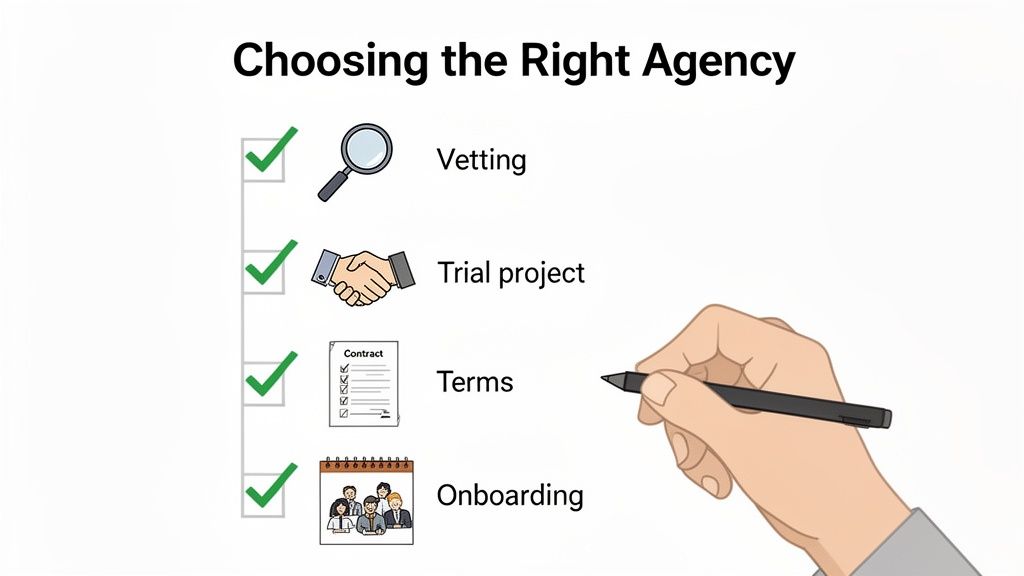
Think of this as a pre-flight checklist. A few smart questions and a clear process now will save you a world of turbulence later. Don't just take their sales pitch at face value; you need to run them through your own evaluation.
Before you even think about scheduling a call, get brutally honest about what you're looking for. "We need a developer" isn't a plan; it's a wish. A good partner can work wonders, but they can't read your mind.
Drill down into the details. What are the absolute must-have technical skills versus the nice-to-haves? What's the minimum time zone overlap you can live with? And what’s your actual, real-world budget? The clearer you are, the faster they can find your perfect match.
Your first call with a potential agency tells you almost everything you need to know. This isn't just a friendly chat—it’s an interview. You’re testing their competence, transparency, and whether they’re just trying to push resumes.
The $500 Hello
Here are the critical questions to ask:
If an agency can't give you crisp, confident answers to these questions, consider it a massive red flag. It likely means they’re more focused on their sales commission than your long-term success.
Once you have a shortlist of a couple of agencies, it’s time to see what they've got. Ask to review profiles of candidates who fit your criteria. Look for detailed summaries that offer more than a copy-pasted resume; a great partner provides context on why a candidate is a strong fit.
But the ultimate test? A paid trial project.
This is the single best way to de-risk a hire. Bring your top candidate on for a small project lasting one to two weeks. It gives you a real-world preview of their skills, communication, and work ethic before you make a long-term commitment. Any agency worth its salt will fully support this.
Finding the right person is only half the battle. The agency's support during onboarding is just as critical. A top-tier partner doesn’t just give you a name and disappear; they should help with contracts, initial setup, and ensuring a smooth transition into your team.
On your end, have a clear plan to integrate your new remote team member. Treat them like part of the core team from day one—add them to your main Slack channels, invite them to all-hands meetings, and assign them an in-house buddy to show them the ropes.
Choosing a partner is a major business decision. For more context, you can explore detailed comparisons and reviews of the best remote recruiting companies to see how different models and specializations stack up. This playbook gives you a roadmap to make a confident, informed decision and build a global team that delivers from day one.
Alright, let's tackle the questions that are probably already on your mind. No fluff here—just straight answers from someone who's spent years in this space.
Pricing is all over the map, so you really need to pay attention to the details. Some agencies will hit you with a hefty one-time placement fee, often 15-30% of the candidate's first-year salary. For a senior engineer, that’s a painful check to write.
Others, particularly those using an Employer of Record model, work on a markup system. They simply add a percentage on top of the talent's monthly salary, which covers all their services—payroll, benefits, compliance, the works. Be very skeptical of any agency that isn't completely transparent about their pricing. A true partner will give you a simple, all-inclusive monthly rate so you're not ambushed by "administrative fees" down the road.
Think of it like this: a traditional staffing agency is your talent scout, while an Employer of Record (EOR) is your legal HR department in another country.
The best modern remote staffing agencies have smartly bundled EOR services right into their offering. A standalone EOR won't find you talent; they just handle the legal and HR paperwork for someone you’ve already found. A full-service agency does both: they source, vet, and then employ the talent on your behalf through their own EOR infrastructure. Honestly, going with the bundled approach is almost always the simpler, saner choice for most companies.
This is where you separate the pros from the amateurs. Traditional hiring can drag on for months—a death sentence for any fast-moving company.
A top-tier remote staffing agency should be presenting you with vetted, qualified candidates in a matter of days, not weeks. The entire process, from sending them a job description to getting a signed offer, can often be wrapped up in just one to two weeks.
Some of the very best agencies, the ones with curated and pre-vetted talent pools, can get a shortlist of candidates in your inbox in as little as 24 hours. When you compare that to the typical two- to three-month grind of direct hiring, it’s not even a fair fight. This speed is one of the single biggest reasons founders turn to agencies in the first place—it's a massive competitive advantage.

