
So, what exactly are quality of hire metrics? Let’s cut the HR jargon. They're the report card on your hiring. They tell you whether that brilliant hire who aced the interview is actually delivering, or if you just got suckered by a great storyteller. It's about measuring the real, long-term value someone brings—think job performance, retention, and whether their manager secretly wants to fire them.
This isn’t just about ticking boxes; it's about separating the wins from the expensive mistakes.
We’ve all been there. A key role is empty, the team is drowning, and you just need a warm body in that seat. Yesterday. You hire someone who looks solid on paper—maybe they even nailed the interview—and you finally breathe a sigh of relief.
Fast forward six months. You're now dealing with missed deadlines, team drama, and that sinking feeling you made a massive, expensive mistake. Congrats, your new full-time job is micromanaging and putting out fires.
This isn't just a headache; it's a silent killer for your bottom line. And I'm not just talking about the wasted salary. The real damage is the invisible stuff that doesn't show up on a spreadsheet:
This is where quality of hire metrics stop being a fluffy buzzword and start being your best defense against hiring blunders that cost you way more than just a salary.
Turns out there’s more than one way to burn cash without mortgaging your office ping-pong table. The industry knows this is a problem, even if everyone's struggling to fix it. While a staggering 89% of talent pros agree that measuring quality of hire is critical, a measly 25% feel they can actually do it well.
This gap has huge financial consequences. Companies can spend up to 200% of an executive’s salary to replace a bad hire. That’s a massive, preventable expense that should make any founder's eye twitch.
The cost of a bad hire is never just their salary. It's the projects they derail, the customers they alienate, and the A-players who leave because they’re tired of carrying the dead weight.
To stop the bleeding, you have to start at the source. Crafting an effective revenue operations job description that clearly defines expectations is the first step. This upfront clarity helps you avoid the costly cycle of bad hires and high turnover. For more on this, check out our guide on how to reduce employee turnover.
Your recruiter just dropped a 15-day time-to-fill on you. Great. But did they hire a rockstar or just the first person who could fog a mirror?
Relying on speed metrics alone is like judging a restaurant by how fast the food arrives, not how it tastes. It's a recipe for disappointment. When your entire recruiting strategy is built around speed and cost, you're not hiring talent; you're just filling requisitions. This transactional mindset actively encourages bad decisions.
Think about it. If the only goal is to lower the cost-per-hire, the incentive is to rush the process, skip thorough vetting, and make a quick offer. Hope you enjoy spending your afternoons fact-checking resumes and running damage control—because that’s now your full-time job.
Too often, the shiny numbers your team brags about are just vanity metrics. They look good in a report but tell you absolutely nothing about the long-term impact on your business. It's time to look deeper.
| Metric Type | Example Metric | What It Measures | Potential Pitfall |
|---|---|---|---|
| Vanity Metric | Time-to-Fill | How fast you hired someone. | Encourages rushing, leading to poor-fit hires who leave quickly. |
| Value Metric | 90-Day Retention | How many new hires are still with you and performing well after three months. | Reveals if the hiring process is identifying candidates who actually fit the role and culture. |
| Vanity Metric | Cost-per-Hire | How cheaply you filled the role. | Pushes for corner-cutting and devalues thorough, quality-focused screening. |
| Value Metric | Manager Satisfaction | How happy the hiring manager is with their new team member's performance. | Directly links hiring outcomes to team productivity and business goals. |
| Vanity Metric | Number of Applicants | The size of your candidate pool. | A large pool often just means more unqualified resumes to sift through, not better talent. |
| Value Metric | Time-to-Productivity | How quickly a new hire starts delivering tangible value. | Measures the true ROI of a hire by tracking their ramp-up and impact. |
As the table shows, vanity metrics are easy to track, which is why everyone loves them. But they’re lazy. They measure activity, not impact.
Here’s a quick breakdown of the usual suspects:
Moving past them requires a shift from filling seats to strategically building a high-performance team. Improving your process can also help you reduce time to hire without sacrificing the quality of your candidates.
Focusing on time-to-fill is like trying to win a marathon by sprinting the first 100 meters. You’ll look great for a moment, right before you completely flame out.
Quality of hire is now widely seen as the most critical hiring metric because it connects directly to business outcomes like productivity and innovation. As companies wise up, they're realizing that balancing speed with quality is non-negotiable, often using smarter tools to manage both without cutting corners. You can learn more about 2025 talent acquisition trends on zrgpartners.com.
This is where quality of hire metrics become your North Star, guiding you toward hires who don’t just fill a role but elevate your entire organization.
Alright, let's cut through the noise. You don't need a data science degree to measure what matters. In fact, overcomplicating it is exactly where most companies go wrong. They get lost in a dozen spreadsheets, tracking everything and understanding nothing. It's all noise, no signal.
I’ve been there, and I’ve learned the hard way. There are only four foundational quality of hire metrics you really need. Think of them as the four legs of a table—if one is missing, your whole hiring strategy wobbles.
This is the pivot. From vanity metrics to value.
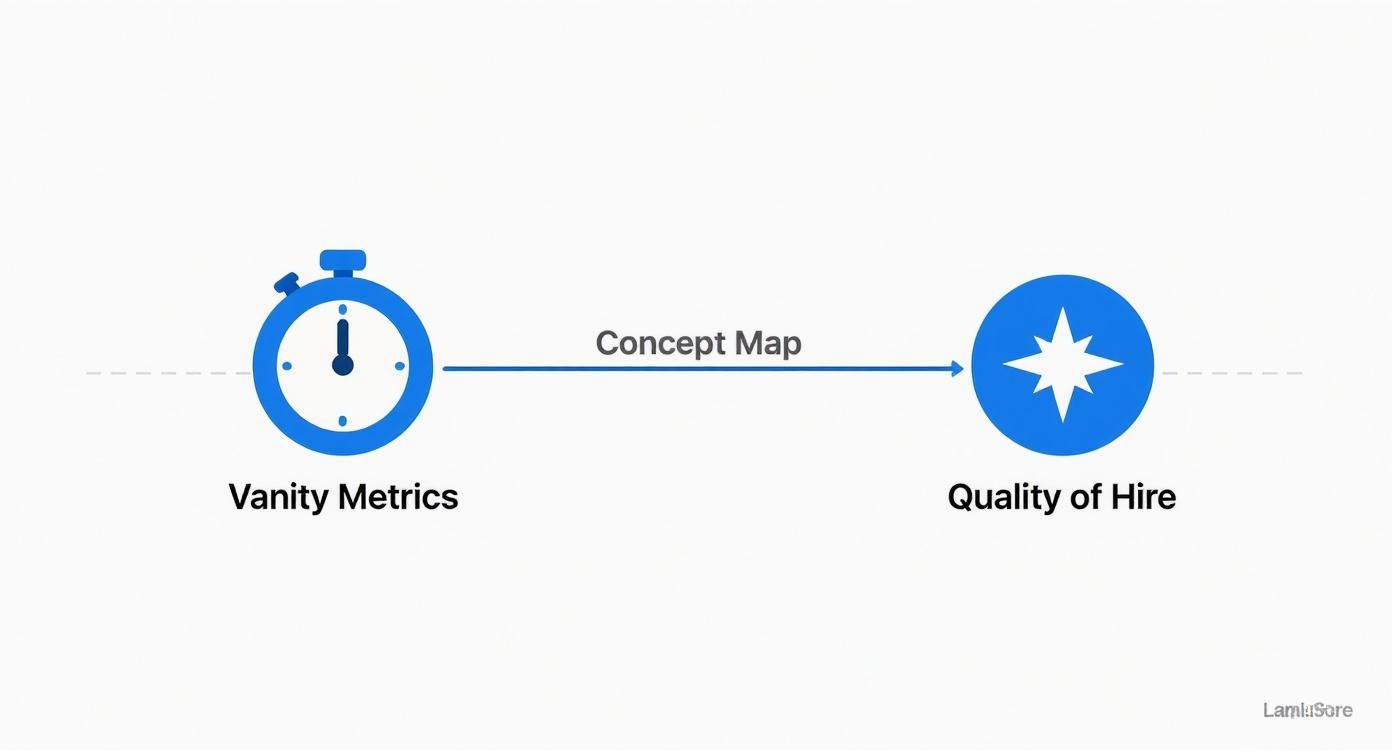
True hiring success isn’t about how fast you fill a seat. It's about the value that person brings over the long haul.
To help you get started, here's a simple scorecard that breaks down what to track, how to track it, and why it's so important.
| Metric | Formula or How to Measure | Why It Matters | Data Source |
|---|---|---|---|
| New Hire Performance | Average performance review scores for new hires after 6-12 months. | Directly links hiring activity to business output. Are you hiring people who move the needle? | HRIS, Performance Management System |
| Time to Productivity | The time it takes a new hire to reach full productivity, often defined by specific role-based milestones. | Measures the efficiency of onboarding and the new hire's ability to adapt and contribute. | Manager Feedback, Project Management Tools |
| Manager Satisfaction | Pulse surveys sent to hiring managers at 30, 60, and 90 days. Ask, "Would you hire them again?" | A leading indicator of team fit, performance, and alignment with expectations. | Survey Tools (e.g., Google Forms, SurveyMonkey) |
| First-Year Retention | Percentage of new hires who remain with the company after 12 months. | The ultimate test. High turnover is a huge red flag for your hiring or onboarding process. | HRIS/Payroll System |
This scorecard gives you a clear, actionable framework. Let's dig a little deeper into each of these four pillars.
This is the big one. Did the person you hired actually do the job well? We can’t just rely on a manager's gut feeling during the annual review.
To measure this, you need objective data. Look at performance review scores, sales quota attainment, or project completion rates after the employee has had about 6-12 months to settle in. This metric directly connects your recruiting efforts to business results. High performers drive growth, while low performers drain resources. It’s that simple.
A great hire is fantastic. But a great hire who starts delivering real value in two weeks instead of six months? That's a complete game-changer. This "ramp-up time" is a direct measure of your hiring and onboarding ROI.
Time to productivity isn’t just an HR metric; it’s a cash flow metric. The faster someone contributes, the faster you see a return on their salary.
One of the best ways to shorten this critical window is to verify skills before an offer is ever made. Using tools for pre-employment skills testing helps you hire candidates who can hit the ground running from day one, not just talk a good game in the interview.
Let’s be honest: if the hiring manager isn’t happy, nobody is happy. Their feedback is the ultimate litmus test for a new hire’s team fit, performance, and overall impact.
The best way to capture this is with simple pulse surveys sent to the manager at 30, 60, and 90 days. Just ask them to rate the new hire on a scale of 1-10 and include one killer question: "Knowing what you know now, would you hire this person again?" An unhappy manager is a canary in the coal mine, signaling misaligned expectations or a hidden performance gap.
Did your star hire stick around, or did they jump ship after nine months for a 5% raise and better snacks? High turnover among new hires is a massive red flag. It practically screams that something is broken in your hiring or onboarding process.
This one is simple to track: what percentage of new hires are still with your company after one year? If that number is disappointingly low, it’s a sign that your "quality" hires weren't so high-quality after all.
Let's be brutally honest. Data buried in a spreadsheet no one ever looks at is useless. It's digital clutter. The magic happens when you make that data visible, intuitive, and—most importantly—actionable.
This is where your Quality of Hire dashboard comes in. Forget those overly complex, multi-tabbed monstrosities that require a business intelligence degree to operate. We're talking about a simple, single source of truth that tells you a story about your hiring effectiveness at a glance.
A dashboard like this visualizes key metrics like manager satisfaction and performance ratings, making it easy to spot trends without digging through raw data. The goal is to immediately see what's working and what's broken.
A dashboard is only as good as the decisions it drives. So, who gets a login? It's not just for the C-suite. Your dashboard should be accessible to the stakeholders who can actually use the information to make a difference.
A great dashboard doesn't just present data; it provokes questions. Why is the engineering team's ramp-up time twice as long as sales? Why do hires from Recruiter X consistently outperform everyone else?
This is where the real insights live.
So, how do you turn numbers into a narrative? You segment them. Slicing your data is how you uncover the powerful patterns that lead to smarter hiring.
Start by filtering your quality of hire metrics by:
Building a dashboard doesn't have to be a massive project. When you're just starting, using effective workflow automation strategies can significantly improve data accuracy and collection efficiency without needing a dedicated team. This isn't about creating more reports; it's about building one that drives action.
This is it. The moment you go from being a solid Head of People to an indispensable strategic partner. Because let's be real—reporting on retention is important, but reporting on revenue is what gets you a permanent seat at the table.
How do you prove that better hiring is actually fueling the bottom line? You have to connect the dots. The data from your quality of hire dashboard is your ammunition, but now you need to aim it squarely at the KPIs the rest of the business lives and breathes.
It’s time to stop talking like an HR leader and start talking like a business leader. This means shifting the entire conversation from inputs to outcomes. Frankly, nobody in the C-suite gets excited about "time-to-fill." They get excited about gaining market share.
Instead of saying this:
Try this:
Or, ditch this:
And go with this:
See the difference? One is a tactical update. The other is a strategic win.
Your job isn’t just to hire people. It’s to acquire the talent that drives the business forward. Frame every single hiring win in the language of business impact—revenue, speed, and customer satisfaction.
When you walk into that executive meeting, you can't just have data; you need a story. The long-term impact of quality of hire is massive, touching everything from retention to pure, unadulterated growth. For instance, performance-focused companies are a staggering 4.2 times more likely to financially outperform their competitors and see 30% higher revenue growth. You can discover more insights about quality of hire on mandfconsultants.com.
Use your metrics to build a narrative that clicks with each leader in the room.
This isn’t about bragging (okay, maybe a little… toot, toot!). It’s about proving that the people team isn’t a cost center. It’s the engine room of the entire company, and your quality of hire metrics are the receipts. Investing in talent isn't an expense—it's the ultimate growth lever.
So you’ve decided to start tracking quality of hire. Fantastic. Now, welcome to the part where good intentions smash head-on into the messy reality of human behavior and bad data. It’s a minefield out there, and trust me, I’ve stepped on nearly every single one.
Implementing these metrics isn't a "set it and forget it" task. The road to hellish data is paved with well-meaning spreadsheets. Let’s talk about where it all goes wrong, so you can sidestep the traps that turned my early efforts into a dumpster fire of useless numbers.
First up is the classic "measure everything" approach. You get excited and decide to track 50 different metrics, from performance scores to how many times a new hire smiles at the coffee machine. Before you know it, you’re drowning in data but have zero actual insights.
It’s a rookie mistake. More data doesn't automatically mean better decisions; often, it just means more noise. You end up spending all your time collecting information instead of actually acting on it.
Your goal isn't to build the world's most comprehensive hiring database. It's to find the 2-3 signals that consistently predict long-term success at your company and ignore the rest.
Focus on the vital few we covered earlier. Anything else is just a distraction that will slow you down.
Here’s a fun one. You build a beautiful system, create slick surveys, and set up automated reminders for hiring managers to give feedback. Their response? Crickets. They’re "too busy" fighting fires—some of which were probably started by the last person they hastily hired.
You can't force buy-in, but you can make it incredibly easy for them to participate.
Getting their feedback is non-negotiable. Without it, your quality of hire metrics are just a shot in the dark.
Alright, let's wrap this up with a quick-fire round. These are the questions I get asked all the time, so I’ll keep the answers short, sharp, and to the point. No fluff, just the stuff you need to know to get back to building your team.
You don't need a fancy BI tool or a team of data analysts. What you need is a spreadsheet and the discipline to use it.
Start dead simple. Fire up a Google Sheet and track just one metric: first-year retention. Next, add a column for hiring manager satisfaction, which you can gather with a free Google Forms survey. Ninety days after the hire, ask them one simple question: "On a scale of 1-10, how likely are you to hire this person again?"
That’s it. You now have a basic, free system that’s already more insightful than what 90% of companies are doing.
Don't overdo it. Measuring QoH daily is pointless; the data needs time to mature before it tells you anything useful. A quarterly review is the perfect cadence.
This rhythm gives you enough time to see real trends emerge—like whether that new sourcing strategy is actually bringing in people who stick around—without letting bad habits fossilize into your process. Treat it like a proper business review for your talent engine.
Ah, the classic "good vibes" metric. Manager feedback is crucial, but it can be a total mess. One manager’s "rockstar" is another’s "meets expectations."
The key is to anchor their subjective feelings to objective, business-focused questions. Don't just ask, "How are they doing?" Get specific and tie their feedback to tangible outcomes:
This approach forces managers to think beyond personality and focus on actual performance. It’s how you turn a gut feeling into a data point you can actually act on.

