
Treating every hire like its own mini-project isn't just a neat idea—it's the only sane way to operate. Project management in recruitment means every role has a clear start, a finish line, a budget, and a non-negotiable definition of "good." Forget the chaotic scramble. It's time for a structured, predictable system that actually delivers.
Let's be brutally honest. Does your hiring process feel more like a series of panicked Slack messages and crossed fingers than a well-oiled machine? You post a job, pray to the algorithm gods, and then get buried in a mountain of resumes that look like they were written for a completely different company.
This reactive mess isn't just stressful—it's a slow, expensive leak in your company's hull. When you treat recruitment like a random list of chores, you get dropped balls, candidates who ghost you for a reason, and new hires you start regretting three months in.
Every disorganized hiring cycle is a tax on your best people. It’s the engineering lead pulled out of a critical sprint for another pointless interview. It's that phenomenal candidate who vanishes because your follow-up took a week too long. And it’s you, hoping to spend your afternoons fact-checking resumes—because that’s now your full-time job.
This isn't sustainable. It’s a fast track to burnout and a team full of B-players. Turns out there’s more than one way to hire elite talent without mortgaging your office ping-pong table.
The core problem is a stunning lack of ownership. When no one truly owns the project, everyone assumes someone else is handling it. That’s how great candidates end up in an application black hole, never to be seen again.
This is where battle-tested project management principles come in to save the day. The demand for these skills is exploding for a reason. The Project Management Institute (PMI) projects a need for 30 million new project managers by 2035. That’s a giant blinking sign that critical business functions—like, you guessed it, hiring—can't afford to wing it anymore. You can explore more about project management trends and see for yourself why this is non-negotiable.
Time to diagnose the chaos and build a hiring system that doesn't make you want to scream into a pillow.
Ready to trade chaos for clarity? Good. Let's build a blueprint that turns the hiring scramble into a predictable, repeatable project. This isn’t theory; it’s a practical plan to get you from “we need someone” to their first day without losing your mind.
The goal is to create a system so consistent it’s almost boring. Think of it as an IKEA guide for building a world-class hiring process—all the essential parts are included, just without the confusing diagrams and leftover screws.
Most broken hiring processes follow a familiar, painful arc: they start with chaos, quickly rack up massive costs, and end in deep, deep regret.
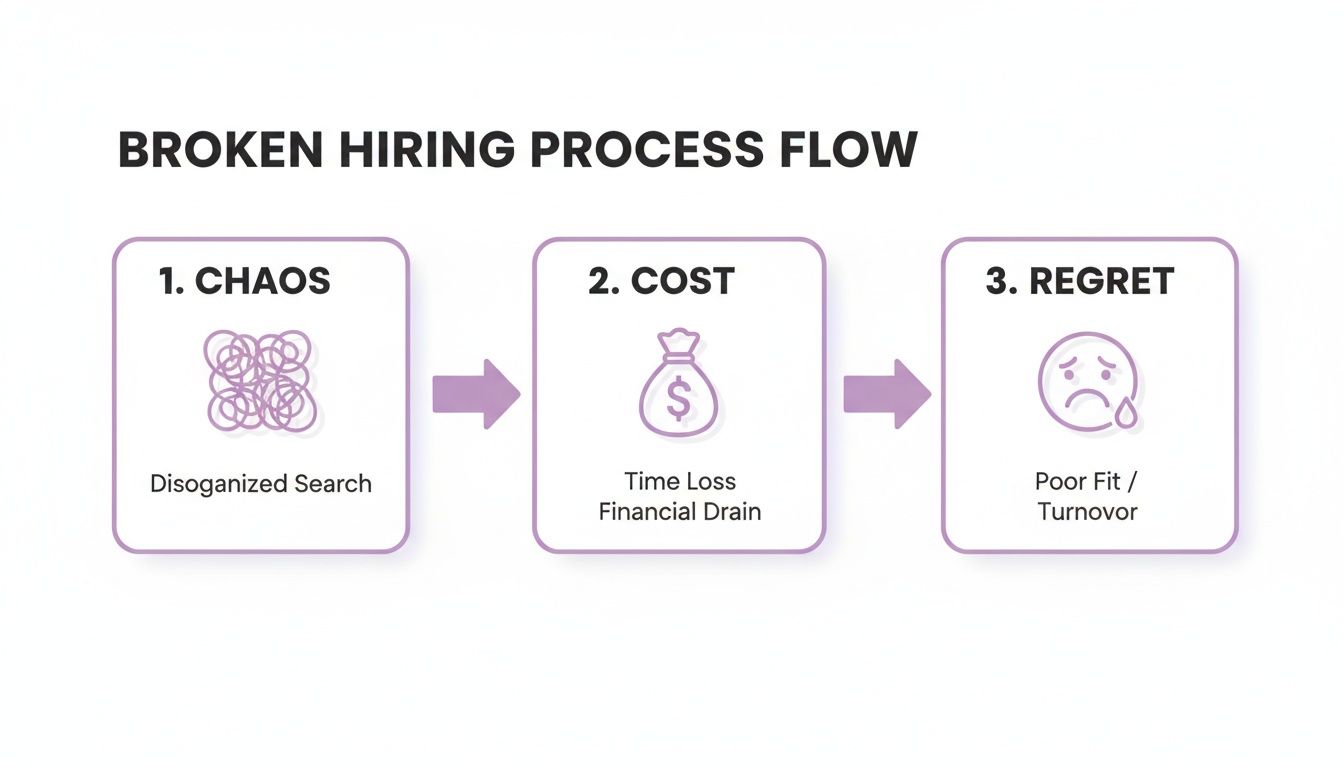
This cycle doesn't just waste time; it actively poisons team morale and craters your bottom line. The only way out is to break the madness down into clear, sequential stages.
To give you a bird's-eye view, here’s how a structured recruitment project flows. Each stage has a clear purpose and a set of tasks that stop things from going completely off the rails.
| Project Stage | Key Objective | Critical Tasks |
|---|---|---|
| 1. Planning & Kickoff | Define the role, timeline, and responsibilities so everyone is on the same page. | – Host a kickoff meeting with the hiring team. – Finalize the job description and scorecard. – Agree on the salary band and interview panel. |
| 2. Sourcing & Attraction | Build a strong pipeline of qualified people who are actually interested. | – Post the job on relevant platforms. – Conduct proactive outreach on LinkedIn, etc. – Engage with your existing talent pool and referrals. |
| 3. Screening & Shortlisting | Efficiently filter the noise to find the top contenders. | – Review applications against the must-haves. – Conduct punchy initial phone screens. – Present a shortlist of the top 10-15% of candidates. Period. |
| 4. Interviewing & Assessment | Objectively evaluate skills, experience, and whether they're a good human. | – Conduct structured, competency-based interviews. – Administer technical or practical assessments. – Gather feedback using a scorecard (no "gut feelings" allowed). |
| 5. Offer & Closing | Secure the best candidate with a competitive, fast offer. | – Verbally extend the offer and discuss the details. – Send the formal written offer letter. – Manage negotiations and background checks without delay. |
| 6. Onboarding | Integrate the new hire smoothly so they don't quit in 90 days. | – Prepare equipment, accounts, and a first-week plan. – Schedule intros with key team members. – Set clear 30-60-90 day goals. |
Treating each phase as a distinct milestone forces accountability and makes the process transparent. No more secrets.
Every single hire, from a junior marketer to a senior engineer, moves through these six phases. Skipping a step is like trying to build that IKEA bookshelf without instructions—it’s going to collapse.
This is where you define reality. Get stakeholders in a room and agree on the role, the must-haves, the salary, and who is responsible for what. Nailing this prevents 90% of downstream headaches. Seriously.
Hope is not a strategy. Don't just post a job and pray. Proactively find talent where they live online—LinkedIn, GitHub, niche communities. This is about building a pipeline, not just waiting for one to magically appear.
Your goal is ruthless efficiency. Use smart criteria to filter out the noise and identify the top 10-15% of applicants who are actually worth your team's time. Never waste a hiring manager's afternoon on a "maybe."
Structure is your best friend. A critical part of any sane workflow is knowing how to conduct effective interviews that actually tell you something useful. Use scorecards and standardized questions to compare candidates apples-to-apples, not based on who you'd rather have a beer with.
You found your person—now don't blow it. This stage is about clear communication and moving fast. A great candidate won't wait a week while your team debates an extra vacation day.
The project isn't over when they sign. A structured onboarding ensures your new hire succeeds from day one, cutting down ramp-up time and preventing that dreaded three-month buyer's remorse.
By treating each of these phases as a distinct project milestone, you create checkpoints for quality. It forces accountability. For a deeper dive, check out our guide on streamlining your recruitment process. It’s the perfect next step.
Ever had two people interview the same candidate but nobody followed up? Or a hiring manager and a recruiter giving totally conflicting feedback, leaving a rockstar candidate confused and annoyed? That’s what happens when nobody truly owns their part of the process.
It’s a slow-motion train wreck. And it’s time to end it with a simple tool project managers have used for decades: the RACI matrix.
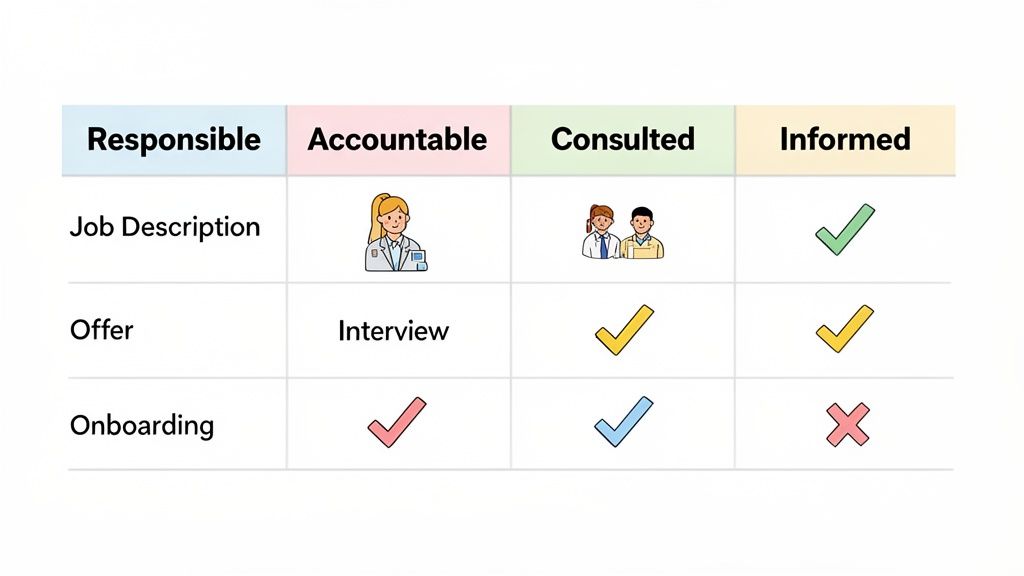
I know, it sounds painfully corporate. But stick with me. This little grid is your secret weapon against the dreaded "I thought you were doing that" excuse.
The acronym stands for Responsible, Accountable, Consulted, and Informed. Think of it as a cheat sheet for who does what, who calls the shots, and who just needs the cliff notes.
Here’s the breakdown in plain English:
Laying this out before you even post a job forces a critical conversation. Who really has the final say on the hire? Who is actually going to chase down interview feedback?
Defining these roles upfront isn't micromanagement; it's clarity. It kills bottlenecks and stops great candidates from slipping through the cracks because everyone was waiting for someone else to make a move.
By mapping this out, you get a single source of truth for every hiring project. No more guessing games, no more dropped balls. It's a fundamental step in treating project management in recruitment as a core business function, not an afterthought.
If you can't measure it, you can't improve it. "Hiring faster" isn't a goal; it's a wish. It's time to get brutally honest about the numbers that matter, not the vanity metrics that look pretty in a slide deck.
Gut-feel hiring is how you end up with a team full of people who are great at interviews but terrible at their jobs. The whole point of applying project management principles is to build a predictable system, and that requires cold, hard data.
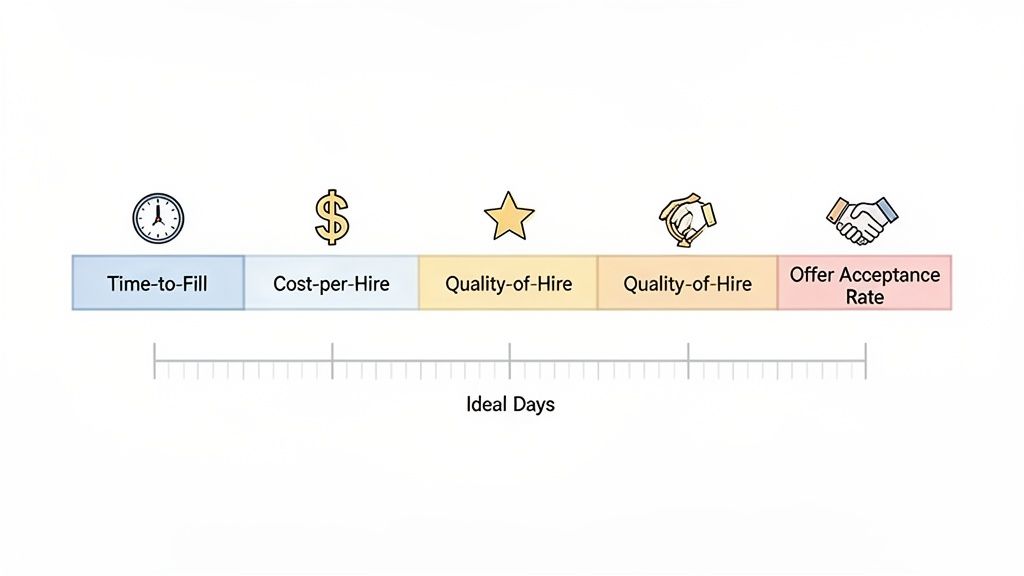
This isn’t about creating rigid, soul-crushing deadlines. It's about setting clear expectations, finding where your process breaks, and using data to make intelligent fixes.
Forget tracking total applicants. Who cares if you get 500 applications if 499 are unqualified? That’s a sign of a broken sourcing strategy, not a successful one.
Instead, obsess over these four numbers:
This kind of measurement is a survival skill. The World Economic Forum shows project managers are juggling more complex projects than ever—just like running multiple hiring pipelines at once. Dive deeper into the latest project management statistics to see just how critical these metrics have become.
So, what does a good timeline look like? For a standard professional role, aiming for a 30-45 day Time-to-Fill is a strong, achievable goal.
Don’t just track these numbers; act on them. If your Time-to-Fill is lagging, find out why. Is one department taking weeks to give feedback? Are your offers getting rejected? The numbers always tell you where to look.
Here’s a sample breakdown that keeps things moving:
Of course, this isn't set in stone. But without a baseline, that "urgent" hire will still be an empty desk three months from now. And nobody has time for that.
The market is flooded with shiny HR tech promising to solve all your problems. Spoiler: most of them are expensive distractions that create more work than they save. Let's cut through the noise.
The goal isn't to buy more software. It’s to build a lean, integrated system that automates the mind-numbing stuff so you can focus on talking to great people. You need a few core tools that play nicely together, not a dozen subscriptions and a data-entry nightmare.
If you’re still managing candidates in a spreadsheet, we need to have a serious talk. A solid Applicant Tracking System (ATS) is the non-negotiable central nervous system of your hiring operation. It’s where everything lives. Without one, you’re flying blind.
Beyond the ATS, you need two other workhorses:
When picking tools, think about clean data. Exploring the best online form builders can be a game-changer for standardizing applications and internal feedback, making your process cleaner from the start.
Steer clear of the "all-in-one" behemoth platforms that claim to do everything from payroll to performance reviews. They often do everything poorly. You’ll pay a fortune for features you never use while wrestling with a clunky interface that slows everyone down.
The best tech stack isn't the one with the most features; it's the one your team will actually use. Simplicity and integration beat complexity every single time. It's about finding tools that amplify your process, not replace it.
And please, don't get bogged down in tools that require a PhD to operate. If it takes a week of training just to post a job, you’ve chosen wrong. The right tech should feel intuitive. This philosophy extends to how you evaluate candidates; for a look at effective software, see our breakdown of top candidate assessment tools.
So, you’ve mapped out your project plan, set your KPIs, and picked your tech. Now for the grind: where do you actually find the right people without pulling your hair out?
This is where, if you'll indulge us for a moment, we get to toot our own horn. (Toot, toot!)
Applying project management is smart, but even the world's best process falls flat without a pipeline of quality candidates. You could spend your afternoons buried in sourcing and running initial screens—and make it your new full-time job. Or, you could just skip that whole mess.
We took this same project management mindset and applied it to the most painful part of hiring: sourcing. We've already pre-vetted over 800,000 professionals across Latin America, so you don't have to start from scratch every single time. We’re not saying we’re perfect. Just more accurate more often.
When a new role opens up, you're not just throwing a job description into the void. You're tapping directly into a curated, verified talent pool that’s ready to go. Think of it as letting someone else run the most time-consuming phase of the project for you.
Our platform handles the entire cross-border hiring project. Here’s how:
This approach is a game-changer for scaling teams. You get all the benefits of a global workforce without the operational drag. It’s like having an entire international HR department on speed dial.
This is all powered by a structure known as an Employer of Record (EOR). If you're new to the concept, learn all about what an Employer of Record is and how it works in our guide. It’s the engine behind seamless global hiring.
Got questions? We have direct, no-fluff answers. Let's get right to it.
Forget the corporate jargon. Project management in recruitment is just treating every hire like a self-contained project. It has a clear goal (hire an amazing person), a budget (cost-per-hire), a deadline (time-to-fill), and a team responsible for making it happen.
Instead of a chaotic scramble, you get a structured, repeatable process. You know who’s doing what, when it needs to be done, and what success looks like. It’s that simple.
Don't try to overhaul everything at once. The single most powerful first step is to run a proper kickoff meeting for your next open role. Get the hiring manager, recruiter, and one key team member in a room for 30 minutes.
Lock down three things:
Getting alignment on these three points from the start prevents 90% of the confusion that derails most hiring.
You'll feel it, but the numbers will prove it. Track two metrics obsessively:
If both of those numbers are trending in the right direction, you're winning. It means you’re moving faster and closing the candidates you actually want.

