

So, you're thinking about outsourcing custom software development. Let me guess: you're either drowning in feature requests your in-house team can't handle, or you just saw a salary quote for a local senior developer that made you question your life choices.
Welcome to the club. The good news? Turns out there’s more than one way to hire elite developers without mortgaging your office ping-pong table.
This isn't another bland, corporate guide. This is your gut-check moment. We're skipping the fluff and diving straight into the "why now?" and "is this actually for me?" questions that keep founders up at night.
Let's be honest. The idea of outsourcing probably popped into your head somewhere between your third coffee of the day and the gut-wrenching realization that your in-house team is completely swamped. Or maybe you just saw a salary quote for a local senior developer that made you question all your life choices.
The good news? You're not alone. And there's a much smarter way to build great software than auctioning off the office ping-pong table for another hire.
This is your gut-check moment before you take the plunge. We're going to skip the corporate fluff and get right to the "why now?" and "is this actually for me?" questions that really matter.
I've worked with hundreds of companies making this exact move, and it almost always boils down to one of three critical pain points. If you find yourself nodding along to any of these, it’s probably time to seriously consider outsourcing.
I’ve learned this the hard way: trying to force your existing team to learn a new, complex tech stack under immense pressure is a recipe for burnout and mediocre code. It's almost always faster, cheaper, and better to bring in a specialist who has already mastered it.
Outsourcing isn't a silver bullet for every problem. If your company's core intellectual property is a deeply complex, proprietary algorithm that only a handful of people on Earth truly understand, you'll probably want to keep that team close to home.
But for most product development, a hybrid approach works wonders.
Think about it this way: your in-house team members are the architects. They own the vision, the core product strategy, and the long-term roadmap. Your outsourced partners are the elite specialists—the master carpenters, electricians, and plumbers you bring in to execute specific parts of the blueprint with precision and speed.
It’s about augmentation, not replacement.
So, you’ve decided to take the leap. Now for the tricky part: figuring out how you’re going to work with outside talent. Picking the right model for outsourcing your software development can feel like a minefield. You've got freelancers, agencies, and dedicated teams all vying for your attention.
Which one is right for you? Here’s a hint: it’s almost never the cheapest one. This single decision will have massive downstream effects on your budget, your timeline, and, frankly, your sanity.
Let's cut through the noise and break down the practical pros and cons of each model from a founder's perspective, because theory doesn't ship products.
The first question you should ask is a simple one: is your in-house team completely swamped? This decision tree gets right to the point.
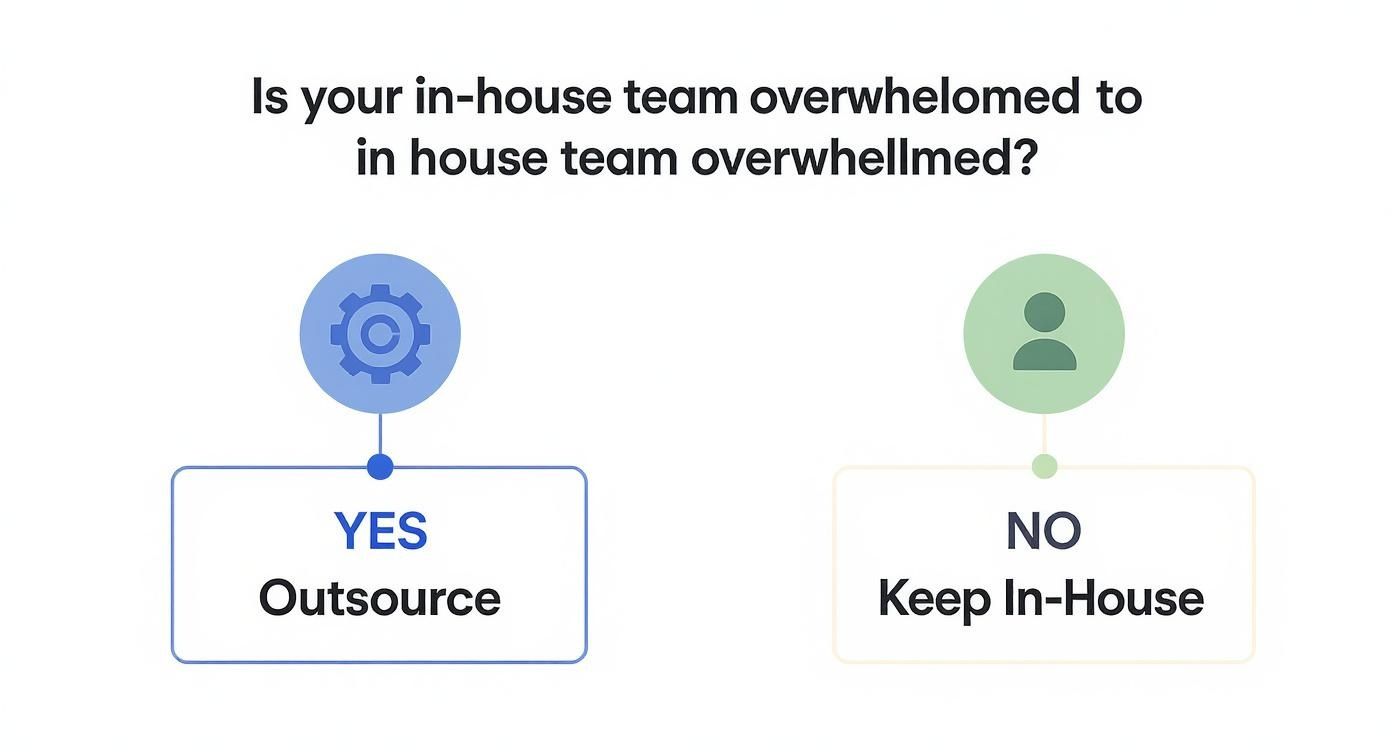
This prompt cuts to the heart of the matter. Outsourcing is a strategic move to fix capacity issues or skill gaps—not just a race to the bottom on cost.
Think of freelancers as hired guns. You have a specific, well-defined task—maybe building a landing page, squashing a nasty bug, or spinning up a quick prototype. You just need a specialist to come in, get it done, and get out.
They’re perfect for short-term gigs where you can provide a crystal-clear brief and don’t need deep, daily integration with your core team. The upside is speed and often a lower cost for these isolated tasks.
The downside? You’re managing an individual, not a team. If they get sick, take a better offer, or just disappear, your project grinds to a halt. It’s a model built on transience, which is a big risk for anything mission-critical.
Next up is the classic agency or vendor model. You hand them a project, a timeline, and a fat check. They disappear into their “black box” and, hopefully, come back with a finished product.
This approach can work well when you have a project with an iron-clad scope and minimal expected changes. You're essentially buying a predictable outcome for a fixed price.
But you often sacrifice control and visibility. Communication gets filtered through a project manager, and you might never speak directly to the developers writing your code. And heaven help you if you need to pivot mid-project; the change orders and contract renegotiations can be absolutely brutal.
It’s a trade-off. You offload the management headache, but you also offload direct influence. If you're building the core of your future empire, do you really want it built inside a black box you can't see into?
This is my preferred model for any serious, long-term product development. A dedicated team is a hand-picked group of developers who work exclusively on your project. They are, for all intents and purposes, an extension of your in-house team.
They’ll be in your daily stand-ups, active in your Slack channels, and will become deeply familiar with your codebase and business goals. This model gives you the high-touch collaboration of an in-house team combined with the flexibility and cost advantages of outsourcing.
Here’s why it works so well:
Of course, this model requires more of your own management time than just handing off a project to an agency. But if you're building something that truly matters, that's time well spent.
To make this even clearer, here's a head-to-head comparison of the three main models. I've focused on the factors that actually matter to founders and managers when making this call.
| Model | Best For | Typical Cost Structure | Level of Control | Red Flag to Watch For |
|---|---|---|---|---|
| Freelancer | Small, well-defined, one-off tasks (e.g., bug fix, prototype) | Hourly or fixed-price per task | High on task, low on long-term direction | Disappearing acts or juggling too many clients |
| Agency | Projects with a fixed, unchanging scope (e.g., marketing site) | Fixed-price for the entire project | Low; you manage the outcome, not the process | Vague contracts and exorbitant fees for change requests |
| Dedicated Team | Core product development and long-term, complex projects | Monthly retainer per team member | High; they function as direct reports | Lack of true integration; being treated like "outsiders" |
Ultimately, the choice depends on your project's complexity and strategic importance. For tactical, short-term needs, freelancers are great. For predictable, scoped-out work, an agency might fit. But for building your core product, a dedicated team is almost always the right long-term investment.
The rise of nearshoring, especially with the incredible talent pool in Latin America, makes the dedicated team model even more compelling. Our deep dive into offshore vs. nearshore development explains exactly why time-zone alignment is a game-changer for this approach. When you're weighing your options, exploring things like Fractional CTO services can also provide that high-level technical leadership you need without the full-time overhead.
Alright, let's get into the hardest part of outsourcing custom software development. It’s not the contracts or the project management tools—it’s finding the actual humans who can build great things without driving you crazy.
Hope you enjoy spending your afternoons fact-checking resumes and running technical interviews—because if you use most platforms, that’s now your full-time job. Kidding. Sort of. Most talent marketplaces are just noisy, glorified resume databases. You post a job, and within hours, you're buried under a mountain of applications that all look suspiciously similar.
This isn't about finding just a coder. It's about finding a partner who gets your vision, challenges your assumptions, and writes clean, scalable code. This is where we need to get tactical.

Your first line of defense against the noise is a killer project brief. A vague, one-paragraph request for a "React developer" is an open invitation for chaos. A great brief, on the other hand, acts as a filter, attracting serious players and making the unqualified self-select out.
Forget the corporate job description template. Instead, structure your brief like you’re explaining the project to a smart friend.
A well-crafted brief saves you dozens of hours in clarification calls. It tells top-tier professionals you respect their time and know what you're doing.
Once the proposals start rolling in, the real work begins. I’ve refined my vetting process over the years to move beyond the resume and assess the things that actually predict success on a remote team. It's less about their listed skills and more about their demonstrated abilities.
Here’s my three-part filter:
The goal isn't to find a perfect developer. It's to find a resilient problem-solver you can trust. Resumes are marketing documents; real-world tests reveal character and competence.
For years, the default for outsourcing was to look to Eastern Europe or Asia. But that model is broken for fast-moving teams that need real-time collaboration. The time zone difference is a productivity killer, turning every quick question into a 24-hour waiting game.
This is why I’m a huge advocate for nearshoring to Latin America. You get access to an elite pool of talent operating in the same time zones as the U.S. and Canada. This isn't just a minor convenience; it's a fundamental shift in how you work.
The demand for these skills is exploding. In fact, 76% of executives report outsourcing at least part of their IT functions as the worldwide custom software development market barrels toward $126 billion by 2026. Discover more insights about this growing global demand on 10pearls.com.
Platforms built specifically for this region do the heavy lifting for you. For a deeper look at the nuts and bolts, check out our guide on recruiting for engineers in Latin America, which details how to find and secure top talent. It’s about building one cohesive team, not managing distant contractors.
Alright, let’s talk about the part everyone loves to ignore until something catches fire: Contracts. Legal stuff. The boring-but-absolutely-critical documents that stand between you and a world of pain when outsourcing software development.
A handshake deal over Zoom and a shared sense of optimism won't cut it when your intellectual property is on the line. I’ve seen friendly partnerships turn into legal nightmares over a simple misunderstanding about who owns the code. Don't let that be you.
Getting this right isn't about mistrust; it’s about creating clarity so everyone can focus on building, not bickering.
You don't need to become an international legal scholar overnight, but you do need to understand the big three documents that will govern your relationship. Think of them as a three-legged stool—if one is weak, the whole thing collapses.
This structure is smart because it saves you from renegotiating your entire legal relationship every time you start a new feature. You just sign a new, much simpler SOW.
Skimming these documents is a rookie mistake. A few poorly worded sentences can cost you your entire company. While your lawyer should have the final say, here are the clauses I personally check with a fine-toothed comb before signing anything.
The moment you transfer ownership of your code to a third party, even unintentionally, you've lost. Your IP is the most valuable asset you have. Protect it like a dragon guards its gold.
First and foremost is IP Ownership. Your contract must state, in no uncertain terms, that you own 100% of the intellectual property created for you, period. This includes source code, designs, documentation—everything. Make sure the agreement includes a clause where the vendor "assigns" all rights to you upon payment.
Next, focus on the Termination Clause. What happens if things go south? Your agreement needs a clear exit ramp. It should define the notice period required to end the contract and, crucially, what happens to the work-in-progress and final payments. Without this, you can get trapped in a bad partnership.
Don't forget Dispute Resolution. If you’re in the US and your team is in Brazil, whose laws apply? This clause specifies the jurisdiction (e.g., "State of Delaware, USA") where any legal disagreements will be settled. It’s a simple detail that can save you a fortune in international legal fees.
Finally, remember that the internet has borders, especially legal ones. If you handle user data, you need to think about compliance from day one.
Your outsourcing partner should have experience working within these frameworks. Ask them directly about their familiarity with the regulations that apply to your industry. Their location matters, as some countries have stronger data protection laws than others, which can be a hidden benefit. This isn't just a box-ticking exercise; it's about protecting your users and your business from massive fines.
You did it. The contracts are signed, the first invoice is paid, and the slightly awkward "welcome to the team" Zoom call is in the rearview mirror. So, what's next?
If your game plan is to just lob tickets over a digital wall and hope for the best, let me save you some trouble: it won't work. Treating your outsourced team like a faceless, ticket-crunching machine is the fastest way to get mediocre, uninspired code. True collaboration isn't just a buzzword; it's the secret sauce that separates game-changing products from buggy, forgettable messes.
Here's my personal playbook for running a high-performing distributed team. The goal is to build one cohesive unit, not an "us vs. them" dynamic that poisons productivity from the start.

Your onboarding process sets the tone for the entire relationship. Firing off a generic welcome email with a link to the code repository is a massive missed opportunity. You need to immerse your new team members in the mission, not just the codebase.
My rule is simple: over-communicate the "why." Before they write a single line of code, your new developers must understand:
A developer who understands the user's pain is infinitely more valuable than one who only understands the technical requirements. They'll make better architectural decisions and spot edge cases you missed. Invest in context, not just credentials.
Next up, you need a rhythm. Chaos thrives in ambiguity. A predictable communication cadence builds trust and keeps everyone rowing in the same direction, which is absolutely critical when outsourcing custom software development.
Forget about endless, soul-crushing meetings. The key is a smart blend of synchronous and asynchronous communication. Here’s what works for me:
Speaking of tools, don't overcomplicate things. You don't need a dozen different subscriptions to make this work. You just need a core stack that everyone lives and breathes in. A solid project management board, a reliable video conferencing tool, and a central chat app are the foundation. Our guide to the best remote collaboration tools breaks down the top options for keeping your distributed team in sync.
When you're managing an outsourced custom software development team, picking the right time tracking software specifically for developers can make a huge difference in project visibility. Just make sure you find a tool that integrates smoothly with your project management system to avoid creating extra admin work for everyone.
"But how do I ensure code quality when I can't look over their shoulder?" I get this question all the time. The answer is simple: you build a system of quality, not a system of surveillance.
Micromanaging pull requests is a colossal waste of your time and an insult to their professionalism. Instead, implement a framework that makes quality the path of least resistance.
This systematic approach is incredibly powerful. In fact, hybrid teams that mix in-house and outsourced developers often see a 37% boost in delivery speed, launching MVPs up to seven weeks faster than teams that keep everything in-house. This kind of efficiency drops the average time to ship a first release to just 12 weeks. You can find more data on how outsourcing impacts development speed by visiting DesignRush.
Alright, let's wrap this up with a quick-fire round. I get asked these same questions all the time by founders who are on the fence about outsourcing custom software development. No fluff, just straight answers based on years of doing this—and seeing where it goes wrong.
Think of this as the final gut check before you pull the trigger.
This is always the first question, and for good reason. The honest answer? It depends. I know, I know—not helpful. But anyone giving you a flat number without knowing your project scope is selling you snake oil.
Your costs are driven by three main factors:
The smart move is to budget for outcomes, not just hours. A cheaper hourly rate from a slow, junior developer will end up costing you more than a higher rate from a senior engineer who ships clean code twice as fast.
This one keeps founders up at night. The short answer is yes, if you do your homework. Your IP is only as safe as your contracts. As we covered, a rock-solid MSA and SOW that explicitly state you own 100% of the code and all related IP is non-negotiable.
Don't just sign a template. Have a lawyer—your lawyer—review it.
Your code is your company's crown jewel. A few hundred dollars on a legal review is the cheapest insurance policy you'll ever buy. Don't be the founder who learns this lesson the hard way.
Work with reputable partners who have a track record of serving international clients. They understand the stakes and have processes in place to protect your assets. A fly-by-night operation might be cheaper, but you’re gambling with your entire business.
Nope. In fact, it can be the opposite. This is a common myth rooted in old-school management thinking that equates physical presence with productivity. Quality isn't determined by geography; it's determined by talent, systems, and communication.
Outsourcing gives you access to a global talent pool. This means you’re not limited to the best developer within a 30-mile radius of your office. You can hire the best developer for the job, period.
The key is to implement the quality assurance systems we talked about earlier: mandatory code reviews, robust automated testing, and crystal-clear acceptance criteria. These practices enforce quality regardless of where your team is located.
The global IT outsourcing market is set to hit around $618 billion by 2025 for a reason. Companies that get it right can see a return on investment between 150% and 230%, driven by faster development and higher-quality code. Furthermore, 63% of businesses outsource to slash internal complexity, letting them focus on their core mission. Discover more insights on outsourcing ROI and market trends at Arnia.com.

