

Let's be blunt. The phrase "offshore software development company" probably conjures up two conflicting images: glorious, budget-saving fantasies and soul-crushing, 3 AM project-implosion nightmares.
You've heard the horror stories. I’ve lived some of them. But you’ve also seen the unicorns—the companies that cracked the code and built killer products with a global team.
The difference? It’s not luck. It’s knowing what to look for and, more importantly, what to run from.
You've got a brilliant product idea, a budget that makes you sweat, and a local talent pool that’s either priced into the stratosphere or completely barren.
Sound familiar? Welcome to the club.
For years, the playbook was simple: either raise a king's ransom in venture capital or start mortgaging your office ping-pong table to afford a couple of decent local engineers.
But this isn’t 2005. “Offshore” is no longer a dirty word whispered in boardrooms. It’s a strategic weapon for founders who are smart enough to realize the best talent doesn't always live within a 20-mile radius of their office. It’s how you get a lethal competitive edge.
The market has gone from a niche tactic to a multi-billion-dollar juggernaut. We're talking an industry valued at around $178.7 billion in 2025, with projections screaming toward $413 billion by 2033. This explosion is fueled by U.S. companies staring down the barrel of chronic talent shortages—over a million unfilled software jobs in critical fields like AI and cybersecurity.
The proof is in the pudding: a mind-boggling 92% of Fortune 2000 companies now use offshore strategies to slash costs by 40-70% and ship products 30% faster.
This isn't about finding cheap code monkeys anymore. It's about finding the right talent, period. The kind of specialized expertise in machine learning or cloud architecture that's basically a mythical creature in most local markets.
The real shift is in mindset. We've moved from viewing offshore as a cost-cutting tactic to seeing it as a talent acquisition strategy. You’re not just outsourcing tasks; you’re insourcing expertise.
This mirrors what’s happening everywhere in business. To understand the broader strategic advantages of delegating specialized business functions, you might also consider the benefits of HR outsourcing. It’s all part of the same playbook: focus on your genius, and bring in experts to handle the rest.
The challenge, of course, is navigating this minefield without, well, getting blown up. You need a partner, not a vendor. A team that feels like an extension of your own, not a faceless support ticket on the other side of the world. This guide is your map. We're skipping the generic fluff and getting straight to what actually works.
Let's get the obvious out of the way. Everyone leads with cost savings because, well, the numbers are intoxicating. The headline practically writes itself: hire an offshore software development company and watch your burn rate plummet.
But if you think this is just about hunting down the cheapest hourly rate on the planet, you’re setting yourself up for a world of pain. I've seen founders chase a $15/hour rate only to spend $50/hour worth of their own time managing the resulting dumpster fire. The real win isn’t just about saving money; it’s about investing smarter.
The sticker price of an offshore developer is tempting, no doubt. But the true financial picture is much bigger. On average, a smart offshore strategy can deliver 40-70% cost reductions compared to hiring locally.
This isn't just about salaries. You're also dodging the crippling overhead of recruitment fees, benefits, and office space. Some of the more streamlined platforms can even help you cut hiring expenses by up to 80%.
This financial breathing room is a game-changer. It means you can:
To see just how stark the difference is, let's look at the fully-loaded costs of hiring a senior developer. This isn't just salary; it includes the often-overlooked expenses that really add up.
| Cost Factor | Onshore (US) | Offshore (Latin America) | Offshore (Asia) |
|---|---|---|---|
| Annual Salary | $150,000 | $70,000 | $55,000 |
| Benefits (Insurance, 401k) | $30,000 (20%) | $10,500 (15%) | $8,250 (15%) |
| Payroll Taxes & Overhead | $22,500 (15%) | $14,000 (20%) | $11,000 (20%) |
| Recruitment Fees | $37,500 (25%) | $14,000 (20%) | $11,000 (20%) |
| Total First-Year Cost | $240,000 | $108,500 | $85,250 |
Disclaimer: Figures are estimates and can vary based on role, location, and specific platform fees.
The numbers don't lie. The total investment for a single U.S. developer can fund an entire team in other regions, fundamentally changing what’s possible for your business.
Of course, there's a catch. Choose the wrong partner, and those savings evaporate faster than your Series A funding. The "hidden tax" comes in many forms: endless rework from misunderstood requirements, deadlines that whoosh by, and the soul-crushing drag of managing a team that just doesn't get it.
This is where you need to be pragmatic. It's not just offshore vs. onshore; it's about finding the right balance of cost, talent, and collaboration. Many North American companies are finding a sweet spot in Latin America, a prime example of nearshoring that offers significant savings without the brutal time-zone differences. To dive deeper, check out our guide on the strategic differences between offshore and nearshore models.
The market's upward trajectory shows that, despite the risks, companies are figuring out how to make it work. The chart below visualizes the massive growth expected in the offshore development market.
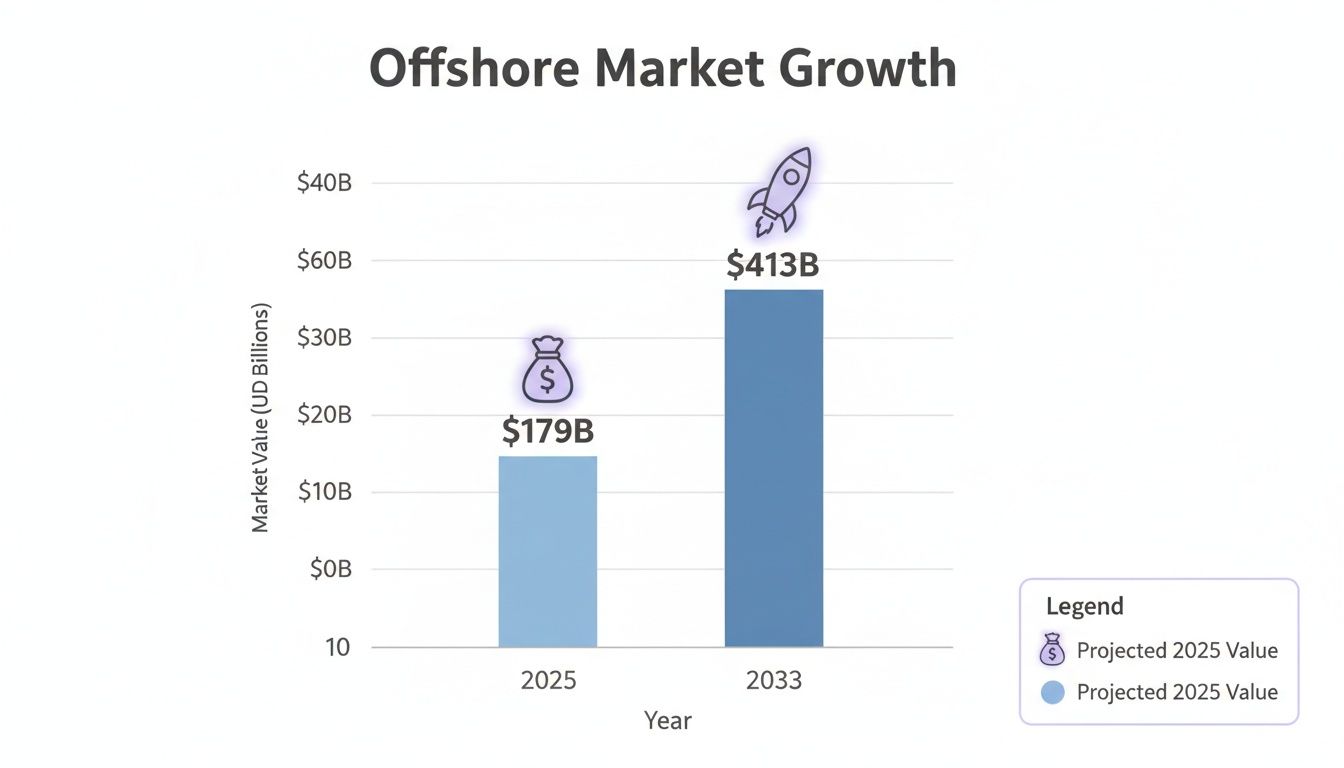
This jump from $179 billion to over $413 billion in under a decade isn't just hype. It's a clear signal that strategic offshoring has become a core business imperative.
The goal isn’t to find the cheapest developer. The goal is to achieve the highest possible output for every dollar you invest in your tech. Sometimes that means paying a little more for a pre-vetted, highly-skilled engineer who just happens to live in a different country.
Ultimately, the economics of hiring an offshore software development company are compelling, but they demand a savvy approach. It’s about shifting from a cost-center mindset to a value-creation one.
Choosing the wrong offshore software development company is a lot like getting into a bad marriage—it's emotionally draining, incredibly expensive, and an absolute nightmare to escape. Think of this section as your pre-nup. I’ve seen the disasters firsthand, and they almost always start with the same subtle, easy-to-miss warning signs.
Let’s be clear: a slick sales pitch and a glossy website mean absolutely nothing. I’ve seen gorgeous proposals from teams that couldn't code their way out of a paper bag. You have to learn to see through the marketing fluff and spot the red flags from that very first conversation.

This is the most common trap out there, and it comes in a few different flavors. The core of the trick is simple: promise the world, get the contract signed, and then swap out the talent, hoping you won't notice until it's too late.
The "A-Team" That Vanishes: During the sales process, you meet their senior architects and lead engineers. They’re brilliant. You’re sold. But the moment the ink is dry, those experts are mysteriously "reassigned to another critical project." You're left with the B-team, or worse, the interns.
The $500 Hello: This one is devious. They'll offer a ridiculously low-priced "discovery phase" or "scoping project." It seems like a no-brainer—a cheap way to test the waters. But its real purpose is to get their hooks into your business. Once they're integrated, the real, much higher costs are revealed, and leaving becomes a massive headache.
The rule of thumb is simple: if the price seems too good to be true, it’s a trap. A great offshore software development company knows its value and prices it accordingly. They’re selling expertise, not just keystrokes.
When you're vetting a partner, you need concrete answers, not corporate jargon. If their responses feel like they were pulled from a marketing brochure, that’s a huge red flag. Ambiguity is the enemy of successful software development.
Pay close attention to how they answer these questions:
This one feels counterintuitive. Shouldn't a good partner be agreeable? Yes, but they should also be willing to push back.
If a potential vendor agrees to every single feature request and an impossible timeline without asking a single clarifying question, they are not your partner. They are a short-term vendor who is terrified of losing the sale. They're telling you what you want to hear, not what you need to know.
A true partner challenges your assumptions. They’ll tell you when your timeline is unrealistic or when a requested feature will create massive technical debt. They act like a CTO, not an order-taker. A team that says "yes" to everything is effectively saying, "We'll figure it out later"—and you'll be the one paying for that discovery process, one missed deadline at a time. This lack of pushback is one of the clearest signs you're dealing with an amateur offshore software development company.
So, you’ve managed to dodge the most obvious red flags. The slick sales team promising you the moon and the suspiciously cheap "A-team" didn’t fool you. Congratulations, you've made it past the first boss level.
Now what?
Hope you enjoy spending your afternoons fact-checking résumés and running technical interviews—because that’s your new full-time job. Or is it? There’s a much smarter way to vet a potential offshore partner that doesn’t involve you moonlighting as a recruiter.
This isn't about running down a generic checklist of questions. This is a framework for stress-testing a potential partner before you sign a single document.
Let's be honest: a résumé is a marketing document, not a sworn affidavit. It tells you what a developer claims they can do, not what they can actually deliver when a deadline is looming. Relying on it alone is like hiring a chef based on a menu they wrote.
The only real test is seeing them in action. This is where pre-employment skills testing becomes non-negotiable. You need to see how they solve real problems, not just hear them talk about theory. Any platform that builds this into its process from the very beginning has a massive advantage, weeding out the 80% of candidates who look great on paper but can't perform.
Stop reading résumés and start reviewing code. A 30-minute live coding challenge will tell you more about a developer's true problem-solving skills than a ten-page CV ever could.
A great partner won’t shy away from this; they’ll welcome the chance to prove their team’s skills. A bad one will make excuses, claiming their developers are "too busy" or that their internal vetting is "good enough." That's your signal to walk away.
Never, ever commit to a six-figure, year-long contract based on a series of pleasant conversations. You need to take the team for a test drive, and the best way to do that is with a small, paid pilot project.
This isn’t a "discovery phase" (remember the '$500 Hello' trap?). This is a real, self-contained piece of work with a clear deliverable at the end.
Your Pilot Project Checklist:
How do they handle ambiguous requirements? What happens when they hit an unexpected snag? Do they communicate proactively, or do you have to chase them down for updates? The answers to these questions are worth far more than the code they produce.
This sounds obvious, but you’d be shocked how many companies skip this step. The salesperson you’ve been talking to for weeks isn't going to be writing your code. The project manager isn’t the one who will be debugging a critical issue at 2 AM.
You must insist on speaking with the actual developers, QA engineers, and designers who will be assigned to your project. Ask them about their workflow, what they enjoy about their job, and how they approach technical challenges. You're looking for genuine passion and engagement, not just someone who can list off acronyms.
Then, you need to take it a step further.
A top-tier firm will have a roster of happy clients ready to vouch for them. If they get defensive or can't provide solid references, consider it a massive red flag.
The truth is, this level of due diligence is practically a full-time job. It’s why platforms that handle this heavy lifting—vetting skills, validating experience, and building a trusted talent pool—offer such an incredible advantage. They’ve already run this gauntlet hundreds of times so you don't have to. You can skip the tedious fact-checking and focus on what really matters: finding the right fit for your team and your culture.
You did it. You survived the vetting gauntlet, signed on the dotted line, and toasted the new partnership. The hard part is over, right?
Wrong. The real work starts now.
Success with an offshore software development company isn't sealed when the contract is signed; it’s forged in the daily grind of integration and management. If you just sit back and hope for the best, you’re essentially lighting your investment on fire. This is where the operational grit comes in—the stuff that separates a high-performing extension of your team from a project that quietly implodes.
First things first: stop using the word "vendor." They are not your vendor. They are your team. The moment you treat them like a faceless ticket-taking machine, you’ve already lost.
A strong culture isn’t built with ping-pong tables or free snacks; it’s built on inclusion and a shared mission. Your new developers in Colombia or Poland should feel just as connected to that mission as the person sitting next to you. This isn’t fluffy HR talk; it’s a pragmatic necessity for getting great work done.
Here’s how to make it real:
Treating your offshore team like second-class citizens is the fastest way to get second-class work. Invest in integration, and they will invest their talent and dedication right back into your product.
“We’ll just use Slack and Zoom” is not a communication strategy. It’s a recipe for chaos, especially across time zones. You need a deliberate, documented plan for how information flows. A minor misalignment on a simple feature can easily cost you a week of development time.
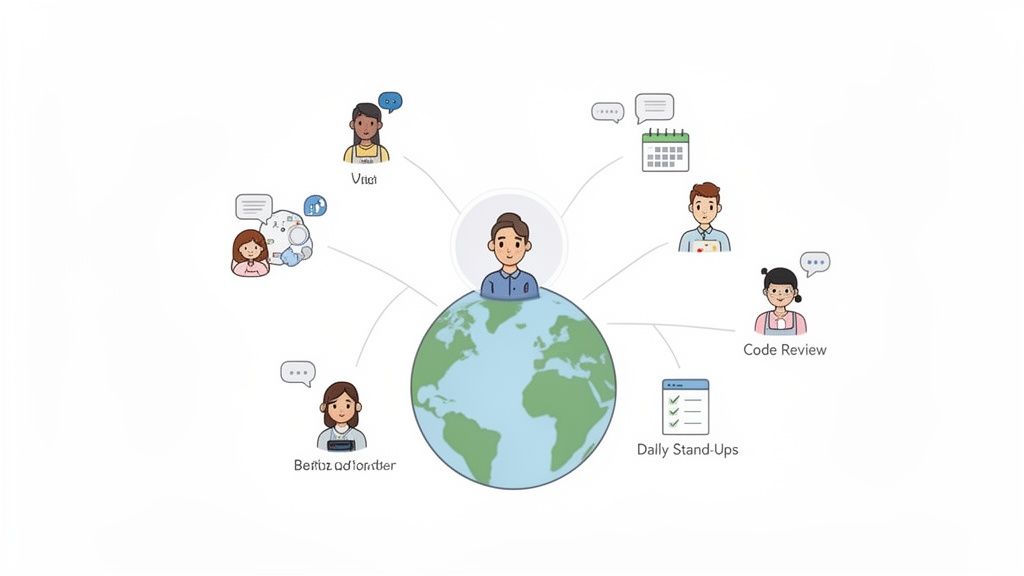
Start by defining your rhythm of communication. This isn't about more meetings; it's about better meetings. For an offshore team, the daily stand-up is sacred ground. Keep it brief (15 minutes max), focused, and ruthlessly consistent. This is your single best tool for spotting roadblocks before they derail an entire sprint.
From there, map out the rest of your communication stack. For more structured ideas, you can check out our deep dive on onboarding remote workers. Every interaction should have a designated channel and a clear purpose.
A Simple Communication Blueprint
| Channel | Purpose | Cadence |
|---|---|---|
| Slack/Teams | Quick questions, real-time sync, and team bonding. | Asynchronous, always-on. |
| Daily Stand-up | Sync on progress, identify blockers. | Daily, same time. |
| Sprint Planning | Define the work for the next cycle. | Every 2 weeks. |
| Jira/Asana | Formal task tracking and status updates. | Source of truth. |
| Formal, external communication only. | Use sparingly internally. |
Don't treat code reviews as just another chore to check off the list. They are one of your most powerful management and mentorship tools. A well-run code review process is what ensures quality, spreads knowledge, and reinforces your core engineering standards.
Set clear expectations from day one. Every pull request needs at least one approval from another developer, preferably from a mix of onshore and offshore team members. This cross-pollination is critical for building a unified engineering culture and preventing knowledge silos from forming.
A good offshore software development company won't just welcome this; they'll insist on it as a best practice for maintaining code health and team cohesion. Your goal should be a single, high standard for code, regardless of who wrote it or where they live.
The old model of offshoring is officially on life support. You know the one: firing off a 100-page spec document, crossing your fingers, and hoping something decent comes back in six months. That’s not a partnership; it’s a lottery ticket, and the odds are never in your favor.
The future isn’t about finding the cheapest vendor anymore. It’s about building a strategic, integrated team that feels like an extension of your own. This fundamental shift is giving rise to two powerful forces: nearshoring and AI-powered hiring.
Let's talk geography for a second. For companies in the US and Canada, the agonizing 12-hour time difference with Asia is a productivity killer. Your workday ends just as theirs begins, turning every simple question into a 24-hour waiting game. It's a logistical nightmare that quickly eats away at any cost savings.
This is exactly why Latin America has emerged as a nearshoring powerhouse. Hiring an offshore software development company in a country like Colombia or Brazil means you get:
Suddenly, you’re not managing a disconnected vendor halfway across the world. You’re collaborating with a team that’s just a few time zones away, making everything faster, more intuitive, and far more efficient.
Now, for the real game-changer: AI-powered hiring platforms. For years, the biggest gamble in offshoring was the vetting process. How do you really know if a developer is as good as their résumé claims? You could either trust the vendor (risky) or spend hundreds of hours interviewing candidates yourself (expensive and slow).
AI completely short-circuits this broken process.
Modern hiring platforms use AI to do the heavy lifting that used to be impossible at scale. They can analyze code, run complex skills assessments, and even evaluate problem-solving approaches before a candidate ever gets to a human interview.
This isn’t science fiction; it’s how smart companies are de-risking the entire hiring process right now. These platforms are completely changing the space by using AI to handle the entire lifecycle:
This is how you build a scalable, global team with confidence. You’re no longer guessing about talent quality; you’re making data-driven decisions. As AI continues to shape the future of hiring, exploring platforms like Parakeet AI can offer a clear window into how these recruitment strategies are evolving. It's about replacing hope with certainty.
We’ve covered a ton of ground, but you probably still have a few questions buzzing in your mind. Let's get right to them.
Easy. Chasing the absolute lowest hourly rate. It’s a classic rookie mistake and the fastest way to light your project on fire.
A $20/hour rate looks fantastic on paper, but it quickly turns into a nightmare of endless rework, constant hand-holding, and code that’s held together by duct tape and blind faith. Paying a bit more for a pre-vetted, highly skilled developer isn't just an expense—it's an investment in getting the job done right the first time. You have to think in terms of total cost and overall value, not just the sticker price.
This is non-negotiable, and any partner worth their salt will take it just as seriously as you do. The fix is actually pretty straightforward: you need a rock-solid legal framework in place from day one.
Your IP protection really comes down to two key documents: a strong Non-Disclosure Agreement (NDA) and a Master Services Agreement (MSA) that makes it crystal clear that your company owns 100% of the IP created.
Reputable partners and modern hiring platforms build these protections right into their process. If a potential company is hesitant about signing an NDA or their contracts are fuzzy on IP ownership, don't just see it as a red flag. See it as a giant, flashing neon sign telling you to walk away. Fast.
That's actually a trick question. Both models have their pitfalls.
Big agencies can throw a lot of people at a problem, but you risk becoming a tiny fish in a massive pond, getting passed off to their B- or C-team. On the flip side, smaller boutique firms give you that personal touch but might not have the specific expertise or the bench strength you need when it's time to scale.
There’s a smarter third option: a modern talent platform. It gives you the flexibility to hand-pick vetted individuals and build your own dream team. You get the scale of a big agency but with the dedicated focus of a boutique. You’re not just buying a service off the shelf; you're assembling a team that's a perfect fit for you.

