

Let's get straight to it. An offshore development team is a group of tech pros you hire in a country far from your own to build your software. Forget the dry, corporate definitions—think of it as expanding your hiring search from your zip code to the entire planet. It’s how you get access to elite talent you couldn't otherwise find or afford in your backyard.
You’ve heard the buzz about going offshore. The wild promises of slashing costs and tapping into a global genius pool. You’ve probably also heard the horror stories—the missed deadlines, the ghosting, the project that went completely off the rails.
So, what's the real story?
It’s not about finding cheap labor. Let me repeat that: it is not about finding cheap labor. That’s a rookie mistake that almost always ends in a dumpster fire. The real goal is to build a genuine extension of your in-house crew, just located a few time zones away. It's a strategic play for speed, skill, and financial sanity.
The fact is, the global talent market is exploding. The offshore software development market hit $122 billion in 2024 and is projected to soar to $283 billion by 2031. North America is the biggest player, commanding over 38.5% of that market. This isn't some fringe trend anymore; it's how modern companies get built.
Sure, the cost savings are a huge draw. But if that’s your only motivation, you’re missing the bigger picture. The real magic happens when you combine that financial leverage with access to a deeper, more diverse talent pool.
Turns out there’s more than one way to hire elite developers without mortgaging your office ping-pong table. Many companies turn to offshore teams as a strategic response to market demands, especially when facing hurdles like the IT skills gap and the outsourcing imperative. It's not just about filling a seat; it's about finding the right person for that seat, right now.
Here’s why savvy founders are increasingly looking abroad:
This decision tree gives a quick visual on when each hiring model—onshore, nearshore, or offshore—makes the most sense based on your core needs.
The flowchart makes it clear: offshore is the go-to option when maximizing your budget and tapping into a global talent pool are your top priorities, especially for projects that don't require constant, minute-by-minute hand-holding.
Let’s have an honest conversation. The number one reason founders even whisper the words “offshore development” is money. Everyone dangles the carrot of saving 70-80%, and look, the math can be incredibly seductive.
But the sticker price of a developer is just the beginning of the story. If you think you're just swapping a $150/hour US developer for a $40/hour one and pocketing the difference, you’re in for a rude awakening. That’s spreadsheet math, not reality.
Hidden costs are lurking everywhere, ready to eat your lunch. Think currency conversion fees, international wire charges, and the productivity drain from managing a team on the other side of the planet. It's a financial minefield if you walk in blind.
The allure of low hourly rates is powerful, I get it. Cost savings are the crown jewel of going offshore. In Latin America, hubs like Argentina offer stellar talent for $30-$55 per hour, while some parts of Asia range from $21-$60. When you compare that to US rates pushing $72-$150, the appeal is obvious—you can potentially slash development expenses by 65-80%.
With the global developer pool expected to hit 28.7 million by 2024, access to elite, affordable talent has never been greater. Find out more about the surprising economics of global development rates.
But that hourly rate is just one line item on a much longer, scarier invoice.
The cheapest developer is often the most expensive one you'll ever hire. Rework, miscommunication, and missed deadlines cost far more than a higher hourly rate ever will.
Smart founders don't look at the hourly rate; they calculate the Total Cost of Ownership (TCO). This means factoring in every single expense associated with your offshore team, both direct and indirect.
TCO forces you to look beyond the salary and consider the operational realities of a global team. It’s the difference between a pleasant surprise and your CFO having a heart attack six months down the line.
Here’s a quick look at what the concept of TCO covers, which is essential for understanding the true financial picture.
This framework shows that TCO includes not just the purchase price but also all the costs incurred during the asset's life—exactly how you should view your offshore team.
So, what sneaks into the TCO of an offshore developer?
Failing to account for these factors is how a “great deal” turns into a budgetary nightmare. To sidestep these common pitfalls, it's wise to explore strategies for how to reduce software development costs without sacrificing quality.
Ultimately, the goal isn't to find the cheapest offshore team. It's to find the one that delivers the best value—the optimal balance of skill, speed, and total cost. That requires looking past the hourly rate and embracing the full financial picture.
So, you're sold on the idea. Awesome. Hope you enjoy spending your afternoons fact-checking resumes and running technical interviews—because that’s now your full-time job.
Unless, of course, you have a better plan.
This is your roadmap for sourcing, vetting, and hiring top-tier remote talent without burning out. The goal isn’t just to find a developer; it’s about finding the right one for your team.
First thing's first—where do you even start looking? The internet is flooded with options, and trust me, they are not all created equal. I’ve been down these roads, and most of them are dead ends.
Here’s my unfiltered breakdown:
A slick résumé and a polished GitHub profile can be incredibly misleading. I’ve been burned by developers who looked perfect on paper but couldn't solve a practical problem to save their lives. You absolutely must test for real-world skills, not just credentials.
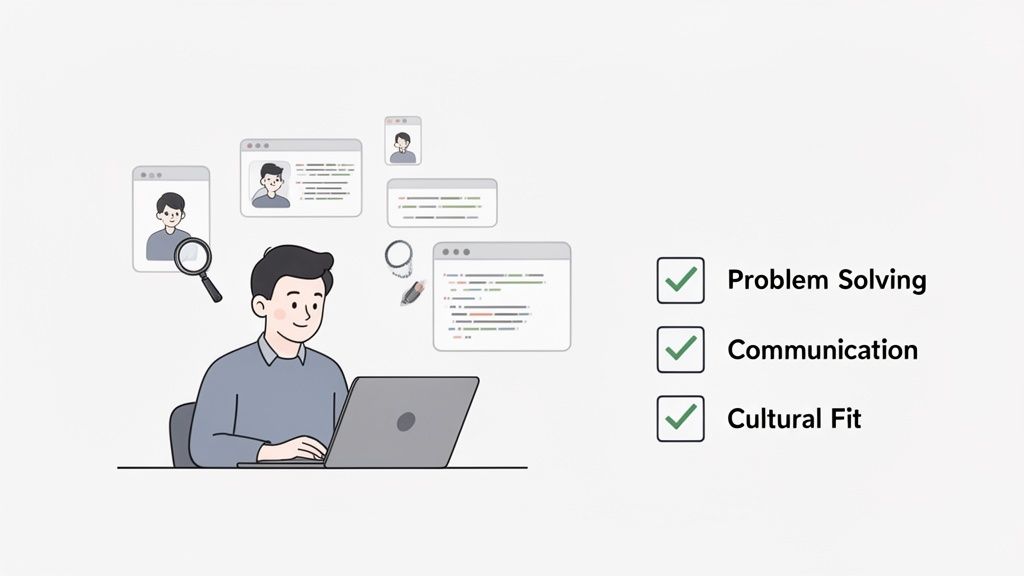
Your vetting process should be ruthless and zero in on three key areas:
The biggest red flag isn't a missing skill—that can be taught. It’s a lack of curiosity and a passive attitude. You can't teach someone to care.
To really nail this down, it’s worth understanding the details of effective pre-employment skills testing to make sure you’re evaluating what truly matters.
The standard technical interview is broken. It’s a game that rewards people who are good at memorizing algorithms, not the ones who are good at building software.
Here’s a much better approach for your offshore candidates:
Using these two methods together will give you a far more accurate picture of a candidate's abilities than any brain teaser ever will. For more in-depth strategies, check out these expert tips for hiring remote software developers.
Finding the right person is the single most important step. Don't rush it. Be deliberate, be skeptical, and always trust your gut.
Alright, let’s talk about the part of building an offshore team that nobody enjoys: the paperwork. This is the unglamorous world of international contracts, compliance, and cross-border payroll. Get this wrong, and you're not just facing a headache—you're risking serious legal and financial trouble.
This isn't just about dotting i's and crossing t's; it's about building a stable, long-term foundation. A sloppy approach here could mean discovering that your brilliant new developer technically owns the IP for your flagship product. No thanks.
Your first line of defense is a rock-solid contract. A handshake deal and a friendly email chain simply won’t cut it when you’re dealing with international labor laws. Your agreement needs to be ruthlessly clear.
Think of your contract as the operating system for your professional relationship. If it’s buggy, the whole system is bound to crash.
Here’s what it absolutely must include:
So you have a contract. Great. Now, how do you actually pay your team? This is where most founders get tripped up. You can't just Venmo a developer in Brazil their monthly salary.
International payroll is a maze of tax obligations, currency conversions, and local labor regulations. Every country has its own rules about mandatory benefits, vacation time, and severance pay. Trying to manage this yourself is a full-time job you didn't sign up for.
You're trying to build a product, not become an expert in Argentinian tax law. The moment you start googling "13th-month salary requirements," you've already lost.
This administrative nightmare is exactly why smart companies use an Employer of Record (EOR) service. An EOR acts as the legal employer for your offshore talent in their home country. They handle all the messy stuff—payroll, taxes, benefits, and compliance—so you don't have to. You can learn more about how an Employer of Record service simplifies global hiring and takes this entire burden off your plate.
Using an EOR frees you up to focus on what you’re actually good at: leading your team and building your business. It turns the entire legal and logistical minefield into a simple monthly invoice. It's a no-brainer.
So, you did it. You found your rockstar, navigated the legal maze, and the contract is signed. Time to pop the champagne, right?
Not so fast. The hard part isn't hiring your offshore development team; it's leading them.
If you try to manage your offshore crew with the same playbook you use for your local team, you’re setting yourself up for a world of pain. This isn't about micromanagement or surveillance. It's about building a system of trust, clarity, and relentless communication.

First things first: you need the right tools. But don't just throw software at the problem and hope it sticks. Your tool stack needs to be intentional, designed to eliminate friction, not create more of it. Think of it as the central nervous system for your distributed team.
Here's the bare-minimum stack that actually works:
#project-phoenix), teams (#dev-team), and even just for fun (#random-chatter) to build camaraderie.Time zones are a reality. You can either fight them or learn to use them to your advantage. The secret is mastering asynchronous ("async") communication. This means building a culture where progress doesn't halt just because someone is asleep.
This isn't just about sending emails. It's a fundamental shift.
Your goal should be to create messages and documentation so clear that they anticipate and answer the recipient's next three questions. If they have to ask for clarification, you've failed.
To make async work, you have to over-communicate. Record quick Loom videos to explain complex ideas instead of writing a novel. Write project briefs that are so detailed they feel almost insultingly specific. It feels like overkill at first, but it’s the only way to avoid the dreaded "time zone tax" where a simple question blocks progress for an entire day.
Okay, now for the "soft stuff" that's actually the hardest part. How do you make someone feel like part of the team when you've never even shared a coffee with them? You have to be incredibly deliberate.
Culture doesn’t happen by accident.
Running an offshore team is a skill. It requires you to be a better manager, a clearer communicator, and a more intentional leader. Get it right, and you’ll unlock a level of productivity you never thought possible.
We’ve covered a lot of ground. By now, you’re either nodding along or you've got a list of burning questions. Let's tackle the big ones head-on.
These are the real, in-the-trenches questions we hear from founders every single day. No fluff, just straight answers.
Honestly? It all comes down to two things: time zones and travel time. That’s it.
"Offshore" usually means a significant time difference—think hiring a team in India when you’re based in New York. You're working while they're sleeping. This can be a secret weapon for 24/7 support, but it's a nightmare for agile teams that need real-time collaboration.
"Nearshore" points to countries in similar time zones, like a U.S. company hiring from Latin America. This is a game-changer for teams that live on daily stand-ups and collaborative problem-solving. Cultural alignment is often closer, too, which smooths out a ton of communication friction.
Bottom line: if your team needs to jump on a call and jam on a problem together, nearshore is almost always the smarter bet.
This is a legitimate concern, and anyone who tells you otherwise is naive. But it's also completely manageable. Fear of IP theft shouldn't stop you from accessing global talent; you just need to be smart.
First, never start work without a rock-solid contract. This agreement must have powerful IP clauses that clearly state all work product, code, and ideas belong exclusively to your company. Period. Have everyone sign a Non-Disclosure Agreement (NDA) from day one.
Second, lock down your digital environment. Use secure servers, VPNs, and role-based access controls. Don’t hand out the keys to the kingdom. Limit access to your most sensitive source code to only those who absolutely need it.
Your IP is your company’s lifeblood. Protect it with strong legal agreements and smart security practices, not wishful thinking.
Finally, work with reputable partners. A good hiring platform or Employer of Record has its own reputation on the line and already has robust legal frameworks in place to protect you. They've done this hundreds of times. Don't let fear paralyze you; just be diligent.
I’ve seen them all. The biggest, most catastrophic mistake is treating your offshore team like a separate, second-class entity. If you view them as cheap "code monkeys," you will get uninspired, mediocre work. You absolutely must integrate them into your company culture. Include them in all-hands meetings, add them to your main Slack channels, and celebrate wins together.
Another classic pitfall is under-investing in communication. You can't just throw a task over the wall and hope for the best. You need obsessively clear documentation and regular, structured check-ins. Ambiguity is the enemy of remote work.
Lastly, choosing the absolute cheapest option is almost always a recipe for disaster. You get what you pay for. The developer with the impossibly low hourly rate will cost you ten times more in rework, missed deadlines, and management headaches. Focus on value and skill, not the lowest price tag.
If you decide to go it alone, get ready for a marathon. Sourcing candidates, screening endless applications, and conducting multiple rounds of interviews across different time zones can easily swallow 2-3 months of your life. It’s a massive, soul-crushing time sink that pulls you away from building your actual business.
This is where modern hiring platforms completely change the game.
Because platforms like LatHire maintain a pool of pre-vetted talent, the entire process is radically accelerated. You’re not starting from scratch; you’re starting with a curated list of qualified professionals. We've seen companies match with interview-ready candidates in just a few days.
The entire cycle—from finalizing a job description to having a signed contract—can often be wrapped up in under two weeks. In a competitive market, that speed is a massive strategic advantage.

