

Here’s the unfiltered truth on nearshoring vs offshoring: Offshoring is the siren song of the lowest possible hourly rate, luring you halfway across the world. Nearshoring is about finding elite, cost-effective talent right in your backyard, minus the 3 AM stand-up calls and the soul-crushing, lost-in-translation headaches.
Turns out there’s more than one way to hire elite developers without mortgaging your office ping-pong table.
Let's be real. You need top-tier talent, but US engineering salaries make your eyes water. Every founder I know hits this wall. You've got a killer product idea, a tight runway, and not enough hands on keyboards.
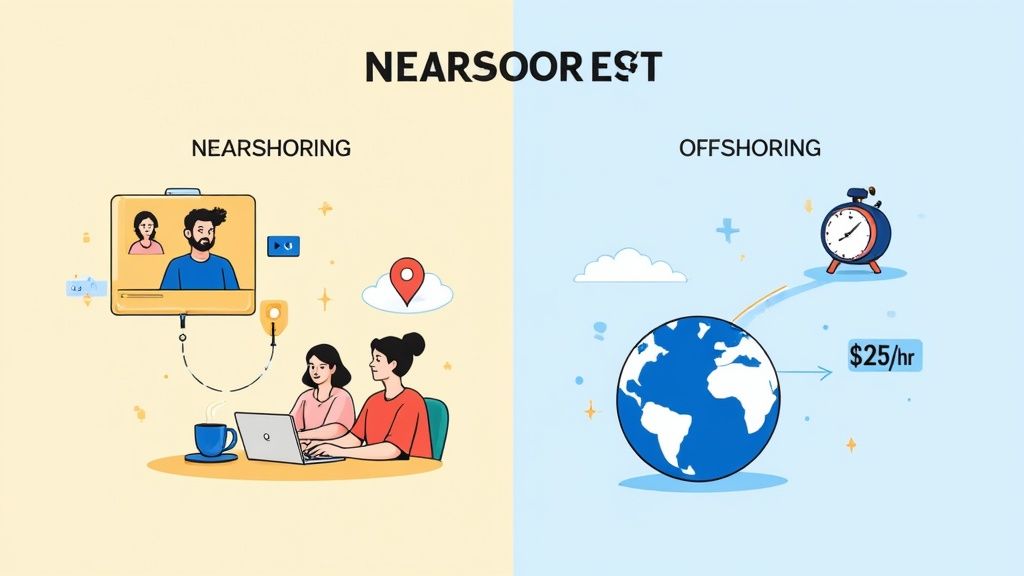
The knee-jerk reaction? Look "far east" for a developer who bills at a fraction of the cost. On paper, it’s a beautiful arbitrage play.
But I’ve seen that movie before, and it rarely has a happy ending. That cheap hourly rate lures you into a world of communication black holes, cultural disconnects, and projects that mysteriously double in timeline. It’s the classic rookie mistake—optimizing for the sticker price instead of the total cost of engagement.
This isn't just about saving a few bucks. This is about building a team that can actually ship product without you babysitting every line of code. It’s the difference between a high-functioning extension of your team and a frustrating, expensive science experiment.
Choosing between these models isn't a simple spreadsheet calculation. It's a strategic gut check that impacts your company's agility, culture, and ultimately, its ability to innovate.
The numbers tell the story once you factor in the "soft" costs. Nearshore outsourcing projects, for example, boast an impressive 80% success rate, while offshore projects lag at just 60%. Those closer partnerships slash communication issues and speed up project completion, proving that proximity pays dividends.
So, how do they really stack up? Here’s the cheat sheet I wish I had years ago.
This table breaks down the core differences. Think of it as your quick-reference guide before we dive into the painful details.
| Factor | Nearshoring (e.g., US to LatAm) | Offshoring (e.g., US to Asia) |
|---|---|---|
| Time Zone Overlap | High (0-3 hours difference) | Low (8-12+ hours difference) |
| Collaboration | Real-time, synchronous communication | Asynchronous, often with painful delays |
| Cultural Alignment | High cultural and professional similarity | Significant differences in work norms |
| Cost Savings | Good (up to 70% vs. US rates) | Highest (often the lowest hourly rates) |
| Travel & Logistics | Simple, short-haul flights | Complex, expensive long-haul flights |
| Agility | High – easy to iterate and pivot quickly | Low – rigid processes and communication lag |
As you can see, nearshoring is the balanced approach. It blends significant cost savings with the collaborative benefits of having a team that operates on your clock and actually gets your jokes.
If you're looking to learn more, check out our guide on what is nearshore outsourcing for a deeper dive. The rest of this guide will break down what these differences really mean for your bottom line and your sanity.
Everyone falls for the same trap. You see an offshore developer rate of $25/hour, and your spreadsheet brain lights up. It looks like a cheat code for scaling your tech team.
Spoiler alert: it's not.
That tempting sticker price is the tip of a very large, very expensive iceberg. If you only focus on the hourly rate, you’re making a rookie mistake—one that will ambush your budget with a dozen hidden costs you never saw coming.
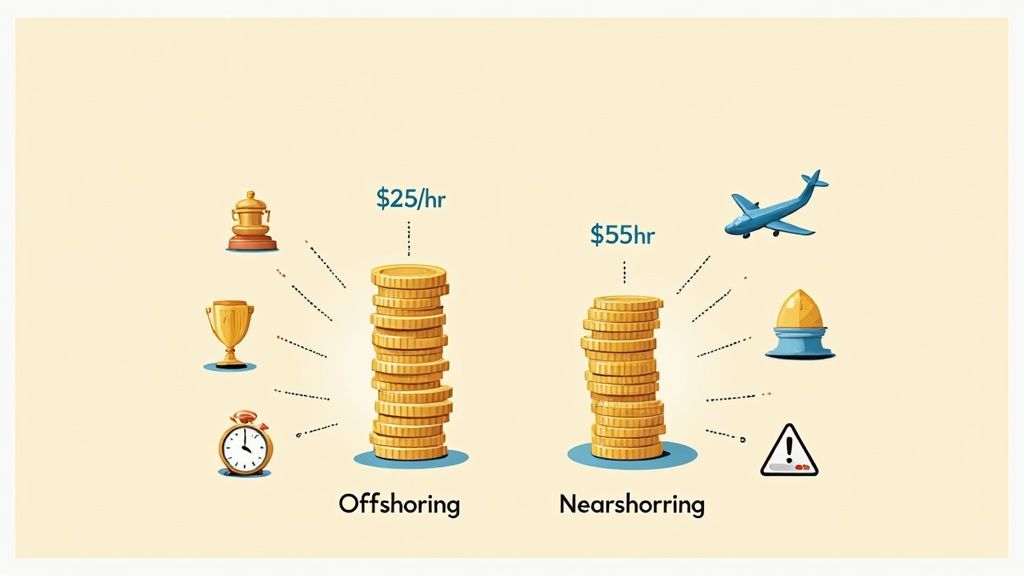
Let's get brutally honest about what you’re really paying for. This is the Total Cost of Engagement—the number that actually hits your P&L.
That cheap offshore rate starts to look a lot less appealing when you factor in the real-world operational drag. What you save per hour, you pay back in inefficiency, management overhead, and straight-up rework.
I’ve watched founders burn through cash on things they never budgeted for:
The sticker price of an offshore hire is a vanity metric. The real number to watch is your team's velocity and your managers' sanity. If both are dropping, you're not saving money—you're just lighting it on fire more slowly.
Let's make this real. Imagine you need a senior software engineer.
Option A: The Offshore Gamble
You hire an engineer in Southeast Asia for $35/hour. The savings look incredible. But then reality hits. Your PM spends hours each day clarifying requirements. Critical bugs get delayed a full day. Your local team has to spend 10-15 hours a week rewriting bad code.
Option B: The Nearshore Investment
You hire an engineer in Latin America for $60/hour. Yeah, the rate is higher. But this developer is two time zones away. They join your daily stand-ups, collaborate on Slack in real-time, and contribute clean code from the get-go. Your management overhead is minimal. Your project stays on track.
Which one actually costs less? It’s not even a contest. The nearshore developer delivers far more value per dollar because the friction is gone. You’re paying for output, not just hours logged.
The math on global talent isn't simple. Offshore developer rates in regions like Asia can be four to five times cheaper than U.S. onshore hiring, often billing $20-40/hour. Nearshore rates are higher at $40-80/hour in Latin America, but they still provide 50-70% savings versus domestic options.
The key difference? A recent PwC study noted 80% of COOs plan to expand nearshoring specifically to build resilience and lower their total costs. The smart money is catching on. You can explore a full breakdown of these offshore developer rate comparisons to see the raw numbers for yourself.
The conversation is shifting from "who is the cheapest?" to "who delivers the most value with the least chaos?" Offshoring optimizes for the first question. Nearshoring is the definitive answer to the second.
Let’s talk about the single biggest lie of offshoring: that a 10-hour time difference is a minor inconvenience. It’s not. It’s a momentum killer, a silent assassin of agility, and the place where the beautiful theory of cheap global talent goes to die.
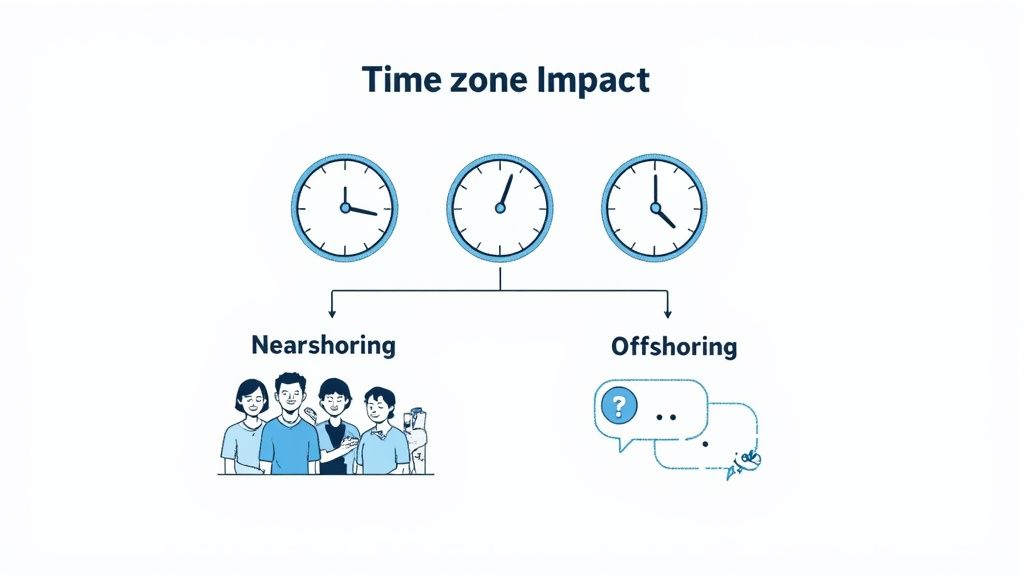
I’ve lived this nightmare. You find a show-stopping bug at 4 PM. Your US team is ready to swarm it, but your dev team in Manila has been offline for hours. So, you write a painfully detailed ticket, cross your fingers, and go home.
The next morning, you log on to a flurry of questions. Your ticket was misinterpreted. The bug is still there, your launch is now a day behind, and your blood pressure is through the roof. This isn't rare; it's the daily reality of asynchronous work at its worst.
That 24-hour feedback loop is where agile development goes to be buried. You can’t “sprint” when every clarification takes a full day. Spontaneous problem-solving? Forget it. A quick Slack huddle? Not happening unless you enjoy 11 PM video calls.
This is the fundamental trade-off in the nearshoring vs offshoring debate. Offshoring forces you into a rigid, slow-motion workflow.
Contrast that with nearshoring. Your developer in Mexico is maybe one time zone away. They’re in your daily stand-ups. They’re active on Slack when you are. When that critical bug appears at 4 PM, they’re right there with you, debugging in real-time.
That’s not just a convenience; it’s a competitive advantage. The ability to resolve issues in minutes, not days, is what separates companies that ship from companies that slip.
Effectively handling remote teams requires solid strategies for managing time zones and global teams, but no strategy can fully bridge a 12-hour gap when speed is critical. You can learn more about the critical role of time zones in remote work in our detailed guide.
Okay, let’s tackle the other big lie: that all talent pools are created equal. They’re not.
Different regions have different tech specializations, driven by their education systems and local industries. It’s not about one region being "smarter" than another; it's about finding the right ecosystem for your specific tech stack. An offshoring strategy might connect you with a massive pool of developers in India, which is a powerhouse for enterprise Java. But if you're building a cutting-edge AI product, are you fishing in the right pond?
I think of global talent not as one giant ocean but as a series of specialized lakes.
Here’s my breakdown from the trenches:
Offshore Hubs (e.g., India, Philippines, Eastern Europe):
Nearshore Hubs (e.g., Latin America):
Choosing the right location isn't just about finding a "JavaScript" keyword on a resume. It’s about finding a developer who has been breathing the same technological air as your in-house team. When your nearshore developer in Brazil follows the same thought leaders and contributes to the same open-source projects as your CTO in Austin, the synergy is immediate.
You think "culture" is a fluffy HR term? Try explaining "radical candor" to a team culturally wired to avoid direct conflict.
Good luck with that. I've seen more projects torpedoed by cultural mismatches than by bad code. It's the silent killer of productivity. When you ignore cultural alignment in the nearshoring vs. offshoring debate, you're not just taking a risk; you're actively betting against your own success.
Here's a classic offshoring horror story. You ask a developer, "Can we get this feature deployed by Friday?" They smile and say, "Yes, of course."
Friday comes. The feature is nowhere near done. You're furious. But in their culture, saying "no" to a superior is a sign of disrespect. "Yes" often means "I will try my best, but I don't want to disappoint you right now."
That single misunderstanding just cost you a week of runway. Now multiply that by every task, every deadline, every single day. This is how projects slowly bleed out.
Cultural alignment isn't about finding people who think exactly like you. It's about establishing a shared operational language where "done" means the same thing to everyone.
This simple flowchart shows how communication and feedback styles can make or break a project when deciding between nearshoring and offshoring.
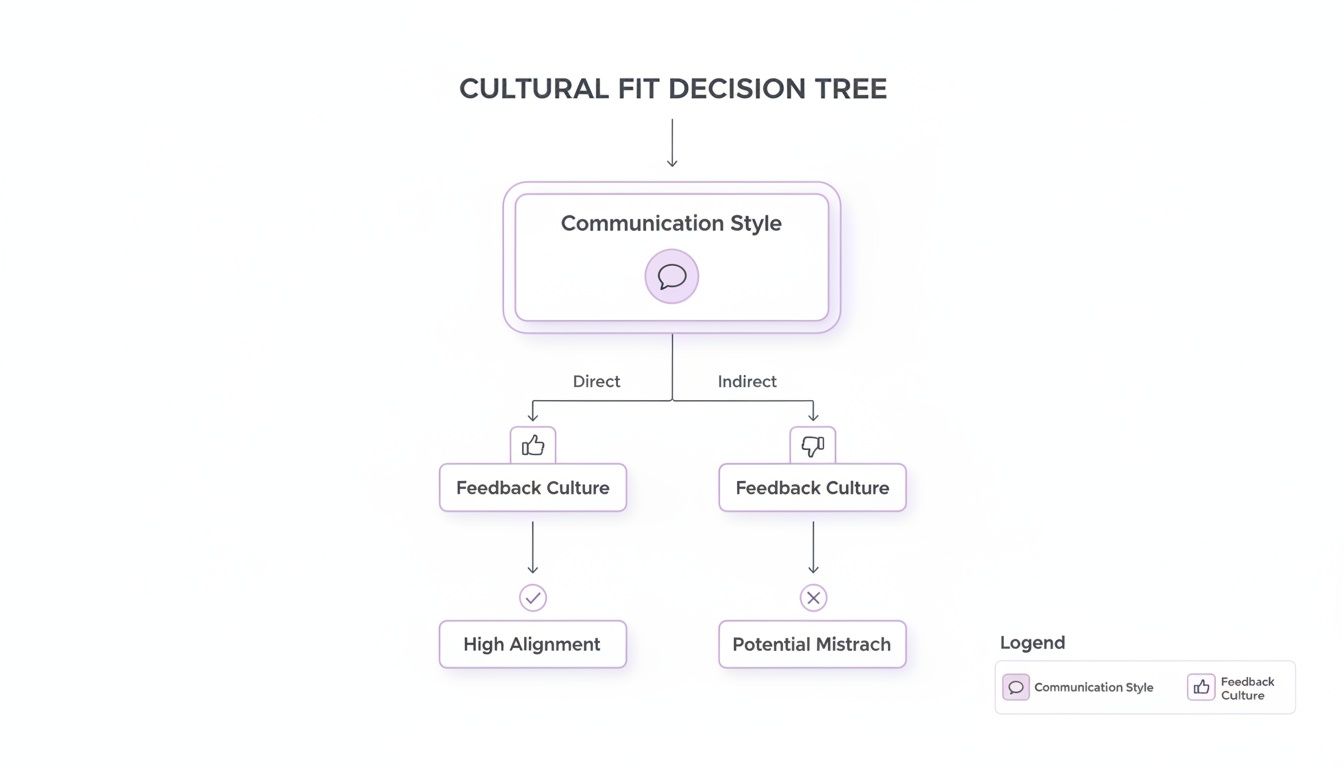
The visualization highlights a critical decision point: teams accustomed to direct feedback and proactive communication are far more likely to integrate seamlessly, avoiding the costly delays that stem from indirect styles.
This is where nearshoring, particularly with Latin America, becomes a game-changer for US companies. The cultural proximity is a massive, underrated, strategic advantage.
Latin American professionals have grown up consuming US media and working with US companies. The communication style is more direct, the approach to problem-solving is proactive, and agile development isn’t a foreign language.
Here’s what that actually means for your daily workflow:
Offshoring demands you become an expert in cross-cultural management overnight. Nearshoring lets you focus on building your product. For a closer look at this dynamic, you can explore why cultural fit is the key to successful remote hiring in LatAm in our dedicated guide.
If your team can’t communicate without a translator and a cultural handbook, you've already lost.
Alright, enough theory. It’s time to make a call. The "nearshoring vs offshoring" debate isn't an interesting thought exercise; it’s a critical strategic choice with real consequences for your budget, your product, and your sanity.
This isn't about finding the one "best" answer. The right model for a Fortune 500 is completely wrong for a seed-stage startup. The key is to stop looking for a universal winner and start diagnosing your specific situation with some brutal honesty.
Nearshoring isn’t just a middle ground; it's a strategic weapon for when speed and collaboration are non-negotiable. If you're nodding along here, this is your play.
You should seriously consider nearshoring if:
If your project description includes words like "agile," "innovative," "iterative," or "collaborative," choosing offshoring is like trying to win a Formula 1 race with a unicycle. You’re using the wrong tool for the job.
Look, I'm not here to bash offshoring entirely. There are specific, well-defined situations where it can work. These almost always involve low-complexity, high-volume tasks that require minimal real-time collaboration.
Offshoring could be a viable option if:
When considering an offshore strategy, understanding the nuances of different jurisdictions is key. This includes exploring the best country to set up an offshore company to align with your business objectives. But remember, legal structures are only one part of the puzzle.
Still weighing your options? This table breaks down common scenarios to help you see where your needs align.
| Your Primary Need | Best Fit Nearshoring | Best Fit Offshoring |
|---|---|---|
| Rapid Prototyping & MVP Development | Ideal for agile sprints, immediate feedback, and quick pivots. | Poor fit. The communication lag will slow you to a crawl. |
| Core Product Engineering | Perfect. Keeps your core engineering team in sync for complex problem-solving. | Risky. Miscommunications can lead to costly rework on business-critical features. |
| 24/7 "Follow the Sun" Support | Possible, but less cost-effective than a true global model. | The classic use case. A team in Asia can handle tickets overnight. |
| Augmenting an Existing Agile Team | Excellent. New members can join daily stand-ups and collaborate in real time. | Difficult. The asynchronous nature disrupts the flow of agile ceremonies. |
| Legacy System Maintenance | A good fit if the system requires occasional but immediate troubleshooting. | Works well if tasks are routine, well-documented, and can be handled overnight. |
| Large-Scale, Repetitive Data Entry | Overkill. You’d be paying a premium for collaboration you don't need. | A strong contender, especially when cost per task is the most important metric. |
This isn't an exhaustive list, but it covers the most common situations. Your choice should always come back to the nature of the work itself.
If you’re still on the fence, ask yourself these three brutally honest questions:
Making the right choice in the nearshoring vs. offshoring dilemma isn’t about following a trend. It’s about matching the model to your mission. Choose wisely.
I get it. You've weighed the pros and cons of nearshoring vs offshoring, but a few nagging questions are probably still bouncing around your head. Let’s tackle the ones that keep founders up at night.
That’s a classic spreadsheet mistake—fixating on the hourly rate instead of the Total Cost of Engagement. The sticker price for a nearshore developer might look higher, but it almost always delivers a much better ROI.
Offshoring is cheap per hour but expensive per project. You pay a "hidden tax" in management overhead, communication delays, and rework. Nearshoring costs more upfront to eliminate that friction, which means your projects actually get done on time and on budget.
Trying to navigate international labor laws, taxes, and contracts by yourself is a fantastic way to get a massive headache and an even bigger fine. Don't do it.
The smart move is to work with an Employer of Record (EOR) partner who specializes in the region you're hiring from. They handle all the local HR, payroll, and legal compliance, letting you tap into global talent without the administrative nightmare. It’s a plug-and-play solution.
Absolutely. This isn't about finding junior coders to handle grunt work. Latin America has booming tech hubs in places like São Paulo, Mexico City, and Bogotá, full of senior engineers who have cut their teeth at top global companies.
The talent is definitely there. The trick isn't finding it—it's getting access to it. The best engineers aren't scrolling through generic job boards; you need a partner on the ground who knows the local ecosystem and can connect you with pre-vetted, high-caliber professionals. Toot, toot

