
That job offer email isn't just another HR task to check off. It's the final, make-or-break conversion point in your entire recruitment funnel. This is the document that turns a great candidate into your next great hire. A killer email seals the deal, sells the dream one last time, and ensures weeks of your life didn't just vanish into the great recruiting void.
Let’s be brutally honest. You've just spent weeks, maybe months, digging through a mountain of resumes, running interviews, and checking references. You finally found the one. Now, the only thing standing between you and your new team member is that job offer email.
Fumbling at this stage is like dropping the ball on the one-yard line. It's painful, expensive, and completely avoidable.
This email is your closing argument, not a dry list of salary figures and a start date. It’s the grand finale of a hiring process with razor-thin margins. Think about this: data shows that only about 0.5% of job applications actually result in a hire. But once a strong offer lands in their inbox? Acceptance rates rocket up to a staggering 82%. The stakes are ridiculously high.
So, what’s the difference between an offer that gets a resounding "YES!" and one that gets you ghosted? It all boils down to clarity, confidence, and context. A weak, ambiguous, or unenthusiastic offer creates doubt. It makes top-tier candidates wonder if you’re truly sold on them, or worse, if your company is as disorganized as your email.
Your job offer email isn’t just an offer; it’s a reflection of your company's culture and professionalism. It sets the tone for the entire employment relationship before it even begins. Get it right, and you don’t just gain an employee—you gain an advocate.
This is especially true when you're competing for elite talent, a challenge we know all too well. Every detail matters, from the subject line to the final sign-off. If your process feels clunky at this final hurdle, a candidate will naturally assume that working for you feels the same way.
Before you even think about templates, you have to internalize this mindset. This isn't just HR paperwork. It's a sales document, and the product you're selling is a career at your company. If you're building out your team from scratch, you might find our guide on how to build a talent pipeline useful.
To put it simply, getting this email right is non-negotiable. Here’s a quick breakdown of what separates a winning offer from a losing one, based on what we see in the trenches every day.
| Essential Component | Why It Matters (No Fluff) | The Cost Of Getting It Wrong |
|---|---|---|
| Clear, Enthusiastic Subject | Grabs attention in a crowded inbox and sets a positive tone immediately. | Your offer gets lost or ignored. The candidate feels undervalued from the start. |
| Personalized Opening | Shows you see them as an individual, not just another applicant. | Comes across as a generic, mass-produced email. Kills all the rapport you built. |
| Core Offer Details (Cleanly Formatted) | Salary, start date, title, and reporting structure are crystal clear. No room for confusion. | Ambiguity creates friction and forces unnecessary back-and-forth, or worse, a "no." |
| Brief Role & Company Reinforcement | A quick reminder of why this role is exciting and why your company is the place to be. | The candidate might be weighing multiple offers. You lose your last chance to sell them. |
| Clear Call-to-Action & Deadline | Tells them exactly what to do next and by when, creating a sense of urgency and respect. | The candidate procrastinates, shops your offer around, or simply forgets to reply. |
| Attachment for Formalities | Keeps the email clean and scannable, with the full legal document attached for review. | A wall-of-text email is overwhelming and looks unprofessional. Key details get missed. |
Getting these components right isn't just about good practice—it's about protecting your investment. A poorly executed offer can undo weeks of work and send you right back to square one.
Alright, let's move past the theory. It's time to roll up our sleeves and build a job offer email that doesn't just inform but actually closes. This is where all your hard work interviewing and vetting candidates pays off, turning a promising conversation into a signed contract.
Think of this email as a final sales pitch for a career at your company. Every single component has a critical job to do. Get them right, and you’ll have an offer that’s nearly impossible for a top candidate to refuse.
First things first: the subject line. This is your email's gatekeeper. A boring, generic subject like "Job Offer" is the digital equivalent of a weak handshake. It’s forgettable and just screams "corporate drone."
You need something that cuts through the noise of their inbox, which is likely already packed with LinkedIn notifications and, let’s be honest, offers from your competitors. The goal is to project confidence and clarity right from the start.
Here are a few formulas that consistently work:
Job Offer from [Your Company Name]Job Offer: [Your Company Name] – [Candidate Name][Your Company Name] Job Offer for [Role Title]!See the difference? The last two add a personal touch and a welcome bit of energy. It’s a small tweak, but it completely reframes the interaction. It says, "We're excited about you," not just, "Here's some paperwork."
Once they've opened the email, that first sentence is your chance to reaffirm their decision and make them feel genuinely wanted. Don't just dive straight into the numbers. You’re a human hiring another human—act like it.
Start with real enthusiasm. You just spent weeks getting to know this person; show them it was worth it.
A great job offer email doesn’t start with logistics; it starts with celebration. Reinforce that this isn't just another hire for you—it's the hire.
For example, instead of a dry "Please find your employment offer attached," try something with a little more life:
"Hi [Candidate Name],
The entire team was incredibly impressed after our conversations, and we are thrilled to officially offer you the position of [Role Title]!"
This simple shift in tone makes them feel valued from the very first word. It confirms they made a great impression and kicks off the new relationship on a high note.
Now we get to the main event: the money. This is the part everyone immediately scrolls to, and it's where ambiguity goes to die. If you make a candidate hunt for the details or do mental math, you're introducing unnecessary friction and doubt.
Don’t be shy here. Lay it all out with absolute clarity. A confusing compensation section is a massive red flag for any candidate.
Break it down like this:
This isn't just about being transparent; it's about showing you have your act together. A well-organized breakdown screams professionalism and leaves zero room for misinterpretation.
Here’s where a lot of companies drop the ball. They either list every single generic perk imaginable ("free coffee!") or link out to a dense, 80-page benefits PDF that nobody is ever going to read.
Instead, highlight the benefits that truly impact someone’s life and work, especially when hiring remote talent.
When hiring internationally, benefits can get complicated fast. Instead of getting lost in the weeds, it’s often smarter to partner with a service that handles all the local nuances. If you’re building a team across borders, you can learn more about our international benefits administration to see how we simplify this entire mess.
The goal is to frame your benefits as a core part of the total compensation package, not just a tacked-on afterthought.
Finally, you need to tell them exactly what to do next. Don't leave them hanging. A strong call to action provides clarity and creates a gentle, professional sense of urgency.
State the deadline clearly and respectfully. "To accept this offer, please sign the attached agreement and return it to us by [Date], at 5:00 PM [Time Zone]."
Always end on a high note, reiterating your excitement and opening the door for any questions they might have. "We are incredibly excited about the possibility of you joining the team. Please don't hesitate to reach out if you have any questions at all."
This combination of a clear directive and an open invitation strikes the perfect balance, making the candidate feel both guided and supported. It’s the final piece of an offer that’s designed not just to be read, but to be signed.
Let's kill the idea of a one-size-fits-all job offer email right now. Sending the same generic template to a star developer in Brazil and a part-time marketing assistant in the US is like trying to use a hammer to fix a software bug. It’s the wrong tool, shows you don’t get it, and is just plain lazy.
You need an arsenal. Battle-tested, copy-paste-ready templates tailored for the real-world scenarios you actually face. This isn't about just finding a template online; it’s about having the right template for the right hire, infused with the right tone and the critical details that matter most to them.
This flowchart breaks down the core decision path for any offer email, hitting the critical points of salary, benefits, and next steps that every candidate evaluates.
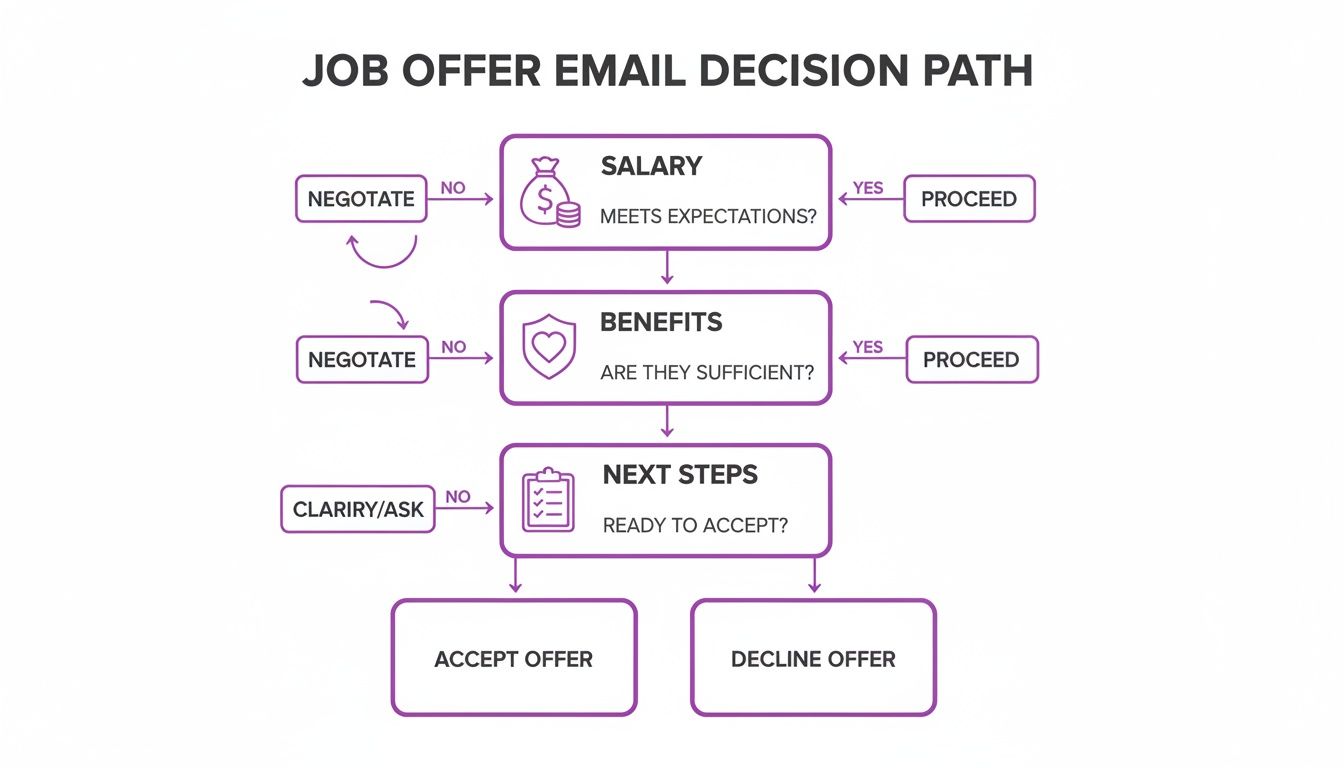
As you can see, a successful offer addresses these three pillars directly and clearly. It leaves no room for the kind of ambiguity that kills deals before they even get started.
Not sure which template fits your situation? This quick guide breaks down which email to grab for each hiring scenario you’ll face.
| Hiring Scenario | Key Focus Of The Email | Critical Compliance Note |
|---|---|---|
| Full-Time Remote (LATAM) | Reassurance on global payroll, USD salary, and locally compliant benefits. | Must mention the international payroll partner and compliance with the candidate's home country laws. |
| Independent Contractor | Project scope, specific deliverables, payment terms, and timeline. | The language must reinforce a business-to-business relationship, not employment. Avoid mentioning "benefits." |
| Part-Time Role | Absolute clarity on expected hours, schedule flexibility, and hourly rate. | Clearly state if the role is benefits-eligible or not, as this varies by company policy and local laws. |
| Internal Promotion | Celebration of achievement, formalizing the new role, title, and updated compensation. | While less about compliance, it creates an official record of the change in role and salary for HR purposes. |
Using the right framework from the start sets clear expectations and shows you understand the unique context of each hire.
Hiring globally isn't a niche strategy anymore; it's how smart companies are winning. In fact, global hiring is booming, with 71% of teams actively recruiting internationally and 87% successfully filling at least four out of ten roles with talent from outside their local markets. Tech leaders are at the forefront of this shift, which has turned the job offer email into a critical document for navigating cross-border compliance. You can see more data on this global talent surge from Select Software Reviews' recent report.
When you're extending an offer to a top-tier candidate in Colombia or Argentina, their priorities are different. They're thinking about currency stability, local benefits, and how their role fits into a company headquartered thousands of miles away.
Your offer needs to address this head-on.
Subject: Job Offer from [Your Company Name] for [Role Title]!
Body:
Hi [Candidate Name],
Following our conversations, the entire team is incredibly excited to officially offer you the full-time, remote position of [Role Title] at [Your Company Name]!
We were so impressed with your expertise in [Mention a specific skill or project] and are confident you’ll make a huge impact on our [Specific team or project].
Here are the details of our offer:
This is a permanent position, and we’re excited to have you grow with us for the long term.
Please review the attached formal employment agreement, which outlines all the terms and local compliance details. To accept, simply sign and return the agreement by [Date].
We can’t wait to have you on board.
Best,
[Your Name]
Contractors are a different breed. They're business owners, not employees, and your offer needs to reflect that professional relationship. The focus shifts from company culture to project scope, payment terms, and autonomy. Forget the fluffy perks; they care about clarity and prompt payment.
Clarity is your best friend here. Ambiguity about deliverables or payment schedules is the fastest way to create friction and sour a good working relationship from the start.
Your offer to a contractor isn't an invitation to join the family; it's a business proposal. Treat it with the directness and respect it deserves. Scope, deliverables, and payment—that’s the holy trinity.
Subject: Project Agreement: [Project Name] with [Your Company Name]
Body:
Hi [Candidate Name],
It was great speaking with you about the [Project Name] initiative. We're thrilled to formally offer you the independent contractor role to lead this project.
As we discussed, this engagement will focus on:
Attached you'll find our standard Independent Contractor Agreement with the full Statement of Work (SOW). Please review it, and if everything looks good, sign and return it by [Date].
We're excited to partner with you on this.
Regards,
[Your Name]
Part-time roles can be tricky. Candidates need absolute clarity on expectations, time commitment, and how their contribution fits into the bigger picture. Is this a 10-hour-a-week role or a 25-hour role? Are the hours flexible or fixed?
Your job offer email must answer these questions before they even have a chance to ask them. This simple step prevents future misunderstandings and ensures you're both perfectly aligned from day one.
Subject: Part-Time Job Offer: [Role Title] at [Your Company Name]
Body:
Hi [Candidate Name],
The team really enjoyed getting to know you, and we’re pleased to offer you the part-time position of [Role Title]!
We believe your skills in [Mention a specific skill] will be a fantastic addition to the team.
This role is structured for approximately [Number] hours per week. Your primary responsibilities will include [List 2-3 key tasks]. We offer flexibility in your schedule, but we’ll need you available for our weekly team sync on [Day] at [Time, Time Zone].
Here are the offer details:
If you're ready to accept, please reply to this email confirming so by [Date]. We’ll then get your onboarding process started.
We’re looking forward to having you join us!
Cheers,
[Your Name]
Never, ever underestimate the power of a formal offer for an internal promotion. It’s a massive mistake to handle this with just a casual Slack message. A formal email validates the employee’s growth, resets expectations for their new role, and solidifies their new compensation package in writing.
This email is part celebration, part formal agreement. It should make your employee feel recognized for their hard work and genuinely excited for the next chapter of their career with you.
Subject: Congratulations on Your Promotion to [New Role Title]!
Body:
Hi [Employee Name],
I am absolutely thrilled to officially confirm your promotion to [New Role Title], effective [Start Date]!
Your incredible work on [Mention a specific achievement or project] has been instrumental to our success, and this promotion is well-deserved recognition of your contributions and leadership potential.
In your new role, you will be taking on [Briefly describe 1-2 new key responsibilities]. You will now report to [New Manager Name].
To reflect these new responsibilities, your new annual salary will be $[XX,XXX]. All of your existing benefits will, of course, continue.
We’ve attached a formal letter outlining the changes for your records. No signature is needed—just a reply to this email confirming you’re ready to take on this new challenge!
Congratulations again. We can’t wait to see what you accomplish next.
Best,
[Your Name]
So, you hit "send" on that perfect job offer email. Time to pop the champagne, right? Not so fast.
Sending the offer isn't the finish line; it’s really just the opening bell for round two. Now comes the real fun: the dance of negotiation, the thrill of acceptance, and the occasional—but inevitable—"thanks, but no thanks."
This is where great hires are won or lost. Mess it up, and all that work finding them evaporates. Handle it like a pro, and you solidify a relationship built on mutual respect from day one.
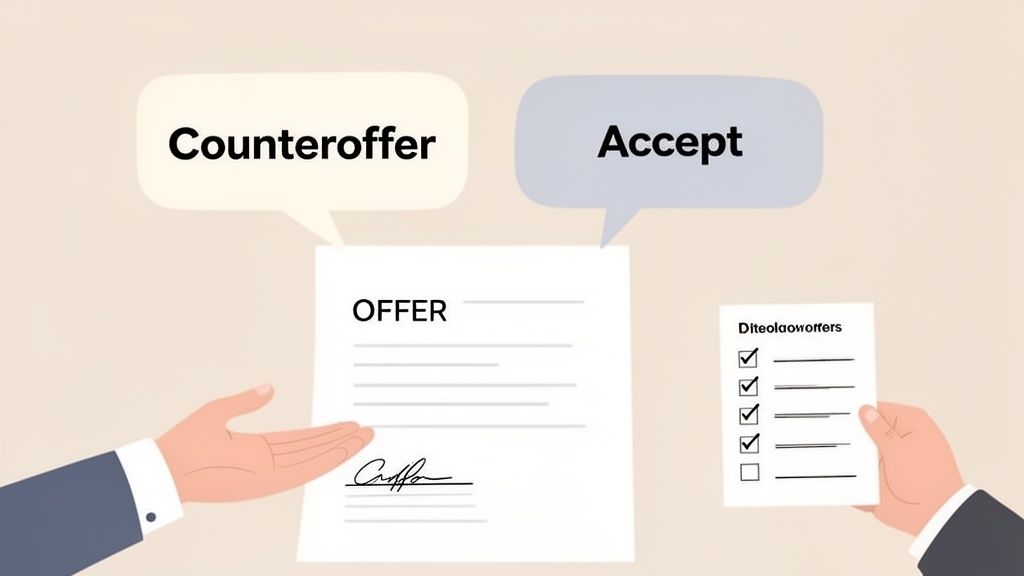
Let’s get one thing straight: if your top candidate doesn't try to negotiate, you should almost be worried. Good people know their worth. A counteroffer isn't an insult; it's a sign they’re engaged and taking this seriously. The key is how you respond.
First, take a breath. Don't get defensive. Your reaction sets the tone for the entire negotiation.
Is their request reasonable? Can you meet them halfway? Perhaps you can find wiggle room with a small salary bump, a one-time signing bonus, or an extra week of vacation.
Sometimes, the answer is just no. And that's okay. If you’ve made your best and final offer, be prepared to say so with confidence and grace.
Here's an example of a firm but fair response:
"Hi [Candidate Name], thanks for getting back to us. We’ve reviewed your request and while we can’t move on the base salary, this offer represents the top of the range for this role. We are, however, able to offer a one-time $3,000 signing bonus. We’re still incredibly excited about you joining and believe the overall package is highly competitive."
This response is clear, respectful, and holds the line while still offering a small concession. It shows you listened but also that you have a well-defined compensation strategy. No drama, just business.
They said yes! This is a huge win. Your very next move should be to send an acceptance confirmation that transitions them from "candidate" to "new team member."
Make this email warm, enthusiastic, and packed with clear, actionable next steps. This isn’t just a formality; it’s the official kickoff to their onboarding experience. A clunky, confusing process here creates immediate buyer's remorse.
Your acceptance confirmation should do three things:
This email bridges the gap between the signed offer and day one, keeping their excitement high and ensuring a smooth administrative start. It shows you’re organized and ready for them.
It happens. You make a great offer, but the candidate goes another way. It stings, but how you handle it matters more than you think.
Ghosting them or sending a cold, one-line reply is a rookie move that burns bridges. The tech world is small, and you never know when your paths will cross again.
Your goal is to leave the door open. Thank them for their time and wish them well. It’s that simple.
"Hi [Candidate Name], thanks for letting us know and for your transparency throughout this process. While we're disappointed, we completely understand and wish you the very best in your new role. We were truly impressed with you and would love to stay in touch for any future opportunities."
This response takes all of 30 seconds to write and costs you nothing. It leaves a lasting positive impression and keeps a talented individual in your network for the future. Don’t mortgage future opportunities because of a little short-term disappointment. Play the long game.
Hiring someone in another country sounds like a compliance nightmare, right? It’s the kind of thing that brings to mind late-night calls with lawyers and deciphering tax codes that look like ancient hieroglyphics. And honestly, it used to be.
This is the part of the process most guides conveniently skip over—the nitty-gritty of payroll, benefits, and legal compliance when your new hire is in São Paulo and you’re in San Francisco. It’s exactly where a perfectly good job offer can crumble under the weight of international bureaucracy.
Okay, time for a little self-aware horn-tooting (toot, toot!). This exact mess is why LatHire exists. We saw brilliant founders drowning in paperwork, trying to figure out if they needed to pay into a Brazilian pension fund or how to offer locally competitive health benefits in Mexico. Hope you enjoy spending your afternoons running payroll—because that's now your full-time job.
Your job offer email needs to confidently state that you’ve got this handled. Vague promises about "international payments" won't cut it. Top talent in Latin America needs assurance that you're a professional operation, not a startup figuring things out on the fly.
A global hire isn't just about finding talent; it's about building the infrastructure to support them. Your offer must reflect that you've already built the bridge, not just pointed to the other side of the canyon.
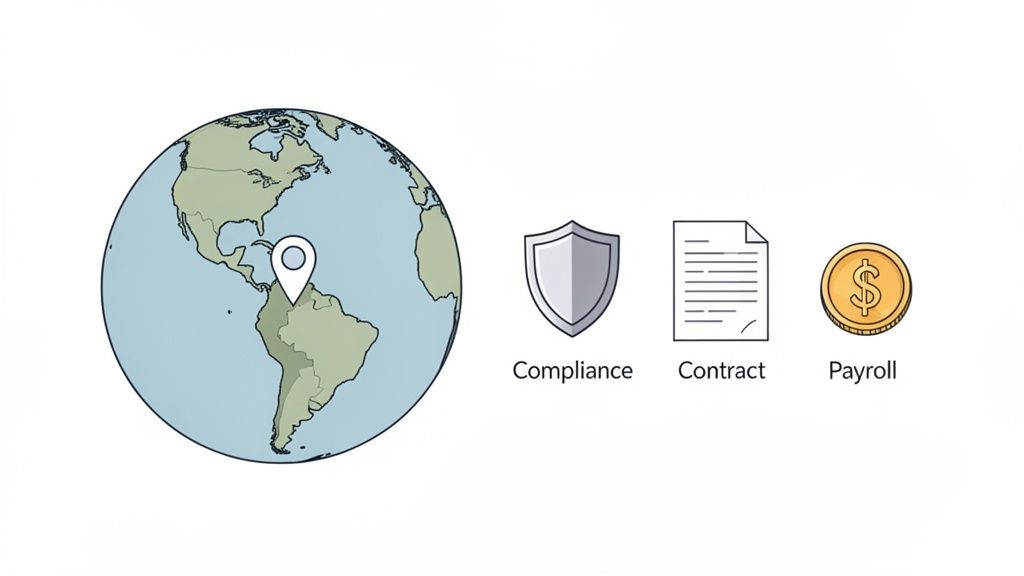
That means your offer has to nail the big three concerns for any cross-border professional: compliant contracts, stable pay in their preferred currency, and locally relevant benefits.
The numbers show why this is so critical. The global Net Employment Outlook is stabilizing, with 40% of companies planning to hire, but the competition is fierce. In fact, 21% of employers report getting over 200 applications for a single role. When you finally find your person, you can't afford to trip over compliance at the finish line.
With Brazil leading Latin America with a 54% NEO, having a streamlined, compliant process isn't just a nice-to-have; it's a must.
Let’s get tactical. When you extend an offer to someone in Latin America, you're not just offering a job—you're offering stability. This means your operational backend has to be flawless.
This is where an Employer of Record (EOR) becomes your secret weapon. Turns out there's a way to hire elite developers without mortgaging your office ping-pong table. The EOR hires the employee on your behalf, handling all the legal, payroll, and HR complexities. It’s the single best hack for hiring globally.
We've written a detailed guide explaining what an Employer of Record is and how it can save you from a world of pain.
Plus, when extending offers to international candidates, a deep understanding of immigration considerations, visas, and work permits is paramount to avoid legal snags. This is another layer of complexity that a dedicated platform can manage for you.
Ultimately, LatHire bakes all of this into one seamless process. Your job offer email becomes a simple, confident document because we’ve handled the chaos behind the scenes. You get to focus on building your team, not becoming an amateur expert in Brazilian labor law.
Alright, let's get into some of the rapid-fire questions that always seem to come up when you're on the one-yard line, about to send that critical job offer email. We’ve been in the trenches and have seen it all, so here are the straight-shot answers you're looking for.
The sweet spot is 3-5 business days.
Anything less feels like a high-pressure sales tactic, and frankly, it comes off as a bit desperate. But give them more than a week, and you’re basically inviting them to shop your offer around to every competitor they've ever spoken with.
The goal is to create a professional sense of urgency without being a bully. You want their decision to be confident, not coerced. A few days gives them the courtesy to review everything properly, talk it over with their family, and come back to you with an enthusiastic "yes."
Being vague about the money. Period. This is the number one deal-killer we see time and time again. Don't just list a single salary number and call it a day—that’s amateur hour.
You have to break down the Total Compensation Package with surgical precision. Candidates, especially senior tech talent, aren't just looking at the base salary. They're weighing the entire financial picture.
Ambiguity about compensation is a massive red flag. It signals a lack of transparency and immediately erodes the trust you've worked so hard to build. Lay all your cards on the table, face up.
Both. Always, always, always call first. A verbal offer is personal. It lets you convey genuine excitement in your voice and build on the human connection you’ve already established.
Here's the script: "Hi [Candidate Name], I'm calling with some fantastic news—we'd love to formally offer you the [Role Title] position!"
After you share the good news and they express their initial excitement, you follow up with: "I'm sending the official job offer email over to you right now. It has all the details we just discussed. Take your time to review it, and please let me know if any questions come up."
This one-two punch is unbeatable. The call creates the moment; the email formalizes the agreement.
It absolutely can be, which is precisely why you need to be so careful with your wording. You're not just sending a friendly note; you're creating a document with potential legal weight.
To protect your company, it's wise to include a simple disclaimer. A sentence like, "This offer is contingent upon the successful completion of a background check and is not an employment contract" can provide a crucial layer of legal protection.
Of course, when you're hiring internationally, the game changes completely. That’s where a platform like LatHire steps in. We handle the creation of locally compliant employment agreements for talent in Latin America, taking that entire legal burden off your shoulders. Your offer letter sets the terms; our contracts make it official and ironclad.

