
Let's be honest. Most hiring is a glorified coin toss. You spend weeks sifting through resumes that look suspiciously similar, sit through interviews where candidates tell you exactly what you want to hear, and then make a gut decision that costs your company a small fortune when it goes wrong. I’ve been there. I’ve hired the rockstars and, yes, the ones who made me question my life choices. The difference wasn't luck; it was a system.
This isn't another fluffy HR post about "finding your purple squirrel." This is a battle-tested, no-nonsense playbook detailing interview best practices for hiring managers who are tired of guessing. We’re going to dismantle the broken parts of your process, inject some much-needed structure, and turn your interviews from a crapshoot into a predictable pipeline of A-plus talent. This guide focuses on what happens during the interview, but getting the right people in the room is half the battle. If your candidate pool is weak, you’ll need to refine your sourcing strategy first; consider this a modern playbook for recruiting top talent to ensure you're starting with high-quality applicants.
We will cover everything from structured interview formats and bias reduction to navigating the legal minefields of what you can and can't ask. You'll get actionable frameworks like the STAR method, practical advice on building diverse interview panels, and tips for creating a standardized experience that fairly evaluates every candidate. Ready to stop mortgaging your office ping-pong table for another bad hire? Let's dive in.
If you’re still "winging it" in interviews, you’re not just being unfair; you’re setting your company up for a bad hire. Relying on gut feelings and unstructured chats is one of the fastest ways to introduce bias and hire someone you like, not someone who can actually do the job. So, what’s the fix?
A structured interview format. This is the single most effective antidote to this common pitfall.
This approach forces discipline by standardizing the process. Every candidate for a specific role gets the same questions, in the same order, and is evaluated against the same pre-defined rubric. It transforms a subjective conversation into a more objective, data-driven assessment, making it a cornerstone of effective interview best practices for hiring managers. Companies like Google and Unilever have famously adopted this method because it’s proven to be a better predictor of on-the-job performance. It works.
Getting started is straightforward. Before you even post the job, define the core competencies required for the role and create questions that directly test for them.
By systemizing your approach, you create a level playing field where you can compare candidates' skills and experiences directly, rather than comparing your varying impressions of them.
If asking candidates hypothetical questions like "Where do you see yourself in five years?" is your go-to move, you're basically asking them to be good storytellers, not good employees. Past performance is a far better predictor of future success than a well-rehearsed answer about climbing the corporate ladder.
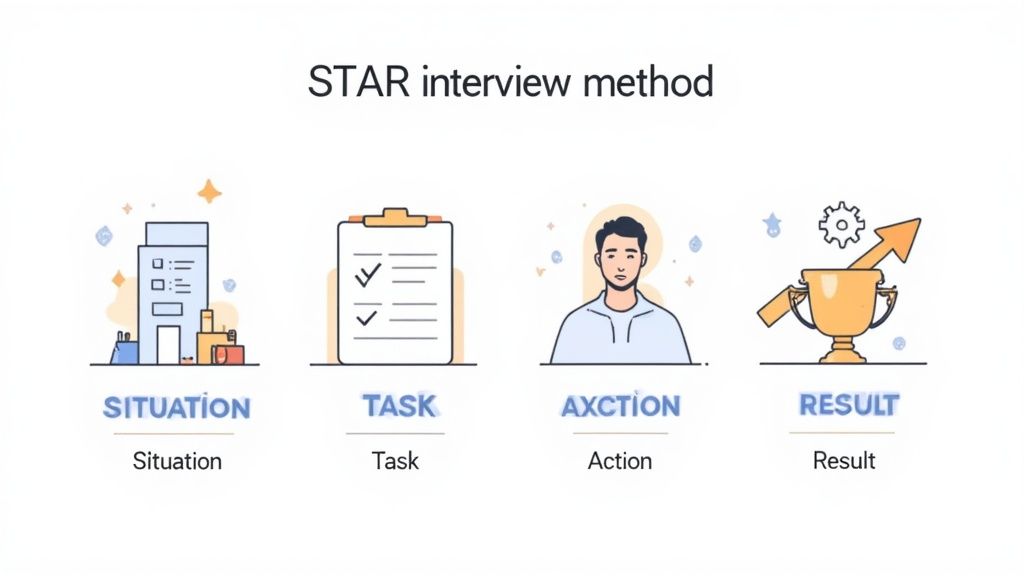
Enter the STAR method. It cuts through the fluff and gets straight to the evidence of a candidate's actual skills and behaviors.
This technique forces candidates to provide concrete examples from their work history by framing questions around specific situations. It’s not about what they would do; it’s about what they have done. You ask them to detail the Situation, the Task they faced, the Action they took, and the Result of that action. This framework is a core part of the interview process at giants like Amazon and Salesforce precisely because it reveals how a candidate truly operates under pressure. It's a foundational element of effective interview best practices for hiring managers.
Getting started means shifting from theoretical questions to evidence-based ones. Identify the key competencies for the role, then build questions designed to pull out real-world examples.
By using the STAR method, you stop guessing and start gathering data. You’ll get a much clearer picture of whether a candidate's past experience actually translates to the challenges and opportunities in the role you're hiring for.
Letting one person make a hiring decision is like asking a single friend for life advice after they've had two coffees and no sleep. Their perspective is valid, but it’s just one perspective. You're gambling on their mood, their personal biases, and whether they happened to connect with the candidate over a shared love for a niche TV show.
A panel interview is the ultimate safeguard against this kind of hiring roulette.
This approach brings multiple interviewers together to assess a candidate simultaneously. It streamlines the process for the applicant and provides a richer, more holistic view for your team. Instead of comparing one person’s gut feeling to another’s, you get a multi-faceted evaluation grounded in diverse viewpoints. Major players like Apple and consulting firms such as Boston Consulting Group rely on this method because it stress-tests a candidate from multiple angles, leading to more robust and reliable hiring outcomes.
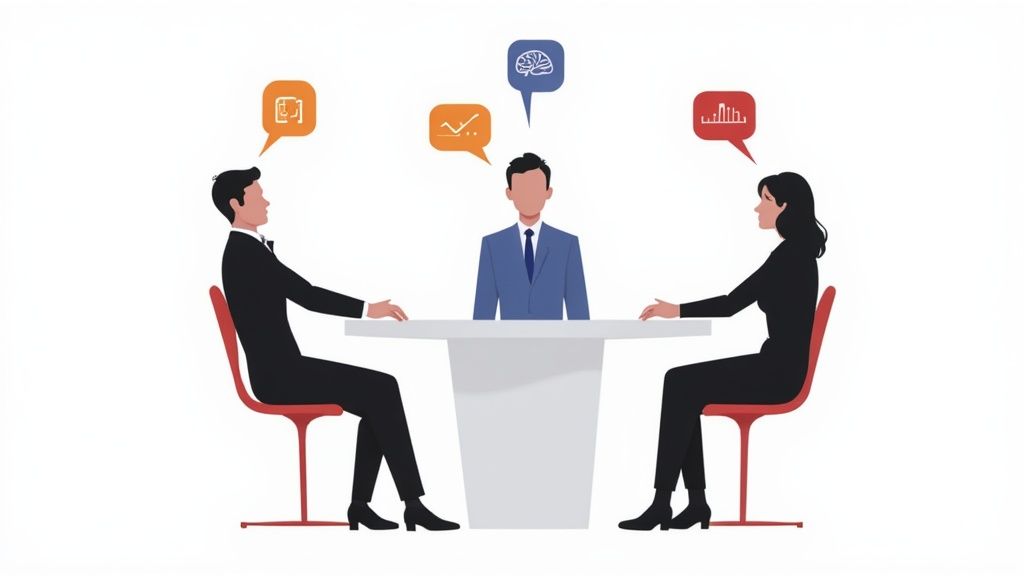
A poorly run panel feels more like an interrogation than an interview. The key is coordination, not just cramming more people into the room.
By diversifying your feedback loop, you dramatically reduce the risk of a single biased viewpoint derailing a great hire or championing a poor one. This is a core component of strong interview best practices for hiring managers looking to build resilient, high-performing teams.
If your interview panel looks and thinks exactly alike, don't be surprised when you hire people who also look and think exactly alike. A homogenous panel is an echo chamber, amplifying existing biases and spotting strengths only within its own narrow frame of reference. This is how you end up with a team that has major blind spots, not a well-rounded group of problem-solvers.
Intentionally assembling a diverse panel is a critical safeguard against this groupthink.
By bringing together interviewers from different backgrounds, departments, genders, and seniority levels, you get a multi-faceted evaluation of a candidate. It’s not just about fairness; it’s about making a smarter, more robust hiring decision. Companies like Salesforce and Microsoft have made this a core part of their hiring because they know diverse perspectives lead to a more accurate assessment of a candidate's true potential.
This isn't about just checking demographic boxes; it's about deliberately engineering a better evaluation process. A well-constructed panel challenges assumptions and provides a 360-degree view of a candidate.
By diversifying who asks the questions, you radically improve the quality and fairness of the answers you get, which is one of the most impactful interview best practices for hiring managers to adopt.
Walking into an interview without having glanced at the candidate's resume since you first screened it is an amateur move. It’s like showing up to a sales demo without knowing anything about the client. You waste precious time asking basic questions they’ve already answered on paper, and worse, you signal that you aren’t truly invested.
Thorough preparation isn't about being nosy; it’s about conducting a more meaningful, respectful, and insightful interview.
This practice transforms the conversation from a generic Q&A into a focused discussion about the candidate’s actual accomplishments and potential fit. Instead of asking "tell me about your last role," you can ask, "I saw you led the Project X initiative that increased user retention by 15%. Can you walk me through the specific challenges you faced?" This level of detail shows you’ve done your homework and allows you to dig deeper, making it one of the most critical interview best practices for hiring managers who want to move beyond surface-level evaluations.
Effective preparation doesn't mean cyber-stalking. It means methodically reviewing a candidate’s professional footprint to inform your questions.
By investing 15-20 minutes before each interview, you set the stage for a conversation that respects the candidate's time and gives you far more accurate data to make a hiring decision.
If you walk out of an interview remembering only your general "vibe" about a candidate, you’ve failed. The interview isn't a social call; it's a data-gathering mission. Active listening and meticulous note-taking are the tools you use to capture that data accurately, ensuring your decision is based on evidence, not a fuzzy memory of a pleasant chat.
It's the difference between saying, "I liked her," and "She provided three specific examples of leading a cross-functional project that increased Q3 revenue by 15%."
This deliberate practice requires you to fully concentrate, avoid interrupting, and take detailed notes that link directly to your scorecard competencies. It’s a core discipline in professional recruiting, from executive search firms that build detailed candidate dossiers to healthcare systems that require rigorous documentation for legal compliance. Great hiring managers know that the quality of their notes directly impacts the quality of their hiring decision, making it one of the most critical interview best practices for hiring managers.

Transforming your listening into actionable data is a skill. It’s not just about jotting things down; it’s about creating a record that allows for fair, side-by-side comparisons later.
Hiring someone based on a good resume and a charming personality is like buying a car because you like the color. It tells you nothing about the engine. If you aren't systematically evaluating the specific skills and behaviors needed for success, you're just guessing.
Competency-based assessment is the framework that stops the guesswork. It focuses on what truly matters: can the candidate demonstrate the abilities required to excel in the role?
This approach shifts the conversation from "tell me about yourself" to "show me what you can do." Instead of asking about general strengths, you ask for specific examples that prove a candidate possesses core competencies like leadership, analytical thinking, or technical proficiency. It’s a method championed by talent management leaders like Korn Ferry and Deloitte because it directly links interview performance to predictable, on-the-job success, making it one of the most critical interview best practices for hiring managers.
Start by deconstructing the role into its essential building blocks. What skills and behaviors separate a top performer from an average one in this position?
By focusing on proven behaviors instead of vague claims, you ensure you're hiring for capability, not just charisma.
First impressions aren't a one-way street. While you're evaluating candidates, they are absolutely evaluating you, your company, and your process. A chaotic, inconsistent interview experience screams disorganization and can repel top talent before you even get to an offer.
A standardized experience signals professionalism, fairness, and respect for every candidate's time.
This practice goes beyond just asking the same questions. It’s about creating a consistent, equitable container for every interaction, from the first email to the final debrief. Think of it as controlling the variables in your hiring experiment. Companies like McKinsey do this flawlessly; their famous case interview format is identical globally, ensuring that a candidate in London faces the same challenge as one in New York. This isn't just about fairness, it’s about brand integrity and building a predictable, high-quality talent pipeline.
Standardizing the candidate journey is about meticulous planning and disciplined execution. It shows every applicant they are being taken seriously.
By orchestrating a uniform experience, you ensure the only thing you’re comparing is the candidate’s ability, not the random circumstances of their interview slot.
Walking into a legal minefield is surprisingly easy in an interview. You might think you're just making friendly conversation, but asking an innocent-sounding question like "What year did you graduate?" can land you in hot water.
Eliminating legally risky questions isn't about being cold or impersonal; it’s about protecting your company. It ensures you evaluate candidates on what actually matters: their ability to do the job.
This practice involves a deliberate audit of your interview script to remove any questions that could be perceived as discriminatory. These questions often touch on protected characteristics like age, religion, marital status, disability, or national origin. The Equal Employment Opportunity Commission (EEOC) doesn't play around, and a single misstep can lead to costly legal battles. This discipline forces you to focus squarely on professional qualifications, making it an essential interview best practice for hiring managers who want to build a fair and compliant hiring process.
The goal is to keep every question strictly job-related. If you can’t draw a direct line from the question to a core job function, cut it.
By cleaning up your question list, you’re not just avoiding lawsuits; you're building a more professional, equitable, and effective system for identifying top talent.
Leaving candidates in a black hole after an interview isn't just rude; it's brand sabotage. In an age where a single bad Glassdoor review can deter top talent, treating candidates with respect is no longer optional.
Maintaining prompt, clear communication throughout the hiring process is a non-negotiable part of your employer brand.
The "we'll be in touch" black hole is a relic of an outdated hiring mindset. Top candidates have options, and being left in the dark for weeks is a clear signal that your company is disorganized or indifferent. Companies like Unilever, which commits to providing feedback within 48 hours, and Salesforce, known for its transparent hiring timeline, understand this. They've turned candidate communication from a courtesy into a competitive advantage, ensuring even rejected applicants walk away with a positive impression.
Turning your communication strategy into a well-oiled machine requires setting clear expectations internally and externally. It's about systemizing respect for a candidate's time and effort.
By treating every candidate like a potential future hire or customer, you build a reputation that attracts the best talent, even when you have to say no.
| Item | Implementation complexity | Resource requirements | Expected outcomes | Ideal use cases | Key advantages |
|---|---|---|---|---|---|
| Structured Interview Format | Medium — design rubrics and questions | Medium — upfront time, interviewer training | Consistent, legally defensible comparisons; higher reliability | High-volume hiring, regulated sectors, campus recruitment | Reduces bias; improves predictive validity; easier comparison |
| Behavioral Interview Technique (STAR) | Low–Medium — interviewer training to probe STAR | Low–Medium — prep of questions and scoring guidance | Clear evidence of past behavior; better prediction of performance | Competency-focused roles, leadership and experienced hires | Elicits verifiable examples; assesses problem‑solving and soft skills |
| Panel Interviewing | High — coordinate multiple interviewers and format | High — several interviewers' time and scheduling effort | Broader evaluation; reduced single-interviewer bias | Senior/executive hiring, cross‑functional roles, academia | Multiple perspectives; strong organizational buy‑in |
| Diverse Interview Panel Composition | High — intentional sourcing and scheduling of diverse panelists | High — recruitment, scheduling, diversity training | Lower systemic bias; more inclusive assessments | DEI initiatives, public‑facing roles, organizations prioritizing inclusion | Improves fairness and representation; attracts diverse candidates |
| Candidate Research and Preparation | Low–Medium — process for pre-interview research | Medium — time per candidate, research tools | Deeper, more focused interviews; identification of gaps | Senior, technical, design roles, targeted searches | Enables informed questions; improves candidate engagement |
| Active Listening and Note-Taking | Low — skill development and templates | Low — note templates or simple tools | Accurate records; better decision-making and compliance | All interviews, high‑stakes hires, compliance‑sensitive sectors | Captures details; aids debriefs and legal documentation |
| Competency-Based Assessment | High — job analysis and competency framework creation | Medium–High — framework development and interviewer training | Objective evaluation of job‑critical skills; improved job fit | Role-specific hiring, succession planning, large organizations | Focuses on critical competencies; supports development and succession |
| Standardized Interview Experience | Medium — consistent logistics and communication setup | Medium — systems, scheduling, standard materials | Uniform candidate experience; reduced logistical bias | Employer branding, global or high‑volume hiring | Ensures fairness; strengthens employer brand and process consistency |
| Eliminating Questions That Create Legal Risk | Low–Medium — audit and policy updates | Low — legal review and interviewer training | Reduced litigation and compliance risk; fairer process | All organizations, especially regulated industries | Protects legal compliance; maintains fair, job‑relevant questioning |
| Timely Feedback and Candidate Communication | Medium — process and tooling for prompt communication | Medium — staff time or ATS automation | Improved candidate experience and employer reputation | Competitive talent markets, high-touch recruitment | Builds positive employer brand; supports candidate retention and referrals |
So, there you have it. A deep dive into the interview best practices for hiring managers that separate the strategic builders from the managers who just get lucky. We’ve covered everything from structured interviews and the STAR method to building diverse panels and sidestepping legal landmines. The common thread? Intention. Great hiring isn't an accident; it's a deliberate, disciplined process.
The old way of "going with your gut" is a recipe for expensive mistakes, high turnover, and a team that looks suspiciously like a carbon copy of yourself. The modern, effective approach is about replacing guesswork with a system. It’s about creating a standardized experience that gives every candidate a fair shot and provides you with the objective data needed to make a confident decision. Remember, you're not just filling a seat; you're making a significant investment in your company's future.
Putting these principles into practice is where the real work begins. If you’re serious about upgrading your hiring game, here’s your immediate to-do list:
Implementing these interview best practices for hiring managers is a game-changer. It transforms a chaotic, subjective mess into a predictable engine for attracting and identifying top-tier talent. The goal is to spend less time on gut feelings and more time evaluating concrete evidence of a candidate's ability to succeed in the role.
The Key Takeaway: Your interview process is the ultimate product demo for your company culture. A structured, respectful, and efficient process signals to top candidates that you are a well-run organization worth joining. A disorganized one tells them everything they need to know, too.
Let's be brutally honest. Building and running this kind of rigorous process is a full-time job. Hope you enjoy spending your afternoons fact-checking resumes and running technical interviews—because that’s now your full-time job.
Or… you could just skip it.
We built LatHire because we got tired of the hiring circus. Our platform handles the heavy lifting, serving up pre-vetted, elite talent from Latin America who have already passed rigorous skills assessments and structured interviews. We’re not saying we’re perfect. Just more accurate more often. You get to focus on the final, meaningful conversations, not the administrative drain. You get the structure, the quality, and the speed, without having to become a full-time recruiter yourself. If you’re ready to trade guesswork for a proven system, see how LatHire can connect you with your next game-changing hire. (Toot, toot!)

