

The whole insourcing vs outsourcing debate boils down to one simple question: are you building your own team, or are you buying a service? When you insource, you get total control and a team that (hopefully) lives and breathes your company culture. Outsourcing, on the other hand, is like hitting the fast-forward button—you get speed, specialized skills, and cost-efficiency right out of the gate.
Let's cut right to it. The choice between insourcing and outsourcing isn't just about filling a role—it’s a major strategic decision that will define how your company operates. Get it right, and you put your growth on the fast track. Get it wrong, and you suddenly become the full-time manager of a mess you never wanted, wondering if you'll have to mortgage the office ping-pong table just to keep the lights on.
Think of this as your executive briefing—the cheat sheet you wish you had before your last hiring headache. We're skipping the corporate jargon to give you a clear-eyed view of the battlefield.

Before we get into the weeds, let's start with a high-level look at the trade-offs. No fluff, just the facts. This is your 30-second verdict on what you gain and what you give up with each model.
This table breaks down the fundamental differences between building your team in-house and hiring an external partner.
| Factor | Insourcing (The 'Build' Model) | Outsourcing (The 'Buy' Model) |
|---|---|---|
| Control | Total Control. Your team, your rules, your culture. You own the process from top to bottom. | Shared Control. You manage outcomes, not people. Less direct oversight but also less micromanagement. |
| Cost | High Upfront & Ongoing. Think salaries, benefits, taxes, office space, and gear. A big, long-term investment. | Predictable & Lower. Pay for the service, not the person. Often up to 70% cheaper, with fewer hidden fees. |
| Speed to Hire | Slow & Painful. Weeks or months of recruiting, interviewing, and onboarding. Your time is the budget. | Fast & Scalable. Access pre-vetted talent pools. Can have skilled people working in days, not months. |
| Expertise | Homegrown. You build skills over time, but risk knowledge gaps or a long learning curve. | On-Demand. Instantly access specialized skills you can't find or afford to hire full-time. |
| Risk | Concentrated. Key person leaves? The whole project can stall. You bear all compliance and HR burdens. | Distributed. The vendor manages HR, compliance, and retention. Easier to swap talent if it’s not a fit. |
Ultimately, "building" your team is a serious commitment, while "buying" a service gives you much-needed flexibility.
As you explore the 'buy' side of the equation, it's critical to understand the full scope of contingent workforce solutions. This model can be a game-changer, but it’s just one of several approaches. For example, many founders get stuck comparing staff augmentation vs. consulting when trying to scale their teams—each one serves a very different strategic purpose.
Everyone loves the idea of an in-house team. The camaraderie, the total control, the shared mission—it’s the classic startup dream, maybe with a ping-pong table and Friday beers thrown in. But what people rarely talk about is the real price tag. And trust me, it’s a lot more than just the number on the offer letter.
The $100k Hello.
The salary you see on a spreadsheet is just the tip of the iceberg. The real financial drain comes from the mountain of costs lurking just below the surface. This is the stuff that quietly bleeds your budget dry while you’re busy trying to build a product.
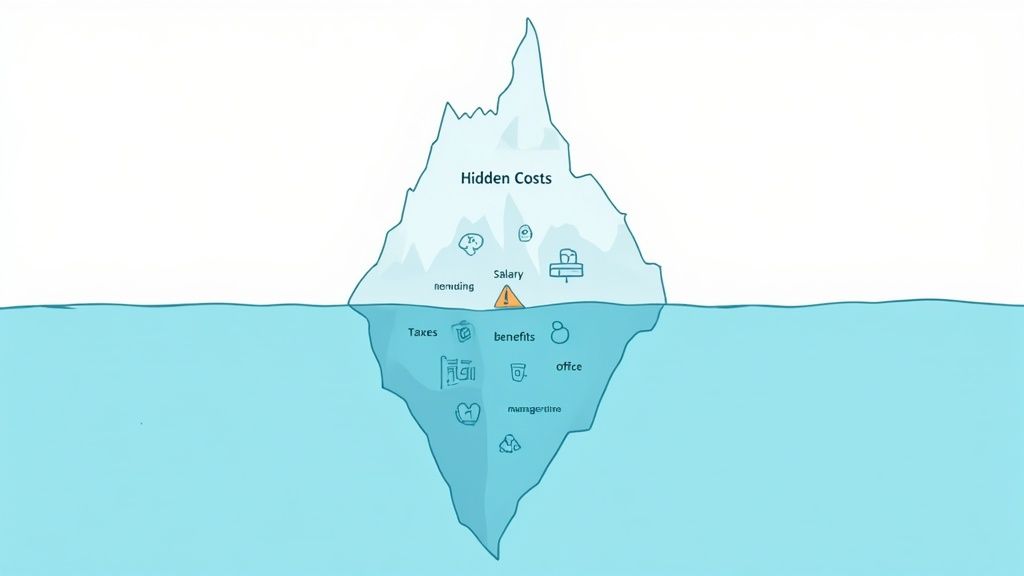
Let's do some quick, painful math. A good rule of thumb is that the true cost of a full-time employee is typically 1.25 to 1.4 times their base salary. So that $100,000 developer you just hired? They’re actually costing you closer to $140,000 per year.
Where does all that extra money go? I’m glad you asked.
And that’s just the stuff you can easily track on a balance sheet.
The most insidious costs of insourcing aren't on any invoice. They’re measured in your time, your focus, and your sanity.
Hope you enjoy spending your afternoons fact-checking resumes and running technical interviews—because that’s now your full-time job. Every hour you or your team spends on HR tasks is an hour you’re not spending on strategy, sales, or product development. It’s the ultimate "management tax," and it’s brutally expensive.
The Unspoken Truth: The biggest hidden cost of insourcing is the opportunity cost. While you spend six months trying to hire one senior developer, your competitor—who outsourced—has already shipped three new features.
This isn’t just a financial calculation; it’s a strategic one. You’re trading speed and focus for control. Sometimes that’s the right trade-off, but you have to go into it with your eyes wide open. You need to understand the ROI of hiring remote talent and how it stacks up against the ballooning costs of a purely local, in-house model.
Let's break down the timeline of pain for a typical in-house hire:
By the time your new hire is actually productive, a full quarter has passed. The insourcing vs. outsourcing debate isn't just about money; it’s about momentum. Stalling your momentum to build the "perfect" in-house team can be a fatal mistake.
Outsourcing often gets sold as a silver bullet for speed, talent, and magical cost savings. And sometimes, it actually works. But let's be painfully honest: it can also turn into a spectacular, budget-burning dumpster fire if you don’t know what you’re doing.
The key to avoiding disaster in the insourcing vs. outsourcing debate is understanding what you're really buying. "Outsourcing" isn't a single choice; it's a spectrum, and each option comes with its own unique blend of benefits and potential chaos. You're not just picking a vendor; you're choosing your trade-offs.
When you look outside your own walls for talent, you’ll generally find three main paths. Each one forces you to balance cost, communication, and complexity differently.
Choosing the right model means being brutally honest with yourself. Are you optimizing for cost, collaboration, or convenience? You can only pick two.
For years, the argument for outsourcing was simple: it's cheaper. While that’s often true, it’s a dangerously incomplete picture. The global outsourcing market is exploding for a reason. Statistics show the market was valued at USD 302.62 billion in 2024 and is projected to soar to around USD 525 billion by 2030. A significant 59% of businesses still point to cost-cutting as their primary driver.
But the smartest companies have moved beyond this one-dimensional thinking. Dig into the latest outsourcing statistics, and a new trend becomes clear.
The old model was about labor arbitrage—finding the cheapest possible hands to do the work. The new model is about talent arbitrage—finding the best possible minds, wherever they are.
Today, the real motivator isn't just saving a few bucks; it's gaining access to skills you can't find or afford at home. It’s about speed. While your local competitors are stuck in a six-month hiring cycle for a single AI engineer, a strategic outsourcing partner can have a pre-vetted, elite team ready to go in weeks.
The conversation has shifted from "How can we do this cheaper?" to "How can we do this at all?"
This talent-first mindset is why so many businesses are making more nuanced decisions in the insourcing vs. outsourcing comparison. They're not just chasing the lowest hourly rate in a far-flung time zone. They’re building strategic partnerships that plug critical talent gaps, accelerate product development, and create a genuine competitive edge. The question is no longer just about cost, but about capability and momentum.
Alright, enough theory. We’ve covered the costs, risks, and trade-offs of insourcing vs outsourcing. Now, let's get ruthlessly practical. This isn't a philosophical debate; it's a business decision that demands a clear framework, not just a gut feeling.
The right answer depends entirely on your situation. Are you a seed-stage startup building your core intellectual property? Don’t even think about outsourcing that. Are you a scale-up that needed to double its customer support team yesterday? Insourcing will absolutely kill your momentum.
Let's move beyond generic advice and build a situational playbook. The goal is to plug your specific business needs into a clear model and get an answer that actually works in the real world.
The first question you should always ask is: How fast do I need this done? Your answer immediately narrows the field.
If you're chasing a market opportunity or plugging a critical operational hole, you don't have six months to spare on recruiting. Outsourcing, especially nearshoring, is your speed dial. You can get a pre-vetted team in place in a matter of weeks, not months.
On the other hand, if the function is a permanent, slow-burn part of your business with no immediate urgency, then taking the time to insource and build that capability internally might make more sense. This is about building for the long haul.
This speed-to-market calculation is often the most overlooked factor. Founders fall in love with the idea of a perfect in-house team, forgetting that their competitors are already shipping product while they're still stuck in interviews.
Next, let's get specific about what you're sourcing. Not all business functions are created equal. Where a task falls on the spectrum from core competency to commodity work should dictate your strategy.
The Founder's Litmus Test: If this function fails, does my entire company crumble? If the answer is yes, that's your core. Guard it with your life. Everything else is a candidate for optimization.
Let's break it down with a few common scenarios:
This flowchart simplifies the outsourcing decision tree by location, which is a key factor once you've decided to look externally.
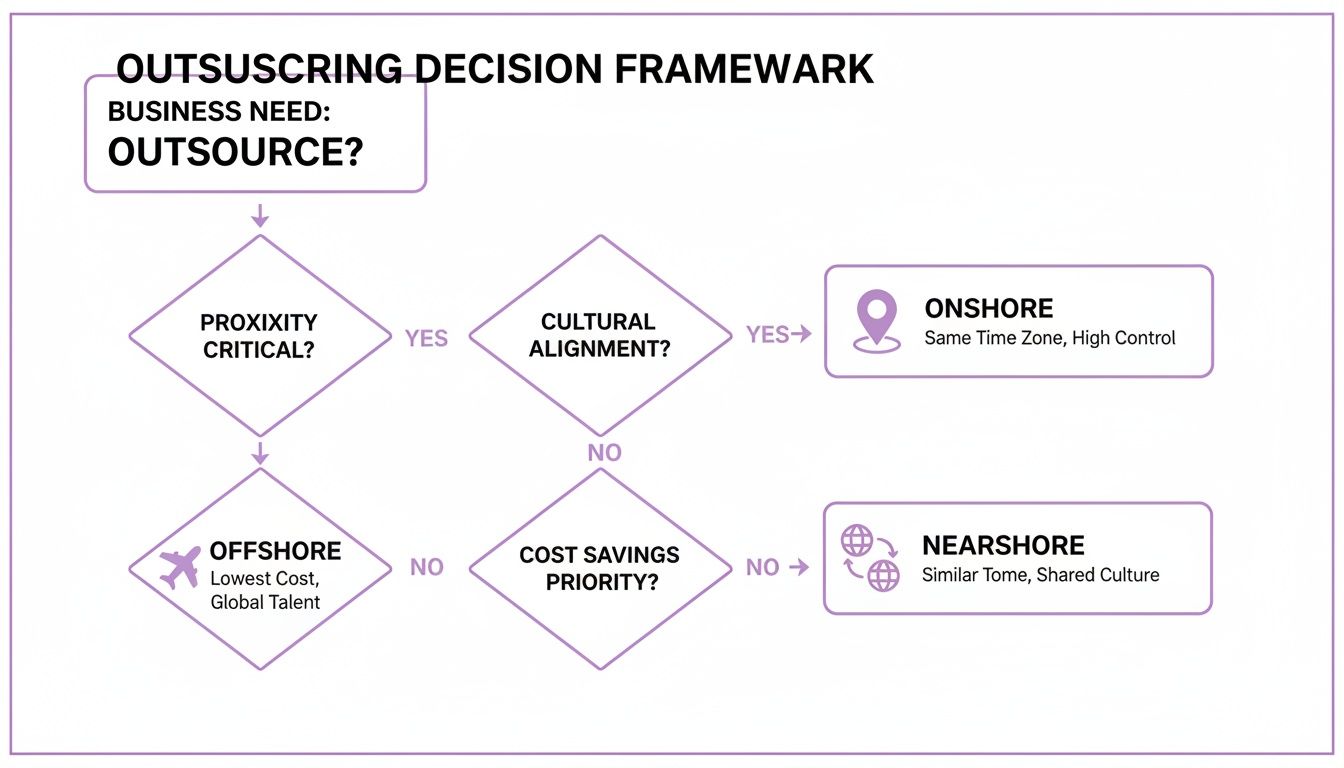
As you can see, when the need shifts from pure cost-savings toward more collaboration, nearshore models like those in Latin America offer a balanced solution between onshore proximity and offshore pricing.
To make this even more concrete, here's a matrix to help map your specific needs to the right model.
This table is a practical framework for mapping your business needs to the optimal choice between insourcing, outsourcing, and a hybrid model.
| Business Scenario | Recommended Model | Why It Works |
|---|---|---|
| Developing core IP or a proprietary algorithm. | Insourcing | Protects trade secrets and ensures the team has deep, long-term institutional knowledge. Full control is non-negotiable. |
| Needing to scale a customer support team by 50% in one quarter. | Outsourcing (Nearshore) | Speed is everything. Nearshoring provides rapid access to a large, time-zone-aligned talent pool without the long hiring cycle. |
| Building a one-off mobile app when your main product is web-based. | Outsourcing (Project-Based) | Access specialized skills for a defined project without adding permanent headcount. Pay for the expertise you need, when you need it. |
| Managing IT infrastructure and cybersecurity. | Outsourcing (MSP) | Leverages the expertise and economies of scale of a dedicated provider, reducing costs and freeing up internal resources. |
| Maintaining legacy code while the core team builds new features. | Hybrid (Nearshore Team) | Augment your in-house team with a dedicated remote squad to handle maintenance, allowing your core engineers to focus on innovation. |
Use this as a starting point. Your specific context will always add nuance, but this framework provides a solid foundation for making a smart, strategic decision.
The final piece of the puzzle is arguably the most important one today: access to talent. The game has completely changed. By 2025, the strategic reasons companies outsource have shifted dramatically, with access to specialized skills now frequently trumping pure cost savings.
A recent survey on HR outsourcing found that 'access to talent' overtook 'cost/efficiency' as the top driver for the first time since the pandemic. This talent-driven shift has supercharged the nearshoring trend, with Latin America emerging as the number one destination for North American companies needing time-zone alignment and specific skill sets. You can explore more about these HR outsourcing trends moving the market in 2025.
The modern insourcing vs. outsourcing debate isn't just about saving money anymore. It's about finding the elite engineers, data scientists, and marketers you simply can't hire in your local market. If the talent you need is scarce and expensive at home, looking abroad isn't just an option; it's a competitive necessity.
Let’s be honest. Offshoring to a team 12 time zones away feels like a bargain until your first 3 AM conference call turns into a recurring nightmare. On the flip side, insourcing sounds great until you’ve spent six months and a small fortune trying to hire one senior developer in a hyper-competitive local market.
There has to be a better way. And there is.
It’s the smart middle ground that sidesteps the extremes of the insourcing vs. outsourcing debate. This isn't about finding the absolute cheapest labor or mortgaging the office ping-pong table for a local hire. It’s about building a genuine extension of your team, just a few hours away.
Nearshoring is the "just right" option that clever founders are using to scale faster and smarter. It means partnering with talent in nearby countries with similar time zones and cultural contexts—for U.S. and Canadian companies, that means tapping into the incredible talent hubs across Latin America.
This isn't your classic, faceless outsourcing. It's a strategic partnership. Here’s why it works so well:
Think of it this way: Nearshoring gives you the collaboration and control of an in-house team with the cost-efficiency and scalability of traditional outsourcing. You get the best of both worlds without the worst of either.
The biggest difference between nearshoring and old-school offshoring is the mindset. You're not just handing off tasks to a faceless firm; you're integrating skilled individuals into your daily workflow, your Slack channels, and your company culture.
This model is built for a world where you need both agility and quality. You’re building a cohesive unit that understands your mission and contributes to it directly. It’s about adding firepower to your team, not just offloading work. For a deeper dive into the mechanics and benefits, check out our guide on what nearshore outsourcing really means and how it can reshape your growth strategy.
Ultimately, the choice isn’t just about insourcing vs outsourcing anymore. It's about finding the smartest, most effective way to build the team you need to win. Nearshoring provides a powerful, pragmatic path forward—one that balances cost, quality, and collaboration without compromise. It’s how you build a world-class team without breaking the bank or your sleep schedule.
Alright, you’ve made the call. The endless insourcing vs. outsourcing debate is settled, and you have a direction. Now for the hard part: execution. Getting this next step wrong is like picking the right destination but driving your car off a cliff.
Whether you’re building your team in-house or bringing on a partner, the implementation phase is riddled with traps that can completely sabotage your strategy. This isn’t just about following a process; it’s about sidestepping the rookie mistakes that cost a fortune in both time and sanity.
So, you're building the dream team in-house. Fantastic. But how do you pull it off without turning your entire C-suite into a full-time HR department?
Your goal is to create a repeatable, scalable hiring machine, not just to fill a single open role. Forget about winging it.
Decided to outsource? Smart move. Now, how do you pick the right partner without getting fooled by a slick sales deck? After you decide to outsource, a successful outcome hinges on solid vendor management best practices that will streamline your workflows and cut down on risk.
Don't just ask about their skills; you need to grill them on their process. Here are the questions that separate the real pros from the pretenders:
The decision to insource or outsource is no longer a permanent one. The best companies treat it like a strategic muscle, constantly re-evaluating their approach based on market conditions, internal capabilities, and new technology.
The ground is always shifting under our feet. Automation, for instance, is changing the economic calculus entirely. Recent industry data showed that around 60% of finance and accounting outsourcing contracts were unlikely to be renewed by 2025. Why? Because old headcount-based pricing models no longer make sense when automation is driving so much productivity. The decision today is about total cost and capabilities, not just counting bodies.
Alright, let's tackle a few of the questions that are probably bouncing around in your head. No corporate speak—just straight answers to what founders and managers actually want to know about the insourcing vs. outsourcing dilemma.
Hands down, the single biggest mistake is choosing a partner based solely on the lowest price. It’s a classic rookie error, a trap that almost always leads to communication nightmares, shoddy work, and deadlines that fly by in a blur of excuses.
That "cheap" option quickly becomes the most expensive decision you’ll ever make. You have to factor in the cost of rework, your own team's wasted time managing the mess, and the opportunity cost of a delayed project. A solid outsourcing relationship is a partnership, not just a transaction.
The Real Bottom Line: Don't chase the lowest hourly rate. Chase the highest value. Zero in on expertise, communication, and cultural fit. A slightly higher rate for a team that delivers is infinitely cheaper than a bargain-bin price for a team that doesn't.
Not anymore. The old playbook said to guard your "secret sauce" with an in-house team at all costs. For some things, that’s still true, but the definition of "core" is getting a lot more flexible these days.
Let’s be realistic. What if a specialized skill, like advanced AI development or cybersecurity, is absolutely critical to your product but nearly impossible for you to hire and retain locally? Is a struggling, understaffed internal team really better than a dedicated, world-class team from a specialized partner?
The modern answer is a firm no. Sometimes, the most strategic way to protect and build your core function is to partner with experts who can execute faster and better than you ever could on your own. It's about securing capability, not just owning the location.
You have to be intentional about it. Culture doesn't just magically happen because everyone shares the same email domain. It’s built through shared experiences and daily interactions.
The key is to treat your outsourced team members like part of your company, not just line items on an invoice.
Your company culture is defined by how you work together to solve problems. If you treat your remote talent like true teammates, that's exactly what they'll become.

