

So, what exactly is a global recruiting agency? A fancy way of saying they’re your matchmaker for hiring talent anywhere in the world. They handle the messy, complicated parts—local labor laws, compliance, payroll nightmares—so you can tap into a global talent pool without the usual headaches.
Simple, right?
Let’s be honest. Your local talent pool is starting to feel more like a puddle. That rockstar Senior Engineer or niche Marketing Director you desperately need probably isn’t living down the street. But the thought of hiring internationally brings on visions of compliance nightmares, confusing tax laws, and enough paperwork to build a fort.
This is exactly where a global recruiting agency steps in.
Think of them as a talent marketplace with a built-in legal and HR team. They promise you access to the world’s best talent, but what does that really mean in practice?
Sure, you could try to figure out German labor laws or Brazilian tax withholding on your own. But do you really want to spend your afternoons buried in foreign bureaucracy instead of, you know, building your company? That’s what happens when you go it alone. A good agency takes all that nonsense off your plate.
Their core job is to be your boots on the ground, connecting you with vetted professionals you’d otherwise never find. This isn’t just about posting on a few international job boards and hoping for the best. It’s about leveraging deep, established networks and local expertise to find people who are a genuine fit for your team, not just a keyword match on a resume.
Turns out there’s more than one way to hire elite developers without mortgaging your office ping-pong table to pay for legal fees. The goal isn't just to hire someone from another country. It's to hire the right person from any country.
The best global recruiting partners do way more than just forward you a stack of CVs. They become a true extension of your team, managing the logistical chaos that comes with building a distributed workforce.
This typically includes:
This isn't some tiny niche, either. The global recruitment market is exploding and is projected to be worth over USD 650 billion by 2025. That growth is being driven by companies just like yours realizing that incredible talent is borderless—and they need a smart partner to help them make the connection. You can dig into the numbers yourself and learn more about the recruitment industry's rapid growth on researchandmarkets.com.
Before we go deeper, here's a quick cheat sheet to help you decide if this model is right for you.
| Core Benefit | Potential Downside | Best For Companies That… |
|---|---|---|
| Access to a global talent pool | Higher upfront costs | …Need to fill highly specialized roles (e.g., Senior AI engineers, niche marketers). |
| Handles all legal & compliance | Less direct control over process | …Are scaling quickly and don't have an in-house international HR team. |
| Faster time-to-hire in new markets | Can feel transactional if not a true partner | …Want to test a new market without establishing a legal entity there first. |
If the benefits resonate and the downsides seem manageable, let's look at how these agencies really work.
Every agency website has the same stock photo of a smiling, diverse team and a bold promise of "top-tier global talent." It all looks great. But what actually happens after you sign the contract and they cash your check? Let's pull back the curtain.
This isn't about their marketing pitch; it's about the real, day-to-day grind. How do they find a brilliant developer in Brazil while you're still asleep in Seattle? The process is part art, part science, and a whole lot of logistical wizardry you’re paying them to handle so you don't have to.
This quick overview shows the simplified journey from your hiring headache to a solution.
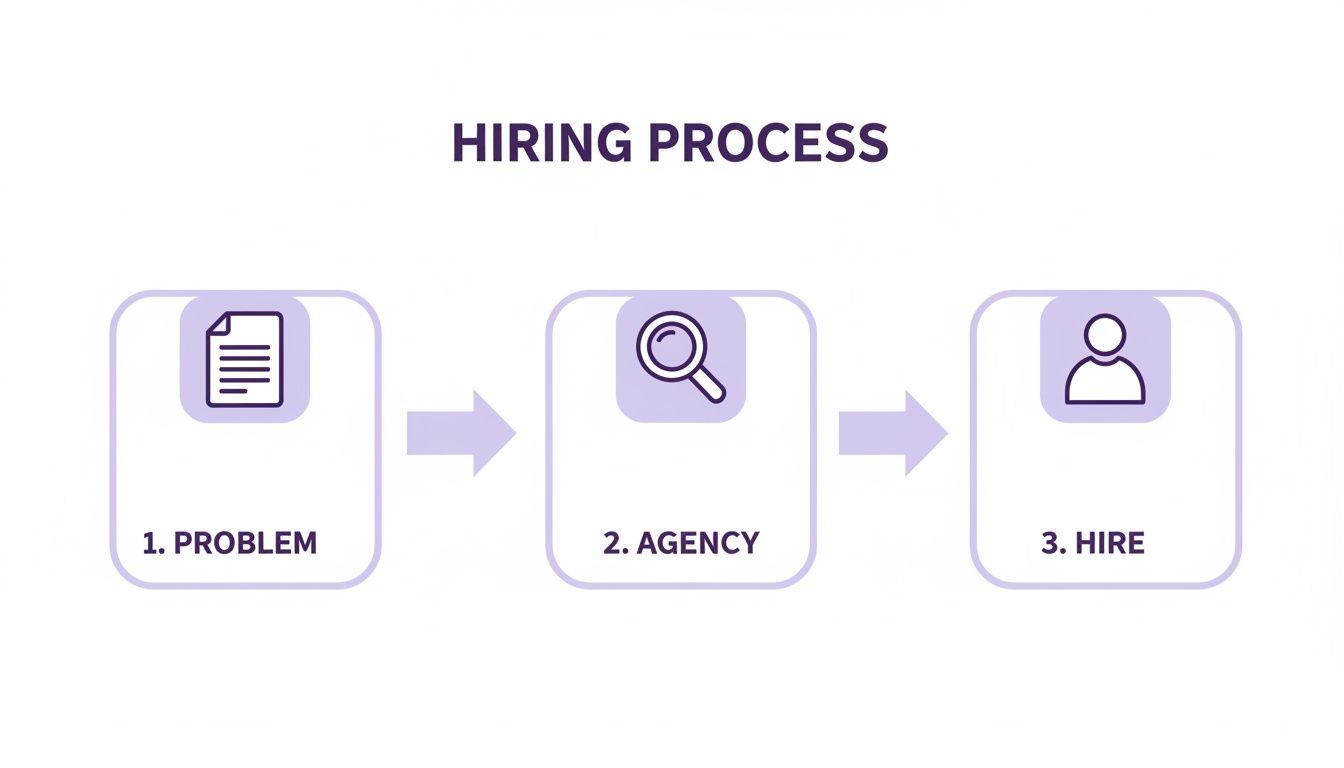
Essentially, a global recruiting agency acts as the bridge, taking your well-defined need and applying a rigorous search-and-vetting process to deliver a qualified hire.
If you think a global recruiting agency just runs a few advanced searches on LinkedIn, you might as well do it yourself. Sure, LinkedIn is part of the toolkit, but it’s the bare minimum. The real value comes from what they do beyond the obvious.
A serious agency operates on multiple fronts, building and nurturing talent pipelines long before you even have a job opening. Their sourcing methods are a blend of technology and old-fashioned networking.
This is where a great agency earns its fee. Finding a resume that lists "Python" is easy. Finding a developer who can actually write clean, scalable Python code under pressure is another story entirely. Hope you enjoy spending your afternoons fact-checking resumes and running technical interviews—because that’s their full-time job.
The real work isn't finding people; it's disqualifying the wrong people. A top-tier agency filters out 95% of applicants before a single candidate profile ever lands in your inbox.
Their multi-stage vetting process is designed to be ruthless. It usually looks something like this:
Once a candidate passes the gauntlet, the agency shifts into a coordination and logistics role. They present you with a curated shortlist, not a data dump. Each profile is a summary of why that person is a strong fit, saving you hours of reading through resumes.
They manage the entire interview loop, wrangling calendars across impossible time zones so you can focus on the conversation, not the scheduling. And when it’s time to make an offer, they act as a crucial intermediary, managing salary expectations and navigating cultural nuances in negotiation.
They know what a competitive offer looks like in São Paulo versus Berlin, ensuring you secure your top choice without overpaying. It’s a full-service operation designed to make global hiring feel almost as simple as hiring locally. Almost.
Alright, let's talk about the elephant in the room: money. A global recruiting agency will send you an invoice, and it won't be for pocket change. But framing this as just an "expense" is the fastest way to make a bad decision.
The real conversation is about the agency's fee versus the colossal, often invisible, costs of doing it all yourself. This isn't about finding the cheapest option. It’s about finding the smartest one.
When an agency quotes you a price, it usually falls into one of three buckets. Each model is built for a different kind of hiring need, and picking the wrong one is like bringing a spoon to a knife fight—ineffective and messy.
The most important line item isn't on the agency's invoice. It's the cost of your time, your team's lost productivity, and the risk of a bad hire, which can cost up to 2.5 times that employee's salary to fix.
To really see the difference, let's break down the costs of hiring a single senior remote developer with a $100,000 salary. One path involves a standard agency, and the other is the "do-it-yourself" route.
| Cost Factor | Global Recruiting Agency (Contingency) | In-House DIY Approach |
|---|---|---|
| Recruitment Fee | $25,000 (at a 25% fee) | $0 |
| Internal Time Cost | Minimal (a few hours for final interviews) | ~$15,000 (100+ hours for a senior manager) |
| Legal/Compliance | Included in the service | $5,000 – $10,000+ (for international lawyers) |
| Payroll/HR Setup | Included in the service | $2,000+ (for a global payroll provider) |
| Opportunity Cost | Engineering team stays focused on product | High distraction, lost productivity |
| Risk of Bad Hire | Low (often includes a replacement guarantee) | High (no safety net) |
| Total Outlay | $25,000 (Predictable) | ~$22,000 – $27,000+ (Unpredictable, with major risk) |
Suddenly, that agency fee looks less like a cost and more like an insurance policy against distraction, legal headaches, and costly hiring mistakes. When evaluating the overall expense, it's important to understand how to calculate and potentially lower your overall recruitment cost per hire.
The direct savings are just the beginning. The right partner unlocks savings you haven't even thought of yet.
For US and Canadian companies, this is where specialized platforms make a huge difference. For example, some cut hiring expenses by up to 80% and shrink time-to-hire by just as much by handling international payroll, benefits, and compliance for hundreds of thousands of vetted Latin American pros. While industry giants lead, focused AI platforms are empowering companies to scale seamlessly, matching candidates in 24 hours with timezone-aligned talent.
Finally, read the fine print. Does your contract include a replacement guarantee? If your new hire flames out in 90 days, a good agency will find you a replacement for free. That clause alone can be worth the entire fee.
Not all agencies are created equal. Not even close.
Some are genuine strategic partners who will fundamentally change your company's trajectory for the better. Others are little more than resume forwarders, blasting your inbox with every profile that vaguely matches a keyword. Firing one of them is a painful, expensive lesson you only want to learn once.
Choosing the right global recruiting agency has less to do with their sales pitch and more to do with your own vetting process. This is your playbook for separating the real deal from the noise. It’s about making an informed choice, not just an optimistic one.

Every agency has a "Success Stories" page, and they all look fantastic. But glossy PDFs and glowing testimonials can easily hide a multitude of sins. You have to read between the lines to gauge their true effectiveness.
Look for specificity. A case study that says "we helped a SaaS company scale" is useless marketing fluff. One that says "we sourced, vetted, and placed three senior DevOps engineers in Brazil and Colombia in seven weeks, reducing their time-to-hire by 60%"—now that tells you something real.
Don't just ask for references. Ask for a reference from a client who had a placement fail. How the agency handled that failure will tell you everything you need to know about their character and commitment.
Before you even book a discovery call, your potential partner needs to pass a basic sniff test. If they can’t tick these fundamental boxes, just move on. Your time is too valuable to sit through a sales pitch that’s going nowhere.
Here’s what to look for:
For a deeper dive, check out our guide to choosing a remote work recruitment agency which covers more of these foundational aspects.
Now for the fun part: the interview. Your goal is to break them out of their rehearsed presentation and see how they think on their feet. Generic questions get generic answers. Sharp, pointed questions reveal the truth.
Here are a few of my favorites to throw into the conversation:
Choosing an agency is a big commitment. Don't rush it. Use this framework to be methodical and demanding. The right partner will welcome the tough questions because they know they have the right answers.
So, a global recruiting agency sounds like a solid plan. But let's be honest—it's not your only move. Before you sign on the dotted line, it’s just good business to size up the other players on the field. You have a few different paths you can take, and each one comes with its own unique blend of potential wins and guaranteed headaches.
Let’s stack them up. This isn’t about finding the one "best" way, but figuring out the right way for your company, right now.
First up is the classic DIY approach: building your own international recruiting team from scratch. This is the path of absolute control. You own the entire process, the candidate experience, and every single decision from sourcing to offer letter. Sounds empowering, right?
Well, I hope you enjoy spending your days trying to verify foreign university degrees and deciphering obscure tax laws in another language—because that’s your new side hustle. Going in-house means you’re on the hook for everything: sourcing, vetting, compliance, payroll, and benefits administration in every single country you hire from. It is a monumental lift.
The real cost here isn't just the salaries for your new HR hires. It's the massive distraction from your core business and the steep, expensive learning curve of becoming a mini-expert in global employment law overnight.
Building an in-house team only really starts to make sense when you're hiring dozens of people in a single country and have the capital to pour into local legal and HR infrastructure. For most scaling companies, it’s like building your own power plant just to charge your phone.
Next, you've got the sprawling, chaotic world of freelance marketplaces. Think of them as the gig economy for professional services. They’re fantastic for one-off projects with a clearly defined start and end. Need a logo designed or a small piece of code written? Perfect.
But hiring a core, permanent team member? It’s a total gamble. These platforms are transactional by their very nature. You aren't typically finding long-term, committed team players who are deeply invested in your company’s mission. You’re finding skilled contractors looking for their next gig.
The vetting is often superficial at best, leaving you to sift through countless profiles and conduct an endless parade of screening calls. And when it comes to compliance? You’re completely on your own, walking the tightrope of contractor misclassification and praying you don’t slip.
Finally, there’s Recruitment Process Outsourcing, or RPO. This isn't just hiring an agency to fill a few roles; it’s handing over the keys to your entire talent acquisition function. An RPO provider literally becomes your recruiting department, managing everything from your employer brand and sourcing strategy all the way through to onboarding.
This model is a heavy-duty solution designed for large enterprises that need to completely overhaul their hiring engine. It’s a long-term, deeply integrated partnership. For a startup or a mid-sized company looking to make a few strategic global hires, it's almost always overkill.
Here’s a quick breakdown of how these options compare:
| Model | Best For | Biggest Headache |
|---|---|---|
| In-House Team | Massive hiring scale in a single country | The insane administrative and legal burden |
| Freelance Marketplaces | Short-term, project-based tasks | Finding genuinely committed, long-term talent |
| RPO | Enterprise-level process overhaul | High cost and a massive long-term commitment |
| Global Recruiting Agency | Strategic, targeted global hires | Finding the right agency partner to trust |
At the end of the day, a global recruiting agency hits the sweet spot. It gives you the expertise and infrastructure of an in-house team without the crushing overhead, and it delivers the kind of committed, long-term talent that marketplaces simply can't. They often handle the messy backend work through services that act as an Employer of Record, which you can learn more about in our in-depth guide on what an Employer of Record is. This frees you up to focus on what you actually do best: building your business.
Alright, enough theory. You’ve seen the models, compared the costs, and hopefully dodged the analysis paralysis that kills most great ideas. It’s time to move from "what if" to "what's next."
The best way to do that isn’t by drafting a 10-page global expansion strategy—it’s by hiring one person.
This is your pilot project. Your proof-of-concept. Pick one critical role that’s been a thorn in your side for months. That Senior DevOps Engineer you can’t find locally? The niche Content Marketer who truly understands your audience? That’s your target.
By focusing on a single, strategic hire through a global recruiting agency, you get to test the entire system with minimal risk. You’re not committing your whole hiring budget; you’re just dipping a toe in the global talent pool to see if the water’s as warm as everyone says it is.
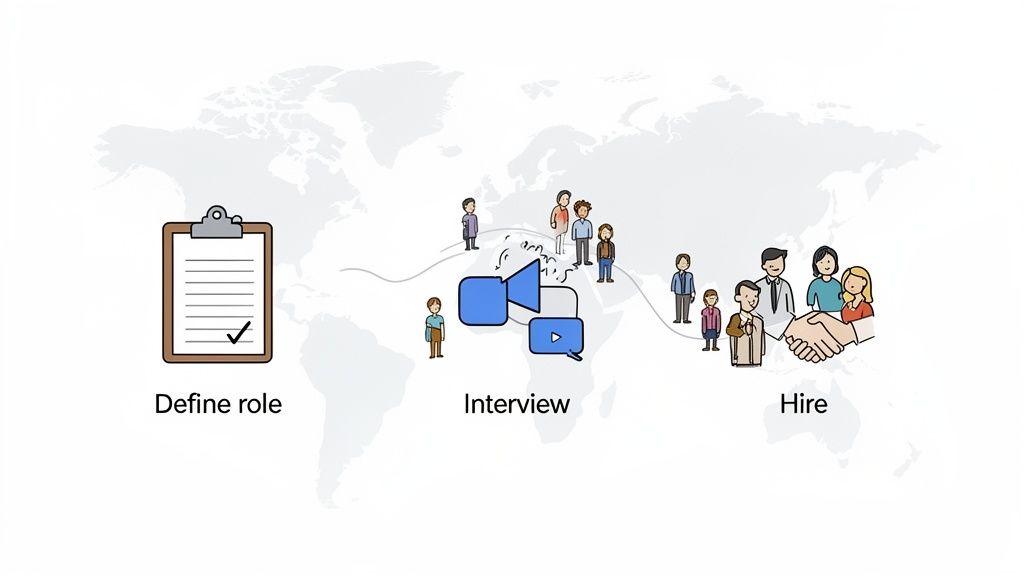
Forget the endless planning meetings. Let’s get tactical. Here’s your simple, no-fluff roadmap to getting started this week.
The goal of this first hire is to learn. You'll discover unforeseen challenges in your interview process, your onboarding, and your team communication. Better to learn those lessons on one hire than on ten.
Making this leap involves more than just finding a candidate; it means navigating the specific legal groundwork. For any company looking to hire in the UK, for example, obtaining a UK Sponsorship Licence is often a mandatory first step—something a good global agency can help facilitate. Every country has its own non-negotiables.
For a complete breakdown of the operational side, read our guide on how to hire international employees to get your checklist in order. The goal here is confident execution, not perfection. Make your first global hire, learn from it, and then you’ll be ready to build the world-class team you need, no matter where they are.
Alright, you’ve made it this far, which means you’re either seriously considering this or just looking for the footnotes. Either way, let’s tackle the quick-fire questions we hear all the time. No fluff, just the straight answers you’re probably wondering about.
This is the million-dollar question, isn't it? The answer is a frustrating "it depends," but I can give you the real breakdown. A traditional, old-school agency might take 6-12 weeks to fill a role. It’s a slow, manual process of sourcing, screening, and scheduling from square one.
But modern platforms that maintain pre-vetted talent pools are built for speed. Because they aren't starting from scratch, they can often present you with qualified, vetted matches in as little as 24 hours.
From there, your internal interview process is the only variable. The total time-to-hire can be slashed by over 80%, often wrapping up in just a couple of weeks instead of a couple of months.
This is the single biggest headache and the best reason to partner with a comprehensive service. A top-tier global recruiting agency doesn’t just toss resumes over the fence and wish you luck. They handle the messy, high-stakes backend work so you don't have to.
This service is typically called an "Employer of Record" or EOR. They become the legal employer in the candidate's country, managing local payroll, taxes, and benefits. It’s how you hire in another country without needing a law degree and an international accounting firm on retainer.
This completely removes the administrative and legal burden from your team. You can focus on integrating your new hire, not on deciphering foreign tax code.
Not necessarily. In fact, it’s often the exact opposite. While the agency charges a fee for their service, the talent itself can unlock significant savings that more than cover it.
For example, hiring an elite developer or marketing specialist from a talent-rich region like Latin America can reduce your salary costs by up to 80% compared to an equivalent role in San Francisco or New York—without sacrificing an ounce of quality.
You have to look at the total cost: the agency fee plus the salary. In most cases, that number is far lower than what you’d pay for local talent.
This is critical, and any agency that brushes it off isn't worth your time. A great partner vets for more than just a list of technical skills. Their process should feel like an extension of your own hiring philosophy.
They need to be screening for the things that actually matter in a remote team:
They should also focus on talent pools in similar time zones to minimize collaboration friction. The goal is to get a holistic view of the person, not just a technical profile. Your job is to confirm that fit during the interview, but their job is to make sure you’re not wasting your time on candidates who will never work out.

