

Let's cut the jargon. Global hire placement is a fancy term for a dead-simple idea: hiring the best person for the job, period. It doesn’t matter if they’re in your city or halfway across the world.
It’s the whole nine yards—sourcing, vetting, hiring, and managing talent anywhere on the planet—while someone else handles the messy legal and payroll headaches. Simple as that.
If you’ve tried to fill a critical role recently, you know the drill. The local talent pool feels more like a shallow puddle, and every decent candidate is juggling three other offers. You’re left competing with giants who can just throw money at the problem until it goes away.
But what if you didn’t have to play that game?
Turns out there’s more than one way to hire elite developers without mortgaging your office ping-pong table. Clinging to a 30-mile hiring radius is a surefire way to get left behind. The real opportunity—the untapped, ambitious, and surprisingly affordable talent—is global. This isn't about finding cheap labor; it’s a strategic countermove against a brutal talent shortage. It’s about finally accepting that your company's next superstar probably has a different stamp in their passport.
For too long, the go-to "solution" for tapping into international talent was to hire a bunch of freelancers on some platform. That might work for a one-off project, but it’s a terrible strategy for building a real team. Suddenly, your afternoons are spent fact-checking invoices and navigating the murky waters of worker misclassification. That becomes your new part-time job.
A genuine global hire placement strategy has nothing to do with gig workers. It’s about building a core, committed team. It means finding full-time professionals who are truly integrated into your company culture, aligned with your mission, and invested in your long-term success.
This requires a real process, one that handles everything from finding a qualified developer in São Paulo to running their payroll correctly. This is where a dedicated partner comes in, making the experience of hiring someone in another country feel just as simple as hiring someone down the street.
This is a fundamental shift in how smart companies build winning teams. The logic is simple and powerful:
This isn’t outsourcing in the old-school sense. It’s strategic team building on a global scale—finding the right skills, at the right time, at a cost that actually makes sense.
So, you’re sold on the idea. You’ve pictured that brilliant engineer from Bogotá joining your morning stand-up, and you’re ready to dive in. Hold on. This is the part where good intentions meet the operational gauntlet. Welcome to the messy, complicated, and absolutely critical part of global hire placement.
Trying to DIY this is like deciding to perform your own dental surgery—it’s going to be painful, messy, and you’ll almost certainly regret it. It boils down to four distinct pillars of pain, each one ready to derail your brilliant plan. Let's break them down, founder-to-founder.
This diagram breaks down the core components you'll need to master.

As you can see, a successful global hire requires a connected strategy across sourcing, hiring, and ongoing management, not just isolated actions.
First up: sourcing and vetting. Your usual LinkedIn spam tactics won't cut it here. You’re not just looking for a keyword match; you're hunting for a cultural fit, technical excellence, and genuine commitment from someone thousands of miles away.
Hope you enjoy spending your afternoons fact-checking resumes and running technical interviews at 10 PM—because that’s now your full-time job. The real challenge isn't just finding candidates; it's validating them. Are their skills legit? Do they actually speak English as well as they claim? Running effective and secure international background checks is a complex but non-negotiable step to protect your business from bad hires.
Next comes onboarding and integration. You found your star player. Now what? You can't just ship them a laptop and a welcome T-shirt and call it a day. How do you make someone in a different country feel like part of the team?
The difference between a disengaged remote worker and a dedicated team member is the onboarding experience. If you get it wrong, you’ve just spent thousands on a very expensive revolving door.
A sloppy onboarding process screams, "You're just a resource, not a teammate," and that’s a death sentence for morale and long-term retention.
Now for my favorite headache: payroll and benefits. Your domestic payroll software will laugh you out of the room. Suddenly, you're a day trader trying to figure out currency fluctuations, wire transfer fees, and withholding taxes in a country whose laws you can’t even read.
Getting this wrong doesn’t just frustrate your new hire; it puts you in direct violation of local labor laws.
Finally, we arrive at the big one: compliance. This is the invisible minefield that can sink your company before you even get started. Every country has its own unique set of employment laws, tax codes, and worker classification rules.
Misclassifying a full-time employee as a contractor can lead to staggering fines, back taxes, and forced severance payments. The trend is clear—companies are looking abroad more than ever. The Remote 2025 Global Workforce Report found that more than half of organizations plan to increase their international hires. Without a legal entity in that country, you’re navigating this maze blindfolded. This isn't a risk; it's a certainty waiting to happen unless you have an expert guiding you.
To put it all in perspective, here's a look at what handling these challenges yourself really entails versus working with a partner.
| Challenge Area | The DIY Nightmare (What You Handle Alone) | The Smart Way (Using a Partner like LatHire) |
|---|---|---|
| Sourcing & Vetting | Endless hours on job boards, late-night interviews, and guessing if a candidate's skills are real. | Access to a pre-vetted talent pool. We've already done the technical screening and cultural fit interviews for you. |
| Onboarding | Shipping laptops internationally, wrestling with IT security, and trying to make someone feel included over Zoom. | A structured onboarding process that handles everything from equipment to initial team integration. |
| Payroll & Benefits | Juggling currency conversions, international wire fees, and trying to create a compliant benefits package. | A single invoice in your local currency. We handle all local payroll, taxes, and statutory benefits. |
| Compliance & Legal | Praying you don't misclassify an employee and trigger an audit, fines, or legal action from a foreign government. | Full compliance handled through our local legal entities. We assume the risk so you don't have to. |
The takeaway is simple. While going it alone might seem cheaper upfront, the hidden costs in time, legal risk, and administrative headaches are enormous. A partner turns these operational nightmares into a simple, managed service.
So, how do you actually bring global talent onto your team without accidentally setting up an illegal subsidiary in another country? There are really only three paths forward, each with its own brand of headaches and triumphs.
Let's do a founder-to-founder breakdown. This isn't some neutral overview; it’s an opinionated guide to help you pick the right tool for the job.
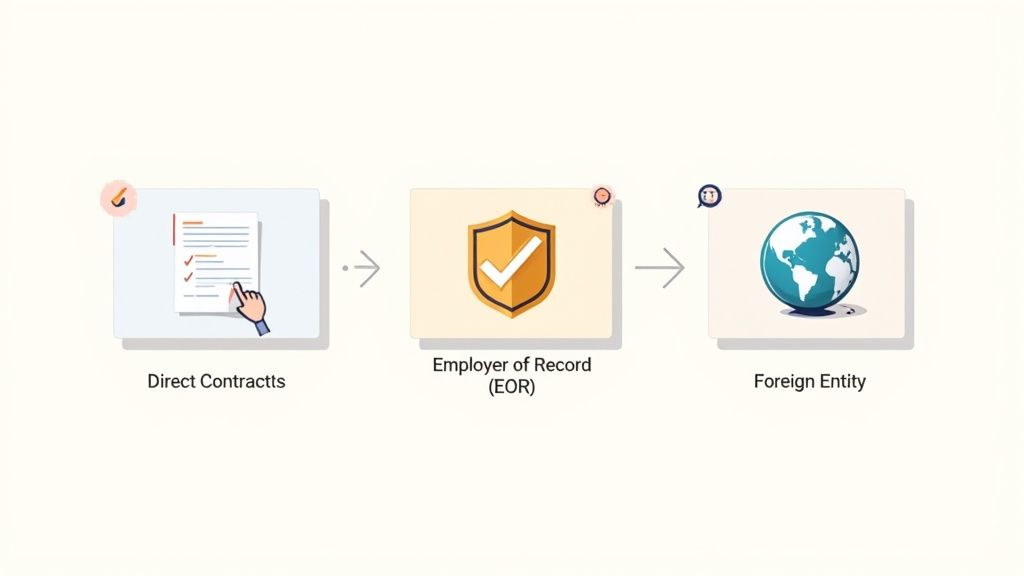
The first and most common path is hiring someone as a direct contractor. On the surface, it’s beautiful. Fast, flexible, and you skip all the messy employer taxes. You find someone, sign a contract, and wire them money. Simple, right?
Wrong. This model is a compliance time bomb.
Governments worldwide are cracking down hard on worker misclassification. If your "contractor" works exclusively for you and follows your direction, they probably aren't a contractor in the eyes of the law. The penalties for getting this wrong are severe—think back-taxes, fines, and forced severance pay that can cripple a startup.
Option two: establishing your own foreign legal entity. This gives you maximum control. You can hire employees directly, create custom benefit packages, and operate just like you do back home.
Sounds great, until you realize you’ve just signed up for a multi-year, six-figure bureaucratic nightmare. Hope you enjoy foreign tax law and navigating a legal system you don't understand. This route requires a massive investment of time and capital.
Unless you’re a massive enterprise planning to hire dozens of people in one specific country, setting up your own entity is like using a sledgehammer to crack a nut. Expensive, slow, and completely unnecessary.
Then there's the third way, the one we’ve seen win time and time again: using an Employer of Record (EOR).
Think of an EOR as your in-country HR and legal department-as-a-service. They legally employ the talent on your behalf, handling all the compliance, payroll, taxes, and statutory benefits required by local law.
You still source, interview, and manage your team member's day-to-day work. But the EOR handles the backend administrative and legal burden. It’s the perfect middle ground, offering the compliance of direct employment without the cost and complexity of setting up your own entity. This approach also simplifies decisions around talent location; our guide on the differences between offshore vs nearshore hiring can help you pinpoint the best regions for your needs.
Here's a quick look at how they stack up:
| Model | Speed to Hire | Compliance Risk | Cost |
|---|---|---|---|
| Direct Contractor | Days | Very High | Low (at first) |
| Foreign Entity | 6-12+ Months | Low (if done right) | Extremely High |
| Employer of Record (EOR) | Weeks | Very Low | Moderate & predictable |
For 99% of startups and SMEs, the EOR model is the smartest, safest, and most efficient path for global hire placement. You get all the benefits of a global team without having to mortgage the office ping-pong table.
Alright, let's get into the metrics that actually move the needle for your business.
Sticking to your local market isn't just old-fashioned; it's a huge competitive disadvantage. When you’re only fishing in your local pond, you’re paying a premium for a limited supply of talent who are probably being courted by five other companies down the street. You're entering a bidding war you can't win.
The most immediate win is cost. And no, this isn't about finding "cheap" labor—it's about finding incredible value. A senior software engineer in São Paulo brings the same—or even better—skill set as their Silicon Valley counterpart for a fraction of the cost.
And the savings stack up when you factor in all the overhead you're sidestepping:
This is significant capital you can pour back into your product, marketing, or your bottom line.
What's the real cost of an unfilled role? Every week that a key position sits open, your product roadmap stalls, sales targets get missed, and your current team gets one step closer to burnout. The opportunity cost is massive.
By opening your search to the world, you drastically shorten your time-to-hire. We’ve seen critical roles filled in under two weeks. That kind of speed is a serious advantage.
When your competitors are stuck in a six-month hiring cycle for a single engineer, and you've already built out an entire product team in that time, you've already won.
The demand for cross-border talent has exploded, particularly in tech, sales, and marketing. A recent report found that 57% of HR professionals are planning to hire talent from another country within the next year. This isn't some niche strategy anymore; it’s quickly becoming the standard for smart, agile companies.
Beyond the immediate financial and operational wins, a global team gives you strategic advantages that are much harder to quantify but infinitely more powerful.
You get a team with diverse perspectives, shaped by different markets and cultural experiences. This isn't just a feel-good metric; it leads directly to more creative problem-solving and a product that resonates with a broader, global audience.
Ultimately, to really tap into these advantages, you need to understand the key steps to attract global talent by fine-tuning your company culture. It's not just about finding people; it's about building an environment where they can thrive, no matter where they are. This is how you create a resilient company that isn't at the mercy of a single local market.
The global hiring market is crowded and noisy. Every platform flashes slick dashboards and promises you a world-class team by next Tuesday. So, how do you separate the real partners from the glorified resume databases held together with duct tape and wishful thinking?
You need a vetting checklist. As someone who’s seen it all from the inside, I can tell you the difference between a great partner and a terrible one comes down to asking a few brutally honest questions. Let’s get into it.
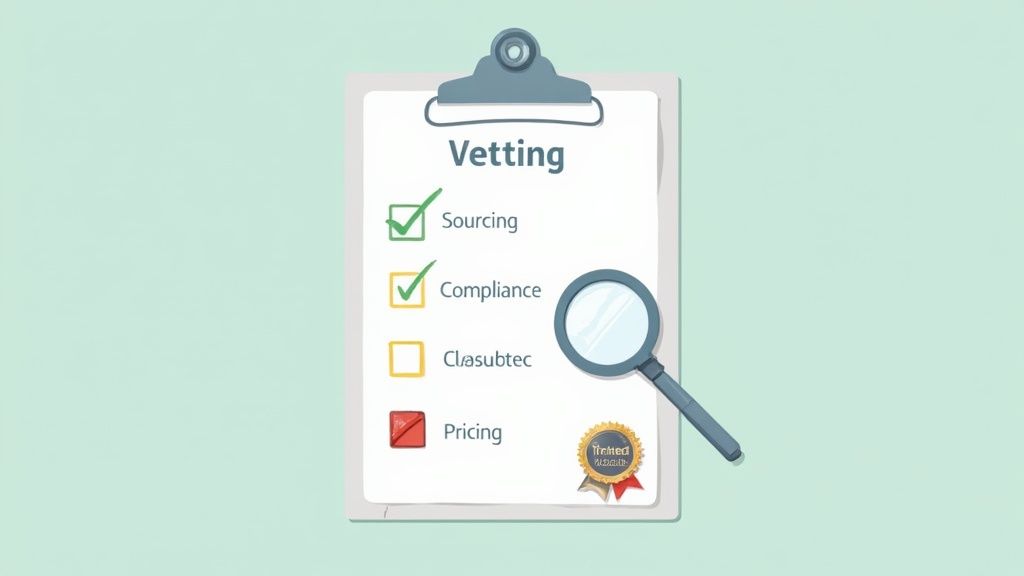
First things first: how do they actually find and screen their talent? This is the single most important question you can ask. Many platforms are just thin software layers over a messy process where they scrape LinkedIn and forward every resume that matches a few keywords.
That's not good enough.
If a partner can’t give you a clear, detailed breakdown of their technical assessments, cultural fit interviews, and background checks, run. You’re not looking for a matchmaker; you’re looking for a curator.
Ask them directly:
At LatHire, our vetting is founder-led and ridiculously rigorous. (Toot, toot!) We put candidates through the wringer so you don’t have to. We're not saying we're perfect. Just more accurate more often.
Next, let's talk about money. Hidden fees are the industry’s dirty little secret. Some platforms will quote you a low monthly rate, then ambush you with setup costs, offboarding charges, and mysterious "administrative" fees.
The price on the proposal should be the price on the invoice. Period.
Demand a transparent pricing model. Ask for a complete breakdown of all potential costs. A trustworthy partner for your global hire placement won't shy away from this conversation.
This one’s a dealbreaker. Your partner is your shield against the legal minefield of global employment. Are they using their own legal entities in the countries where they operate, or are they daisy-chaining a series of third-party providers?
The latter is a massive red flag. It means if something goes wrong, you’re stuck in a chain of finger-pointing. Your partner should be the direct Employer of Record. For a deeper dive, you can explore what an Employer of Record is and why it matters.
This is also where a partner’s commitment to diversity and inclusion becomes clear. According to the World Economic Forum’s Future of Jobs Report 2025, 83% of employers now have DEI initiatives. A good partner will have access to diverse talent pools baked into their model, helping you build a stronger, more representative team from day one.
Choosing a partner is a high-stakes decision. Dig in, ask the hard questions, and demand clear answers. The right partner won’t just find you talent; they’ll become a seamless extension of your own team.
Alright, let's bring it all home. We've talked about the what, the why, and the how of global hire placement. Now it’s time for a final, pragmatic gut-check.
The core message is this: global hiring is one of the most powerful strategic levers you can pull, but only if you do it right. It’s not about finding a cheaper resource on a map. It’s a fundamental shift in mindset from just "hiring" to actively "building a distributed team."
Before you dive in, ask yourself a few direct questions. Be honest.
If you answered "no" to any of these, you have some internal work to do first. Jumping into global hiring without this foundation is like trying to build a skyscraper on sand.
The real challenge isn’t finding talent; it’s being the kind of company that global talent wants to work for. It’s about building a culture of trust, clarity, and autonomy that transcends borders.
So, is a global hire placement strategy right for you?
If you’re looking for a quick fix or a way to micromanage a cheaper workforce, absolutely not. You'll end up with a disengaged, revolving door of a team that costs you more in the long run.
But if you see this as a strategic opportunity to access world-class talent, build a more resilient company, and scale faster than your landlocked competitors, then the answer is a resounding yes. Understanding strategies to reduce recruitment cost per hire is crucial for maximizing your return on investment here.
The path has its complexities, no doubt. But the rewards—faster growth, incredible talent, and a genuinely global perspective—are more than worth the effort. It’s a game-changer, plain and simple.
And if you’re ready to make that move, you need a guide. At LatHire, we’ve navigated this path for dozens of companies, turning the complexities of global hiring into a simple, straightforward process. We handle the vetting, compliance, and payroll so you can focus on what you do best: building something great.
Let's cut through the noise and tackle the questions that are probably bouncing around in your head. No corporate jargon, just straight answers.
Thinking about the partner fee and the new hire's salary is only half the equation. The real number to focus on is the insane cost of a prolonged local vacancy.
How much revenue are you bleeding every month that critical role sits empty? What's the price of your current team burning out? When a top-tier developer in Latin America can be hired for a fraction of a comparable role in San Francisco, the math becomes incredibly simple. You’re not just saving on salary; you're buying back time and eliminating the massive opportunity cost of waiting for a local "perfect fit" that might never show up.
The monster under the bed for any company hiring internationally is worker misclassification. It’s that nightmare scenario where you treat a contractor like a full-time employee, and suddenly the local government comes knocking for back taxes and penalties. It’s a legitimate company-killer.
The other major pitfall is accidentally violating local labor laws you never knew existed—things like mandatory 13th-month salaries or specific termination clauses. A proper Employer of Record (EOR) partner is your shield against all this. They become the legal employer in that country, ensuring every contract is ironclad and every payroll run is compliant.
If you try traditional international hiring on your own? Good luck. You’re easily looking at 6-12 months just to set up a local legal entity—before you can even post a job description. It's a bureaucratic marathon designed to grind your momentum to a halt.
But when you work with a global placement partner that maintains a pre-vetted talent pool, the timeline shrinks dramatically. From searching to sending an offer, you can have a new team member ready to start in as little as two to three weeks. We’re talking about filling a mission-critical role before your local recruiter has even finished building their shortlist.
Absolutely. While the tech talent shortage grabs all the headlines, the principles of global hiring work just as well across the entire organization. We've seen companies build out incredible remote teams in:
Great talent is great talent, no matter the department. The goal is to find the best person for the role, period. Don't let geography limit your ambition.

