

An engineering recruiting firm is a highly specialized agency that does one thing: it finds, vets, and places technical talent. Unlike a generalist recruiter who might also be looking for a marketing manager, these firms live and breathe software development, mechanical engineering, and data science. They’re supposed to be a strategic partner to fill your most critical roles without derailing your team's productivity.
Let’s be honest. The moment you realize you need a specialized engineer is usually three months after you actually needed them. It’s a familiar, gut-sinking panic.
So, you throw a job description on a few boards, cross your fingers, and wait. Instead of magic, you get your lead developer—the one you pay six figures to ship mission-critical code—spending their afternoons sifting through a mountain of wildly unqualified resumes.
Hope you enjoy spending your afternoons fact-checking resumes and running technical interviews—because that’s now your full-time job.
This isn't just about finding someone. It's about finding the right someone without mortgaging your product roadmap in lost productivity. Every hour your best minds spend playing recruiter is an hour they aren't solving problems, building features, or moving the needle. The DIY approach quickly becomes a recipe for two things: team burnout and bad hires.
The real cost of a bad hire isn't just their salary. It's the wasted time, the derailed projects, and the morale hit your team takes when they have to clean up the mess.
This is where a dedicated engineering recruiting firm is supposed to change the game. They aren't just a resume factory. They’re a partner designed to handle the heavy lifting. They find, vet, and deliver candidates who don’t just look good on paper but can actually do the work. You can get more insights on recruiting for engineers in our detailed guide.
Think handling recruitment in-house is the "cheap" option? Let's do some quick, painful, back-of-the-napkin math.
Every hour your senior engineer spends on a screening call is an hour they aren't squashing bugs or shipping your next big feature. That lost productivity isn’t just an inconvenience; it’s a direct hit to your bottom line.
The $500 Hello.
That's just the start. The invisible price tag on DIY hiring includes everything from subscription fees for job boards to the crippling cost of your team's divided attention. And that's before we even talk about the financial gut punch of a bad hire.
A single failed engineering hire can cost a staggering 150% of their annual salary in lost productivity and rework.
This is where your team's valuable time gets vaporized in the DIY hiring panic.
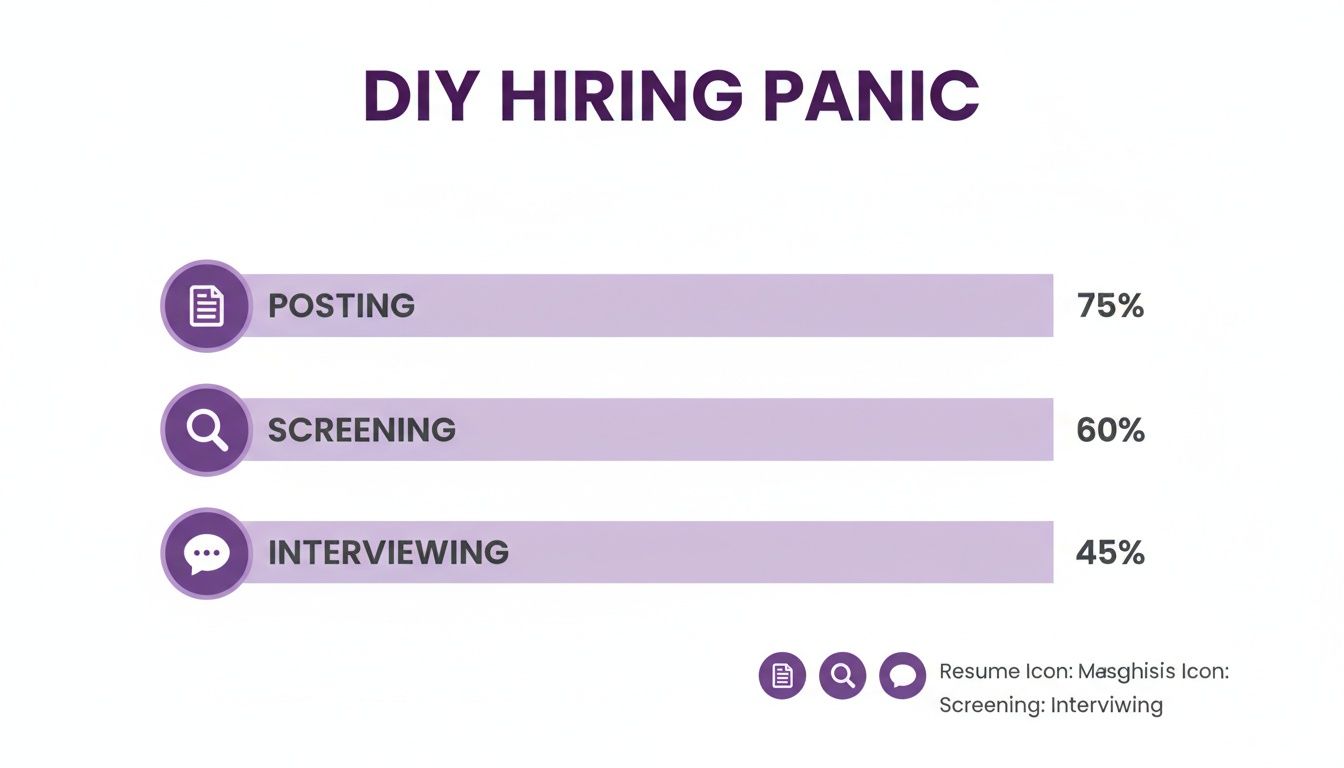
As you can see, the process is a funnel of lost time, pulling your most valuable assets away from their actual jobs. An engineering recruiting firm isn't just an expense; it's an investment in getting that time back.
The damage doesn't stop with your current team. Every week that a critical engineering role sits empty, your product roadmap slips. Deadlines get pushed, features are delayed, and your competitors get a little further ahead.
That vacant seat is an anchor dragging down your entire operation.
You're not just looking for a person; you're trying to buy back time and momentum. The longer you wait, the more of both you lose.
So, what's the real cost? It’s a toxic cocktail of:
To put this in perspective, let’s break down the numbers side-by-side.
| Expense Category | In-House DIY Cost | Specialized Firm Model |
|---|---|---|
| Job Board Postings | $500 – $2,000+ per month for premium listings on platforms like LinkedIn or Indeed. | $0. Included in the firm’s fee; they leverage their own premium accounts and networks. |
| Productivity Loss | $10,000 – $25,000+. Based on 100+ hours of senior engineering time spent screening. | $0. Your team stays focused on product. The firm handles all screening and vetting. |
| Management Overhead | $5,000 – $15,000. Time spent by hiring managers and HR on coordination and interviews. | Minimal time investment. Managers only engage with a final, pre-vetted shortlist. |
| Risk of a Bad Hire | ~$225,000 on a $150k salary. Includes rework, severance, and re-hiring costs. | Low risk. Firms offer replacement guarantees if the hire doesn't work out. |
| Time-to-Fill | 60-90+ days. Each day represents lost momentum and project delays. | 2-4 weeks. Firms tap into an existing pipeline of qualified, passive candidates. |
| Total Hidden Cost: | ~$40,000+ (before bad hire risk) | A single, predictable fee. Typically a percentage of the first year’s salary. |
When you add it all up, partnering with a specialized firm starts to look less like a luxury and more like a brutally pragmatic business decision. They do the heavy lifting so your team can get back to building.
Let's get one thing straight. A great engineering recruiting firm isn't just a glorified resume-forwarding service. If all they do is send you a pile of lukewarm LinkedIn profiles, you’ve hired a bulletin board, not a partner.
A real firm acts as an extension of your team, but with hiring superpowers you don't have time to develop.
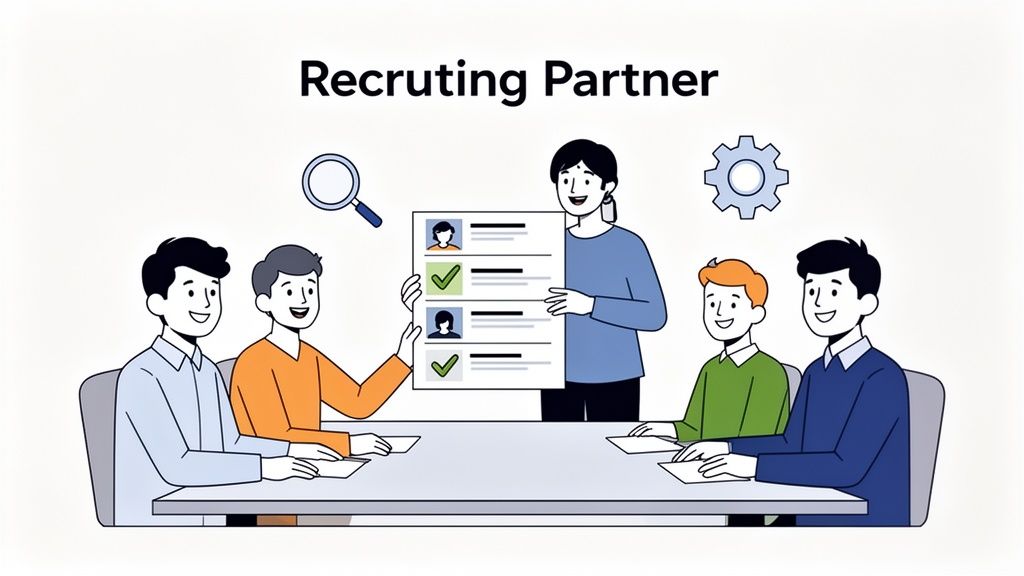
Their main job is to hunt, not just gather. They go after the passive candidates—the elite engineers who are happily employed, crushing their current roles, and not scrolling through job boards. These are the people you actually want, and they’re notoriously hard to reach.
The best engineers aren't looking for a job. A top-tier firm knows how to find them, start a conversation, and show them why your opportunity is the one worth leaving for.
Beyond just sourcing, a good firm becomes your front-line defense against bad hires. They handle the brutal, time-consuming work of technical vetting so your team can stay focused on shipping code.
While you're building products, they are:
This is more critical now than ever. The global engineering market is facing a severe skills shortage, with the UK alone staring down an annual shortfall of up to 59,000 engineers. The only way to compete is to slash your time-to-hire by using partners who can find talent faster. For a deeper dive, check out the full engineering talent market update.
Ultimately, a premier engineering recruiting firm doesn't just find people. They understand your business goals, your culture, and the specific technical challenges you’re solving. They deliver candidates who can contribute from day one, turning a painful hiring process into a strategic advantage.
The old-school Rolodex is dead. Seriously. If your recruiter is still bragging about their "deep local network," they're already a decade behind the curve.
Let’s be blunt: the best talent isn't always in your backyard. Turns out there’s more than one way to hire elite developers without mortgaging your office ping-pong table.
Today’s best engineering recruiting firm isn't a traditional firm at all—it's a platform. These modern partners use sophisticated AI to find needles in a global haystack, moving far beyond the saturated, overpriced markets you’re used to.

This isn't some futuristic idea; it's how smart companies are building elite, cost-effective teams right now by tapping into international talent hubs like Latin America.
Think about it. How long would it take your internal team to manually vet thousands of candidates from around the world? AI-driven platforms do it in a fraction of the time, screening for things that actually matter:
This isn’t just a faster way to do the same old thing. It’s a fundamentally smarter model that gives you a massive competitive edge. In fact, it's quickly become the industry standard.
AI has totally reshaped engineering recruitment, with nearly 99% of companies now using it in their hiring process. For tech startups, these platforms can slash time-to-hire and costs by over 80% by connecting them with a pre-vetted talent pool and handling all the HR busywork.
This new approach offers access to a curated, global talent network without the friction of cross-border compliance. It's the difference between fishing in a local pond and having an entire ocean of talent at your fingertips.
Ultimately, these platforms aren't just finding candidates; they are building a bridge to a global workforce. By automating the most tedious parts of recruitment, they allow you to focus on what truly matters: connecting with brilliant engineers who can help you build the future, no matter where they are.
You can learn more about how to leverage AI-powered recruitment tools in our guide.
Not all recruiting firms are created equal. Some will spam your inbox with irrelevant profiles, while others become the most valuable partners you have. Choosing the right one is less about their slick marketing and more about how they answer a few brutally direct questions.
Let’s be real: you’re not just hiring a vendor. You’re trusting someone with your most critical asset—your engineering team. So, treat the vetting process like you’re hiring a key executive, not ordering office supplies.
Start by asking them to walk you through their process, step-by-step. If their answer sounds anything like "we have a big database," run.
A great engineering recruiting firm will love these questions. A bad one will start sweating. Before you sign anything, get clear, specific answers to these:
The goal isn't to find a firm that sends you the most candidates. It's to find one that sends you the right candidates so you can stop interviewing and start building.
Finding that true partner makes a huge difference. Client concentration in this space is high for a reason—top firms often account for 70% of a company's external hiring because trust and results are everything. For more context, check out the top engineering recruitment agencies for 2025.
Choosing the right partner, especially one that understands the nuances of remote work, can fundamentally change your growth trajectory. If you're building a distributed team, you might be interested in our guide on the best remote recruiting companies to expand your search.
Alright, let's cut through the noise. You’ve got questions, and I’ve got answers based on years of doing this the hard way. Here’s the straight talk you’re looking for.
Think of it like this: A contingency firm only gets paid when you hire one of their candidates. They’re playing a numbers game, sending resumes to as many clients as possible and hoping one lands. It’s purely transactional.
A retained firm is the opposite. You pay them an upfront fee to dedicate a team exclusively to your search. This is the white-glove service you bring in for C-suite roles or hires that absolutely cannot fail. It’s a true partnership, but it comes with a hefty price tag.
Then there’s the modern platform model. This is the third way, blending smart tech with a human touch to give you access to pre-vetted talent on demand. It sidesteps the huge retainers and the transactional chaos of contingency. (Toot, toot! Full disclosure—this is the model we champion.)
Brace yourself, because the costs are all over the map. Traditional firms will often charge a percentage of the engineer’s first-year salary, usually somewhere between 20% and 30%. For a senior engineer making $150,000, you’re looking at a $30k-$45k invoice. Gulp.
That fee isn't just for a successful hire; you're paying for speed and to offload risk. But you have to ask yourself if that price tag really justifies the outcome.
Newer, AI-driven platforms that tap into global talent pools completely flip this equation. By connecting you with top-tier engineers in more affordable markets, they can bundle recruiting, payroll, and HR into a single, much more manageable cost. We’re not saying we’re perfect. Just more accurate more often.
The good ones, absolutely. The bad ones will just nod, smile, and send you anyone whose resume has the right keywords.
A top-tier partner makes it their business to learn what makes your team tick. They’ll spend time understanding not just your tech stack, but your communication style, your workflow, and the unwritten rules of how you get things done. They ask tough questions and actually listen to the answers.
If a firm just asks for your job description and nothing more, they aren't an engineering recruiting firm—they’re a resume mill. Run from anyone who tries to skip this crucial step.

