
Let's be honest, you've probably sat through more painful tech interviews than you care to admit. You ask the same textbook questions, get the same rehearsed answers, and end up hiring someone who looked great on paper but can't handle a real production fire. It’s time to stop the madness. Hope you enjoy spending your afternoons fact-checking resumes and running technical interviews—because that’s now your full-time job. Or, you could just ask the right questions.
After building and scaling more teams than I have fingers and toes, I've learned that hiring elite DevOps talent isn't about finding someone who can recite the Kubernetes documentation from memory. It’s about finding a strategic problem-solver who thinks in systems, breathes automation, and doesn't flinch when things go sideways. A candidate's ability to architect resilient pipelines is the real measure of their skill, which is why a solid grasp of core principles is non-negotiable. For a deeper dive into these foundational concepts, understanding DevOps automation is key for any engineer who wants to build systems that don't crumble under pressure.
This isn't just another generic list of devops engineer interview questions. This is a battle-tested interrogation kit designed to separate the true practitioners from the certification collectors. We'll move beyond the basics and give you the exact questions, follow-ups, and red flags to watch for. Let's dive in.
This is the warm-up, but it's also a deal-breaker. If a candidate can't walk you through a CI/CD pipeline they've built or significantly improved, they aren't a DevOps engineer. Full stop. It's the bread and butter of the role, automating the path from a developer's keyboard to live production. You're not just asking about tools; you're probing their understanding of the entire software delivery lifecycle.
A strong answer reveals their grasp of automation, quality gates, and deployment strategy. You want to hear the "why" behind their choices, not just the "what." Why Jenkins over GitHub Actions for that project? How did they integrate security scanning without grinding the pipeline to a halt?

A seasoned engineer will tell a story about a specific pipeline, not just list tools.
Technical skills are table stakes. But how a candidate behaves when the entire production environment is on fire? That’s where you separate the engineers from the button-pushers. This is one of those behavioral devops engineer interview questions that cuts straight to the heart of the role: resilience, problem-solving under pressure, and accountability. You’re not just hiring a keyboard; you're hiring a firefighter.
A good answer here isn't about being a lone hero. It’s about demonstrating a methodical approach, clear communication, and a commitment to learning from failure. Anyone can follow a runbook. A true DevOps pro can think on their feet when the runbook is useless and the alerts are screaming.
The best candidates will use a narrative framework like the STAR method (Situation, Task, Action, Result) without sounding like a robot.
Ah, the migration question. This is where you separate the orchestrators from the operators. Migrating a clunky monolith into a sleek, containerized Kubernetes environment is a rite of passage. It’s messy, complex, and high-stakes. This question isn't just about kubectl apply; it's a test of architectural vision, risk management, and strategic planning.
Answering this well proves a candidate can think beyond a single tool and manage a full-scale technical transformation. A vague answer here is a massive red flag. It suggests they’ve only worked on greenfield projects and might crumble when faced with real-world technical debt.
A strong candidate will immediately start asking clarifying questions. They'll treat it like a consulting engagement, not a pop quiz.
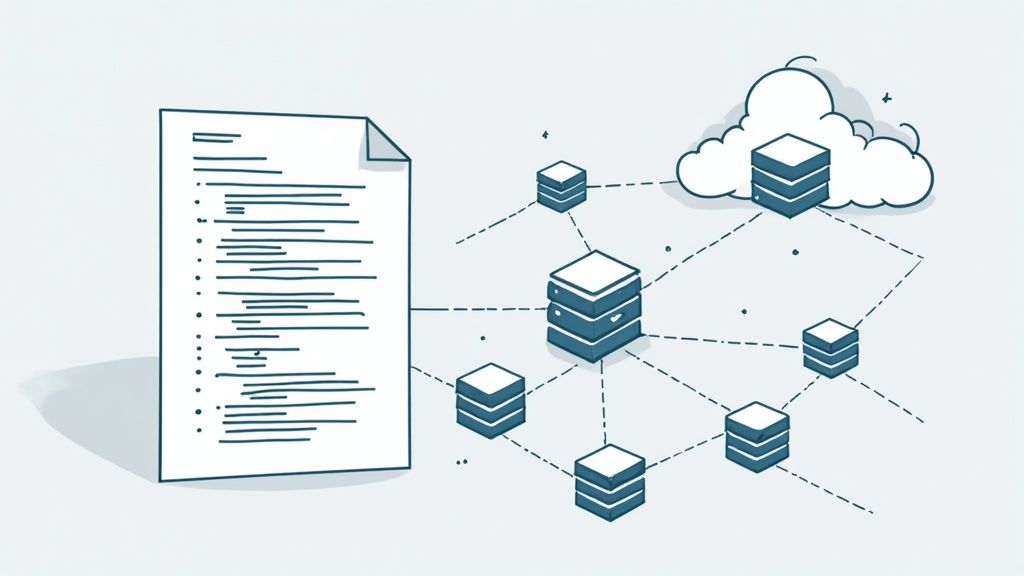
If CI/CD is the engine of DevOps, then Infrastructure as Code (IaC) is the blueprint for the entire factory. This is another non-negotiable. You're not just asking if they know Terraform; you're asking if they treat infrastructure with the same discipline as application code. Manual infrastructure management is a one-way ticket to configuration drift and weekend-destroying outages.
A strong candidate will talk about IaC as a core philosophy. They understand that managing infrastructure through version-controlled, testable code is essential for creating scalable, repeatable, and disaster-proof systems.
A true IaC practitioner has felt the pain of a corrupted state file and knows exactly how to prevent it.
terraform plan, static analysis with tools like tflint, or implementing policy-as-code. This signals a professional approach.This isn't just another buzzword check; this is where you separate the container-curious from the container-commanders. If a candidate's knowledge stops at docker run, they're going to sink. You're looking for someone who has wrestled with the beast that is Kubernetes and lived to tell the tale.
Asking about container orchestration probes their ability to manage complex, distributed systems. It's about more than just launching pods; it’s about ensuring resilience, scalability, and security for containerized apps in the real, messy world of production.
A strong candidate will narrate a story of a specific cluster they managed, highlighting the problems they solved and the architectural decisions they made.
StatefulSet for a database? Configure an Ingress controller? Use NetworkPolicies to lock down pod-to-pod communication?HorizontalPodAutoscaler (HPA) and the ClusterAutoscaler. Ask how they configured health checks (livenessProbe, readinessProbe).ConfigMaps and Secrets. Bonus points for mentioning integration with external secret managers like HashiCorp Vault.If CI/CD is how you ship, observability is how you ensure what you've shipped isn't on fire. This is one of the more telling devops engineer interview questions because it separates engineers who just deploy code from those who take ownership of its performance in production. You're asking how they see into the soul of an application.
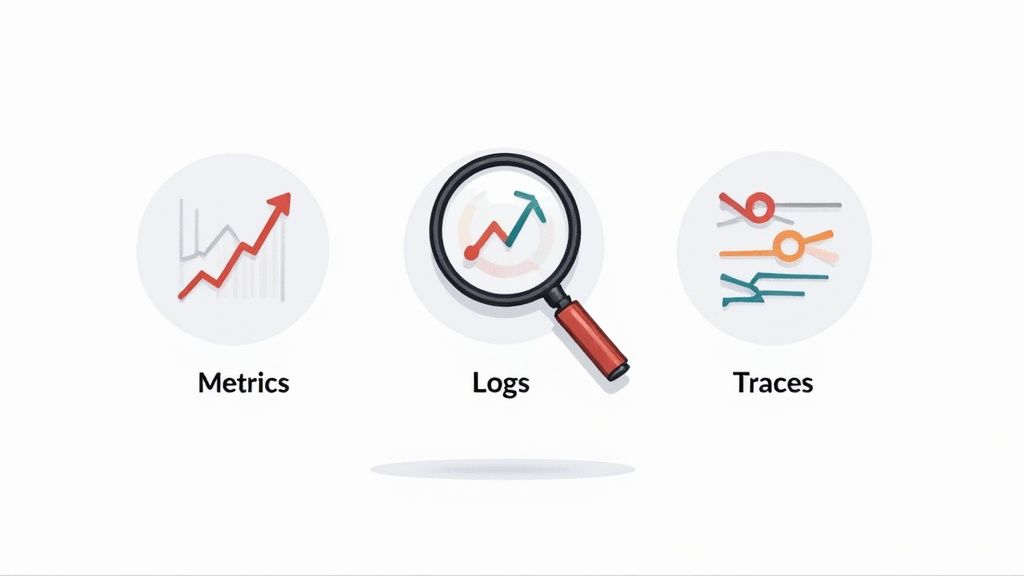
A vague answer about "checking logs" is a massive red flag. A great response details the three pillars of observability: metrics, logs, and traces. They should explain how these three work together to paint a complete picture of system health. You're looking for someone who can build a dashboard that tells a story, not just a screen full of squiggly lines.
A skilled candidate will discuss observability as a proactive strategy, not just a reactive tool.
This isn't just a technical question; it's a business question in disguise. When you ask this, you're finding out if the candidate can connect infrastructure decisions to revenue loss and customer trust. A system that can't handle a hiccup isn't just broken; it's a liability.
A candidate who dives straight into listing AWS services without asking about business needs is a red flag. The right answer starts with questions. What’s the acceptable downtime? How much data can we afford to lose? A crucial aspect of a DevOps engineer's role is to design robust business continuity and disaster recovery strategies, and their answer should reflect this strategic thinking.
A great answer balances idealism with pragmatism. They should be able to design a bulletproof system but also explain the cost and complexity trade-offs.
This is one of those devops engineer interview questions that separates the cloud-native thinkers from those who just rent virtual machines. The cloud is the modern infrastructure playground, and a DevOps engineer who isn't fluent in at least one major platform is a liability. You're asking how they've leveraged the cloud's power to build resilient, scalable, and cost-effective systems.
A great response isn't about listing every service under the sun. It's about demonstrating strategic thinking. Why did they choose a managed service like AWS RDS over running their own database on EC2? How did they use GKE to handle unpredictable traffic spikes? This question uncovers their architectural decision-making process.
A strong candidate will talk about the cloud like a second home, providing specific examples of problems they solved using cloud-native services.
This is a foundational question that separates the pros from the apprentices. If a candidate can't articulate a clear branching strategy, they haven't been in the collaborative coding trenches. Version control isn't just about saving your work; it's the central nervous system for team collaboration, code quality, and a sane release process.
A great answer moves beyond simply saying "we used Git." It delves into the methodology and the trade-offs. Why did their team choose GitFlow's rigidity over GitHub Flow's simplicity? How did their chosen workflow support the CI/CD pipeline and prevent chaos in production?
A skilled engineer will discuss version control as a strategic process, not just a tool.
main branch kick off a production deployment.This is a critical question. If a candidate's security answer is just "we run a scan before production," you've found a major gap. Security can no longer be a final gate; it must be an integrated, automated part of the entire lifecycle. Asking about DevSecOps probes their understanding of "shifting left" and treating security as everyone's problem.
A strong answer demonstrates a proactive, not reactive, mindset. You're looking for someone who thinks about security from the first line of code to the production infrastructure. They should be able to explain how they embed security into the CI/CD pipeline without creating a bottleneck.
A compelling answer will go beyond simply naming security tools. It should articulate a philosophy of embedding security at every stage.
| Item | Implementation complexity | Resource requirements | Expected outcomes | Ideal use cases | Key advantages |
|---|---|---|---|---|---|
| Explain Your Experience with CI/CD Pipeline Implementation | Medium–High (multi-stage automation, integrations) | CI servers/runners, SC storage, test infra, deployment targets | Automated build/test/deploy, faster release cadence, fewer manual errors | Teams adopting DevOps, frequent releases, automated testing needs | Increased deployment velocity, repeatability, traceability |
| Describe How You Handled a Critical Production Incident | Variable; can be high under pressure | Monitoring/alerts, access to systems, runbooks, cross-team coordination | Service restoration, root-cause analysis, post‑mortem actions | Evaluating incident response, on‑call readiness, crisis communication | Demonstrates troubleshooting, communication, resilience |
| How Would You Approach Migrating Legacy Applications to Kubernetes? | High (architecture, compatibility, stateful concerns) | Containerization effort, testing environments, migration tooling, training | Modernized deployment model, improved scalability, clearer operations | Modernization projects, scaling monoliths, cloud-native adoption | Enables portability, scalability, repeatable deployments |
| Explain Your Experience with Infrastructure as Code (IaC) Tools | Medium (design of modules, state management) | IaC tooling, state backend, CI integration, testing frameworks | Reproducible infra, versioned changes, faster provisioning | Infrastructure automation, multi-environment consistency | Repeatability, reduced drift, auditable infrastructure changes |
| Walk Us Through Your Container Orchestration and Kubernetes Experience | Medium–High (cluster ops, networking, storage) | Kubernetes clusters, CNCF tools, monitoring, storage solutions | Managed container workloads, autoscaling, resilient services | Running containerized production workloads at scale | Operational control, scalability, declarative management |
| Describe Your Approach to Monitoring, Logging, and Observability | Medium (stack selection, alerting strategy) | Metrics/log/tracing systems, dashboards, SLOs, alerting tools | Improved visibility, faster troubleshooting, proactive alerts | Production reliability, incident detection, performance tuning | Faster MTTR, data-driven troubleshooting, customer visibility |
| How Would You Design a Disaster Recovery and High Availability Strategy? | High (cross-region design, failover planning) | Redundant infra, backup systems, replication, DR drills | Defined RPO/RTO, tested failover, business continuity | Critical services requiring uptime and regulatory compliance | Minimizes downtime/data loss, ensures resilience and compliance |
| Explain Your Experience with Cloud Platforms (AWS/Azure/GCP) and Their Services | Medium (service selection, architecture) | Cloud accounts, managed services, cost controls, IAM | Scalable, cost-optimized cloud architectures, managed services use | Cloud migrations, new cloud-native applications, multi-cloud plans | Access to managed services, scalability, operational efficiency |
| Tell Us About Your Experience with Version Control Systems and Git Workflows | Low–Medium (workflow design, release integration) | Git hosting, CI integration, code review tooling | Consistent branching, cleaner releases, collaborative development | Any software team, CI/CD integration, release management | Improves collaboration, traceability, and release discipline |
| Describe Your Approach to Security in DevOps (DevSecOps) | Medium–High (shift-left, policy integration) | SAST/DAST, secret management, policy engines, training | Fewer vulnerabilities in pipeline, stronger compliance posture | Security-sensitive environments, regulated industries | Reduces security risk, integrates security into lifecycle |
Well, there you have it. A playbook of devops engineer interview questions designed to separate the true infrastructure architects from the script-kiddies. You now have the tools to dig deeper than a resume and probe the real-world problem-solving skills that define an elite DevOps professional. These questions are your new litmus test for technical and cultural fit.
The goal was never to just give you a list. It was to arm you with a framework for thinking like a top-tier engineering leader. A great interview process isn’t about trick questions; it’s about creating scenarios that reveal how a candidate thinks, communicates, and collaborates. It's about finding someone who doesn’t just use tools but understands the why behind them.
Remember, the best candidates are evaluating you just as much as you are evaluating them. Your ability to ask insightful, challenging questions signals that you run a high-performing team. It shows you value deep expertise over buzzword bingo.
Here’s the bottom line:
The Hard Truth: Asking the right questions is only half the battle. The other half is the grueling, time-consuming process of sourcing, screening, and scheduling enough high-quality candidates to find "the one."
Hope you enjoy spending your afternoons fact-checking resumes and running technical interviews, because that’s now your full-time job on top of your full-time job. Or… maybe not.
Turns out there’s more than one way to hire elite DevOps engineers without mortgaging your office ping-pong table. The list of devops engineer interview questions in this guide is the exact kind of rigorous vetting we live and breathe.
At LatHire, we've already asked these questions (and a whole lot more) to over 800,000 pre-vetted professionals across Latin America. Our AI-powered platform and in-house experts do the heavy lifting, matching you with elite, time-zone-aligned DevOps talent in as little as 24 hours. We handle the vetting, the payroll, the compliance, all of it. You just get to interview the best of the best and make the final call.
We’re not saying we’re perfect. Just more accurate more often. (Toot, toot!)
Stop interviewing and start hiring. Your infrastructure will thank you for it.

