
Let's be real. For too many companies, cultural diversity in the workplace is just corporate theater. It's a beautifully worded statement on the "About Us" page, a checkbox ticked by HR, and a feel-good line item in the annual report.
But here’s the kicker: it’s not actually doing anything.
So you posted a black square on Instagram a few years ago and ran a mandatory unconscious bias workshop that everyone promptly forgot. Congrats. Now what? Your team still looks suspiciously similar, and you’re wondering why that grand diversity plan isn't delivering the promised miracles of innovation and market growth.
The hard truth is that most diversity programs are performative because they treat the symptom, not the disease. They focus on optics, not operations.
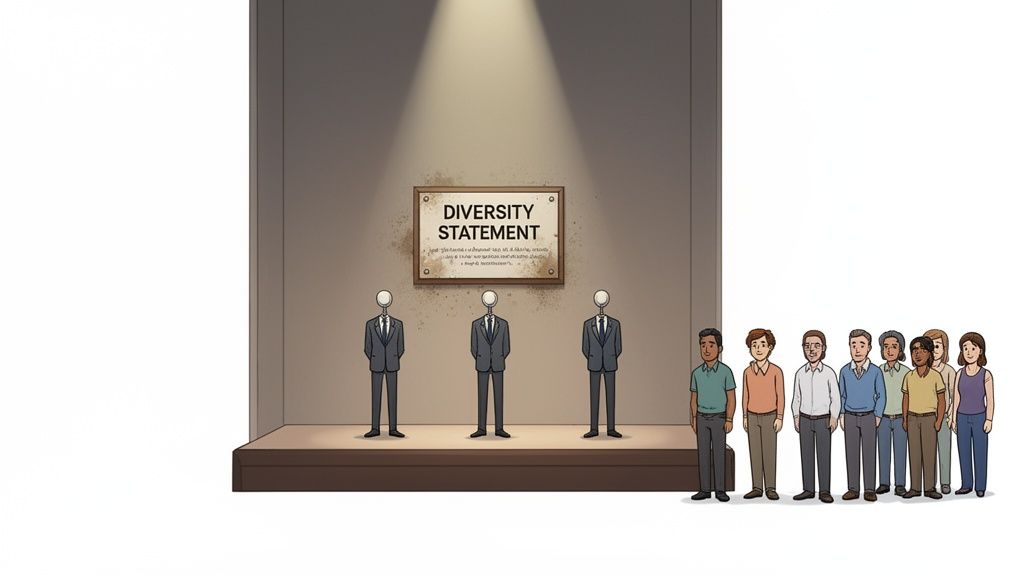
The biggest offender is almost always that fuzzy, feel-good concept of "culture fit." In practice, it’s just lazy shorthand for hiring people who look, think, and act just like you. It’s comfortable. It’s easy. It’s also the fastest way to build an echo chamber where new ideas go to die.
You end up with a team of clones who validate each other’s biases while your more innovative competitors—powered by genuinely different perspectives—eat your lunch. A truly diverse workplace challenges norms; it doesn’t just conform to them.
Diversity without inclusion is just a revolving door for talent. You can spend a fortune recruiting brilliant people, but if they don't feel heard, respected, or valued, they will walk. And they'll take their talent—and your investment—with them.
Another common trap? Treating diversity like a numbers game. You hire a few people from underrepresented groups to hit a quota, pat yourself on the back, and call it a day. This isn't a strategy; it's a vanity project.
The data reveals a massive gap between representation and actual leadership. In the U.S., ethnic minorities make up 38.7% of the workforce, but their presence in management roles lags far behind. This isn't a pipeline problem; it's a promotion problem. It’s a systemic failure to turn diverse hires into empowered leaders.
This is where the real work begins. It means moving past performative gestures and committing to real changes in how you hire, manage, and promote. A good first step is to review some foundational inclusive hiring practices and see exactly where your process falls short.
It's time to forget the empty platitudes and start building a business engine powered by different perspectives—not just different faces for the company photo.
Alright, let's cut through the fluff. Everyone loves talking about the warm-and-fuzzy benefits of cultural diversity. But you’re running a business, not a non-profit. You need to know: what’s the actual ROI?
Forget the corporate jargon for a minute. The real value of a culturally diverse team isn't about looking good in the annual report; it's about out-thinking, out-maneuvering, and out-performing your competition. It's about cold, hard cash.
When your team is a monolith, your thinking becomes a monolith. You solve problems the same way, miss the same market opportunities, and get blindsided by the same risks. Authentic cultural diversity in the workplace smashes that echo chamber.
I’ve seen it firsthand. A team with varied life experiences doesn't just innovate better; they sell better. Why? Because they instinctively understand a broader range of customers. They spot nuances in global markets that a homogenous team would completely miss.
This isn't just my opinion; it's backed by serious data. Globally, companies in the top quartile for racial and ethnic diversity are a staggering 35% more likely to post financial returns above their industry medians. That’s not a rounding error—it’s a massive competitive advantage. You can dig into the research on workplace diversity statistics to see just how deep the connection goes.
Let's break down how this actually works. Diverse teams drive better business outcomes through:
To make this even clearer, let's look at the measurable outcomes. The table below summarizes how a culturally diverse workforce directly impacts your startup's performance.
| Business Outcome | Key Statistic | Why It Matters for Your Startup |
|---|---|---|
| Increased Revenue | Diverse companies are 70% more likely to capture new markets. | Your team's backgrounds directly unlock access to and understanding of new customer segments, driving top-line growth. |
| Higher Innovation | Companies with above-average diversity produce 19% more innovation revenue. | A wider range of perspectives leads to more creative ideas and solutions, helping you build a product that stands out. |
| Better Decision-Making | Inclusive teams make better business decisions 87% of the time. | You reduce the risk of groupthink, leading to smarter, data-driven choices that avoid costly mistakes. |
| Enhanced Profitability | Ethnically diverse executive teams are 33% more likely to be more profitable. | Leadership that reflects a diverse world is better equipped to navigate global challenges and capitalize on opportunities. |
Ultimately, the data shows that diversity isn't an expense; it's an investment with a clear and compelling return.
To get this ROI, you have to move past simply ticking boxes. Genuine cognitive variety is what moves the needle. This includes different nationalities, languages, and ethnic backgrounds, but it also encompasses different ways of thinking and problem-solving.
This is where exploring concepts like the benefits of neurodiversity in the workplace becomes critical. It's all part of building a team that doesn't just look different but truly thinks differently.
Your company's growth is directly capped by the diversity of thought within its walls. If everyone comes from the same background, you're operating with a self-imposed handicap.
Investing in cultural diversity in the workplace isn't an HR initiative; it's a core business strategy. It’s the difference between building a company that’s merely surviving and one that’s built to dominate.
Let's be honest. You say you want a culturally diverse workplace, but what does your hiring process actually look like?
My guess? Your job descriptions are written for one very specific type of person. Your sourcing strategy is a glorified version of asking your friends if they know anyone. And your interviews? More like unstructured chats that reward charisma over actual competence.
Sound familiar? It’s okay. Most hiring funnels are broken. They’re leaky, biased, and designed—often unintentionally—to filter out the very diversity you claim to want.
The good news is you can fix it. But it takes more than just good intentions. It demands a tactical teardown of your entire process, from the first job post to the final offer.
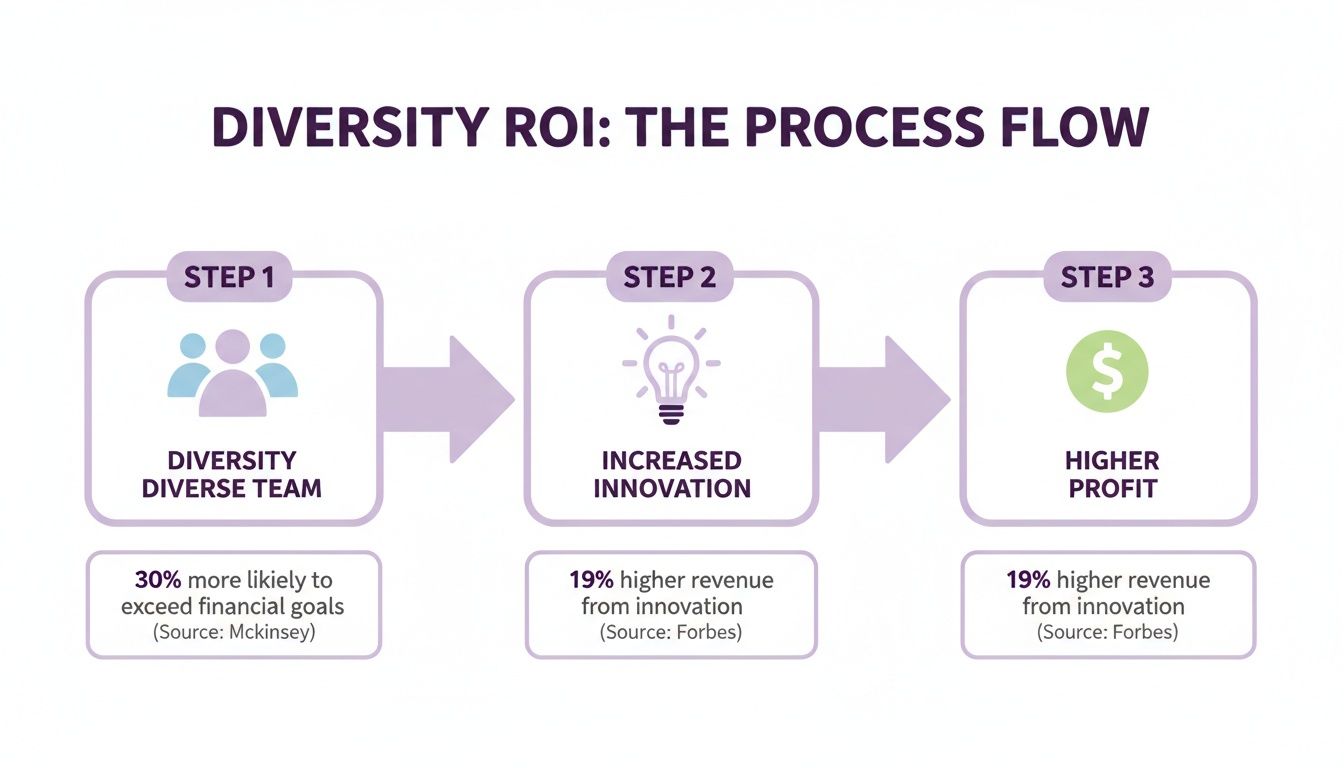
Think of it this way: fixing your funnel isn't just an HR exercise. As the visual above shows, it’s a direct investment in your company's growth engine, creating a clear line from diverse teams to real innovation and higher profits.
First things first, your job descriptions. Most are just a laundry list of impossible qualifications and loaded language that scares off perfectly capable candidates before they even think about applying.
Words like "rockstar" or "ninja" might sound cool in a meeting, but they overwhelmingly appeal to a specific demographic and can deter women and other underrepresented groups from ever hitting "apply."
Instead of a wish list, focus on the core outcomes. What does success in this role actually look like in the first 90 days?
This shift is a core part of a more equitable approach. If you want to dig deeper, it’s worth learning more about what skills-based hiring is and how it systematically removes bias by forcing you to define what really matters for the role.
Now for sourcing. If your main strategy is relying on referrals from your current team, you’re just building a clone factory. It’s human nature—people tend to know people who are just like them.
To build a truly diverse team, you have to intentionally fish in different ponds.
The most impactful decision we ever made was to stop looking for talent in our city and start looking for talent in our time zone. That simple shift opened up a massive, diverse, and affordable talent pool we'd been completely ignoring.
Turns out there’s more than one way to hire elite developers without mortgaging your office ping-pong table. Expanding your search to global talent hubs is the single biggest cheat code for growing companies. Places like Latin America are brimming with elite, pre-vetted professionals who bring the exact cultural and cognitive diversity that fuels innovation.
Finally, let's fix the interview itself. Unstructured interviews are notoriously unreliable predictors of job success. They quickly become a test of "do I like this person?"—which is fertile ground for unconscious bias to take over.
You need a system.
A structured interview process means every candidate for a given role gets asked the same set of questions in the same order. This simple change allows you to compare apples to apples, basing your decision on skill and competency, not just how well someone built rapport.
Here’s a simple framework to get started:
To truly address systemic issues, you should also consider integrating best practices for neurodiversity. For example, understanding autism and job interviews can offer practical insights to make your process more accommodating and effective for everyone. It's about removing barriers, not lowering the bar.
So you did it. You fixed your hiring funnel, expanded your reach, and landed a fantastic candidate from a different cultural background. You spent thousands of dollars and dozens of hours finding them.
Now, are you really just going to email them a generic employee handbook and hope for the best?
That’s not an onboarding plan; it's a bet. And it’s a bad one. The quickest way to lose your new star hire—and the investment you made in them—is to botch their first 90 days.
Most onboarding programs are just an HR paperwork delivery system. They’re designed for compliance, not connection. For a hire from a different cultural context, this is a recipe for disaster.
They’re navigating not just a new job, but a new set of workplace norms, communication styles, and unspoken rules. Handing them a stack of forms and a login password is like dropping them in a foreign country without a map.
Psychological safety isn't a fluffy perk; it's the bedrock of performance. If your new hire is spending their first month just trying to figure out who to ask for help without looking stupid, they're not spending it delivering value.
This isn’t about being nice. It’s about getting a return on your investment. A confusing or isolating onboarding experience means your new hire’s ramp-up time skyrockets, their engagement plummets, and the odds of them quitting within the first year go through the roof.
An inclusive onboarding process moves past the checklist and focuses on three critical areas: clarity, connection, and culture. It's about deliberately engineering an experience that sets your new hire up to win, not just to survive.
Forget the generic welcome basket. A truly effective plan includes:
This proactive approach to integration is the core of any successful remote onboarding process, ensuring that distance doesn't create disconnect.
The most dangerous pitfalls in a culturally diverse workplace are the unwritten rules. Every company has them, and they can be landmines for someone from a different background.
What's your company's stance on punctuality for virtual meetings? How is feedback typically delivered—bluntly and directly, or softened and indirect? What does "taking initiative" actually look like here?
Create a simple document that answers these questions. It might feel a little awkward to write down things you consider "common sense," but your common sense isn't universal. Providing this cheat sheet isn't hand-holding; it’s giving your new hire the tools to navigate your specific culture with confidence.
Ultimately, great onboarding isn't an event; it's a process. It’s the difference between a new hire who feels like an outsider and one who feels like they belong. And that feeling is directly tied to how quickly they start delivering the incredible value you hired them for in the first place. Don't let a lazy welcome turn your best hire into an expensive mistake.
Leading a culturally diverse team isn’t about memorizing national holidays or hosting an international potluck. That’s corporate fluff. The real work—the stuff that actually moves the needle—is about fundamentally rethinking how you communicate, deliver feedback, and define success.
This is where most managers either freeze up or fall back on cringey, counterproductive stereotypes. They treat their team members not as individuals but as ambassadors for their entire country. Spoiler alert: that’s a terrible strategy.
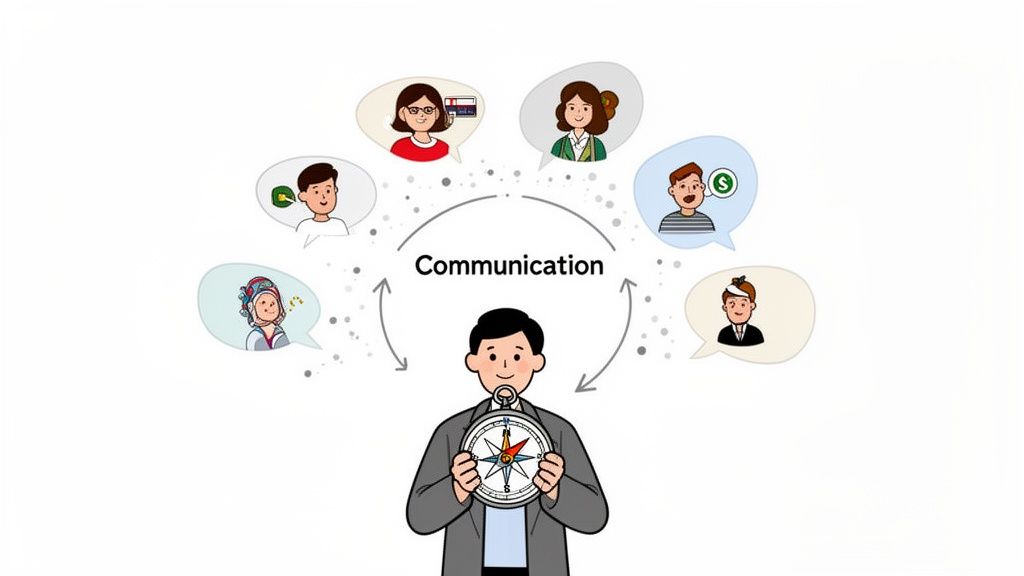
Let's get one thing straight. You can’t manage a person from Brazil or Nigeria based on a three-paragraph summary you read online about their "culture." People are infinitely more complex than that. Your job isn't to become an armchair anthropologist; it's to become an expert on the individuals on your team.
The secret isn’t memorizing cultural trivia. It’s building a management framework that creates clarity and psychological safety for everyone, regardless of their background. It’s about being radically explicit.
The most common mistake managers make with diverse teams is assuming shared context. You have to kill that assumption. Over-communicate everything until it feels slightly ridiculous—then communicate a little more.
This means documenting your processes, defining your expectations in writing, and creating a single source of truth that transcends cultural shorthand. When you rely on unspoken rules, you’re only serving the people who already share your cultural background.
Giving feedback across cultures is where good intentions go to die. In some cultures, direct, blunt feedback is a sign of respect—it shows you care enough to be honest. In others, that same feedback can be deeply offensive, causing the recipient to lose face and disengage completely.
So, what’s the solution? Hope you enjoy spending your afternoons crafting perfectly worded, culturally sensitive feedback for every single person on your team—because that’s now your full-time job.
Just kidding. That’s an impossible task. The real solution is to build a universal feedback system based on objective, observable behaviors and outcomes, not subjective interpretations.
Here's a pro tip that’s saved me more headaches than I can count: have every team member create a one-page "user manual" about themselves. It’s a simple document that answers questions like:
This isn’t a personality test; it’s a practical guide to working effectively with that specific human. It replaces cultural guesswork with individual clarity. It empowers team members to define their own preferences rather than having you project stereotypes onto them.
Managing a culturally diverse team forces you to become a better manager for everyone. It forces you to be more intentional, more explicit, and less reliant on lazy assumptions. The initial effort is an investment that pays off in the form of a more resilient, innovative, and high-performing team.
Alright, let's get into the weeds. You've seen the big-picture ideas, but I know what’s really on your mind—the tough, pragmatic questions that pop up when you’re actually trying to make this work. Here are the straight-up, no-fluff answers to the concerns we hear most often from founders who are serious about building a real, culturally diverse workplace.
First off, stop tracking vanity metrics that look good on a slide deck but mean nothing. A colorful dashboard won't tell you if you're actually building a better company. Real measurement is about business impact, not just checking a box.
Get your hands dirty with the data that actually matters:
The goal isn't a prettier company photo; it's a measurable improvement in retention, innovation, and ultimately, profitability. If your metrics don't connect to the bottom line, you're just playing a game.
Thinking the hard part is finding the talent. That’s just step one. Too many companies get starry-eyed about accessing a global talent pool but completely ignore the operational nightmare of international compliance, payroll, and benefits. It's a classic rookie error.
They try to wing it with flimsy contractor agreements and end up drowning in a legal and financial mess. Suddenly, you’re not a founder anymore; you’re an amateur international labor lawyer, and trust me, you're not a very good one.
This is precisely why an Employer of Record (EOR) service becomes a non-negotiable part of the strategy. It’s the infrastructure that makes global hiring possible. A top-tier EOR handles the entire backend—payroll, taxes, benefits, compliance—so you can focus on what you’re actually good at. You get access to elite professionals without having to mortgage your future on legal fees and tax penalties.
Only if you're lazy about it. Let’s be real: in the short term, you might have to be more intentional about how you communicate. You can’t just rely on unspoken cultural shorthand, inside jokes, and vague instructions anymore.
But that’s a feature, not a bug.
This perceived "barrier" forces you to build clearer processes, document everything properly, and become a more disciplined and organized company overall. The initial friction of adapting communication styles is a tiny price to pay for the massive long-term benefit of diverse problem-solving. A homogenous team might agree faster, but they'll completely miss the blind spots that a culturally diverse team would have caught in a heartbeat.
You don’t need a massive budget or a Chief Diversity Officer with a team of ten. You just need to stop fishing in the same, tiny, expensive pond. For a startup, the highest-leverage move you can make is to fix your hiring pipeline.
Instead of blowing your limited cash on recruiters who just tap into their existing—and likely homogenous—networks, you need to intentionally seek out talent platforms that specialize in diverse, global talent pools. Stop relying on referrals from your current team; it’s the fastest path to building a clone army.
The smart move is to focus on a region like Latin America, where you can find world-class, pre-vetted talent that operates in your time zone. This approach kills two birds with one stone: you get the cultural diversity in the workplace that fuels innovation, and you do it in a way that’s incredibly cost-effective.
Start with one key hire. The operational and financial efficiency makes it one of the most powerful things a small company can do to build a global, diverse team right from the start.

