
When your company hires an outside firm to handle paychecks and tax filings, that’s payroll outsourcing. It’s supposed to be a strategic move to offload the administrative migraine from your team to specialists. The goal? To stop making dumb, expensive mistakes, stay on the right side of the law, and free up your people to do, you know, their actual jobs.
Let’s be real. Nobody starts a business dreaming of becoming an expert on withholding tax schedules. Yet, there you are, neck-deep in tax codes, wondering if you filed that quarterly report correctly. The decision to outsource isn't about "synergy" or "efficiency"—it's about ending the Sunday night scramble and that cold sweat you get when an employee asks about a weird deduction on their payslip.
This isn’t about giving up control. It’s about taking it back from the soul-crushing admin that’s eating your company alive.
The switch from DIY payroll to bringing in the pros isn't usually a single "aha!" moment. It’s a slow-burn crisis made of a thousand tiny papercuts. You've probably hit a few of these already.
The real cost of in-house payroll isn't just a staffer's salary. It's your time, the risk of a five-figure penalty, and the drag on a team that should be building a product, not fiddling with paperwork.
If you're still on the fence, reading up on the 7 Key Benefits of Outsourcing Payroll for UK SMEs can bring clarity. This isn't just for mega-corporations. The percentage of businesses outsourcing payroll more than doubled from 17% to 38% in just four years as founders got wise to the value of offloading this risk.
Jumping headfirst into a payroll service without a plan is a classic rookie mistake. I’ve seen it. It’s like hiring a Michelin-star chef and then handing them a dirty kitchen and a shoebox full of mystery ingredients. Good luck with that.
Before you even think about signing a contract, you need to get brutally honest about the state of your own house.
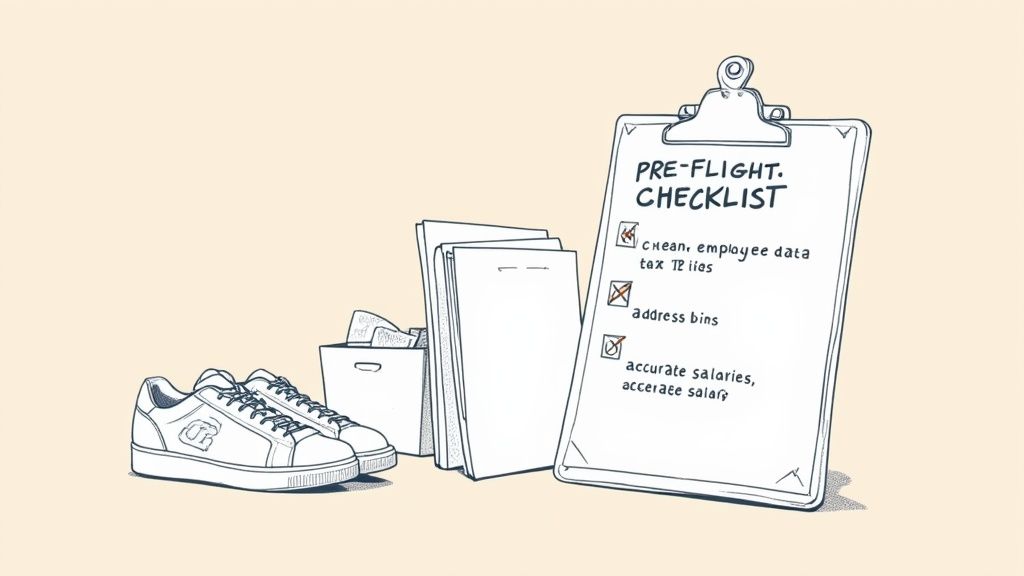
Think of this as your pre-flight checklist. The mission is to fix your internal chaos before you pay someone else to inherit it. Trust me, it’s a lot cheaper to do it now.
First up: your data. Is it clean, or is it a digital dumpster fire? A payroll provider is only as good as the information you give them. Garbage in, garbage out—except in this case, the garbage comes with very real tax penalties.
Get forensic. I’m talking about:
The single biggest point of failure in a payroll migration isn't the new provider's software. It’s the messy, incomplete, and just plain wrong data you hand over to them. Clean it up now or pay for it later. A lot later.
Next, take a hard look at how you actually do things. When a new hire starts, who collects their paperwork? Who tracks PTO? Who approves overtime?
If the answer is "uh, it depends," you have a problem.
Your new provider needs a clear playbook. They can't read your mind or navigate your company’s internal politics. Map out your current processes, find the bottlenecks, and assign clear ownership. For a solid starting point, use a detailed payroll compliance checklist to make sure you're not forgetting something critical.
This isn’t just about making the transition smoother; it’s about professionalizing your entire operation. Once you have clean data and clear processes, you’re not just ready for a company outsourcing payroll—you're ready to scale without everything catching fire.
Alright, let’s talk vendors. The market is a jungle of slick sales pitches, confusing pricing, and dashboards that look pretty but don’t actually do anything. They all promise to make your life easier. Some will. Others will just invent new, more expensive ways to create chaos.
So, how do you pick a winner? After a few painful—and expensive—lessons, I learned to ignore the marketing fluff and focus on what actually matters when payroll inevitably hits the fan.
When you have a payroll emergency—and you will have one—the last thing you want is a chatbot named “Brenda” sending you links to a generic FAQ page. Your first filter should be human support. Can you get a real, live, knowledgeable person on the phone who can solve a real problem?
Here's the trick: before you sign, test them. Call their sales line, then immediately call their customer support line. The difference in response time and expertise will tell you everything you need to know about where their priorities really lie.
A slick user interface is nice. A human being who can fix a botched tax filing at 4:45 PM on a Friday is non-negotiable. One saves you a click; the other saves your business.
Every provider will claim to be a compliance expert. Don’t take their word for it. Grill them, especially if you have employees in more than one state or—God forbid—another country. Ask hardball questions.
Their answers (or their panicked silence) will reveal whether they’re true specialists or just leaning on an algorithm that might be a year out of date. A provider that just files forms is a commodity. One that gives you strategic compliance advice is a partner. If you need a starting list, a guide to top outsourcing payroll companies is a decent place to build your shortlist.
Finally, your payroll system doesn’t live on an island. It has to talk to your accounting software, your HR platform, and your time-tracking tools. A “seamless integration” can mean anything from a true, real-time data sync to a clunky process requiring you to manually export a CSV file every two weeks. You know, the job you were trying to eliminate.
Demand a live demo of the specific integration you need. Make them show you, click by click, how the data flows from their system into your accounting ledger. If they get vague or start throwing around acronyms without showing you a working product, run. A bad integration means you’ve just traded one manual data entry job for another.
This is the part everyone dreads. Moving your company’s entire payroll system feels like performing open-heart surgery on a moving train. It’s scary. One wrong move, and the whole thing grinds to a halt.
But it doesn't have to be a disaster. You just need a pragmatic plan, not a prayer.
Think of this as your project plan for not setting your company on fire. Be methodical, be slightly paranoid, and never assume the data is correct. Trust me, I’ve seen what happens when you skip a step—like paying a new hire their entire annual salary in their first month. Whoops.
The single most critical step is the parallel payroll run. This is non-negotiable. It means you run your old payroll system and your new one at the same time for at least one full pay cycle—ideally two.
Why? Because it’s the only way to catch the gremlins before they cause real damage. You’ll compare net pay, deductions, and tax withholdings line-by-line for every single employee.
A parallel run is your dress rehearsal for the real show. It will feel redundant. It will be annoying. But the handful of errors it uncovers will save you from a full-blown financial and HR catastrophe.
You’re looking for discrepancies in:
Finding a $5 discrepancy now is a minor fix. Finding it after you’ve shut down the old system is a multi-day nightmare of frantic phone calls and angry employees.
To simplify the decision-making process for your team, this visual breaks down the core stages from assessment to final selection.
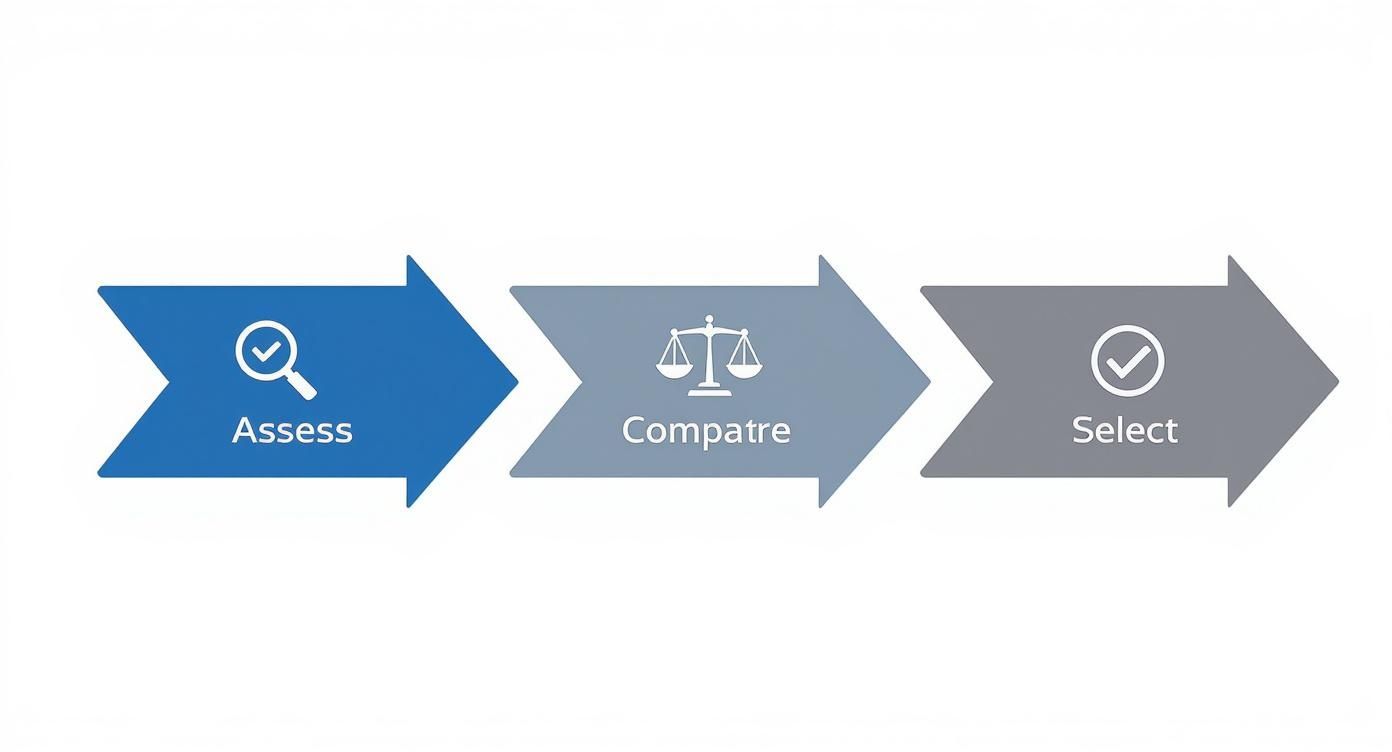
This process flow highlights that selecting a partner is the final step after a thorough assessment and comparison, ensuring you don’t jump to a solution before doing your homework.
The final piece of the puzzle is your team. People get (understandably) nervous when you mess with their paychecks. Vague announcements will only fuel rumors and anxiety.
Be transparent, clear, and proactive. Send a communication that explains:
Don’t just send one email and call it done. Announce it in a team meeting, create a simple FAQ doc, and tell them exactly who to ask if they have questions. Over-communicating is always better here. A smooth migration isn't just a technical win; it's a massive trust-building exercise.
So, you did it. You pulled the trigger, survived the migration, and handed the keys to your new payroll partner. Pop the cheap champagne, but don't get too comfortable. The job isn’t over; it just changed.
Signing the contract is the easy part. The real work is turning this new service from an expense into a strategic asset. You didn't outsource payroll just to stop doing paperwork—you did it to get smarter.
Your new provider is sitting on a goldmine of data. Headcount trends, labor costs by department, overtime analysis—everything you need to make better decisions. But that data is useless if it just sits in a dashboard you never look at.
Your first move: schedule a deep dive with their reporting specialist. Don't just ask for a tour. Demand they show you how to build custom reports that answer your real questions:
You’ve outsourced the task of payroll, not the strategy. Use the reporting tools you're paying for to get a clear, unbiased view of your single biggest expense: your people.
Look, you have to trust your vendors, but you also have to verify. To make sure you’re getting what you paid for, you need a simple review process. This isn't micromanagement; it's just smart.
First, get a dedicated point of contact on their team. No more support tickets into the void. You need a name and a direct line for when things go sideways.
Next, get a quarterly check-in on the calendar. A 30-minute call to review performance, discuss issues, and plan for upcoming changes like new hires or annual raises. Speaking of new hires, when setting them up, a voided check generator can be a handy tool to get banking info right the first time—a small detail a good partner helps you nail.
This regular check-in keeps them on their toes and turns a simple vendor into a genuine partner. It’s how you make outsourcing payroll an offensive move, not just a defensive one.
Alright, let's hit the questions that are probably still rattling around in your head. You've heard the pitch, but there are always a few nagging doubts. Let’s tackle them head-on.
It can feel like you're the last founder on earth still wrestling with payroll spreadsheets on a Tuesday night. You're not. But the herd is definitely moving. The trend is clear: outsourcing is becoming the standard.
While only about 12% of organizations fully outsource their entire payroll function, a massive 73% use a partner for at least one piece of it. For smaller companies, the adoption is even faster—15% have already gone all-in, compared to just 8% of the big enterprise giants.
Bottom line? You’re not late to the party; you’re arriving right on time.
This is the big one. The fear that you’re handing over the keys to the most critical function of your business to a stranger. It’s a valid concern, but it’s wrong.
Good payroll outsourcing isn't about losing control; it's about gaining precision. You still approve hours, set salaries, and give the final "go" on every single pay run. Your provider just handles the tedious execution and the compliance gymnastics.
You're not handing over the steering wheel; you're hiring a professional navigator who knows all the shortcuts and keeps you out of the legal ditches. You still decide the destination.
As you dig in, you’ll hear acronyms like "PEO" and "EOR." They sound similar but solve very different problems. A standard payroll provider pays your existing employees, where you already have a legal entity.
An Employer of Record (EOR), on the other hand, becomes the legal employer for your team in places where you don't have a legal entity.
Want to hire a brilliant developer in Brazil without setting up a Brazilian subsidiary and mortgaging your office ping-pong table? That's what an EOR is for. They handle the local employment contract, payroll, taxes, and benefits according to Brazilian law. It's a game-changer for building a global team. To get the full breakdown, you need to understand what an Employer of Record is and how it works. It's a crucial tool in the modern founder's toolkit.

