
Let's be honest, the classic interview playbook is a broken, soul-crushing charade. You ask a canned question like, "What's your greatest weakness?" and you get a canned answer about being "too much of a perfectionist." You both pretend you learned something profound, but you're no closer to knowing if this person can actually handle the beautiful chaos of a remote team or learn a new tech stack without you holding their hand.
I've been there. I've wasted countless hours on interviews that felt more like a bad first date than a real assessment of competence. Hope you enjoy spending your afternoons fact-checking resumes and running technical interviews, because without the right framework, that’s now your full-time job.
That's why we’ve gone deep to curate a list of the best questions to ask an interviewee that cut through the fluff. These aren't just questions; they're diagnostic tools designed to reveal the critical traits for remote success: accountability, self-direction, and cross-cultural communication. Many of these function as behavioral questions, designed to elicit past experiences rather than hypothetical future actions. To ensure your behavioral interviews are impactful, especially for consulting roles, consider exploring comprehensive guides like these on the top 10 consulting behavioral interview questions for additional frameworks.
Think of this as your new hiring cheat sheet, straight from the trenches. We’ll break down what each question is really asking, what a great answer looks like, and the red flags to watch for. It’s time to stop guessing and start hiring with confidence.
When you're building a distributed team, you aren't just hiring for skill; you're hiring for a very specific operational discipline. This question immediately separates the talkers from the doers. Anyone can say they're a "great communicator," but can they prove it when their lead engineer is five hours ahead and their QA team is three hours behind?
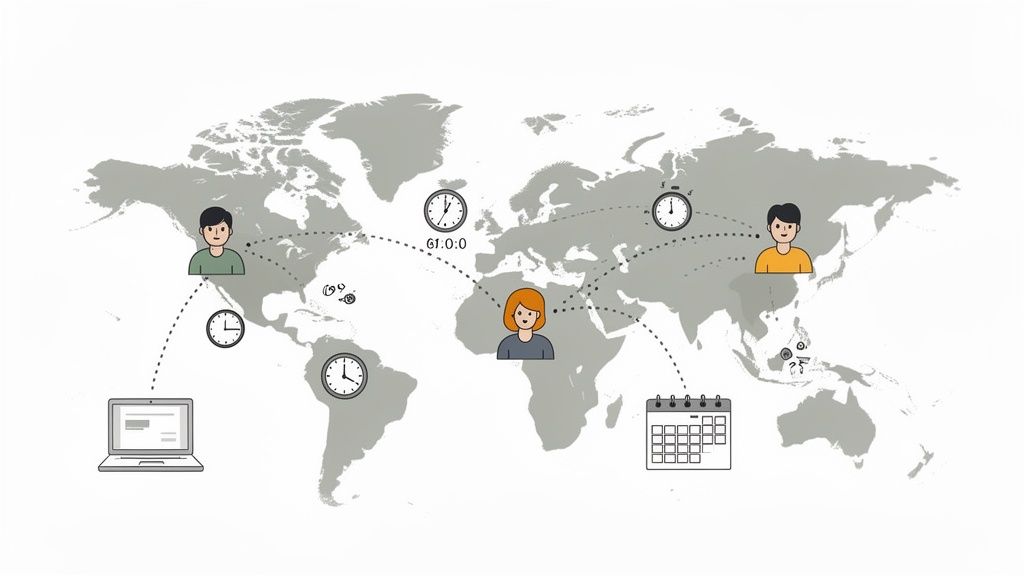
This question cuts through the resume fluff and gets straight to the core competencies required for successful remote collaboration: proactive communication, meticulous documentation, and an async-first mindset. It reveals whether a candidate has actually lived the reality of remote work or just read about it in a blog post.
A strong answer moves beyond "we used Slack." Look for a candidate who can articulate a clear strategy. They should describe the systems they put in place to ensure seamless handoffs, manage expectations, and prevent critical information from getting lost in translation. Did they establish a "single source of truth" for project documentation? How did they structure meetings to maximize the limited overlapping work hours?
For instance, a great response from a marketing manager might sound like this: "On my last campaign, our design team was in Brazil and our copywriters were in the US. I created a centralized Asana board with a strict 'no DMs for project updates' rule. Every task had a clear owner and deadline, and we used Loom videos for asynchronous feedback to avoid time-consuming meetings." This answer demonstrates practical, repeatable processes, not just a vague commitment to "good communication."
For a deeper dive into the specifics of these logistical challenges, understanding the nuances of the South America time difference can provide valuable context for your interviews.
In the tech world, skills have a shelf life shorter than a carton of milk. This is why "Describe a time you learned something new" is one of the best questions to ask an interviewee. It's a smoke test for adaptability. You’re not just hiring for what a candidate knows today; you’re hiring for their ability to learn what your company will need tomorrow.
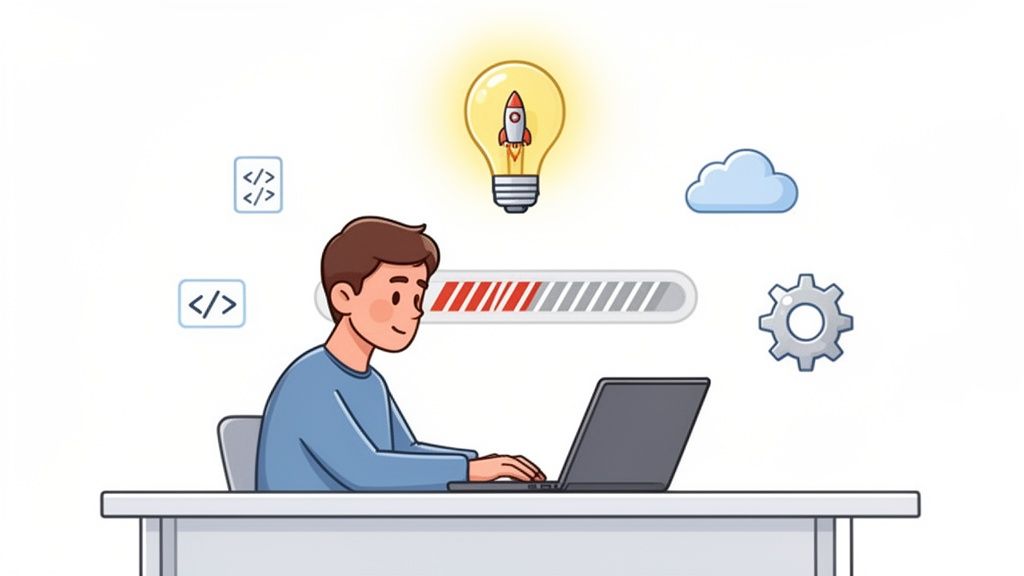
This question reveals a candidate's resourcefulness, learning process, and grit under pressure. Anyone can list "quick learner" on their resume, but can they prove it when a project demands they master Kubernetes in two weeks? This separates the perpetual students from those who just memorized for the test. It's about finding people who see a knowledge gap not as a roadblock, but as a challenge to conquer.
A weak answer is vague and focuses only on the outcome: "Yeah, I had to learn React for a project, and I did it." A strong answer details the process. Look for candidates who can articulate their learning strategy, the resources they used, and how they applied their new knowledge practically. Did they dive into official documentation, find a mentor, or power through an online course? How did they measure their own proficiency?
For example, a strong response from a QA engineer might be: "My team decided to shift from manual to automated testing, and I was tasked with leading the transition using Selenium. I dedicated my evenings to a highly-rated Udemy course, but I supplemented that by building small, personal automation scripts for my daily tasks. Within three weeks, I had built the first regression suite and was able to demo it to the team, explaining the core concepts I'd learned."
This answer showcases initiative, a practical application of knowledge, and a feedback loop. It's proof they can drive their own development, a critical skill for any remote team member, especially when you're working with top-tier tech talent in Latin America who often bring a proactive and self-starting attitude to the table.
Hiring for skill is one thing, but hiring for professional maturity is the real game-changer, especially in a remote setup. This question is a powerful tool because it reveals a candidate's emotional intelligence, communication strategy, and respect for hierarchy all at once. Anyone can claim to be a "team player," but how do they act when the captain calls a play they think is wrong? This is where you separate the constructive contributors from the disgruntled complainers.
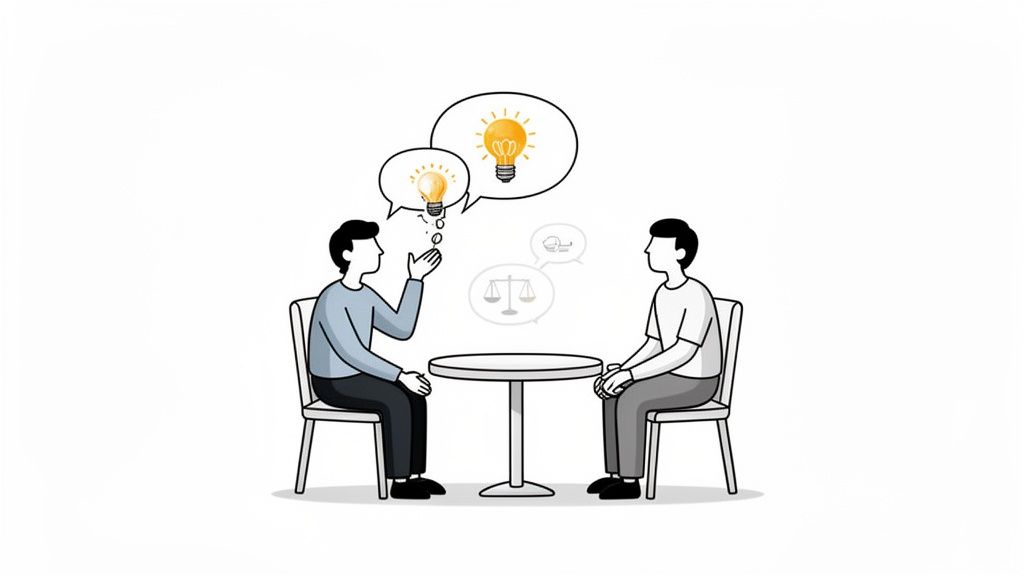
This question gets to the heart of how someone navigates professional conflict. For remote teams, particularly those with talent from Latin America working with North American managers, understanding this dynamic is crucial. It tests for diplomacy and cultural adaptability, showing whether a candidate can challenge an idea productively without challenging authority destructively. It’s about finding people who improve the plan, not just undermine it.
A weak answer is vague, like "I'd tell them I disagree" or, even worse, "I just do what I'm told." You're looking for a structured, respectful process. A strong candidate will talk about preparation, timing, and tone. Did they gather data to support their alternative viewpoint? Did they request a private one-on-one instead of calling out their manager in a group meeting? And critically, did they commit to the final decision even if it wasn't theirs?
For example, a solid response from a developer might sound like this: "I once had concerns about a proposed architecture's scalability. I scheduled a brief call with my manager, presented data from a quick load test I ran, and proposed an alternative that I believed would save us technical debt later. He appreciated the research but decided to stick with the original plan due to tight deadlines. I fully supported his decision and focused on making the chosen architecture as robust as possible." This shows initiative, respect, and ultimate alignment.
When you're hiring top talent, understanding how to foster this kind of psychological safety is key. For more on creating an environment where these conversations can happen, exploring strategies for employee wellness in Latin America can offer valuable insights into building a supportive and productive remote culture.
Mistakes are inevitable, but accountability is a choice. This question is designed to separate the professionals who own their errors from those who run for cover. When you're managing a remote team, you can't stand over someone's shoulder to quality check their work in real-time. You need to hire people who hold themselves to a high standard, catch their own mistakes, and proactively fix them. This is one of the best questions to ask an interviewee because it's a direct stress-test of their character and professional maturity.
This question peels back the curtain on a candidate's resilience, problem-solving skills, and integrity. You're not just looking for an apology; you're looking for a post-mortem. A weak candidate will get defensive, blame others, or downplay the impact. A strong candidate will walk you through their process of identification, communication, resolution, and prevention.
A standout answer demonstrates ownership from start to finish. The candidate should immediately accept responsibility without making excuses. Listen for the specific, actionable steps they took to correct the mistake, not just a vague "I fixed it." Did they communicate the issue proactively to stakeholders, or did they wait until it was discovered? Most importantly, what did they learn, and what systems did they implement to ensure it never happened again?
For example, a DevOps engineer might say: "I deployed a new infrastructure configuration that caused intermittent latency issues we missed in staging. As soon as we detected it, I immediately communicated the impact to the engineering lead, rolled back the change, and performed a root cause analysis. I discovered a misconfigured caching layer. I not only fixed it but also updated our pre-deployment checklist to include performance load testing for that specific service, which we now do for all similar releases." This answer shows accountability, a clear resolution process, and a forward-thinking, preventative mindset.
Let's be honest, anyone can list "TensorFlow" or "Figma" on their resume. It’s the business equivalent of saying you "love to travel." This question is your lie detector, designed to expose the difference between someone who has read the documentation and someone who has battled with the tool in the trenches at 2 AM. It forces them off-script and into the specifics of their actual, hands-on experience.
You're not just testing for knowledge; you're testing for applied skill and problem-solving prowess. For the specialized, high-stakes roles that our clients at LatHire are looking to fill, like DevOps engineers or machine learning specialists, this distinction is everything. It’s the difference between hiring a liability and hiring an asset who can start delivering value from day one.
A weak answer is a feature list. "I used GitHub Actions to set up our CI/CD. It has features for building, testing, and deploying." That tells you nothing. A strong candidate will walk you through a narrative, treating the project like a case study. They'll explain the why behind their choices, the trade-offs they considered, and the ugly problems they had to solve.
For example, an excellent response from a UX/UI designer might sound like this: "We needed to build a scalable design system in Figma for our mobile app. I started by conducting an audit and then created a set of foundational components like buttons and forms. The real challenge was getting engineer buy-in, so I documented every component in Storybook and ran workshops to ensure a smooth handoff. This reduced design inconsistencies by over 40% in the first quarter." This answer demonstrates technical skill, strategic thinking, and a focus on real-world results.
Hiring for a remote role isn't just about finding someone who can do the job; it's about finding someone who can do the job from their living room without missing a beat. This question is a direct probe into their remote work maturity. It separates the candidates who have thrived in a distributed environment from those who merely survived the mandatory work-from-home phase. You need to know if they're self-starters or if they need constant in-person supervision to stay on task.
This is one of the best questions to ask an interviewee because it uncovers their entire operational blueprint for remote success. Their answer reveals their proactivity, their comfort with asynchronous communication, and their ability to create structure in an unstructured environment. It's a window into whether they view remote work as a perk or as a professional discipline requiring specific skills and habits.
A weak answer sounds like, "I used Slack and Zoom during the pandemic." That tells you nothing. A strong candidate will provide a detailed account of their remote stack, their communication philosophies, and their personal strategies for staying productive and sane. They'll talk about the systems they built, not just the software they were told to use.
For example, a great response from a software developer might be: "My last team was fully async. We lived in GitHub and Linear, with a strict 'document everything' policy for pull requests. To avoid burnout, I time-boxed my workdays and had a separate physical space for my office. The biggest challenge was initially feeling isolated, but I addressed that by proactively setting up virtual coffee chats with colleagues to build rapport."
This kind of answer shows they're not just familiar with the tools but have also grappled with the human side of remote work. They've developed personal systems for productivity and connection. Some may even touch upon the broader implications of this freedom, like adopting a digital nomad lifestyle, which indicates a deep commitment to remote-first principles. For a deeper understanding of what makes a remote setup successful, review some remote work best practices to benchmark their answers against.
In a startup or any fast-moving SME, every day is a masterclass in organized chaos. You're not just hiring someone to do one job; you're hiring a professional juggler who can keep multiple projects airborne without dropping a single one. This question instantly reveals if they thrive in that environment or if they'll crumble when a bug fix, a new feature request, and a surprise client demand all land on their desk at once.
This question tests a candidate's real-world ability to prioritize, strategize, and execute under pressure. It's the difference between someone who needs a perfectly curated to-do list from their manager and a proactive problem-solver who can create order from operational noise. You're looking for someone who can make intelligent trade-offs and, just as importantly, communicate those decisions effectively to stakeholders.
A weak answer sounds like, "I just worked harder and got it all done." A strong candidate will talk about their system. They should describe a specific framework they used, whether it's a formal Eisenhower Matrix (urgent/important) or their own battle-tested method for triaging tasks. The key is evidence of a repeatable process, not just brute-force effort. Look for candidates who can articulate what they chose not to do and why that was the right strategic decision.
For example, a strong response from a developer might be: "I was handling critical bug fixes for our live product while also being tasked with a new feature build for a Q3 launch. I used a simple 'impact vs. effort' analysis, focusing first on a patch for a bug that was affecting 30% of our user base. I clearly communicated to the product manager that the new feature's timeline would be delayed by two days, providing a revised schedule. This prevented user churn without completely derailing our product roadmap." This answer demonstrates prioritization, stakeholder management, and a focus on business outcomes.
When you hire remote talent, you're not just plugging a gap; you're integrating a new brain into your company's nervous system. Asking a candidate how they get up to speed on a new business separates task-doers from strategic contributors. It reveals if you're hiring someone who will just follow tickets or someone who will understand the why behind their work.
This question tests for intellectual curiosity, business acumen, and a proactive mindset. Anyone can execute a pre-defined task, but top-tier talent invests time upfront to understand the business context. They want to know how the company makes money, who the customers are, and what success looks like. This initial discovery phase is what enables them to make better decisions and add value beyond their immediate role.
A weak answer is passive: "I wait for my manager to tell me what to do" or "I read the documents I'm given." A strong answer is a blueprint for active discovery. Look for candidates who describe a multi-pronged approach to learning, combining documentation, people, and independent research. They should talk about who they would talk to and what they would ask.
For instance, a great response from a software engineer might be: "First, I'd review the product roadmap and any existing customer feedback or support tickets to understand pain points. Then, I'd schedule short chats with the product manager and a senior sales rep to understand the business goals and the competitive landscape. This context helps me make better architectural decisions, not just blindly code a feature." This shows they connect their technical work directly to business outcomes, a critical skill for any effective remote team member.
In a lean, fast-moving company, every project is a cross-functional project. Your new hire won't live in a silo, so asking about their experience collaborating with different departments is one of the best questions to ask an interviewee to gauge their adaptability and communication skills. It separates the lone wolves from the true team players.
This question tests a candidate's ability to navigate different work styles, technical languages, and departmental priorities. Can your engineer patiently explain a technical constraint to the marketing team? Can your project manager truly understand the sales team's pressures? You're not just hiring a skill set; you're hiring a collaborator who can bridge gaps, not create them. This is especially critical when integrating talented professionals from Latin America into North American teams, where cultural and functional differences are part of the daily reality.
A weak answer is generic and focuses only on their own contribution. "I worked with the sales team, and it went well. I gave them the data they needed." This tells you nothing. A strong answer demonstrates empathy, specific communication tactics, and a genuine understanding of others' roles.
Look for a candidate who can articulate the why behind the collaboration. They should explain the challenges they encountered and, more importantly, what they learned. For instance, a great response from a software developer might be: “On our last feature launch, I worked with marketing. Initially, I was frustrated by their requests for 'simple' front-end changes that were technically complex. I started joining their weekly syncs for 15 minutes to understand their campaign goals. It helped me proactively suggest alternative solutions that met their needs without derailing our sprint. I learned marketing isn't just about making things 'look pretty'; it’s about user acquisition funnels, which our feature directly impacted.”
This response shows humility, a problem-solving mindset, and an appreciation for other disciplines. It’s the kind of thinking that prevents organizational friction and keeps projects moving forward. For insights on building these cohesive teams, exploring the dynamics of hiring developers from Latin America can reveal how to foster this cross-cultural, cross-functional synergy.
Hiring for quality isn't just about finding someone who does good work. It's about hiring someone who has a built-in, non-negotiable process for ensuring good work, especially when their manager is thousands of miles and several time zones away. This question peels back the curtain on their professional standards and discipline. It forces them to move beyond saying "I have great attention to detail" and show you the system that produces it.
For remote teams, this is non-negotiable. You can't hover over someone's shoulder to catch a mistake before it goes live. You need to hire professionals who have their own internal quality control engine. This question reveals whether their engine is a well-oiled machine or a sputtering mess held together with duct tape. It uncovers their commitment to craftsmanship, their ability to think critically about their own work, and their respect for the end-user.
A weak answer is vague and relies on platitudes like "I just check for mistakes" or "I make sure it looks good." A strong answer is a masterclass in process. It’s methodical, specific, and demonstrates a deep understanding of what "quality" actually means in their domain. Look for candidates who can articulate a checklist, a framework, or a multi-step verification process they follow religiously.
For example, a strong response from a senior developer might be: "My PR review process has three phases. First, I check for architectural soundness: does this align with our existing patterns? Second, performance and security: are there any N+1 queries or potential vulnerabilities? Finally, readability and maintainability: is the code clean, and could another engineer easily understand it in six months?" This isn't just a review; it's a risk mitigation strategy. It proves they see quality as a core responsibility, not an afterthought.
For a deeper understanding of the frameworks that produce high-quality output, exploring different quality assurance testing methods can provide valuable context for evaluating a candidate's response.
| Question | Implementation complexity | Resource requirements | Expected outcomes | Ideal use cases | Key advantages |
|---|---|---|---|---|---|
| Tell me about a time you successfully managed a project with a distributed team across different time zones | Medium — requires concrete examples and timeline details | Moderate — interviewer time to probe tools/processes | Evidence of async coordination, time-zone strategies, and project delivery | Remote engineering, product, and marketing teams spanning regions | Directly tests remote coordination and cross-border collaboration |
| Describe a situation where you had to learn a new technology or skill quickly to meet project deadlines | Low–Medium — behavioral with measurable results preferred | Low — ask about resources used and ramp metrics | Demonstrates learning velocity, resourcefulness, and short-term impact | Fast-moving tech roles, startups, roles needing rapid upskilling | Identifies self-starters and adaptability to new tech |
| Walk me through your approach when you disagree with a supervisor or manager's decision | Low — behavioral, focuses on communication style | Low — listen for examples of escalation and tone | Reveals conflict resolution, professionalism, and escalation judgment | Roles with close reporting lines or cross-cultural supervision | Assesses diplomacy, judgment, and cultural fit |
| Tell me about a time you delivered work that didn't meet quality standards initially—how did you handle it? | Medium — needs specifics on corrective actions and prevention | Moderate — follow-ups to validate ownership and outcomes | Shows accountability, remediation steps, and learning from errors | Roles where reliability and independent problem correction matter | Tests ownership, resilience, and improvement processes |
| Describe your experience with [specific technology/tool required for role] and walk through a real project where you used it | High — technical depth required and tool-specific detail | High — technical interviewer or artifacts to validate claims | Validates hands-on competence, depth of knowledge, and real-world results | Specialized technical hires (AI, DevOps, cloud, UX/UI) | Objective skill verification and reduced hiring risk |
| Tell me about your experience with remote work—what tools, practices, and challenges have you encountered? | Low–Medium — broad behavioral assessment | Low — focuses on toolset and routine examples | Assesses remote maturity, tooling familiarity, and self-management | Any remote or distributed role, onboarding to North American teams | Predicts remote readiness and tool/process fit |
| Describe a situation where you had to balance multiple competing priorities—how did you manage them? | Low–Medium — expects prioritization framework and outcomes | Low — request metrics and examples of trade-offs | Reveals time management, prioritization method, and communication about trade-offs | Startups, SMEs, and roles with frequent context-switching | Shows ability to prioritize under constraint and communicate trade-offs |
| How do you approach learning about and understanding a new client's or company's business model and needs? | Medium — requires process and impact examples | Low — ask about sources, stakeholder interviews, and outcomes | Demonstrates business acumen, stakeholder focus, and onboarding speed | Client-facing roles, consultants, product and strategy hires | Predicts faster onboarding and alignment with business goals |
| Tell me about a project where you had to collaborate closely with people from different departments or backgrounds—what did you learn? | Low–Medium — behavioral with interpersonal examples | Low — probe for conflict resolution and cross-functional outcomes | Shows cross-functional communication, cultural intelligence, and compromise | Cross-team initiatives, product launches, interdisciplinary projects | Reveals teamwork, empathy, and ability to bridge silos |
| Walk me through your approach to code review, testing, or quality assurance [or equivalent for non-technical roles]—what do you look for? | Medium–High — expects concrete standards and examples | Moderate — may require artifacts or specific incidents | Indicates quality standards, processes, and preventive practices | Technical roles (dev, QA) and any role with independent deliverables | Assesses rigor, attention to detail, and ability to maintain standards remotely |
So, you’ve just run a killer interview. You’ve deployed a series of surgically precise questions designed to peel back the layers of a polished resume and reveal the raw talent, problem-solving skills, and cultural fit underneath. You’ve successfully navigated the difference between a candidate who can talk the talk and one who has actually walked the walk, probably uphill, both ways, in a blizzard of competing priorities.
Give yourself a pat on the back. You’ve done the hard part, right?
Not even close. The interview is just one checkpoint in a marathon of vetting, assessing, and onboarding. Asking the best questions to ask an interviewee is a critical first step, but it's followed by a dozen more that can drain your resources and derail your focus. You've gathered qualitative data, but now comes the gauntlet of skill validation, reference checks, and the bureaucratic nightmare of cross-border compliance and payroll.
Let’s be honest. You didn't start a company to become a part-time detective, an amateur skills assessor, or an international HR expert. Yet, that's often what the hiring process demands. The insights you gained from asking about managing distributed teams or handling supervisor disagreements are invaluable, but they need to be validated.
This is where the real work begins, and it’s where most hiring processes fall apart.
The truth is, a great interview only gets you to the starting line. Turning that promising conversation into a successful, long-term hire requires an operational machine that most startups and even established companies simply don't have.
The questions in this guide are your new secret weapon for identifying top-tier talent. They provide a framework to move beyond gut feelings and into data-driven decision-making. By focusing on past behavior, technical application, and remote work readiness, you’re already miles ahead of the competition who are still asking "What's your biggest weakness?"
But mastery isn't just about knowing what to ask; it's about building a system that executes flawlessly on the answers.
The ultimate goal isn’t to become a world-class interviewer. It’s to become a world-class builder of teams. The interview is merely a tool, not the end game.
This is where we come in (toot, toot!). At LatHire, we’ve built the engine you need to turn interview insights into hires. We don't just send you a list of names. We handle the entire chaotic process, from AI-powered skills assessments and human-led vetting to managing all the cross-border payroll and HR complexities. We've obsessed over this so you don't have to.
So, use these questions. Master them. Become the interviewer who can spot elite talent from a mile away. But when you’re ready to stop spending your days vetting candidates and get back to building your business, let us handle the rest. We can match you with an elite, fully-vetted developer from Latin America, ready to integrate with your team, in as little as 24 hours. Your roadmap will thank you for it.

