

Let’s get one thing straight. The biggest, most immediate benefit of offshore outsourcing isn't some fuzzy, long-term strategic play. It’s a simple financial truth: it’s the fastest way to stop burning through cash while still bringing on world-class talent. This isn't just a nice-to-have perk; it's a capital-efficient masterstroke for building an A-team without the eye-watering costs that come with local recruitment.
Turns out there’s more than one way to hire elite developers without mortgaging your office ping-pong table.
We’ve all seen those startup burn rates. They look more like a rocket launch countdown than a sustainable business plan. You’re told you need elite talent to compete, but nobody ever mentions that "elite" doesn't have to come with a San Francisco mortgage attached to it.
The reality is that local hiring is a financial black hole. It’s not just about the six-figure salaries. It’s the endless parade of hidden costs that slowly bleed you dry, one line item at a time. Think about it: payroll taxes, expensive health insurance, 401(k) matching, and pricey office space. It all adds up to a number that makes your CFO break out in a cold sweat.
Before you even get to payroll, you’re sucked into the recruitment vortex. Hope you enjoy spending your afternoons fact-checking resumes and running technical interviews—because that’s now your full-time job. The alternative? Paying a recruiter a fee that could have funded your entire marketing budget for a quarter.
Even small internal leaks, like unmanaged employee absences, can cause a significant financial drain. Suddenly, researching how effective absence management strategies can reduce costs becomes yet another task on your overflowing plate. Every dollar spent on inefficient internal processes is a dollar you can't spend on growth.
The real cost of a local hire isn't their salary. It's the salary plus the months of lost productivity, the recruiter fees, the benefits overhead, and the constant risk of them getting poached by the company next door offering a better ping-pong table.
To illustrate the difference, let’s break down the real-world expenses side-by-side.
When you look beyond the base salary, the financial picture becomes painfully clear. Here’s a comparison of what it really costs to hire a senior developer locally versus tapping into the global talent pool.
| Cost Factor | Local Hire (e.g., San Francisco) | Offshore Hire (e.g., Latin America) |
|---|---|---|
| Base Salary | $150,000+ | $60,000 – $80,000 |
| Recruitment Fees (20%) | $30,000 | $0 (with a platform like LatHire) |
| Payroll Taxes & Benefits (30%) | $45,000 | Included in platform fee |
| Office Space & Equipment | $15,000 | $0 (fully remote) |
| Onboarding & Training | $5,000 | Streamlined by platform |
| Total Annual Cost | ~$245,000 | ~$75,000 |
This isn't an exaggeration. The total cost of a local hire can easily be 50-60% higher than their salary alone. With an offshore partner, these costs are either eliminated or bundled into a single, predictable fee.
The financial advantage of going global is impossible to ignore. Industry analysis shows businesses can slash labor costs by 30–60% by offshoring to major hubs. For tech-specific roles, the numbers get even better, with some companies reporting operational cost savings of up to 70%.
This chart really puts the savings potential into perspective.
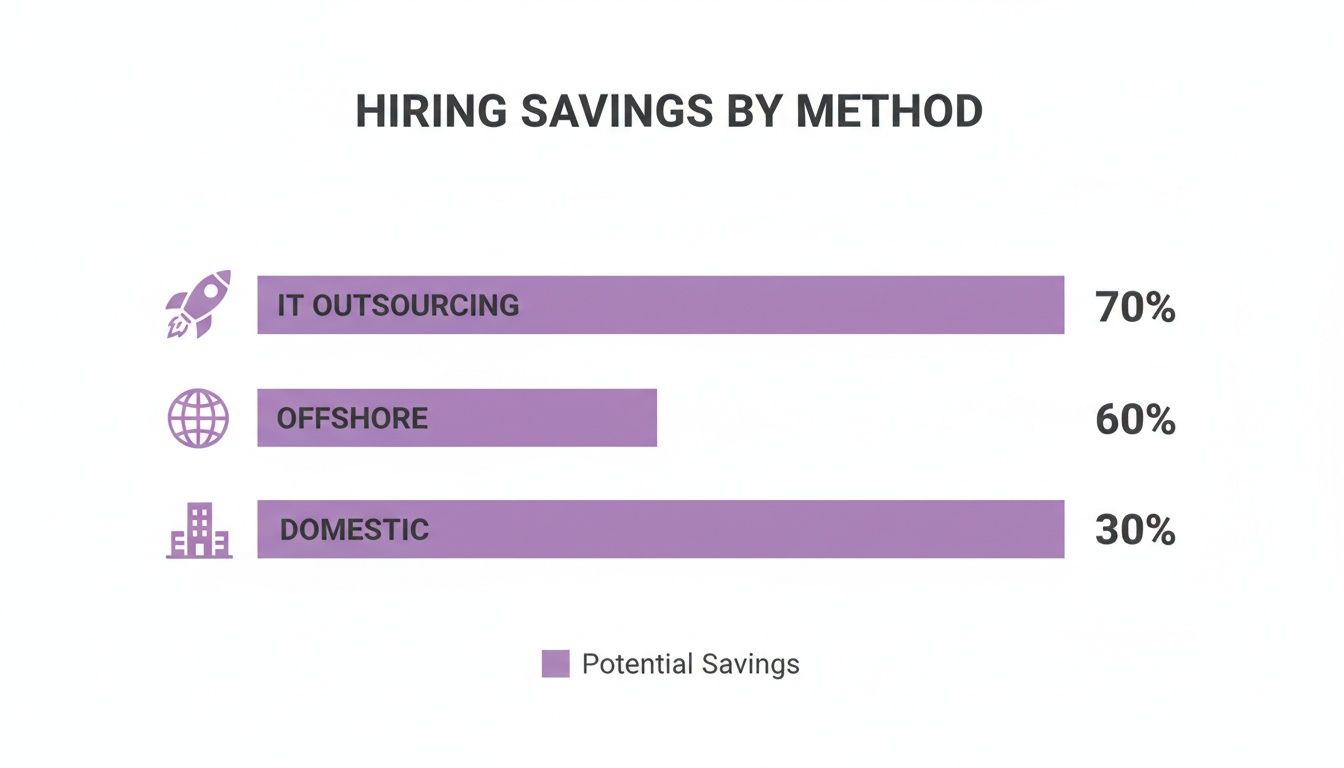
The data is clear: IT and offshore outsourcing deliver exponentially higher savings than sticking to domestic options. That's critical capital you can pour back into product development, marketing, and innovation.
Ultimately, this isn't about being cheap; it's about being smart. It’s about allocating your precious capital to activities that actually grow your business, not just covering an ever-expanding payroll. If you're serious about financial efficiency, it's time to learn how to reduce operational costs without ever sacrificing quality.
If you still think offshoring is just a line item on your budget, you’re playing in the minor leagues. The real strategic benefit of offshore outsourcing isn't about saving a few bucks; it's about gaining access to a global firehose of elite talent. It’s the ultimate unfair advantage.
While your competitors are stuck in a local bidding war for the same handful of engineers, you can tap into a pre-vetted pool of world-class professionals ready to ship code on day one. This isn't just about hiring cheaper; it's about hiring smarter and faster.
Let’s be honest: local hiring is a soul-crushing marathon. You post a job, sift through a hundred mediocre resumes, conduct a dozen phone screens, and maybe—just maybe—you find one decent candidate after two months. By then, your project is already behind schedule.
Offshore platforms flip that entire model on its head. Instead of you hunting for talent, the talent is already there—vetted, tested, and ready to go. You’re not starting from scratch; you're picking from a curated roster of A-players. This can shrink your hiring timeline from months to a matter of days.
Think of it this way: traditional hiring is like fishing in a small, overfished pond. Offshore outsourcing is like dropping your line into the ocean. The sheer volume and quality of talent available is a game-changer.
This speed isn’t a gimmick; it’s a massive competitive advantage. It means you can spin up a new development team for that surprise project or backfill a critical role without missing a beat. While your competition is still scheduling interviews, you’re already deploying new features.
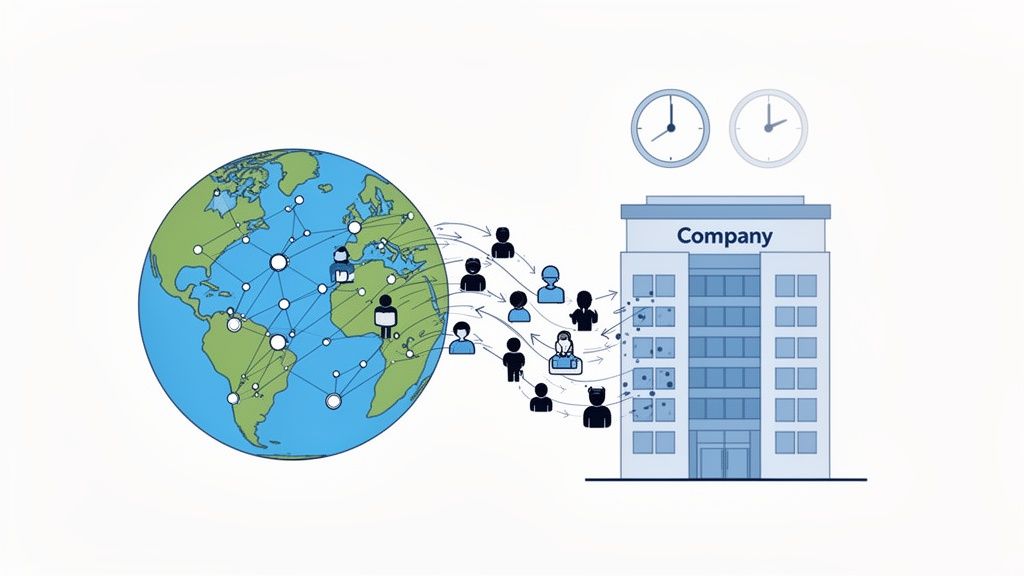
Here’s where things get really interesting. When you build a team in a complementary time zone, you’re not just hiring people; you’re buying time. You can create a "follow-the-sun" workflow that turns your business into a non-stop productivity engine.
Imagine this scenario:
This isn't some futuristic fantasy. It’s how smart companies are operating right now. This approach effectively doubles your productive hours in a day, crushing development cycles and getting you to market faster than anyone thought possible. You can explore more about how this works by checking out our guide on nearshore outsourcing benefits.
Need to scale your engineering team from five to fifteen for a big launch? Good luck doing that locally in under six months without mortgaging your office ping-pong table. With an offshore model, you can scale up—or down—with an agility that traditional hiring simply can’t match.
This flexibility is crucial for startups and growing businesses where demand is unpredictable. You can add specialized talent for a single project without the long-term commitment of a full-time hire. Need a machine learning expert for three months? Done. A team of QA testers for a two-week sprint? No problem.
Beyond just the cost savings on labor, this model delivers massive productivity gains. For instance, the nearshore model in Latin America offers productivity improvements of 10–20% or more, largely because the shared time zones eliminate the communication delays that cripple projects with teams in Asia. It's no wonder that 59% of executives see access to specialized expertise as a key outsourcing benefit.
This strategic approach transforms your workforce from a fixed overhead cost into a dynamic, adaptable asset. You’re no longer constrained by your local talent pool or your balance sheet. You have the freedom to build the exact team you need, exactly when you need it.
Let's get real for a minute. The idea of offshore outsourcing sounds fantastic on paper, but we’ve all heard the horror stories. The 3 AM calls to a team on the other side of the planet, the painful communication breakdowns, and the quality that nosedives the moment a contract is signed.
Ignoring these risks isn't just optimistic; it's a rookie mistake that can sink your project. This isn't a list of vague warnings. This is your field guide to not messing it up, from someone who's learned these lessons the hard way.
The biggest killer of any offshore partnership isn't code; it's communication. It starts small—a misunderstood requirement, a passive-aggressive Slack message, a missed deadline blamed on a "misalignment." Before you know it, you're shipping a product that looks nothing like the spec.
The problem is assuming everyone communicates the same way. Cultural nuances are very real. In some cultures, saying "no" directly is considered rude, so you get a lot of "we'll try our best" right before a feature completely fails.
So, how do you fix it? You over-communicate with ruthless clarity.
Here’s a classic story: you vet a partner, see amazing portfolio work, sign the contract, and get assigned their "B-team." The first month is great, but then the senior talent gets shuffled to a new, bigger client, and you're left with junior developers learning on your dime.
You have to inspect what you expect, from day one until the project is done. Hope is not a strategy.
Your partner’s quality control is not your quality control. Trusting a vendor to police themselves is like asking a fox to guard the henhouse. You need your own systems in place.
Build your own safety nets. Insist on regular code reviews, implement automated testing, and have your internal tech lead (or a trusted consultant) audit the work periodically. It keeps everyone honest and ensures the standards you signed up for are the standards you actually get.
Handing over your codebase to a team in another country can feel like leaving your front door wide open. And you're right to be paranoid. Intellectual property (IP) theft is a real threat, but it's also a manageable one. It's about building a fortress of legal and technical safeguards, not just crossing your fingers.
First, your contract needs an ironclad IP assignment clause stating that all work product created for you is owned by you, period. This should be non-negotiable. Second, you control the access. Use secure, cloud-based environments and grant permissions on a need-to-know basis. No one should be able to download your entire user database.
Protecting your assets is a foundational step. If you're new to this, it's worth reviewing some core data security best practices to ensure you have all your bases covered from the start.
Ultimately, avoiding these disasters comes down to vetting ruthlessly, communicating obsessively, and trusting but verifying—always. Stop chasing the dream of a perfect, hands-off partnership and start building a realistic, successful one.

Let's get a few things straight. Not all offshore destinations are created equal. For decades, the default move for North American companies was to look East—to India, the Philippines, or Eastern Europe. It was a numbers game, pure and simple.
But while everyone else was busy wrestling with 12-hour time differences, the smart ones started looking South. Why? Because Latin America isn’t just offshore; it’s nearshore. That one tiny distinction is your new secret weapon.
It’s the Goldilocks zone for building a remote team—not too far, not too disconnected, but just right.
This isn’t just a hunch. The market speaks for itself, with nearly 60% of businesses using outsourcing to slash costs. For tech giants like Microsoft and Mercedes, offshoring is standard procedure, with some partnerships cutting employment costs by a staggering 70%. The question isn't if it works, but where it works best for you. Dig deeper into how industry leaders are maximizing cost savings through strategic outsourcing.
Forget the 3 AM stand-up meetings and the email chains that take a full 24 hours to resolve. That’s the old way, the painful way. The single greatest operational advantage of outsourcing to Latin America is the massive time zone overlap.
When your team in Bogotá is on the same clock as your team in Boston, you’re not just sending messages into the void—you’re collaborating in real time. You can hop on a quick call, solve a problem, and get back to work without waiting for the other side of the world to wake up.
This isn't a minor convenience; it's a fundamental shift in productivity. Real-time collaboration eliminates the communication lag that kills momentum and introduces costly misunderstandings. It turns your distributed team into a cohesive unit, not two separate groups passing notes in the dark.
This simple geographical reality means faster development cycles, quicker decision-making, and a team that actually feels like a team. It’s the difference between a high-functioning, integrated workforce and a frustrating game of telephone across continents.
Another thing they don't tell you about traditional offshoring? The cultural gap can be a chasm. It’s not about good or bad; it’s about different working styles, communication norms, and business etiquette that create friction. You end up spending half your time trying to translate context, not just language.
Latin America offers a much stronger cultural affinity with North America. The talent pool there has grown up consuming similar media, following similar business trends, and working in professional environments that mirror those in the U.S. and Canada. They’re ambitious, direct, and hungry to work with forward-thinking companies.
This translates to smoother collaboration from day one.
This cultural alignment isn't fluff. It's the grease that keeps the gears of a remote team turning smoothly, a key benefit of offshore outsourcing that’s criminally underrated until you’ve experienced the pain of its absence.
So, Latin America has the talent, the time zone, and the cultural fit. What’s the catch? The catch is that finding, vetting, hiring, and managing talent across borders is a logistical nightmare if you go it alone.
Good luck navigating international labor laws, calculating cross-border payroll, and figuring out benefits compliance in a country you’ve never visited. It’s a full-time job that pulls you away from, you know, actually running your business.
This is where a platform like ours comes in. We’ve seen founders get burned trying to DIY this process, and we built LatHire to de-risk the entire venture. We handle the messy parts so you can focus on the mission. (Toot, toot!)
We’re not just a database of résumés. We are the system that turns a high-stakes gamble into a strategic masterstroke. By handling the AI-powered vetting, the compliance headaches, and the international HR, we let you tap into this incredible talent pool with confidence. This is how you get all the benefits of a global team without any of the classic headaches.
Alright, enough theory. We've covered the why, the where, and the what-not-to-do. Now it's time for the how.
This isn't just a wish list. It's a repeatable blueprint for making your first strategic offshore hire without the usual headaches. We're going to walk through the whole process, from choosing the right role to making your new hire feel like part of the team from day one.
Let's start building your global growth engine.
Think of your first offshore hire as a test run—a proof of concept. For the love of all that is holy, don't start by trying to outsource your CTO. What you need here is a clear win, not a high-stakes gamble.
Look for a role that is:
The goal of your first hire is to prove the model works. You're building a system, a process you can replicate. Once you nail it with one role, scaling to five or ten becomes exponentially easier.
So, pick a role, define its exact responsibilities, and write down what a successful first 90 days looks like. This clarity is your foundation.
Forget the boring corporate template. Your job description is a sales pitch, and you're competing against the world for top talent. You need to sell the mission, the team, and the opportunity—not just rattle off a list of required skills.
A killer remote job description includes:
This isn't about adding fluff; it's about being strategic. You're filtering for candidates who are not just skilled, but genuinely aligned with your vision.
Okay, the applications are rolling in. Now what? The single biggest mistake founders make at this stage is focusing 100% on technical skills. A brilliant coder who can't communicate is a liability, not an asset.
Your interview process should be designed to test three key areas:
This is where you find the people who don't just take tickets, but who think like owners. You’re looking for a partner, not just a pair of hands.
The first week sets the tone for the entire working relationship. A sloppy, disorganized onboarding process sends a clear message: "you're an afterthought." You need to be obsessively organized here.
Your onboarding checklist absolutely must include:
Treat your offshore team member with the same respect and attention you'd give someone sitting three feet away. This isn't just a nice thing to do—it's how you build a loyal, high-performing team that sticks around for the long haul.
Alright, let's cut to the chase. You've seen the numbers and the strategy, but I'm willing to bet there are a few nagging questions bouncing around in your head. The "what ifs" that can keep a founder up at night.
No fluff. No marketing spin. Just direct answers from our time in the trenches.
Honestly? It can be, but only if you treat it like an afterthought. It's not a nightmare; it's a discipline. And it's a guaranteed nightmare if you’re trying to manage a team 12 hours ahead of you.
Success really boils down to three things:
Get these right, and "remote management" just becomes "management."
This is a huge deal, and anyone who tells you otherwise is being careless. Your IP is your business. Protecting it isn't optional.
First off, your hiring partner is your first line of defense. A dedicated platform like LatHire handles the heavy legal lifting from the get-go, making sure every contract includes robust, enforceable IP protection clauses. We’ve seen firsthand what happens when this goes wrong.
Second, you absolutely need an ironclad NDA and IP assignment clause in your direct contract with the talent. It should state unequivocally that all work created for you is owned by you. Period.
Finally, you have to control your environment. Use secure, cloud-based systems and grant access to your codebase and sensitive data on a strict need-to-know basis. It’s all about building a fortress of legal and technical safeguards, not just crossing your fingers and hoping for the best.
They will if you make the effort. Culture doesn’t just magically appear in an office breakroom; it’s built through shared experiences and intentional inclusion. You can’t just toss someone a laptop and expect them to feel like part of the team.
Here's what actually works:
Most importantly, treat them like a core part of the team, not just a contractor you found online. Give them challenging, meaningful work. Recognize their wins publicly. Invest in their growth. Culture is about how you treat people, not where they log in from.
It's the difference between buying a pile of car parts and driving a fully assembled car off the lot.
Freelance marketplaces are the Wild West. They throw raw, unvetted talent at you, and suddenly your full-time job becomes sifting through hundreds of profiles, running background checks, and navigating international payment systems. It’s a massive time sink.
A true outsourcing partner provides an end-to-end solution. They handle the vetting, skills assessments, background checks, and all the administrative headaches like international payroll and legal compliance.
You're not just hiring a person; you're plugging into a proven system for building a reliable, high-quality global team. One approach is a gamble that eats up your time. The other is a strategic move that saves it.
Ultimately, the best benefit of offshore outsourcing is getting your time back to focus on building your business, not your back office.

