
Let’s be honest: traditional recruiting is an expensive, soul-crushing mess. It’s a game of endless job board postings, wading through a blizzard of resumes, and just hoping the person on the video call remotely resembles their LinkedIn profile. An AI powered recruitment platform is designed to fix this broken model by automating the grunt work and zeroing in on what actually matters—a candidate's verified skills.
We’ve all been there. You post a job and get buried under 300 resumes, 90% of which are wildly unqualified. You spend your week manually sifting through profiles, trying to decipher if "proficient in Java" means they wrote a "Hello, World!" app once or if they built a scalable microservices architecture.
It’s a colossal waste of time and energy. This outdated "post and pray" method isn't just inefficient; it's a direct drain on your bottom line. Every hour a hiring manager spends sifting through resumes is an hour they aren't leading their team or driving revenue. It's a slow, expensive grind that rarely produces the best results.

Let’s talk about the real monster in the room: the cost of a bad hire. It’s not just the salary you paid them. It’s the lost productivity, the damaged team morale, the time spent retraining, and eventually, the cost of replacing them. Turns out there’s more than one way to hire elite developers without mortgaging your office ping-pong table.
Some studies suggest a bad hire can cost a company 30% of the employee's first-year earnings. For a senior developer making $150,000, that’s a $45,000 mistake—and that’s a conservative estimate.
Relying solely on resumes and gut feelings is a recipe for disaster. It turns hiring into a high-stakes guessing game where the odds are stacked against you from the start.
This isn't just about financial loss; it’s about opportunity cost. While you're dealing with the fallout from a poor hiring decision, your competitors are shipping products and capturing market share with their A-team. This flawed approach is more than an inconvenience; it's a genuine business risk. For an in-depth look at how to improve these initial steps, check out our guide to streamlining the recruitment process.
Okay, maybe not a complete lie, but it's a marketing document at best. It’s a self-reported highlight reel that tells you what a candidate wants you to see. It doesn't tell you if they can actually code, collaborate, or problem-solve under pressure.
This reliance on resumes is a fundamentally broken way to build a secure, high-performing workforce. You end up filtering candidates based on keywords and pedigree instead of actual, verifiable skills. It’s a system that favors good resume writers over great employees.
This is where the old model completely falls apart. Hope you enjoy spending your afternoons fact-checking resumes and running technical interviews—because that’s now your full-time job.
Let’s cut through the buzzwords. When you hear “AI-powered recruitment platform,” it’s easy to picture a sci-fi movie where a robot decides who gets hired. The reality is far less Skynet and a lot more practical. Think of it as having the smartest, fastest, most data-driven recruiter on your team—one that works 24/7 without ever needing a coffee break.
Here’s a simple way to look at it: a traditional recruiter scrolls endlessly through LinkedIn profiles, hoping for a match. An AI platform, on the other hand, can analyze millions of data points across an entire talent pool in seconds. It's not just a faster way to do the old thing; it’s a completely different approach to finding talent.
These platforms are built to do one thing exceptionally well: automate the repetitive, time-consuming grunt work of hiring so you can focus on what truly matters—the human element. They handle the sourcing, the initial screening, and the skills validation, freeing up your time to build relationships with high-caliber candidates.
So, how does this technology actually work? The heart of any legitimate AI-powered recruitment platform is its matching algorithm. This isn't your basic keyword search that flags every resume with the word "Python." That’s child’s play.
A true AI matching engine understands context and skill adjacencies. It knows that a candidate with deep experience in "data pipeline architecture" is very likely a strong fit for a "Senior Data Engineer" role, even if those exact words aren't listed on their profile. It’s the difference between reading a dictionary and having an intelligent conversation.
At its best, an AI platform acts as a sophisticated filter for reality. It moves past the self-reported fluff on a resume and zeroes in on what a candidate can actually do, based on validated skills and proven experience.
This fundamental shift from keywords to capabilities is the entire game. We’re seeing AI transform other fields in a similar way, like with personalized AI language learning tools that adapt to a user's progress. The same principle applies here. The AI learns, adapts, and gets progressively smarter about identifying the right fit for your team.
Now for the part that really matters. Let's be honest: the skills section on a resume is often the biggest work of fiction in recruiting. An AI-driven platform directly challenges this by integrating objective, data-backed skills assessments. Instead of just taking a candidate’s word for it, the platform can:
The market for these tools is exploding for a reason. Projections show the AI recruitment market is on track to hit USD 1,119.79 million by 2032, and today, 84% of U.S. staffing processes already use AI for tasks like sourcing and scheduling.
Ultimately, an AI-powered recruitment platform is an efficiency engine built for modern teams who can’t afford to waste time or money on guesswork. It’s all about making smarter, faster, and more accurate hiring decisions based on hard data, not just resumes. To see how these concepts are put into practice, take a look at our guide on the top AI-powered recruitment tools available today.
Every AI-powered recruitment platform promises the world, usually with a slick demo and a lot of buzzwords. But once you sign the contract, you quickly learn the difference between flashy bells and whistles and features that actually move the needle. I’ve seen them all, and I’m here to tell you what’s marketing fluff and what’s a genuine game-changer.
Let's cut to the chase. If a platform can't do a few key things exceptionally well, it’s just a prettier, more expensive spreadsheet. You need tools that don’t just speed up the old, broken process but fundamentally change how you find and hire talent.
First up is the heart of any great platform: intelligent candidate matching. I'm not talking about a glorified keyword search that flags every resume with "JavaScript." That’s amateur hour. True AI matching goes deeper, understanding context, skill adjacencies, and even a candidate’s potential growth trajectory.
It’s the difference between finding someone who has a skill versus finding someone who is a great engineer. A smart platform knows that a background in logistics and supply chain optimization might make someone a fantastic project manager, even if their resume doesn't scream "PM." It connects the dots you simply don't have time to see.
This concept map breaks down how a smart AI engine automates sourcing, screening, and matching all at once.
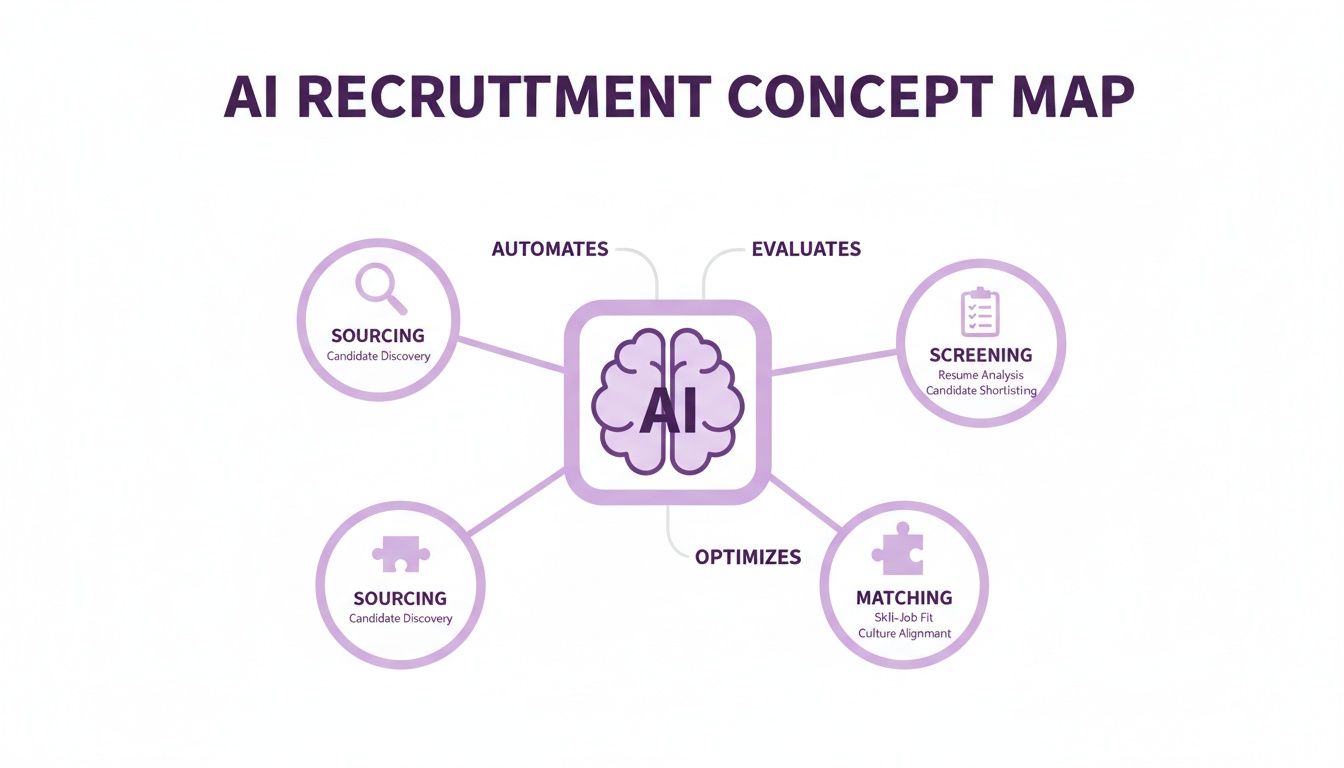
It’s about moving beyond simple automation to predictive analysis, where the system intelligently manages the entire top-of-funnel process for you.
To see just how different this approach is, let’s compare it to the old way of doing things.
| Hiring Aspect | Traditional Recruitment | AI-Powered Platform |
|---|---|---|
| Sourcing | Manual job board posting, keyword searches, sifting through hundreds of resumes. | Automated sourcing from diverse talent pools, proactive candidate discovery. |
| Screening | Time-consuming manual review of resumes and cover letters. | AI-driven analysis of skills, experience, and potential; instant shortlisting. |
| Skills Validation | Guesswork based on resume claims; manual technical interviews for all candidates. | Integrated coding challenges, portfolio analysis, and objective skills tests. |
| Candidate Matching | Relies on recruiter's intuition and keyword matching. Prone to bias. | Data-driven matching based on deep skill analysis and predictive performance. |
| Talent Pool | Limited to active job seekers in local or known networks. | Access to a global, pre-vetted talent pool of both active and passive candidates. |
| Time-to-Hire | Weeks or even months. | Days. |
The contrast is stark. One method is a manual, high-effort numbers game; the other is a strategic, data-informed system designed for precision and speed.
Hope you enjoy spending your afternoons fact-checking resumes and running technical interviews—because if your platform lacks automated skills validation, that's your new full-time job. This feature is absolutely non-negotiable.
A resume is a sales pitch, not a sworn affidavit. Real value comes from a platform that can objectively verify a candidate's abilities before they ever get to your inbox. This means:
This focus on skills over credentials isn't just a feel-good idea; it has a massive impact. Skills-based assessments can expand talent pools by 19 times and are 5 times more effective at predicting job performance than just looking at experience. For startups battling high turnover, this approach can cut 'bad hire' churn by 22%—a figure that can make or break your bottom line. You can discover more insights about these staffing industry trends on aqore.com.
Why fish in a pond when you can have an ocean? The best platforms don’t just give you tools to search; they give you access to a pre-vetted, curated talent pool. Instead of starting from zero every single time, you’re tapping into a network of professionals already screened for skills and availability.
This is especially critical for remote-first companies. A top-tier AI-powered recruitment platform should effortlessly break down geographical barriers, presenting you with elite talent from across the globe, already vetted and ready to work in your time zone.
A platform that only searches your local market isn't a modern solution; it's a digital version of the same old limitations. True value comes from accessing a global talent pool without the global headache.
Think about it: your ideal candidate might be in São Paulo or Mexico City, not San Francisco. A great platform finds them for you.
And it doesn't stop there. The final piece of the puzzle is integrated compliance and payroll. Finding a great developer in Brazil is one thing; figuring out how to pay them legally and handle cross-border HR is another nightmare entirely. A platform that bundles talent discovery with these administrative solutions isn’t just a feature—it’s a sanity-saver. It’s what separates a useful tool from an indispensable business partner.
Alright, let's get down to what your CFO really cares about: the numbers. Fancy tech is great, but if it doesn't translate into cold, hard cash, it’s just a shiny distraction. The true value of an AI powered recruitment platform isn’t in the complexity of its algorithms; it’s in the tangible, real-world return on your investment.
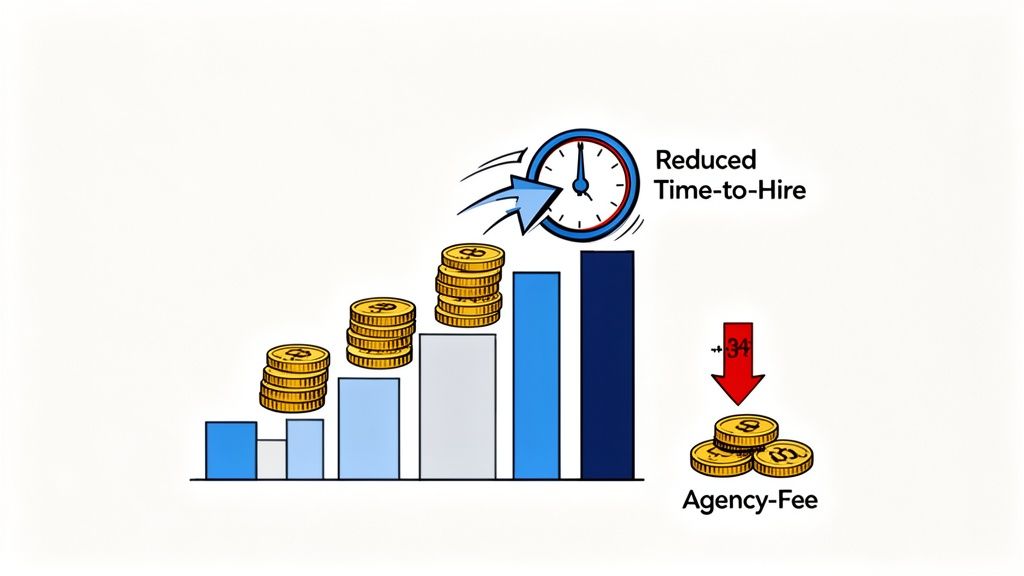
And I'm not just talking about the obvious wins. Of course, you’ll slash those ridiculous agency fees—often by up to 80%. You'll also shrink your time-to-hire from a soul-crushing three months down to a few weeks, maybe even days. Those are the easy metrics, the low-hanging fruit.
The real ROI is hidden a layer deeper. It’s in the costs you avoid and the strategic advantages you gain. Let’s break it down.
The single biggest hidden cost in any company is the bad hire. It's a financial black hole that drains resources, kills team morale, and torpedoes projects. Think about it: the salary is just the entry fee.
You also lose money on:
A solid AI platform dramatically cuts this risk by focusing on verified skills, not just charming interview answers. It’s your insurance policy against that $50,000 mistake.
Then there's the flip side: improved retention. When you hire people based on a proven ability to actually do the job, they're happier, more engaged, and far more likely to stick around. In fact, skills-based hiring has been shown to improve employee retention by up to 34%.
That's not just some feel-good HR metric; it's a direct impact on your bottom line. Less churn means less recruiting, less training, and more institutional knowledge staying right where it belongs—inside your company.
The ultimate ROI isn't just about saving money on a single hire. It's about building a more resilient, scalable team. It's the strategic freedom to spin up a new project team in a week, not a quarter, without compromising an ounce of quality.
This is where the right AI powered recruitment platform becomes a genuine competitive advantage. Suddenly, you have the operational agility of a massive corporation, even if you’re a 50-person startup.
Let’s make this real. Imagine a San Francisco startup needs an elite AI engineer. The local market is absolutely brutal. They're staring down a $200k+ salary, a six-month search, and a bidding war against Google.
Instead, they use a platform like LatHire. Within days, they’re connected with three pre-vetted, top-tier AI engineers from Latin America who are ready to work in their time zone. The total cost is a fraction of the local hire, and the talent is just as good, if not better.
The platform handles the vetting, compliance, and international payroll. The startup gets an A-player without the Bay Area price tag or the administrative nightmare. That’s not just saving money; that’s smart, strategic growth.
It’s important to be pragmatic, though. AI isn't a magic wand, and not every platform delivers. Gartner notes that by 2026, only one in five AI investments will yield a measurable ROI. However, the successful platforms—the ones combining smart tech with crucial services like HR and payroll support—can reduce both hiring costs and time-to-hire by over 80%. The key is choosing a solution built for tangible business outcomes. You can read the full trend report about AI’s impact on work on hbr.org.
After years of fighting our way through the hiring maze ourselves, we got fed up. We were tired of the broken tools, the empty promises from recruiters, and the eye-watering agency fees. As founders and hiring managers, we knew the pain of the “post and pray” method all too well.
So, we decided to build our own way out.
We didn’t just want to create another piece of software. Our goal was to build the platform we always wished we had—one that actually solves the real-world headaches of finding and hiring elite talent. We saw an incredible, often-overlooked pool of professionals in Latin America and knew the right technology could connect them with companies that desperately needed their skills.
That’s how LatHire came to be. It’s not just a product; it’s our answer to a fundamentally broken system.
Our first rule was simple: no more resume guesswork. A polished PDF tells you next to nothing about a person’s ability to actually do the job. That’s why we built our AI powered recruitment platform around proprietary assessments that test for real-world skills.
This isn't your standard multiple-choice quiz. We designed our evaluations to mirror the challenges someone would face on the job. For developers, that means coding tests analyzed for efficiency and quality. For marketers, it means working through practical campaign strategy tasks. The AI handles the initial, data-driven screening, giving us objective metrics on what a candidate can truly do.
But we knew from day one that technology alone wasn't enough.
The best AI in the world can't spot ambition or check references. That’s why our process is a hybrid: AI-driven assessments backed by rigorous, human-led vetting. It’s the perfect blend of data and instinct.
Every single candidate who passes our AI screening then moves on to a human-led background check. We talk to them, verify their experience, and make sure they have the soft skills to thrive in a remote team. It's a meticulous process, but it's exactly why our curated pool of over 800,000 professionals is a source you can actually trust. (Yeah, we’re proud of that. Toot, toot!)
Here’s the thing: finding the right person is only half the battle. The other half is the administrative nightmare of international payroll, benefits, and legal compliance. We’d lived that nightmare and refused to build a tool that just solved one problem while creating another.
This is why LatHire is more than a matching engine. It’s an end-to-end solution. When you hire through our platform, we handle all of it:
We built this because we know that finding talent without the right infrastructure to support it is useless. A great hire shouldn't come with a mountain of paperwork and legal risk. The platform handles the operational complexities so you can focus on one thing: integrating your new team member and getting back to building your business.
We’re not saying we’re perfect. Just more accurate more often because our platform was designed by people who were tired of the alternatives. You can explore how we structure this talent network in our guide to building a recruitment database.
Let's be real—adopting new tech always comes with a healthy dose of skepticism. You've heard the pitches and seen the demos, but you still have questions. Good. You should.
Here are some of the most common ones we hear, answered without the usual marketing fluff.
Absolutely not. And if anyone tells you it will, you should run the other way. Think of an AI powered recruitment platform as a superpower for your existing team, not a replacement for them. It’s a genuine force multiplier.
The platform handles the 80% of high-volume, repetitive work that burns recruiters out—sourcing from millions of profiles, screening thousands of applicants, and running initial skills validations. This frees up your human team to focus on what they do best: building relationships, conducting meaningful final-round interviews, and selling top candidates on your company's vision. It's about augmentation, not just automation. Your team gets better, faster, and far more strategic.
This is a critical question, and frankly, it's the most important one you can ask. The key to mitigating bias lies in the data the AI learns from and the way the system is designed from the ground up. We tackle this head-on by training our AI on vast, diverse datasets that focus purely on objective, measurable data points.
So, what does that actually mean in practice?
Bias creeps in when people rely on flawed human shortcuts or poorly designed algorithms. A well-built AI, combined with thoughtful human oversight, is one of the most effective tools we have to reduce the inherent bias of traditional hiring.
While it’s an absolute game-changer for finding specialized tech talent, its application is much, much broader. The core principles of skills-based matching apply across every single department. If a role can be defined by a set of skills and competencies, an AI platform can find the right person for it, and do it faster.
At LatHire, we connect companies with elite talent in marketing, sales, operations, and customer support. The technology is just as effective at identifying a top-tier digital marketer by analyzing their campaign performance as it is at finding a brilliant DevOps engineer by vetting their coding skills.
For companies used to the old way of doing things, the speed is probably the most shocking part. Because we maintain a pre-vetted, active pool of over 800,000 professionals, you aren’t starting from scratch every single time you have a new opening.
You can share a job description with us and get matched with qualified, available candidates in as little as 24 hours. The entire time-to-hire, from your initial search to a signed offer, is often slashed by over 80% compared to traditional methods that can drag on for months. No more waiting an entire quarter for a single hire.

