
Let's be real: your current hiring process is probably a time-sucking, money-burning machine. You post a job, get flooded with nearly identical resumes, and then spend weeks playing detective just to figure out who actually has the skills they claim.
An AI-powered hiring platform is supposed to stop this madness. But let's be honest, most of them don't.
If you're a founder or hiring manager, I bet you’re nodding along right now. Remember that sinking feeling when you realize you’ve spent 40 hours interviewing candidates for a role that’s still empty? I’ve been there. It’s a full-time job you never signed up for.
Hope you enjoy spending your afternoons fact-checking resumes and running technical interviews—because that’s now your full-time job. This manual, gut-feel approach isn't just inefficient; it's a massive drain on your two most valuable resources: time and money.
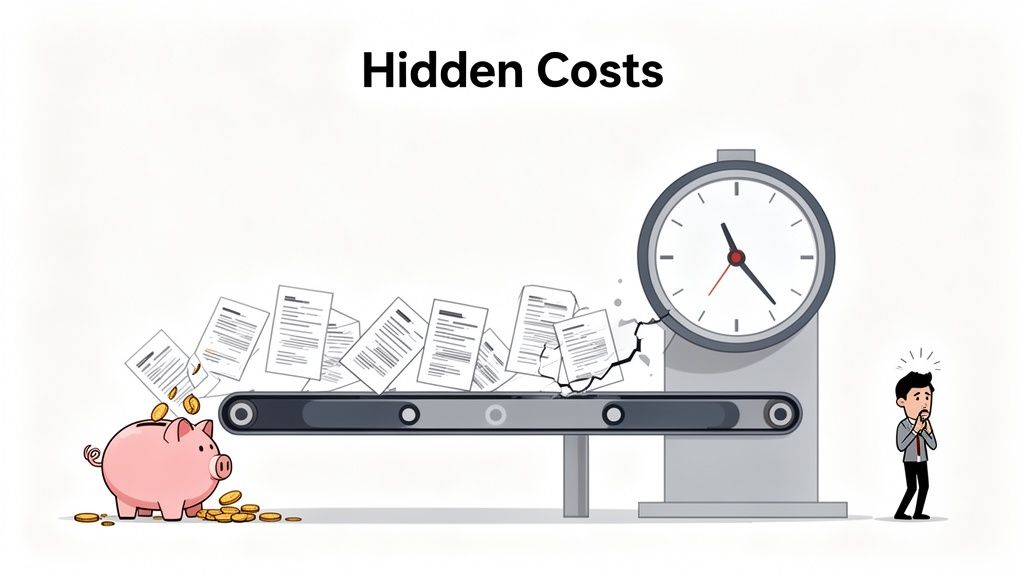
We all know a bad hire is expensive. The U.S. Department of Labor says it can cost up to 30% of that employee's first-year earnings. But the real damage? It goes way deeper than one person's salary. The hidden costs are what truly cripple a growing company.
The real problem isn't just the cost of a bad hire; it's the compounding interest of a slow one. You're not just losing money—you're losing momentum.
The cycle is vicious. You rush to fill a role, make a compromise on skills or culture fit, and six months later, you're right back where you started, posting the same job ad. This constant churn is a quiet killer for startups. If this sounds familiar, you should check out our guide on how your revolving door is costing you a fortune and how to fix it.
It’s time to stop pretending the old way works. The endless sifting, the subjective interviews, the administrative nightmare—it’s a fundamentally broken system.
You need a way to validate skills upfront, match with precision, and get the right person in the seat without taking out a second mortgage. You need an AI-powered hiring platform that solves the real problems.
Let's cut through the jargon. At its heart, an AI powered hiring platform is a smarter, faster way to find the right people for your team. Think of it as your most dedicated recruiter—one that works 24/7, runs on pure data, and never needs a coffee break.
Instead of manually drowning in a sea of resumes, the AI does the heavy lifting. It scans, verifies, and assesses candidates at a scale no human team could realistically manage. And we're not talking about some glorified keyword filter that just flags every resume mentioning "JavaScript."
That’s old-school tech.
A true AI powered hiring platform goes much deeper. It’s the kind of AI that validates technical skills with real-world coding challenges and analyzes a candidate's entire career trajectory. It matches people to your company based on proven performance data, not just a gut feeling or a well-written bio.
It’s like the difference between using a treasure map scribbled on a napkin and a live, satellite-guided GPS. One might get you somewhere in the ballpark; the other takes you directly to the prize.
This isn't about replacing recruiters; it's about giving them superpowers. It automates the 80% of hiring that’s tedious and repetitive so you can focus on the human side of things.
The market has definitely taken notice. The global AI recruitment industry hit US$661.56 million in 2023 and is on track to reach US$1.12 billion by 2030. This explosive growth isn't just hype—it’s a direct response from companies struggling to solve talent shortages, especially in tech. The data shows these tools can boost qualified candidate sourcing by 35%, effectively cutting through the noise that plagues traditional recruiting.
So, what does this look like day-to-day? Imagine you need an engineer and have access to a talent pool of over 800,000 of them. An AI platform doesn't just hand you the list; it curates it for you. It runs assessments, verifies credentials, and brings only the top candidates who meet your exact needs—from their tech stack right down to their time zone—straight to the top of the pile.
These platforms are also getting more specialized, offering features built for specific industries. This is a game-changer for businesses that need powerful AI solutions for recruitment agencies but don't have the resources to build a complex system from scratch.
In the end, an AI powered hiring platform is more than just another piece of software. It’s a fundamental shift in how you build your team, moving the process from hopeful guesswork to data-backed certainty. It ensures that by the time a candidate lands in your inbox, they aren't just a possibility; they're a serious contender.
Let's be blunt: most tools calling themselves an AI-powered hiring platform are just fancy resume filters. I’ve tried them, and they consistently miss the point. They're good at keyword matching and not much else, leaving you with a slightly smaller, still unqualified pile of candidates. A platform that actually delivers isn’t just about scanning PDFs faster.
A truly effective platform stands on three pillars that solve real, painful hiring problems. Miss one, and the whole structure crumbles.
This is where the rubber meets the road. A resume is a marketing document, not a sworn affidavit. Relying on it is like hiring a chef based on a menu they wrote. You need to taste the food.
Intelligent Vetting goes beyond the resume. It’s a multi-layered process that proves a candidate can do the job before you ever speak to them. It must include:
Hope you enjoy spending your afternoons running technical interviews—because without this pillar, that’s your new full-time job. A platform that doesn’t vet deeply is just pushing the work back onto you.
This visual shows the basic flow an AI-powered hiring platform should follow, moving from broad scanning to precise assessment.
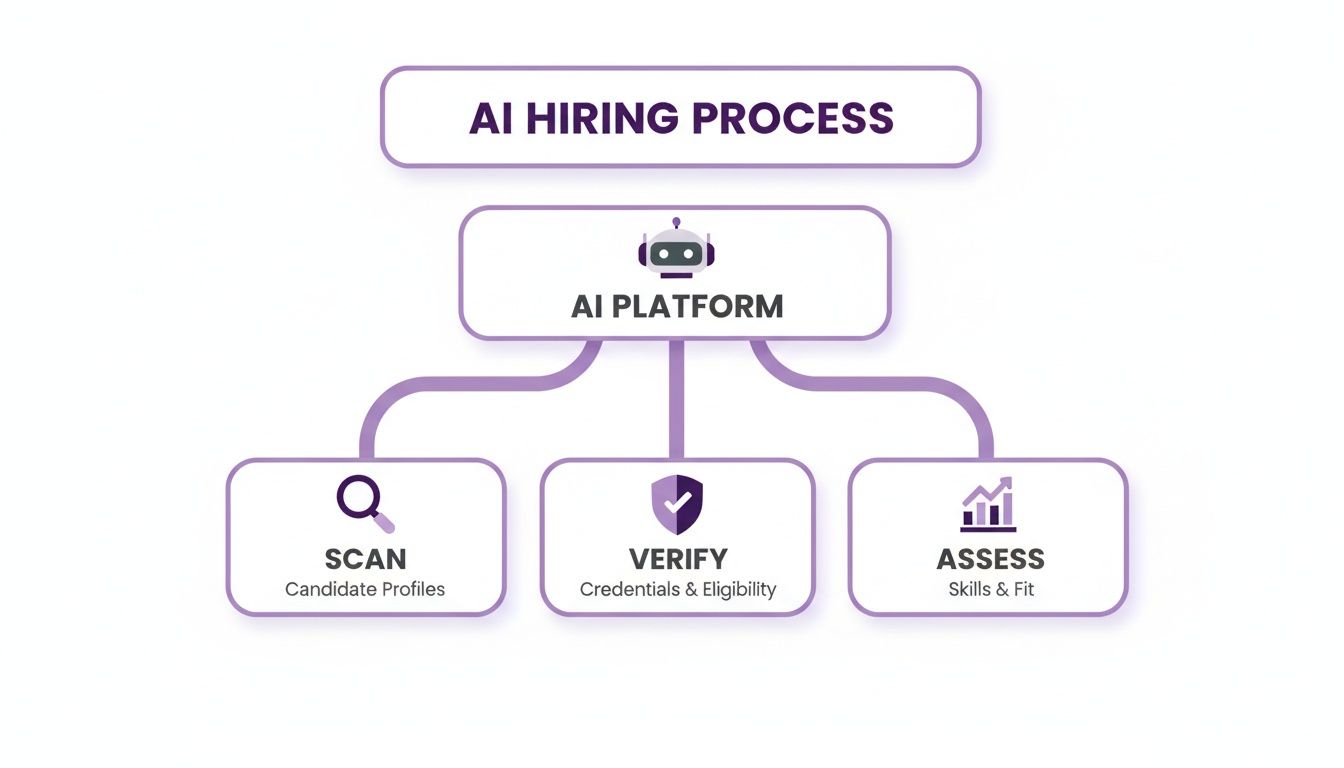
Each step filters the talent pool, ensuring that only the most qualified candidates make it to the final stage. You can learn more about the best candidate assessment tools to see how this process works in detail.
Once you know who’s skilled, you need to know who’s right. Precision Matching is about finding the perfect fit for your specific needs, not just someone with the right job title.
The AI should be smart enough to find you a Python developer who not only knows Django but is also in your timezone, has experience with SaaS billing systems, and is ready to start next Monday. It’s about context, not just keywords.
This is the pillar everyone forgets until it’s too late. You found the perfect remote engineer in Brazil—great! Now what? Are you suddenly an expert in international payroll, benefits, and labor law?
A complete AI-powered hiring platform handles the entire workflow. It’s not just a matchmaker; it’s an operational partner that manages everything from the contract to compliance. Anything less is just a half-measure that creates a new set of administrative headaches for you to solve.

Alright, let's talk numbers. Because at the end of the day, your CFO doesn’t care about buzzwords; they care about the bottom line. Vague promises of "better talent" don't cut it when you're signing the checks.
The real return on investment from an AI-powered hiring platform isn't some fuzzy, feel-good metric. It’s a series of cold, hard numbers you can take straight to the bank. I'm talking about a massive shift in your three most important hiring metrics: time, cost, and quality.
Traditional hiring is shockingly expensive, especially when you factor in agency fees. A standard recruiter can charge 20-30% of a candidate's first-year salary. For a senior developer making $150,000, that’s a $30,000 to $45,000 invoice just to get them in the door.
An AI platform completely flips this model. By tapping into a global talent pool and automating the grunt work of sourcing and vetting, you can slash those costs by up to 80%. Suddenly, hiring three senior developers doesn't cost you $100k+ in fees; it becomes a predictable operational expense.
We’ve seen startups save over $150,000 annually just by making this switch for a handful of roles. That’s money that goes back into your product, your marketing, or maybe even a ping-pong table you don't have to mortgage.
How long did it take to fill your last critical role? Two months? Three? I’ve lived that nightmare. Every week that seat is empty is another week of lost productivity and mounting pressure on your existing team.
An AI-powered hiring platform shrinks that timeline from months to days. Because the platform is constantly vetting candidates, you’re not starting from scratch. You’re tapping into a pipeline of people who are already verified and ready to go.
This isn't just about speed; it's about momentum. An agency that needed to scale its design team cut its project delivery time in half simply because it could source and onboard two vetted UX/UI designers in under a week.
This speed is your new competitive advantage. While your rivals are still sifting through resumes, your new hire is already shipping code.
Finally, let's talk quality. The dirty little secret of recruiting is that a fast, cheap hire is useless if they leave in six months. The true ROI comes from finding people who not only have the skills but also stick around and perform.
This is where AI’s ability to reduce bias and focus on objective skills really shines. AI platforms are transforming hiring outcomes, with some studies showing AI can reduce hiring bias by 60% and lead to a 9% boost in quality-of-hire.
This is because AI’s predictive matching is incredibly effective at spotting top performers who are a better long-term fit, leading to lower turnover and higher performance. You can discover more insights about AI’s impact on recruitment effectiveness at TalentLMS.
When you combine lower costs, faster hiring, and higher quality, the ROI isn't just incremental. It’s a complete overhaul of how you build your company.
The market is flooded with tools waving the "AI" banner, but I’ve seen enough of them to know most are just snake oil in a slick UI. They promise the world and deliver a slightly better keyword filter, leaving you to do all the heavy lifting.
Choosing the right AI-powered hiring platform isn't about picking the one with the flashiest dashboard. It’s about asking the right, pointed questions—the kind that makes a salesperson squirm. This isn't a sales pitch; it’s an insider’s guide to not getting fleeced.
The first question you should ask is brutally simple: what happens after the match?
You’ve found a brilliant remote developer in Colombia. Fantastic. Now, who’s handling the international payroll, benefits, and local labor laws? If the platform’s answer is, "That's on you," then it's not a real solution. It’s just another problem creator.
A true platform is an end-to-end partner that manages the entire administrative headache, from contract to compliance. Anything less just dumps a new, even more complicated, mess back on your desk.
Transparency is everything. Too many platforms hide their vetting process behind a black box, expecting you to just trust their algorithm. Don’t fall for it. You need to be able to see exactly why a candidate was recommended.
Demand access to the data:
If a platform can't show you its work, it's because the work probably wasn't done. Vague "fit scores" are a massive red flag.
Finally, look at the engagement model. Are you being pushed into a rigid, long-term contract before you’ve even hired anyone? That’s a classic sign of a company that isn't confident in its own product.
Turns out there’s more than one way to hire elite developers without mortgaging your office ping-pong table. A platform that delivers should offer flexible models. You should be able to scale up or down as your needs change. The best platforms win your business every month because they consistently deliver value, not because they locked you into an ironclad annual agreement.
Before you commit, it's wise to review a detailed recruitment software comparison to understand what different models offer. Asking these tough questions separates the real players from the pretenders and ensures you invest in a tool that actually solves problems instead of just creating new ones.
Let’s just get it out there. This is the question on everyone’s mind, usually whispered nervously by HR managers who see "AI" and immediately picture their team getting downsized. So, will an AI-powered hiring platform make your recruiters obsolete?
The short answer? No. But it will absolutely change what they do all day—for the better.
This isn’t about replacement; it's about evolution. Think about it: a shocking amount of a recruiter's day is spent on tasks that are tedious, repetitive, and frankly, a poor use of their expertise. I’m talking about the 80% of the job that’s pure grunt work—sourcing thousands of profiles, manually scanning resumes for basic keywords, and sending an endless stream of follow-up emails.
An AI-powered hiring platform takes over that entire soul-crushing process. It handles the sourcing, the screening, and the initial vetting with a brutal, data-driven efficiency that no human can ever hope to match.
This doesn't get your recruiter fired. It sets them free.
Instead of being a glorified resume-sorter, their role shifts to what it always should have been: a strategic talent partner. This frees up your team to zero in on the high-impact, human-centric work that actually convinces great candidates to sign on the dotted line.
The best companies aren't firing their HR teams; they're empowering them with better tools. The goal is to augment human expertise, not render it obsolete.
Your recruiters can finally spend their time on what truly matters:
And for those lean startups running without a dedicated recruiter? An AI platform is your recruiting team. It’s the seasoned pro you can’t afford yet, handling the entire top of the funnel so you can focus on building your business. It’s not about taking jobs; it's about making them better.
Alright, let's tackle the questions I know are bouncing around in your head. No fluff, just straight answers.
Think of it this way: what’s the real cost of a bad hire? Or the price of three months of lost productivity while a key role sits empty?
An AI-powered hiring platform isn't another line-item expense. It's an investment that pays for itself by cutting out traditional agency fees, which often run a steep 20-30% of a candidate's first-year salary. Instead of a massive one-time invoice, you get a predictable operational cost that saves you a ton of money in the long run.
Any legitimate platform takes this stuff incredibly seriously. Your data, from job descriptions to candidate PII, should be encrypted end-to-end and handled under strict privacy protocols.
It’s a fair question, and one you should always ask a potential partner about their security measures. If they can’t give you a clear, confident answer, that's a major red flag.
We’re not saying we’re perfect. Just more accurate more often. (Toot, toot!) And we treat your data like it's our own—because our reputation depends on it.
This is where the model really shines. While traditional hiring can drag on for what feels like an eternity, a platform with a pre-vetted talent pool can change the game completely.
We've seen clients get matched with qualified, ready-to-interview candidates in as little as 24 hours. Forget weeks of sourcing; this is about connecting you with the right person, right now.

