
Recruiting for a startup isn't just another task on your board—it's the whole game. Your first few hires are the co-pilots for your rocket ship, defining your culture, product, and frankly, your odds of survival. This is about laying a foundation of solid rock, not quicksand.

Let's be blunt. The person you hire to write the first lines of code or make the first sales call has more influence on your trajectory than your pitch deck ever will. Get it right, and you create momentum. Get it wrong, and you’re dead in the water, bleeding cash and morale.
Too many founders fall into the trap of hiring for "potential" or taking a flyer on a fresh-faced grad because they're cheaper. That strategy is officially dead. In this cutthroat market, you don’t have the time or resources to run a professional development program.
The game has changed. The old playbook of hiring new graduates is a relic. Today, fresh college talent comprises less than 6% of all tech startup hires—a staggering drop of over 30% from pre-pandemic levels. Founders are now leaning on battle-tested talent, and you should be too.
Your first hire needs to be a Swiss Army knife, not a scalpel. You need someone who can not only do the job but also help define it. Forget the long list of esoteric skills and focus on the core attributes that actually matter in the early-stage chaos.
Your checklist should look something like this:
Of course, a solid hiring strategy is just one piece of the puzzle. Ensuring your startup's long-term viability often starts with writing a compelling business plan that attracts both talent and investment.
Let’s get real about what separates a winning hire from a costly mistake. The mindset required to build something from zero is fundamentally different from the one that keeps a large corporation running.
| Priority | The Old Way (And Why It Fails) | The Startup Way (Your Survival Guide) |
|---|---|---|
| Experience | "10+ years at a FAANG company." This often translates to specialized, slow-moving, and budget-heavy habits. | "Built a side-project to 1k users." This signals initiative, resourcefulness, and a knack for getting things done with nothing. |
| Skills | A long checklist of frameworks and certifications. Most will be irrelevant by next quarter. | Core problem-solving ability and a demonstrated hunger to learn fast. Can they pick up a new tool over a weekend? |
| Culture Fit | "Would I want to grab a beer with them?" This leads to hiring clones and building a homogenous team. | "Do they challenge our thinking in a productive way?" Look for someone who adds to your culture, not just fits in. |
| Cost | "Who is the cheapest option?" This is a race to the bottom that ends in missed deadlines and shoddy work. | "What's the ROI on this hire?" A top performer costs more but delivers 10x the value, saving you money in the long run. |
It's a complete shift in perspective. You're not just filling a role; you're adding a critical piece to your founding DNA.
The biggest mistake founders make is confusing "scrappy" with "unproven." Scrappy means being resourceful with what you have; it doesn't mean hiring someone who has never done the job before. Your first ten employees set the bar for the next hundred. Set it high.
This isn’t about finding a warm body to fill a seat. It's about finding a co-founder in spirit, someone who buys into the vision so deeply they're willing to build the ship while it’s already at sea. After all, a solid team is the first step in creating a sustainable talent pipeline. For more on that, check out our guide on how to build a talent pipeline.
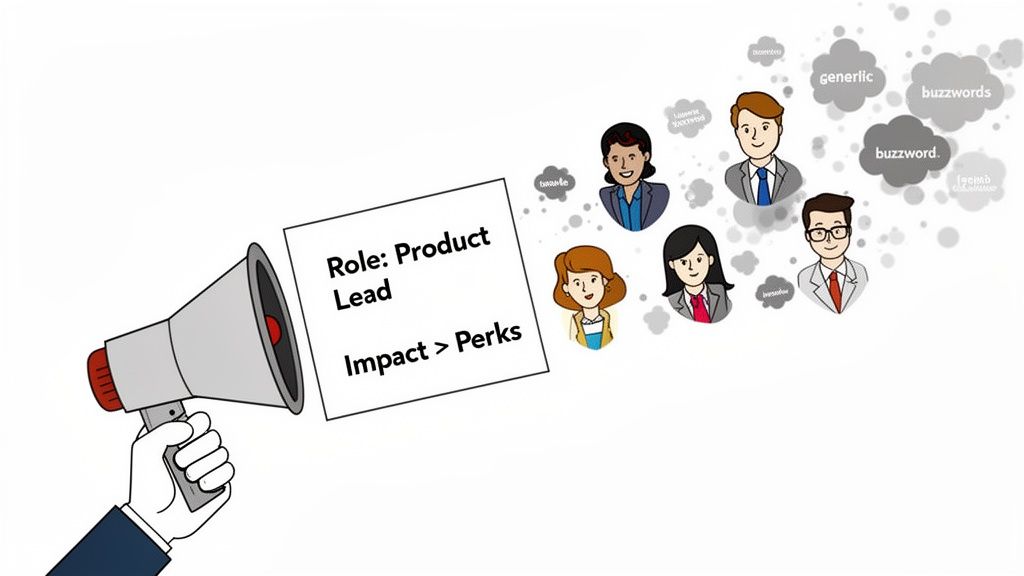
Let's be honest. Most job descriptions are a snooze-fest. They're packed with corporate jargon and vague promises that could apply to literally any company. Yours can't afford to be like that.
You’re not Google. You don’t have free gourmet lunches or on-site massage therapists. What you do have is a mission, the chance to make a real impact, and equity. Your job post isn't just a list of tasks; it’s your number one sales pitch to the very people who will build your company from the ground up.
Think of it as both a magnet and a filter. It needs to pull in the right candidates while actively repelling the wrong ones. If it sounds like it was written by a committee, you've already lost.
Top talent isn't just looking for another gig; they're looking for a dent to make in the universe. Your job post has to lead with the why. What problem are you solving that’s so maddeningly complex or wildly ambitious that it’s worth the beautiful chaos of startup life?
See the difference? One is a bland corporate slogan; the other is a call to arms. Your job is to find the people who read that second one and think, "Finally."
This isn’t just about sounding cool. It’s a core tenet of recruiting for startups. You’re attracting people motivated by the challenge itself, not just the paycheck.
Now for the part that feels a bit counterintuitive. Right after you sell the dream, you need to get brutally honest about the reality. I call this the ‘anti-pitch.’ It’s where you’re completely upfront about the struggles.
Why on earth would you do that? Because you want people who are energized by the hard parts, not scared off by them. You want the person who reads about your messy codebase or total lack of established processes and sees a massive opportunity, not a dealbreaker.
Your goal isn't to get the most applications; it's to get the right applications. Being honest about the struggles is the fastest way to weed out tourists and find the true builders.
Get specific. Talk about the beautiful chaos. Let them know they won't just be executing a playbook—they’ll be helping you write it. This level of honesty builds instant trust and filters for the resilient, high-agency people you desperately need on your team.
Okay, enough with the high-level fluff. What does a Tuesday morning actually look like in this role? What specific problem will they own in their first 90 days? Vague responsibilities like "drive growth" or "manage projects" are massive red flags that basically scream, "we have no idea what we're doing."
Instead of: "Responsible for managing the product roadmap."
Try this: "In your first 3 months, you will own the entire onboarding flow, from shipping the new user tutorial to running A/B tests that cut our drop-off rate by 15%."
This kind of clarity accomplishes two critical things:
For a deeper dive into structuring these critical documents, you might find value in our detailed guide on how to create job descriptions that attract top-tier talent. It’s all about turning a boring document into a powerful recruiting asset.
So, you don’t have a six-figure recruiting budget or an in-house team of sourcers. Welcome to the club. The good news? The best talent often isn't lounging on mainstream job boards anyway. They’re busy shipping products and solving problems at their current gig.
Your job is to find them where they are, not where you wish they were. This isn’t about posting on ten different platforms and praying for a miracle. Recruiting for startups is a game of precision, not volume. It’s about being scrappy, smart, and a little bit relentless.
This is where you stop acting like a corporation and start acting like a founder again—using your network, finding clever arbitrage opportunities, and focusing on quality over quantity.
Let’s get one thing straight: your personal and professional network is your single greatest sourcing asset. It's built on trust, a currency you can’t buy on LinkedIn. Every competent person knows at least two other competent people.
The key is to leverage it without being annoying. Don’t send a generic blast asking, “Do you know any good engineers?” That’s lazy and ineffective. Instead, make your asks specific and easy to act on.
A referral from a trusted source is worth a hundred cold applications. It comes pre-vetted with a layer of social proof, instantly elevating you above the noise.
Turns out there’s more than one way to hire elite developers without mortgaging your office ping-pong table. While the whole world went remote, smart founders started looking just south of the border. Latin America is a hotbed of incredible, time-zone-aligned tech talent.
We're talking about senior engineers in places like Brazil, Mexico, and Colombia who are hungry to work on ambitious projects for US companies. They bring diverse perspectives, a killer work ethic, and often come at a fraction of the cost of their Silicon Valley counterparts. This isn't about finding "cheap" labor; it's about finding an incredible value arbitrage.
Stop competing with Google for talent in Mountain View. Start building a world-class, distributed team by tapping into the immense, and often overlooked, talent pools in Latin America. The ROI is almost laughably high.
This strategy lets you extend your runway and hire two incredible engineers for the price of one. It’s one of the most powerful leverage points in startup recruiting today. You just need to know where to look.
Let’s be real. As a founder, you don’t have time to spend your entire day trawling through LinkedIn profiles and running initial screens. Hope you enjoy spending your afternoons fact-checking resumes and running technical interviews—because that’s now your full-time job.
Or… you could just skip that part.
Platforms like our own (toot, toot!) exist for this very reason. At LatHire, we’ve already done the heavy lifting. We connect you directly with a curated pool of 800,000+ pre-vetted professionals from Latin America. We handle the sourcing, the skills assessments, and the initial vetting, so you only talk to high-quality candidates who match your spec. You can go from job post to qualified matches in as little as 24 hours.
For more inspiration on finding talent in unexpected places, check out these creative recruiting ideas. But sometimes, the most creative move is to simply let someone else handle the sourcing grind for you.
To streamline your hiring without breaking the bank, consider implementing tools that leverage automation in talent acquisition to find and engage candidates more efficiently. It's about working smarter, not harder, to find the needles in the global haystack.
If your interview process feels like a friendly chat, you're doing it wrong. A charming personality doesn’t ship code or close deals, and you can’t afford to find that out three months and $40,000 in salary down the drain. You need a gauntlet—a fair, but rigorous, process designed to test for real-world skills, cultural contribution, and sheer resilience.
This isn’t about setting up trick questions or stroking your own ego. It’s about creating a system that reveals a candidate’s problem-solving DNA, not just their ability to rehearse answers from Glassdoor. Every single step, from the first call to the final handshake, must have a distinct purpose. Otherwise, you’re just wasting everyone’s time, including your own.
Remember, you’re not just filling a role; you’re betting a piece of your company’s future on someone. A structured process is your insurance policy. It replaces gut feelings and biases with actual data, ensuring you make an informed decision, not just a comfortable one.
Forget the ad-hoc, "let me pull in Sarah for a quick chat" approach. That’s how you end up with hires who look great on paper but crumble under the first sign of pressure. A real interview loop has clear stages, each designed to test something specific.
Your process should be a funnel that gets progressively more intensive. Here’s a battle-tested structure that works:
The infographic below shows a simplified view of the sourcing channels that feed into this exact process.
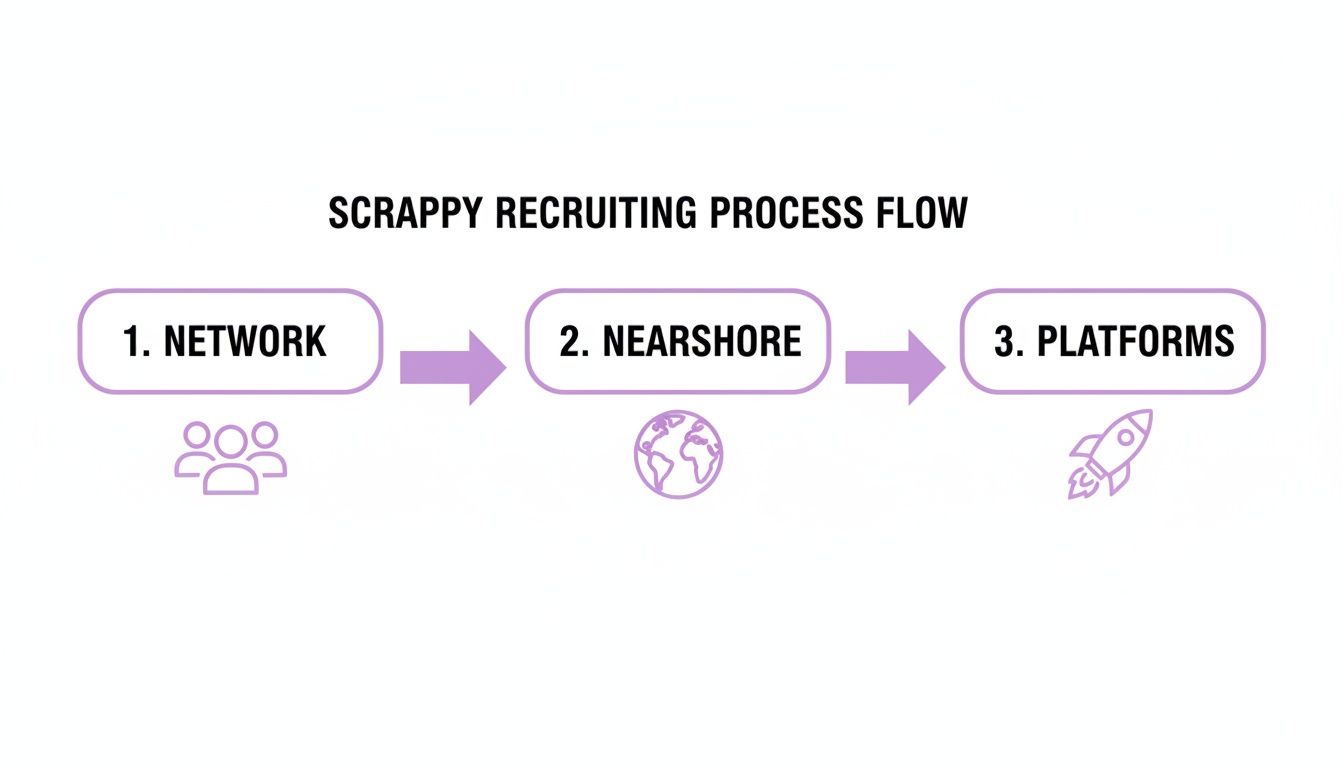
Whether talent comes from your network, nearshore pools, or dedicated platforms, a consistent and rigorous interview process ensures you're evaluating everyone against the same high bar.
Let’s talk about take-home assignments, because most startups get this horribly wrong. They assign some vague, 8-hour project that’s basically unpaid consulting. That’s a great way to signal that you don’t respect a candidate’s time.
A good take-home assignment is different. It should be:
The point of a take-home isn't to see if they can solve the problem perfectly. It's to see how they approach the problem. Their questions, their assumptions, and their trade-offs are more revealing than the final answer.
And for the love of all that is holy, if they spend time on it, you spend time giving them detailed feedback, whether you hire them or not. It’s a basic sign of respect that goes a long way in building your employer brand.
Scrap the classic "What's your biggest weakness?" It’s a tired script, and you’ll only get a tired, rehearsed answer. You need questions that force them to think on their feet and reveal their true operating system.
Try these instead:
These questions don't have a "right" answer. They have an authentic one. And that’s what you’re looking for—the person behind the polished resume. The one who can actually handle the beautiful, messy, and rewarding chaos of building something from nothing.
You found them. The perfect candidate—the one who crushed the take-home, clicked with the team, and has you genuinely excited about what’s next.
Here’s the thing: you’re not the only one who noticed.
In this market, the best people are never on the market for long. They’re like that one perfect apartment in a hot neighborhood—if you don't act immediately, it'll be gone by the time you've finished grabbing a coffee to think it over. The race doesn't end when you decide you want them; it ends when they sign your offer letter.
Big tech companies are notoriously slow. Their hiring processes are tangled in bureaucracy and can take weeks, sometimes months, to finally produce an offer. As a startup, your agility is your superpower. While your well-funded competitor is stuck waiting for three layers of VP approval, you can get a compelling offer into your candidate's inbox.
Don't let this advantage slip away. If you know they’re the one after that final interview, get an offer out within 24 hours. Hesitation signals doubt, and doubt gives them time to entertain someone else's pitch.
In startup recruiting, conviction is currency. A fast, decisive offer tells a candidate they aren't just an option; they're the answer. Slow processes communicate the exact opposite.
This isn’t just a nice-to-have, either. Startups face a grueling reality: it takes an average of six months to hire a single employee, a marathon that can absolutely kill your momentum. This glacial pace is why solutions like LatHire are gaining ground, connecting firms with pre-vetted talent in as little as 24 hours and completely upending traditional timelines. You can find more of these tough truths in these startup statistics on embroker.com.
Let's be real: you can't outbid Google on salary, and you shouldn't even try. It's a game you will lose every time. Instead, you need to structure an offer that plays to your unique strengths—ownership, impact, and a mission that actually matters.
Your offer isn't just a number; it's a story about the future you’ll build together.
When you're ready to present the offer, get them on a call. Never just email a PDF and cross your fingers. This is your final sales pitch. Reiterate why you chose them, remind them of the massive impact they’ll have, and sell the vision one last time with genuine excitement.
If they're a top candidate, they will probably negotiate. Don't take it personally. It’s actually a good sign—it shows they know their worth, which is exactly the kind of person you want on your team. The key is to handle it with confidence and clarity, not desperation.
Know your walk-away numbers before you even get on the call. Figure out where you can be flexible (maybe a signing bonus or a slight equity bump) and where you have to hold the line. If they have a competing offer, ask them about it. What excites them about that opportunity? What are their concerns?
Sometimes, it's not even about the money. It might be about their title, specific responsibilities, or their growth path within the company. Listen more than you talk. By understanding what truly motivates them, you can often find a creative solution that makes them feel valued without derailing your entire compensation structure.
These final moments of the recruiting process are a high-stakes game of speed and conviction. Treat it like your Series A pitch—because getting the right person on your team is just as crucial for your startup's survival.
Alright, let's tackle the questions that probably keep you up at night. You've sorted out the sourcing and interviewing, but the real headaches often pop up in the details. Here’s a quick-fire round of answers to the most common snags in startup recruiting.
Stop looking for a magic number, because it doesn't exist. A good rule of thumb is to set aside an employee option pool of 10-20% of your total equity. Think of that as your starting budget.
From there, it’s all about context. Your first critical hire—say, a founding engineer who’s basically a co-founder in everything but name—might land anywhere from 0.5% to 2.0%. This swings wildly based on their experience, how crucial their role is, and the salary they're giving up. Less cash means more equity. More cash, less equity. It’s that simple.
The most important part? Be transparent. Don't just slide a percentage across the table. Walk them through the strike price, the standard 4-year vesting schedule with a 1-year cliff, and what the potential upside could look like. You're using equity to align everyone on the long-term mission and make them feel like a true owner. It's not a lottery ticket; it's a piece of the company they're helping you build.
Hiring too fast out of pure, unadulterated desperation. We've all been there. You're feeling the heat, a key project is falling behind, and you just need a "warm body" to fill a seat. Don't do it.
That panic hire will almost certainly cost you more down the road. I'm talking about wasted salary, cultural damage that spreads like wildfire, and the soul-crushing task of letting them go six months later. A slow, thoughtful hire is always better than a fast, wrong one.
The runner-up mistake? Getting star-struck by a shiny resume from a big-name tech company instead of hiring for raw grit and adaptability. A fancy background doesn't mean they'll thrive in the beautiful chaos of a startup. Your best bet is to find people with a proven "figure it out" muscle.
A candidate's ability to navigate ambiguity and solve problems with limited resources is infinitely more valuable than a prestigious logo on their LinkedIn profile. In the early days, resourcefulness eats credentials for breakfast.
In the very beginning, you, the founder, are the chief recruiter. Full stop. No one can sell the vision with the same fire and conviction as you. Your passion is your single greatest recruiting tool.
But let's get real. Once you need to hire your fifth employee, your tenth, or a highly specialized engineer, doing it all yourself becomes a massive time-suck. It's a direct threat to your actual job: building the company. You can't live on LinkedIn forever.
This is where you have to be smart. Skip the traditional recruiters who charge a king's ransom—often 20-30% of the first-year salary. Instead, look at more modern, efficient options. For instance, platforms like Lathire give you direct access to pre-vetted talent pools for a fraction of that cost. We handle the heavy lifting of sourcing, screening, and even compliance, so you can focus on what matters: the final interviews.
Your goal is to delegate the time-consuming grunt work while keeping total control over the final hiring decision. It’s truly the best of both worlds.
Here's the secret: you don't. Trying to match Google's salary or Meta's benefits package is a game you're destined to lose. It's like bringing a knife to a gunfight.
Instead, you change the rules of the game entirely. You compete on a totally different playing field. Your offer isn't just a paycheck; it's a unique opportunity that big tech simply can't match.
Sell the experience, the growth, and the story they'll get to tell in five years. That’s your unfair advantage.