
So, you want to build a world-class team. Turns out there’s more than one way to hire elite developers without mortgaging your office ping-pong table.
Let's cut the corporate jargon. The single biggest, fastest win with nearshore outsourcing is that you stop setting money on fire. It’s a strategic play to slash your operational costs—mostly on salaries and recruiting—by tapping into an equally skilled, but less expensive, talent pool right next door.
This isn't a race to the bottom for "cheap" labor. This is about making a brutally smart financial move that frees up your capital to pour back into what actually matters: growth.
Hiring locally, especially in tech, feels like a rigged game. You’re either in a bidding war with giants who use hundred-dollar bills as tissues, or you're waiting months to fill a critical role. I’ve been there, watching the burn rate climb while a key engineering spot sits empty. It’s a special kind of hell.
Thankfully, there's a better way. It's not just about trimming a few points off your payroll; it's a fundamental shift in how you build your team. Let's look at what the costs really look like when you hire a senior software engineer.
| Cost Factor | Traditional US Onshore Hiring | Nearshore Hiring (Latin America) |
|---|---|---|
| Base Salary (Annual) | $150,000 – $180,000+ | $70,000 – $90,000 |
| Recruiter Fees (20-25%) | $30,000 – $45,000 | $0 (Platform fee is baked in) |
| Payroll Taxes & Benefits | $35,000 – $45,000 | $0 (Handled by the platform) |
| Onboarding & Equipment | $5,000 – $10,000 | Minimal, often included |
| "Bad Hire" Risk | High (Costs $100,000+ to replace) | Low (Vetted talent, easy to swap) |
| Total First-Year Cost | $220,000 – $280,000+ | $70,000 – $90,000 |
The table makes it painfully clear. The nearshore model doesn't just save you money; it saves you from the soul-crushing overhead of traditional hiring.
When people hear "cost savings," their minds jump straight to lower salaries. And sure, that’s a big piece of the pie. But the real financial victory comes from dodging all the hidden costs that quietly bleed your company dry.
Just think about the headaches you get to skip:
The conversation around the cost-benefit ratio of hiring from LatAm vs. local talent has totally changed. It's no longer, "Is it cheaper?" but rather, "How is it this much smarter?"
This infographic breaks down why everyone's making the switch.
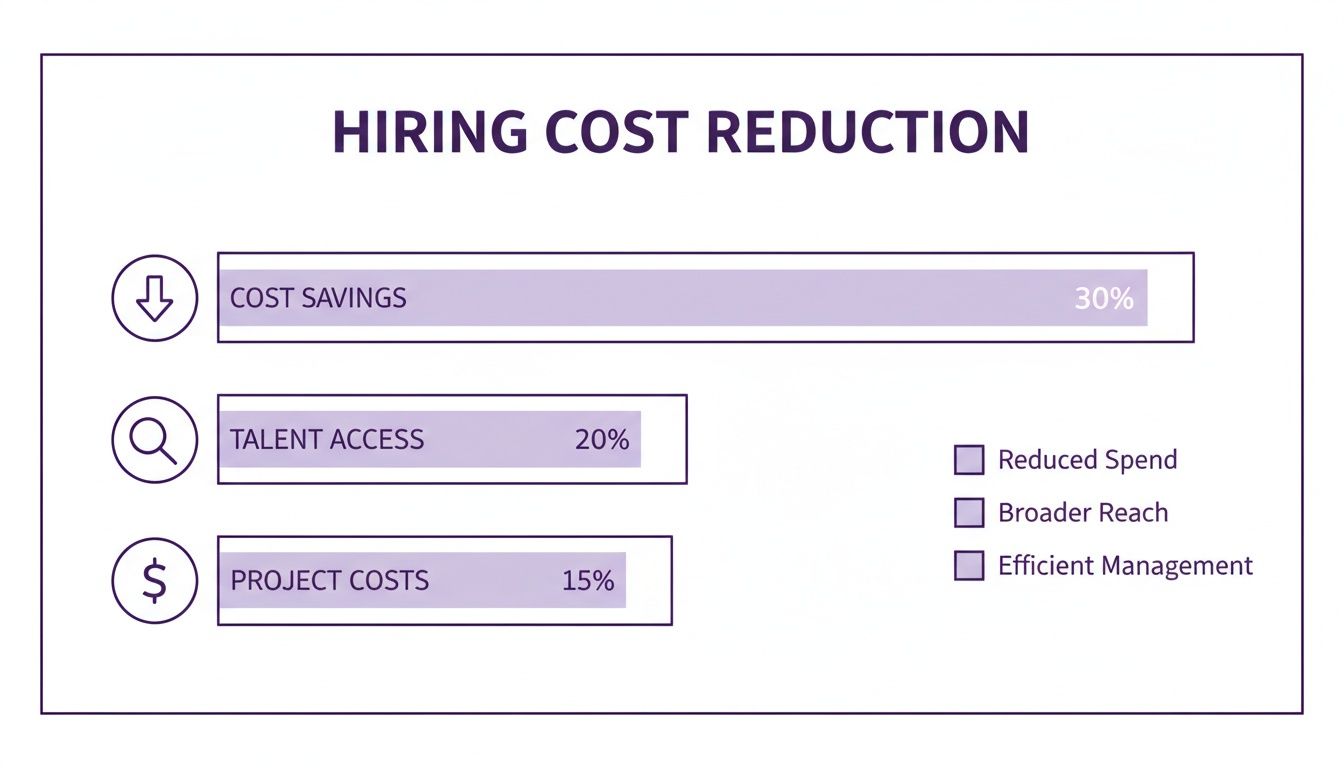
As you can see, direct savings are the main event, but the expanded access to a wider talent pool and lower overall project costs are powerful supporting acts.
This isn't just my opinion; the data is overwhelming. Slashing your hiring costs by up to 80% while bringing on top-tier developers in your time zone isn't a pipe dream. It's happening right now.
In fact, over 80% of U.S. businesses are now actively looking at nearshore partnerships, pulled in by these massive efficiencies. One report found that 72% of companies list cost savings as their top reason, with nearshore teams delivering 18-25% lower total project costs than traditional offshore models.
When you zoom in on Latin America, businesses can save 30-50% on talent acquisition alone, tapping into a huge pool of over 800,000 pre-vetted professionals.
By sidestepping the hyper-competitive, hyper-inflated local talent market, you’re not just saving money. You’re reallocating capital from a bloated line item directly into your product, marketing, and growth. It's the ultimate arbitrage play.
Offshore hiring looks great on a PowerPoint slide. Lower costs, a global talent pool… what’s not to love? Then reality hits you like a 3 AM Slack notification.
Your star developer in Asia is signing off just as your US team is pouring its first cup of coffee. That massive time gap isn't a minor hurdle; it's a productivity killer. I’ve seen it cripple projects. A simple question turns into a 24-hour wait. A critical bug fix gets punted to the next day. The project stalls, momentum dies, and your "agile" sprint becomes an asynchronous crawl.
This brings us to one of the most powerful, yet often overlooked, nearshore outsourcing benefits: genuine, real-time collaboration.
The big sales pitch for traditional offshore is the "follow-the-sun" model. The idea is that your US team hands off work, the offshore team picks it up, and progress magically happens while you sleep. Sounds efficient. Almost never works.
Software development, marketing, and complex ops aren't assembly lines. You can't just pass a widget down the chain. These roles require nuance, spontaneous problem-solving, and the kind of quick back-and-forth that only happens when people are online at the same time.
The truth is, asynchronous work is a tax on your project’s velocity. Every delayed clarification, every missed opportunity for a quick huddle, and every message lost in translation adds friction. Over time, that friction grinds progress to a halt.
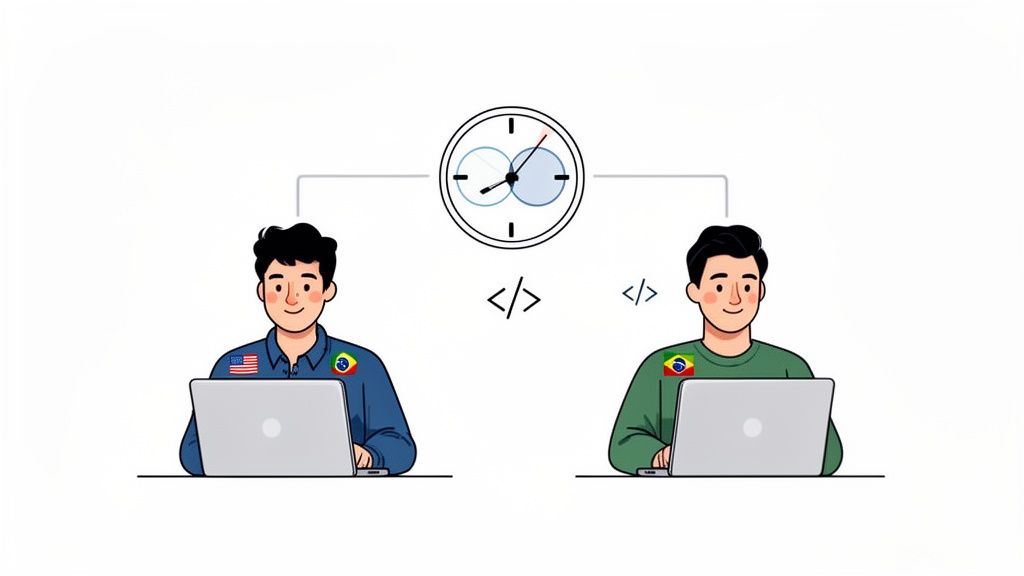
Nearshore hiring, especially from Latin America, completely changes the game. When your team in Brazil or Colombia is in the same or a nearly identical time zone, you’re not managing a remote crew—you’re extending your local one. If you want to dive deeper, our guide on managing time zone differences when hiring from LatAm offers a detailed breakdown.
Let's get practical. Shared business hours are a superpower. Instead of painful delays, you get immediate results.
The real cost of huge time zone gaps isn't just lost hours; it's the steady degradation of quality. When communication is strained, details get missed. Assumptions are made. The final product suffers. You end up with features that don't match the specs or marketing assets that miss the mark entirely.
Then comes the painful and expensive process of rework. Those initial savings from a lower offshore hourly rate get eaten alive by the cost of fixing mistakes that never should have happened.
By aligning your team on the same clock, you slash the risk of these expensive misunderstandings. Clarity is currency, and nearshoring gives you a direct line. It's not just a logistical perk—it’s a strategic advantage that protects your timeline, your budget, and ultimately, your sanity.

So, you need to double your engineering team for that big product launch next quarter. Good luck. Hope you enjoy spending your afternoons fact-checking resumes and running technical interviews—because that’s now your full-time job.
That painful, slow-motion hiring train is where most companies get stuck. Growth comes in waves, but traditional hiring is a fixed, sluggish pipeline. You can’t just turn on a firehose of qualified local talent when you need it.
But what if you could? What if scaling your team wasn't a six-month bureaucratic nightmare but a two-week strategic sprint? This is where the true power of nearshore outsourcing comes into play. It's not just about filling one role; it's about having an entire ecosystem of talent on speed dial.
Think of a nearshore talent pool as an elastic resource. When a massive project lands on your desk, you can stretch your capacity by spinning up a dedicated team of developers, marketers, or support staff in weeks, not months. When the project is over, you can scale back down just as easily.
This is the agility that startups dream of and enterprises desperately need. It lets you:
You're essentially building a resilient, adaptable workforce that grows with your business—not one that holds it back.
The old way forces you to build a team for the company you might be in a year. The nearshore model lets you build the team you need right now, for this quarter, for this project. It’s the difference between planning for the weather and actually controlling it.
This isn’t just a theory. The numbers are striking. Firms using nearshore partners can scale their technical capacity 40% faster than those stuck fishing in local talent pools. In fact, over 80% of U.S. firms now consider nearshoring a standard operational play.
This model lets them drop in a job description, get matched with qualified Latin American professionals in as little as 24 hours, and slash their time-to-hire by over 80%—all while someone else handles payroll and compliance.
In a competitive market, speed is everything. Being first with a new feature or campaign can be the difference between leading the pack and eating dust. The painfully slow pace of local hiring is a direct threat to your speed-to-market.
Every week a critical role sits empty is another week your competitors are pulling ahead. It’s a week your product roadmap is stalled and a week your existing team is burning out trying to cover the gap.
Nearshore outsourcing flips this script entirely. Instead of a months-long search, you get a curated shortlist of pre-vetted, technically validated candidates within days. This isn't a small improvement; it's a fundamental change in your operational velocity and one of the key nearshore outsourcing benefits that gets executives excited. Of course, to make it work, it's vital to adopt proven best practices for managing remote teams.
By dramatically compressing the hiring cycle, you’re not just filling a seat faster. You’re shipping products faster, closing deals faster, and capturing market share faster. You’re turning your hiring process from a bottleneck into a growth accelerator. And let's be honest, that's a much better use of everyone's time.
So, you found the perfect candidate in Brazil. Fantastic. Now, how do you actually pay them? Are you compliant with local labor laws? What about benefits, taxes, and the legally required 13th-month pay?
Suddenly, your brilliant hiring move is buried under a mountain of international paperwork you’re not equipped to handle. This is the unglamorous, behind-the-scenes benefit of nearshoring that can save your company from a world of hurt.
Let’s be honest: you’re not an expert in Colombian labor law or Mexican tax regulations. And you shouldn't have to be. Trying to navigate this yourself is a recipe for disaster, filled with compliance risks, misclassified contractors, and potential fines that will make your head spin.
This is where a full-service nearshore partner steps in as your Employer of Record (EOR). Think of them as your instant international HR and legal department, all rolled into one. They take on the entire burden so you don’t have to.
An EOR handles everything from payroll and benefits administration to ensuring every contract is 100% compliant with local laws. This isn't just a convenience; it's a critical shield that protects your business from massive legal and financial risk.
For many businesses, the benefits of outsourcing payroll are a game-changer, turning a complex, multi-country mess into a single, predictable monthly invoice.
The temptation to just hire everyone as a 1099-style contractor is strong. It seems simpler, right? It’s also incredibly risky. Misclassifying an international employee as a contractor can lead to severe penalties, including back taxes, fines, and even being barred from hiring in that country.
Here’s what a proper nearshore partner manages for you:
If you’re curious about the specifics, our guide on what an Employer of Record is breaks down exactly how this model works. It's the engine that makes secure international hiring possible without you having to build a global legal team from scratch.
This isn’t just about dodging bullets; it’s about peace of mind. Knowing a team of experts is handling the bureaucratic complexities lets you focus on what you actually hired this amazing talent for in the first place—building your product and growing your company. You get all the upside of a global team with none of the administrative headaches. It's one of the most powerful, if least celebrated, nearshore outsourcing benefits you'll find.
Let's be real for a second. Vetting remote talent can feel like a total crapshoot. You get a polished resume, a charming interview, and a whole lot of hope. But you have no real way of knowing if they can actually code their way out of a paper bag until it’s too late.
The traditional hiring process is broken. Hope is not a strategy. This is where one of the most critical nearshore outsourcing benefits comes into play: replacing guesswork with hard data.
The old model of hiring is built on trust and a little bit of faith. A resume is a marketing document. A good interview proves someone is a great talker, not necessarily a great doer. I've been burned more times than I care to admit by candidates who looked perfect on paper but couldn't deliver when the rubber met the road.
When you’re hiring someone thousands of miles away, that risk gets amplified. You can’t rely on gut feelings. You need a system that validates skills before they ever get to your inbox.
This is the fundamental shift: moving from a process of discovery during the interview to one of confirmation. You shouldn’t be figuring out if they’re good; you should be confirming they’re the right kind of good for your team.
Modern nearshore platforms have completely rebuilt the vetting process from the ground up. It’s less about what a candidate says they can do and all about what they can prove.
So, how do you find elite talent you can trust from another country? You stop relying on resumes and start relying on a rigorous, multi-stage vetting funnel. This isn't just about filtering out the bad fits; it's about curating a talent pool of the top 1%. (Toot, toot! We’re not saying we’re perfect. Just more accurate more often.)
A modern, AI-powered vetting process looks something like this:
This entire process is about de-risking the hire for you. By the time a candidate’s profile lands in your dashboard, they’ve already been put through the wringer. You're not starting from a pile of 200 applicants; you’re starting from a pre-qualified shortlist of the top three. This is how you replace hope with data and ensure every person you meet is already a top contender.
We've covered a lot of ground. But if you’re anything like me, your mind is probably still buzzing with the “what ifs” and “hows.” It’s smart to be skeptical.
So, let's cut right to it and tackle the most common questions I hear from other founders and managers. No fluff, just straight answers.
Honestly? The biggest hidden cost is picking the wrong partner. It’s a classic rookie mistake.
Going for the cheapest option you can find might look great on a spreadsheet for a month, but it almost always blows up in your face. Think about it: a low-quality vendor means project delays, sloppy code that your senior engineers have to rewrite, and endless management overhead that just drains your time. Suddenly, those initial “savings” are gone.
The key is to vet your partner as thoroughly as you’d vet a senior hire.
Ask them the tough questions. What’s your screening process? Show me your client success stories. How do you handle underperformance? A good partner isn’t an expense; they’re an investment in getting it right the first time.
Other potential costs, like currency exchange fees or the initial time investment for onboarding, are small potatoes by comparison. A reputable partner like LatHire handles all the messy payroll and compliance work, turning a bunch of unpredictable variables into a single, transparent cost.
It’s the difference between hiring a cousin and hiring a pen pal you've never met. It all comes down to proximity—geographical, temporal, and cultural.
Offshore outsourcing usually means partnering with teams in places like India or the Philippines. This introduces massive time zone gaps—we’re talking 8 to 12+ hours—that make real-time collaboration a logistical nightmare. It feels like you're constantly fighting the clock.
Nearshore outsourcing, on the other hand, means working with talent in neighboring countries, like hiring from Latin America for a U.S. company. The benefits here are immediate and obvious.
In short, nearshore feels like a genuine extension of your local team. Offshore often feels like you’re managing a completely separate entity that operates on another planet.
While software development gets all the attention, the real power of nearshoring is much broader. The rule of thumb is simple: if a role can be done remotely and benefits from real-time collaboration with your core team, it’s a perfect candidate.
Tech roles are a no-brainer. But think bigger:
The real untapped potential, though, is in other departments. Marketing teams can get a huge boost by nearshoring graphic designers, content writers, and digital marketing specialists. Operations is another sweet spot, ideal for finding top-tier virtual assistants, customer support representatives, and sales development reps.
Essentially, any role that needs frequent, clear communication during your standard business hours is where you'll see the biggest nearshore outsourcing benefits. Don’t limit your thinking to just the engineering department.
This is the big one, isn't it? The fear of losing control. The good news is, this is a solved problem. Control doesn't come from micromanagement; it comes from the selection process.
Using a platform with a rigorous, multi-stage vetting process isn’t a "nice to have," it's non-negotiable. At LatHire, we put every candidate through proprietary skills assessments and live technical challenges. By the time a profile lands in your inbox, they’ve already proven they have the chops. That’s step one.
Once they're on board, maintaining quality is all about integration. Treat your nearshore team members like the core part of your team they are.
The time zone alignment makes all of this seamless. And unlike with offshore teams, you can actually hop on a plane for an in-person planning session without it turning into a multi-day travel marathon. This blend of ironclad vetting and deep integration gives you all the quality and control you need, without the headache.