Let’s get one thing straight. "Cultural diversity in a workplace" has been sanitized by HR departments into a buzzword that’s about as exciting as a mandatory compliance seminar. But this isn't about ticking boxes for your annual report. This is about rewiring your company’s DNA so you can actually win.

Think of it like this: a homogenous team is a garage band. You can bang out a decent three-chord rock song, and everyone knows their part. It’s comfortable. It’s easy. It’s also incredibly boring.
A culturally diverse team? That's a full orchestra. Suddenly you have strings, brass, woodwinds, and percussion. The complexity is way higher, sure, but you can create a goddamn symphony instead of just another jingle. That’s the real business case for cultural diversity in a workplace—it expands your company's entire creative and problem-solving range.
This isn’t some feel-good initiative. It's a brutal competitive advantage. When your whole team comes from the same three universities and the same five zip codes, you’re stuck with the same ideas, the same blind spots, and the same tired solutions. You’re operating in an echo chamber, and your competitors with more varied perspectives are going to eat your lunch.
The numbers don't lie. Companies that get this right see a real, tangible impact on their bottom line.
Here’s a quick snapshot of why prioritizing a culturally diverse team isn't just good ethics—it's phenomenal business.
| Diversity Metric | Potential Business Impact | Why It Matters (The Real Story) |
|---|---|---|
| Diverse Leadership | 19% higher revenue for companies with diverse management teams. | Varied perspectives at the top lead to better bets, smarter market insights, and frankly, more money. |
| Inclusive Cultures | 2x more likely to meet or exceed financial targets. | When people feel they belong, they don't just clock in and out. They care. They’re engaged, productive, and committed. |
| Cognitive Diversity | Teams are 35% more likely to outperform their less diverse counterparts. | Different ways of thinking challenge the status quo, spark actual creativity, and prevent the kind of catastrophic groupthink that sinks companies. |
This isn't about charity; it's about revenue. It’s about building a team that actually reflects the world your customers live in. Without that connection, you’re just guessing what people want. And guessing is a terrible business strategy.
Your goal isn't just to hire people from different places. It's to build a team where different ways of thinking collide to create something new, something better. That friction is where the magic happens.
I get it. As a founder, your plate is already overflowing. You're worried about runway, product-market fit, and whether the office coffee is going to run out before noon. Adding another "initiative" can feel like a distraction.
But ignoring diversity is like ignoring your cash flow. It feels fine for a while, until it suddenly, catastrophically, isn't. To truly get it right, understanding how to approach Building a Culture of Diversity and Inclusion isn't optional homework.
Building an inclusive culture from day one is one of the smartest, highest-leverage investments you can make. It’s not a ‘nice-to-have’—it’s a ‘do-or-die’ for any company that genuinely wants to win. Your investors, and your balance sheet, will thank you for it later.
Okay, you're sold on the 'why.' You've seen the numbers, nodded along, and you're ready to build your own corporate orchestra.
Now for the hard part.
Let me be painfully clear: building a culturally diverse team is messy. It’s not some smooth, linear process you can automate with a Slack bot or "fix" with a single DEI workshop. It’s a full-contact sport, and if you aren't prepared for the friction, you're going to fail.
Communication styles are going to clash. Unconscious biases—yes, even yours—will rear their ugly heads at the worst possible moments. Someone, somewhere, is going to make a joke on a cross-cultural Zoom call that lands with the thud of a lead balloon. This isn't a sign of failure; it’s a sign you’re actually doing the work.
You'll quickly find out that "yes" doesn't always mean "yes." In some cultures, it just means "I hear you," not "I agree and will have it done by Tuesday." This isn’t about right or wrong; it’s simply about different default settings.
An engineer from a direct-feedback culture might tell a colleague their code is inefficient. To them, it’s just helpful honesty. But to a teammate from a more relationship-focused culture, it can feel like a public slap in the face. Neither person is a jerk—they’re just operating from entirely different playbooks.
The goal isn't to get everyone to communicate the same way. It's to build a team that's fluent in translating for each other. That requires patience, empathy, and a willingness to ask, "What did you actually mean by that?"—a lot.
Here’s another uncomfortable truth. You can hire the most diverse team on the planet, but if you don’t work on inclusion, you’ve just assembled a group of people who feel like tokens. It's the difference between being invited to the party and being asked to dance.
Inclusion means creating an environment where that new hire from Bogotá feels just as empowered to challenge your roadmap as the developer who sits three feet away from you. This is exactly where most companies drop the ball. They get hyper-focused on the hiring stats but completely forget about the day-to-day experience.
Making people feel they truly belong involves:
The secret to navigating all this chaos is to lean right into the discomfort. These moments of friction aren't bugs; they're features. Each misunderstanding is a chance to build a stronger, more resilient team dynamic. It forces you to be more explicit in your communication and far more intentional in your processes.
Forget the corporate platitudes. This is pragmatic, in-the-trenches work. Your job is to be the conductor who helps turn the cacophony of different instruments into a coherent symphony. It’s challenging, it’s awkward, and it’s one of the most powerful things you can do for your business.
If your team looks like a carbon copy of itself year after year, the problem isn’t a lack of talent. It’s your hiring funnel. It's clogged with biases you probably don’t even know you have, and it’s filtering out incredible candidates before you ever see their resumes.
Hope you enjoy spending your afternoons fact-checking resumes and running technical interviews—because that’s now your full-time job. Or, you could fix the broken system.
Let's start with your job descriptions. Go read one right now. Seriously. Does it use phrases like "rockstar developer," "digital native," or "hit the ground running"? You might as well add a line that says, "must enjoy ping-pong and craft beer."
This kind of language, while seemingly harmless, is coded. It subtly signals a very specific culture and person, deterring qualified candidates who don't fit that narrow mold. You’re telling a huge pool of talent, "you probably won't fit in here," before they even apply.
Here’s the fix:
Your personal network is not as big as you think it is. Relying on referrals from your current team is the fastest way to build a homogenous culture. It’s comfortable, sure, but it’s also lazy. To find genuinely diverse talent, you need to go where they are.
Turns out there’s more than one way to hire elite developers without mortgaging your office ping-pong table. Top talent isn't confined to a few zip codes in Silicon Valley. There are powerhouse professionals across the globe, especially in burgeoning tech hubs throughout Latin America.
The most talented person for the job probably doesn't look like you, think like you, or live anywhere near you. Your job is to build a system that can find them anyway.
The infographic below illustrates the predictable hurdles you'll face—and must overcome—when building a team that's truly diverse.
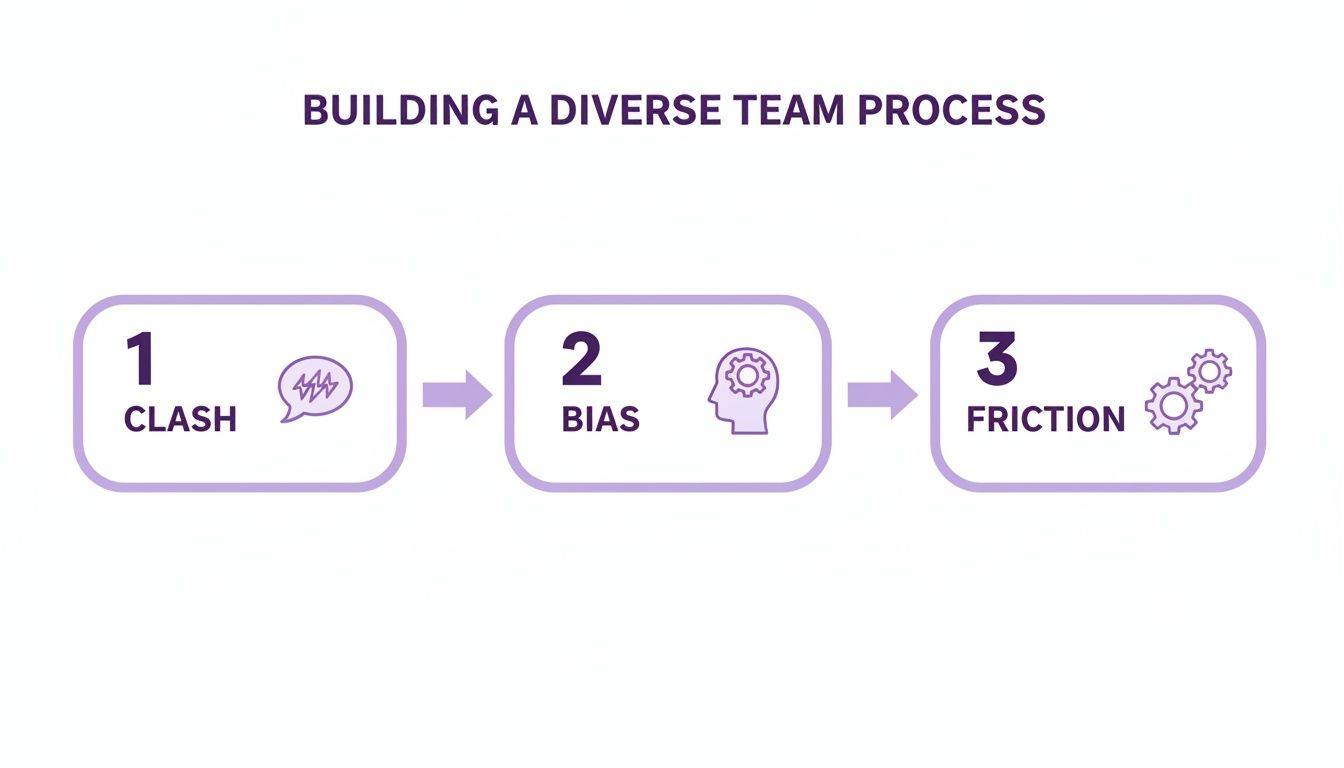
This process shows how initial team clashes, unchecked biases, and operational friction aren't failures—they're expected stages to manage on the path to high performance.
Platforms like LatHire exist for this very reason. (Toot, toot!) They aren't just about saving a buck; they're about giving you direct access to a pipeline of pre-vetted professionals your old methods would have completely missed. Stop fishing in a puddle and start fishing in an ocean. If you're serious about this, check out our guide on inclusive hiring practices.
The "cultural fit" interview is where bias loves to hide. It quickly devolves into a "would I want to have a beer with this person?" test, which is a terrible predictor of actual job performance. You need a structured process that tests for competency, not chemistry.
This part is non-negotiable. Standardize your interview questions for every single candidate applying for the same role. Use a scoring rubric to evaluate answers objectively. This forces you to compare candidates on their skills and problem-solving abilities, not on how well they mirrored your own communication style.
This isn't just a philosophical shift; it's what candidates demand. In fact, 76% of job seekers now say a diverse workforce is a key factor when they evaluate opportunities. By failing to build an inclusive process, you're not just being unfair; you're actively losing out on top-tier talent.
Fixing your funnel is work. It requires you to be intentional, self-aware, and willing to ditch the old playbook. But the alternative is getting out-innovated by teams who were smart enough to do it first.
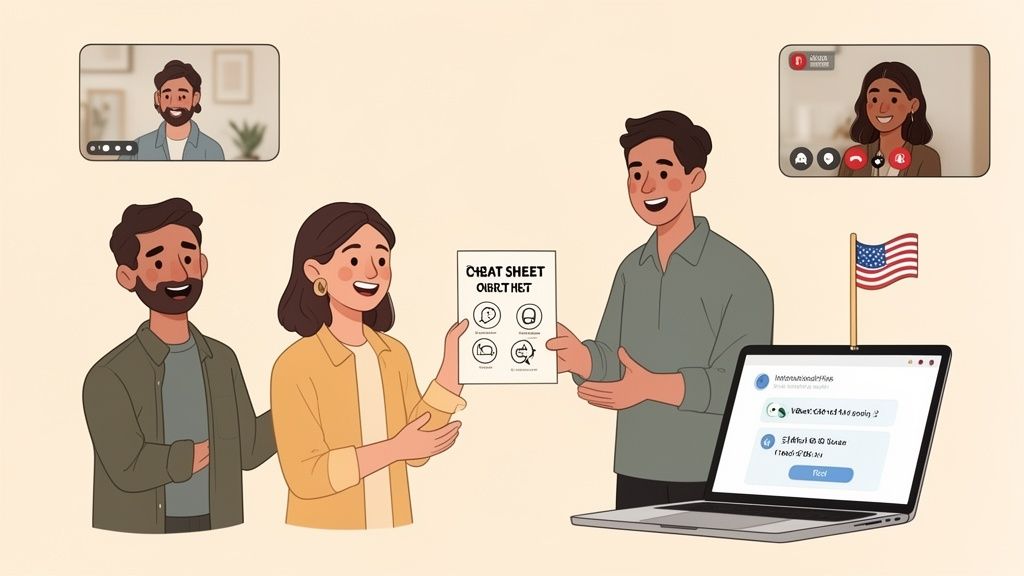
So, you landed an incredible engineer from Bogotá after fixing your hiring funnel. Congratulations. Now what?
If your onboarding is just a series of automated emails with links to company policies and a generic calendar invite, you've already failed. The first 90 days are when your new hire decides if they've joined a real team or just another faceless corporation. This is your first real chance to prove your commitment to cultural diversity in a workplace is more than just a line in your mission statement.
Let's be real: a welcome basket with company swag is nice, but it doesn't help someone navigate the unwritten rules of a new culture. It doesn't tell them if it’s okay to challenge the CEO in a meeting or if they should wait to be asked for their opinion.
The anxiety of starting a new job is universal. Now multiply that by ten when you’re doing it remotely, across borders, and in a different cultural context. A generic, one-size-fits-all onboarding process feels cold and impersonal, signaling that the company doesn't actually care about the individual.
You have to be intentional. This is where you turn a new hire's first few weeks from a period of anxiety into a launchpad for long-term success. For more on this, our deep dive into onboarding remote workers provides a solid playbook.
The goal of onboarding isn't to get someone to fill out paperwork. It's to make a brilliant new hire feel like they've made the best decision of their career.
This means designing an experience that bridges cultural gaps before they become problems. It’s about being proactive, not reactive.
Forget the automated drip campaigns. A truly inclusive onboarding experience is hands-on and human-centric. It acknowledges that what’s obvious to your local team might be a complete mystery to someone from another country.
Here are a few non-negotiable strategies we’ve found that actually work:
The table below breaks down the difference between a lazy, standard process and one designed for a global, culturally diverse team. It's a simple gut check to see where you stand.
| Onboarding Step | Standard Local Hire | Inclusive Global Hire (The Right Way) |
|---|---|---|
| Welcome | Automated welcome email and swag box. | Personalized video message from the direct manager and a curated welcome kit. |
| First Day | Links to HR portal and company handbook. | A structured "Day One" agenda with introductions to key team members across time zones. |
| Communication | Assumes new hire will "pick it up." | Provides a communication 'cheat sheet' and an assigned cultural mentor for navigating norms. |
| First Week Check-In | A quick "How are you settling in?" chat. | A structured 1-on-1 focused on cultural observations and clarifying unwritten rules. |
Ultimately, great onboarding is your first, best chance to prove that you value the unique perspective your new hire brings. It’s the moment you stop talking about inclusion and start actively practicing it. Don't screw it up.
Managing a monoculture is easy. Everyone nods at the same jokes, approaches problems from the same angle, and agrees with you. Congratulations, you’ve built an echo chamber.
Leading a truly diverse team requires a completely different skill set. It demands you check your ego at the door, listen more than you talk, and get damn good at facilitating debates where everyone feels safe enough to disagree—passionately. This isn’t about being “nice”; it’s about being an effective leader who can harness the full intellectual horsepower of every single person on the team.
This is a skill we had to learn the hard way, too. The corporate world is certainly waking up to this reality. The number of global 'Head of Diversity' titles more than doubled between 2015 and 2020 alone, a clear signal that this is no longer a fringe issue. You can find more insights on these leadership trends in ETU's 2023 report.
Let’s be honest: your default meeting structure is probably broken. In a typical brainstorming session, the most extroverted or culturally dominant person speaks first and sets the tone. Everyone else either quietly agrees or tunes out.
You’re paying for the brainpower of your entire team, not just the two loudest people. To fix this, you need to introduce structures that force equitable participation.
This isn't about slowing down; it's about getting better answers by ensuring all perspectives are actually heard. If this sounds like a lot of work, you might be interested in our guide on cross-cultural communication in the workplace.
Giving feedback across cultures is like trying to defuse a bomb while blindfolded. What you consider direct and helpful, someone from another culture might perceive as aggressive and disrespectful. Conversely, what you think is polite and subtle might be so indirect that your message is completely lost.
The golden rule of cross-cultural feedback: Assume nothing. Your version of "common sense" is just your cultural default setting. Be explicit about your intentions and ask for clarification.
Instead of saying, "This report isn't very good," try a more structured approach. Start by stating your positive intent: "My goal is to help us get this report ready for the board meeting. Can we walk through a few sections together?" Then, focus on objective behaviors and outcomes, not subjective judgments.
Here’s the bottom line: none of this works without psychological safety. It's the bedrock of any high-performing, diverse team. It's the shared belief that you won't be punished or humiliated for speaking up with ideas, questions, concerns, or mistakes.
How do you build it? You go first.
Admit when you're wrong. Ask "dumb" questions publicly. When someone challenges your idea, thank them for their honesty instead of getting defensive. Your behavior as a leader sets the standard for the entire team. If you can’t handle being challenged, no one else will ever feel safe enough to bring their best, most disruptive ideas to the table. And you’ll be left leading a garage band, wondering why you can't create a symphony.
Alright, let's stop talking and start tracking. If your diversity efforts are just a line in your mission statement, you're not actually building a better company—you're just hoping for the best. The old saying "what gets measured gets managed" isn't some tired business school cliché; it's the only way to figure out if any of this is actually working.
That warm, fuzzy feeling you get from a well-worded DEI policy is great, but without hard numbers, it's just that—a feeling. This isn't about filling a spreadsheet with demographic data to flash on screen at the next all-hands meeting. It’s about measuring the real, tangible impact of the culture you're trying to build.
You need to focus on metrics that tell a story. Are you just hiring diverse talent, or are you creating a place where they genuinely want to stay, contribute, and grow? It's time to ditch the vanity metrics and start digging into the data that reveals the true health of your workplace.
Here’s what you should be obsessed with:
Tracking diversity isn't about policing your team. It's about finding the leaks in your talent pipeline before your best people drain out. This is an operational imperative, not an HR box-ticking exercise.
Nobody wants to feel like they're just a data point being sorted into a box. The key is to gather this information respectfully and with total transparency. Voluntary, anonymous self-identification surveys are the gold standard here.
You have to explain why you're collecting the data. Frame it as a collective effort to build a more equitable workplace where everyone gets a fair shot at success. When people understand the goal is fairness, not surveillance, they're far more likely to participate honestly.
Think of this data as your map. It shows you exactly where the roadblocks are. Maybe your onboarding process is failing your international hires, or perhaps unconscious bias is creeping into performance reviews. Without the numbers, you’re just guessing where the problems lie.
This is how you move from performative DEI to a data-driven strategy. It’s how you prove the value of your efforts to the C-suite in the language they understand: results. And ultimately, it’s how you finally build an equitable, high-performing team that's built to last.
Alright, let's tackle the questions you're probably thinking about but might not want to ask in a company-wide meeting. Forget the HR-speak; here are some straight answers from someone who's been in the trenches.
Let's put this one to bed right away. No. The goal isn't to hire someone because of their background; it's to dismantle the old, biased systems that stop you from hiring the best person for the job in the first place.
A truly merit-based process recognizes that talent is everywhere, but opportunity certainly isn't. Fixing your hiring process is about leveling the playing field so the most skilled person wins, regardless of their name, location, or cultural context. It’s about widening your talent pool from a small pond to an ocean—not about lowering your standards.
You lean into it. Awkwardness comes from avoidance, not from actually addressing the issue. When a misstep happens—and trust me, it will—treat it as a learning opportunity, not a personal failing.
A good approach is to be direct, transparent, and humble. Try saying something like, "Hey, I noticed X happened in the meeting, and I think we might have had a miscommunication. My intention was Y. Could you share your perspective?" This opens a dialogue instead of assigning blame.
The real goal is to build a culture where it's safe to say, "I didn't understand that," without anyone feeling dumb. It’s about building bridges, not forcing everyone to walk on eggshells.
Absolutely not. In fact, this is the single best time to start. Building an inclusive culture from the ground up is infinitely easier than trying to retrofit one onto a 500-person company with deeply rooted, homogenous norms.
Think of it this way: your first ten hires basically set the cultural DNA for your company's entire future. If you build a team of clones from day one, you create a self-reinforcing referral cycle that becomes incredibly difficult—and expensive—to break later on.
Start now. Define your inclusive values, design a fair hiring process, and make it part of your foundation. It's not a distraction; it's one of the smartest strategic investments you can make, and it will pay dividends for years to come.