Let's be honest about what an Employer of Record really does for you: it saves you from the soul-crushing, time-wasting, and shockingly expensive nightmare of trying to hire global talent on your own. This isn't just about ticking compliance boxes; it's about reclaiming your time and sanity.
You did it. You found the perfect engineer. She’s in Brazil, she’s brilliant, and for a glorious thirty seconds, you felt like a genius founder who’d just hacked global talent acquisition.
Then reality hits you like a ton of misfiled tax forms.
Suddenly, you’re not building a product anymore. You’re an amateur international lawyer, squinting at Portuguese employment contracts and trying to figure out what a “13th-month salary” even is. Welcome to the messy, expensive, and utterly maddening world of DIY global hiring.
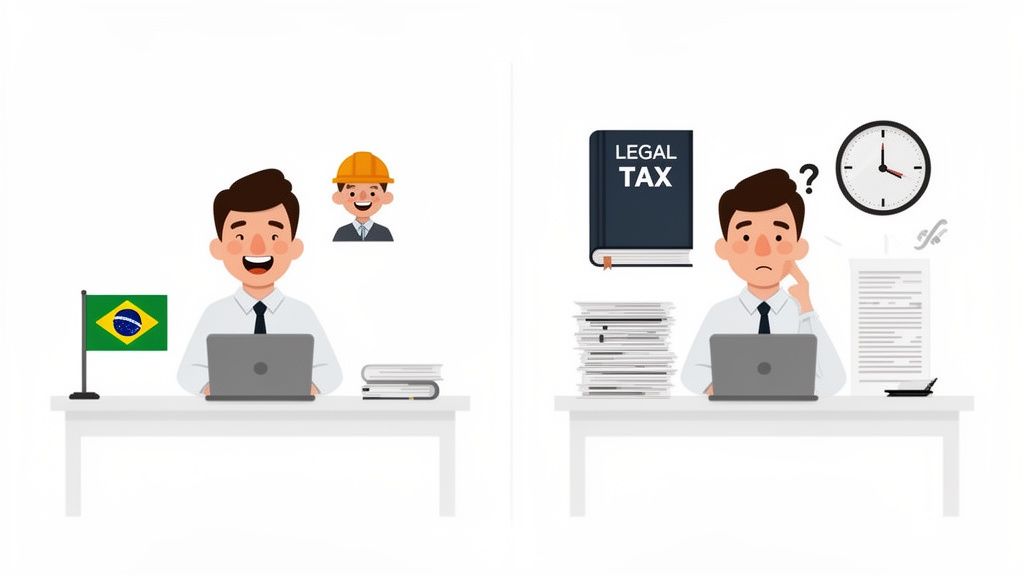
This isn’t about fear-mongering. It's about acknowledging the massive operational drag that hunting for the best people creates for ambitious companies. We’ve been there. The costs are very real, and they go way beyond the salary you offer.
It starts with a phone call. You ring up a law firm specializing in international employment, and they’re happy to chat—for about an hour. That first conversation is what I call “The $500 Hello.”
All you get for your money is a terrifying overview of your own ignorance. You’ll learn about mandatory profit-sharing, severance fund contributions, and a dozen other local regulations you never knew existed. You hang up with a headache, a lighter wallet, and the sinking feeling that you’re in way over your head.
This is the first hidden tax on ambition. Before you’ve even sent an offer letter, you’re bleeding cash just to understand the rules of the game.
Hope you enjoy spending your afternoons fact-checking local labor laws and cross-referencing tax codes—because that’s now your full-time job. The hours you thought you’d spend on product strategy or sales calls are now dedicated to administrative drudgery.
The real "cost" of hiring globally isn't just the legal fees; it's the catastrophic loss of focus. Every hour you spend on compliance is an hour you're not spending on growing your business. It's a silent killer of momentum.
Just look at the sheer volume of tasks involved when you go it alone versus using an EOR.
| Hiring Aspect | The DIY Approach | The EOR Approach |
|---|---|---|
| Time to Hire | 3-6 months to set up an entity, get legal advice, and establish payroll. | 1-2 weeks to onboard a new hire through an existing local entity. |
| Upfront Costs | $15,000 – $30,000+ for legal entity setup, registration, and initial consultations. | $0 upfront setup costs. You pay a monthly fee per employee. |
| Legal & Compliance Risk | High. You are solely responsible for keeping up with ever-changing labor laws, tax codes, and regulations. | Low. The EOR assumes the legal risk and ensures full compliance with local employment laws. |
| Administrative Burden | Massive. You handle payroll, benefits, taxes, and compliance in-house for a country you don't know. | Minimal. The EOR manages all HR admin, payroll, and benefits, freeing up your team. |
The difference is stark. One path is a minefield of complexity, while the other is a clear runway.
By partnering with an EOR, companies can navigate complex international hiring hurdles, including the intricacies of UAE employment visa requirements, without becoming accidental experts in global HR. It’s about offloading the complexity so you can get back to what you’re actually good at. Turns out there’s more than one way to hire elite developers without mortgaging your office ping-pong table.
Let's cut through the jargon. You don't need a textbook definition to understand what an Employer of Record (EOR) does. You just need to know how it helps you build a business without getting tangled in red tape.
Think of an EOR as your company’s legal stand-in in another country. You find the talent—the amazing engineer in Brazil, the star marketer in Spain, or the operations guru in Poland. You direct their work, set their goals, and make them a real part of your team. You do all the important day-to-day management.
The EOR handles everything else. They’re the ones who appear on paper as the official employer, taking on all the messy, complicated admin that comes with hiring someone in a country where you don’t have an office.
Here’s a practical way to look at it. Hiring someone internationally on your own is like trying to build a house from scratch in a foreign city. You’d have to buy the land, navigate local zoning laws, hire architects, and get all the permits before your new hire could even start working. It’s an expensive, slow, and frustrating process.
Using an EOR is like renting a fully furnished apartment in that same city. All the infrastructure—the plumbing, the electricity, the legal framework—is already in place. You just hand the keys to your new hire, and they can get to work the next day. The EOR is the landlord who makes sure the building is up to code and handles all the maintenance. You just focus on the work.
This model is a massive shortcut for founders who care more about speed and talent than bureaucracy. It's about getting the best people on your team, not becoming an expert in foreign labor law.
An EOR isn't a recruiter—they don't find people for you. They're a compliance partner that makes it legal and simple to hire the people you've already found. It’s the difference between talent acquisition and talent administration.
So, what exactly is the EOR doing in the background while you manage your new global superstar? They take on all the legal responsibilities of being an employer, which covers the stuff that gives most founders a headache:
In short, they put their name on all the official paperwork so you don’t have to. You get all the upside of a global team without the downside of becoming a global HR expert yourself.
Alright, let's cut through the noise. When you're trying to grow a business, you don’t have time for a dozen bullet points on a sales page. You care about what actually moves the needle. After trying (and failing at) the DIY approach to international hiring myself, I can tell you there are four game-changing employer of record benefits that will make you wonder why you ever considered setting up a foreign entity in the first place.
Forget the long list of features. These are the four heavy hitters that save you time, money, and most importantly, your sanity.
Think of an EOR as a protective shield. It stands between you and the administrative nightmare of payroll, taxes, and compliance, letting you focus on what you're good at: building your business and managing your team.
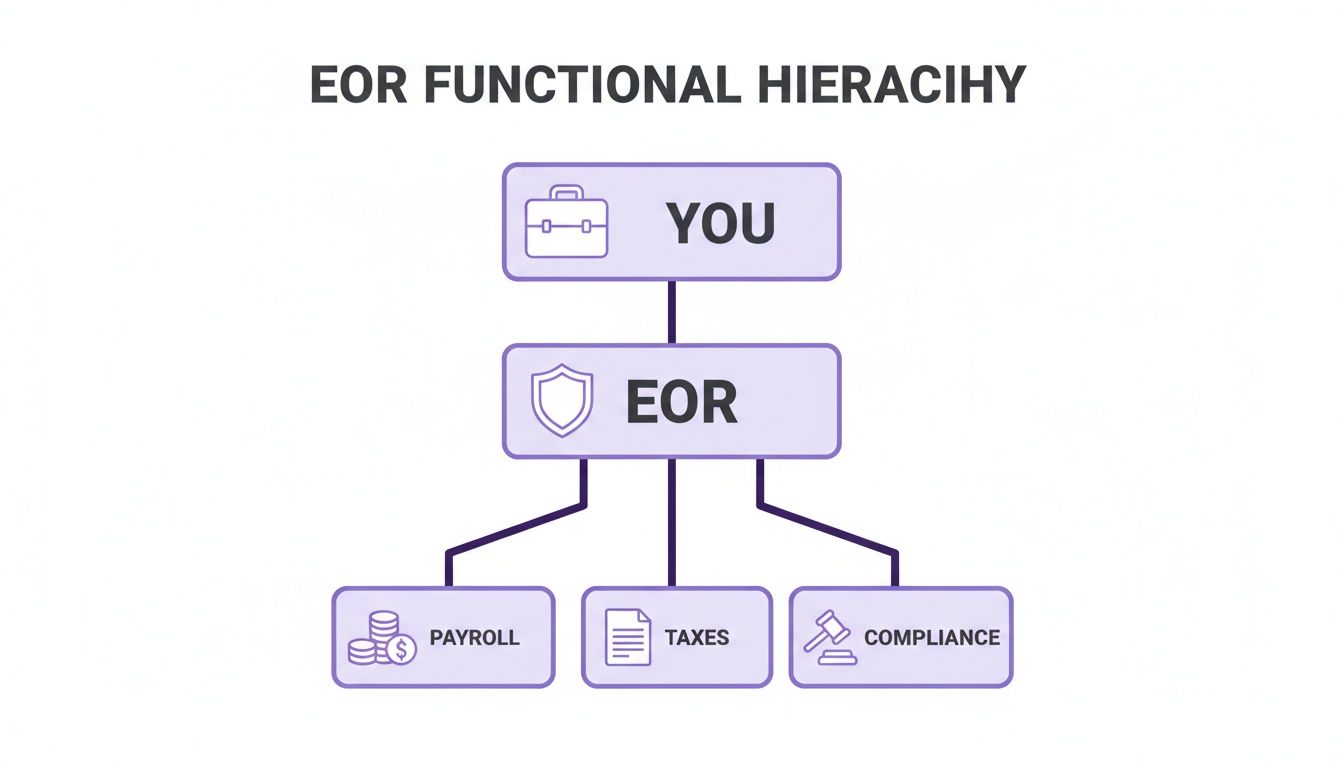
You delegate all the messy, high-risk administrative work, freeing up your internal resources to drive real growth.
Ever tried to set up a legal entity in another country? It’s a masterclass in bureaucratic torture. You’re looking at 6-12 months of drowning in paperwork, waiting on government approvals, and paying eye-watering legal fees just for the privilege of hiring one person.
Your perfect candidate won't wait that long. They’ll be snapped up by a competitor while you’re still trying to figure out which government office to call.
An EOR completely flips the script. Since they already have the legal infrastructure built and ready to go, you can onboard new hires in days, not months. You find the talent, they handle the contract, and your new team member is working within a week. In a competitive talent market, that’s not just an advantage; it's a weapon.
Let’s be honest: you are not an expert in German labor law. You don't know the nuances of Brazil's 13th-month salary requirements or France's mandatory profit-sharing rules. And frankly, you shouldn't have to.
Trying to keep up with international employment law is a full-time job for a whole team of specialists. One wrong move—like misclassifying an employee or missing a social security payment—can trigger crippling fines, drawn-out legal battles, and a reputation nightmare you can't afford.
An EOR’s entire business is built on obsessing over compliance so you don’t have to. They are your human shield against legal drama, constantly monitoring changing laws to keep you protected.
This is arguably the single most important EOR benefit. Beyond just cutting checks, a top-tier EOR ensures your business navigates everything from local tax codes to complex small business health insurance requirements without you breaking a sweat. It's peace of mind as a service.
Founders often balk at an EOR's monthly fee, but they’re looking at the math all wrong. They're comparing a predictable operating expense to a massive, risky capital investment.
Let's break down the real costs of going it alone:
An EOR wipes all of that off the table. You pay a simple, transparent fee per employee, turning a huge upfront capital sink into a manageable operating cost. It’s a much smarter way to allocate cash, especially when you’re still trying to scale. If you're looking for more ways to streamline benefits, it's worth exploring the pros and cons of outsourcing employee benefits administration.
So you’ve hired one person in Portugal. Great! What happens when you find another superstar in Argentina and a third in Poland? With the DIY approach, you have to start the entire soul-crushing entity setup process all over again. For each. and. every. country.
That model doesn't scale. It actively punishes you for finding great talent around the world.
An EOR gives you a single, unified process to hire anywhere. Whether you're onboarding one person or twenty across ten different countries, the workflow is the same. This agility is exactly why small and medium-sized enterprises (SMEs) are driving EOR adoption, and they're expected to capture 53% of the global market share by 2025.
For startups in the IT sector, which is grappling with 1.4 million unfilled roles, this is a lifeline. An EOR provides the framework to hire top talent anywhere, often with up to 80% savings on total employment costs, as platforms like LatHire have demonstrated. You can read more about these EOR market trends in this comprehensive report.
Let’s get one thing straight: an Employer of Record isn't just a tool for mega-corporations with sprawling global org charts. Frankly, that’s where it’s least interesting. The real magic happens when an EOR becomes a secret weapon for ambitious companies in very specific, high-stakes situations.
It's not about outsourcing HR for the sake of it. It’s a strategic move you pull when the stakes are high, speed is critical, and the cost of getting it wrong is catastrophic. I’ve seen it save deals, accelerate growth, and prevent founders from tearing their hair out.
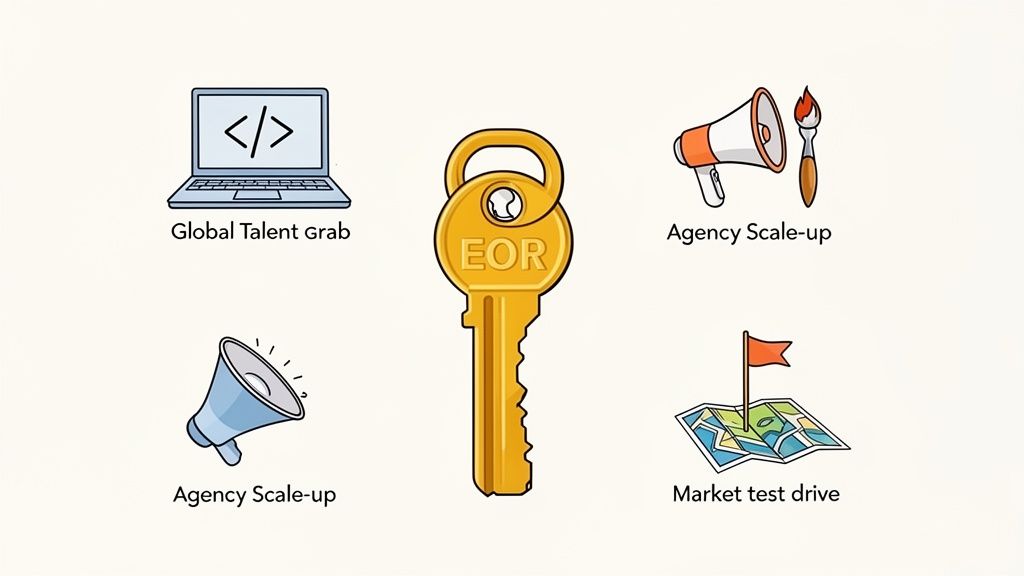
This isn’t theory. These are the trenches. Here are three common scenarios where an EOR is the smartest, fastest, and sometimes only move you have.
You’re a tech startup, and your entire future rests on hiring three specialized AI engineers. The problem? The best ones you’ve found are in Argentina and Poland, and your lead investor wants them writing code yesterday.
Your options are bleak. You could try hiring them as contractors and pray you don’t get hit with a misclassification lawsuit. Or you could start the six-month, $20,000 process of setting up entities in two different countries, by which time those engineers will have already accepted other offers.
This is the classic startup dilemma: your ambition outpaces your administrative capacity. An EOR solves this instantly.
You find the talent; they make it legal. The EOR onboards your new hires with locally compliant contracts in a matter of days, not months. You get the world-class team you need without getting bogged down in a bureaucratic nightmare you can’t afford.
This isn’t just a nice-to-have; it’s a competitive necessity. While your rivals are on hold with international law firms, your team is already shipping product. If you're wondering how to even start this process, check out our guide on how to hire international employees.
Picture this: your marketing agency just landed a massive, nine-month project with a dream client. It's a game-changer. The catch? You need to triple your creative team, and you need a specific mix of talent—a motion graphics artist from the UK, a copywriter from Canada, and a UX designer from Colombia.
You can't afford to bring them on as full-time, permanent staff. The project has a clear end date, and you’re not ready for that long-term payroll commitment. But the client demands the security and reliability of fully employed team members, not a revolving door of freelancers.
This is where an EOR shines for project-based businesses.
You get the flexibility of a contract workforce with the stability and legal protection of a full-time team. It’s the ultimate scale-up-and-down model.
Your company is ready to expand into Europe. Your board is convinced Germany is the perfect entry point. But are they right? Setting up a German GmbH is a slow, expensive, and irreversible bet. If the market doesn't respond, you’ve just burned six figures and a year of effort.
A smarter founder plays it differently. Instead of building a whole house, you rent a room first.
You use an EOR to hire a small "test team" on the ground—a country manager and a couple of sales reps. For a predictable monthly fee, you get a fully operational, legally compliant team in Germany. They can start validating your product-market fit from day one.
After six months, you’ll have real data. If sales are taking off, great—you can confidently invest in setting up your own entity. If it’s a flop, you can compliantly dissolve the team via the EOR and walk away without a massive financial hangover.
This approach is why the global EOR market is exploding, with projections showing it will nearly double from $5.59 billion in 2025 to $10.46 billion by 2035. Companies are realizing it’s the leanest way to test global expansion. Discover more insights about this surge in EOR adoption and why it's becoming a go-to strategy.
Let’s be real: not all EORs are created equal. Some are just glorified payroll processors with clunky software and a support team that only communicates via carrier pigeon. Others are true strategic partners that feel like an extension of your own team.
Picking the wrong one is a fast track to frustration. They’ll nickel-and-dime you with hidden fees, botch a contract in a key country, or leave your new hire feeling like a nameless number in a soulless HR machine. The goal isn’t just to find an EOR; it’s to find the right EOR.
Every EOR website promises the world: seamless onboarding, global compliance, happy employees. It’s all a bit much. To get to the truth, you need to arm yourself with a few sharp questions that cut right through the marketing fluff.
Here’s the no-nonsense checklist I use to vet potential partners. Don't sign anything until you get clear, direct answers to these.
1. How Transparent Is Your Pricing?
This is the big one. Some EORs lure you in with a low-ball quote, then bury you in hidden charges for onboarding, offboarding, or currency conversions. Ask for a full breakdown of their pricing model.
2. What’s Your On-the-Ground Expertise?
Many EORs claim "global coverage" but rely on a patchwork of third-party partners in most countries. This creates a terrible game of telephone when you have a real problem. Ask them directly: "Do you own your own legal entity in [Country X], or are you using a partner?"
An EOR with its own entity has direct control and deep local knowledge. One that uses partners is just a middleman, adding another layer of complexity and cost.
3. What Does Your Platform Actually Do?
An EOR isn’t just a service; it’s a tech platform your employees will have to use. Is it intuitive? Can your team easily access pay stubs, request time off, and manage their benefits without needing a user manual the size of a phone book?
The best EOR platforms provide a single source of truth for your global team, making everyone feel connected and supported. A bad one just creates another login to forget and another support ticket to file.
Look for integrated solutions that don't just handle payroll, but also simplify the entire employee lifecycle. For those wanting to dig deeper, exploring some of the best employer of record services can provide a clearer picture of what a top-tier platform looks like. Choosing wisely here saves you countless headaches down the road.
Alright, let’s run through the questions that are probably on your mind. I get it. This all sounds good on paper, but you need the straight-up answers—no fluff, just what you actually need to know.
This is the number one question, and the answer couldn’t be simpler: you do.
You're still the one in charge. You handle their daily tasks, assign projects, manage performance, and make sure they’re a real part of your team's culture. Think of the EOR as a silent partner working in the background. They're like the landlord of the building, but you're the one designing the office and running the show inside.
At first glance, you'll see the EOR’s monthly fee and think, "Aha, an extra cost!" But that’s the wrong way to look at it. The real question should be, "expensive compared to what?"
Is it more expensive than dropping $20,000+ and waiting six months just to set up a legal entity in Germany? Not even close. The EOR fee flips a huge, risky capital investment into a predictable monthly expense. For hiring one or a few key people in a new country, it's almost always the smarter financial move.
Yes, and frankly, this is one of an EOR's most powerful features. A good EOR has the scale to negotiate and provide enterprise-level benefits packages that a small, brand-new foreign entity could never dream of securing on its own.
This isn’t just about checking a compliance box; it’s about winning the war for talent. You get to offer top-tier health insurance, pensions, and other local perks that actually attract and keep the best people. You immediately look like a major player in that market, even if it's your first hire there.
The speed is the entire point. Forget the soul-crushing 6-12 month timeline it takes to establish a foreign subsidiary. With an Employer of Record, all the legal plumbing is already in place and ready to go.
Once you’ve found your candidate, you can typically get a fully compliant employment contract signed and have them officially onboarded in just a matter of days or maybe a couple of weeks, depending on the country. While your competitors are stuck on hold with their international lawyers, your new hire is already shipping code. It’s that simple.