

Let's be honest. That simple cost per hire calculator you downloaded from a template site? It's a liar. It spits out a neat, clean number—the sticker price—that covers obvious things like job ads and maybe a recruiter's bonus. But it completely ignores the real financial hemorrhage happening just under the surface.
It's like bragging about the low price of a used car while conveniently forgetting to budget for gas, insurance, or the inevitable engine failure two weeks after you drive it off the lot.
That basic spreadsheet is costing you a fortune because it’s built on a fantasy. It pretends hiring is just a series of predictable expenses. But we both know it’s a chaotic, resource-draining marathon that pulls your best people away from their actual jobs.
The real cost isn’t in the invoices you can see. It’s buried in the productivity your team loses every single day a critical role sits empty. It's a silent killer of momentum and morale.
I once watched a single botched hire for a senior developer cost a company I was with nearly six figures. The standard calculator told us we spent around $15,000—agency fee, some ads, a background check. On paper, it looked fine.
But then the truth came out. Our lead engineer wasted over 80 hours screening resumes and sitting in interviews with candidates who couldn't code their way out of a paper bag. The project that new developer was supposed to lead stalled for three months, costing us a key client and delaying revenue. Team morale took a nosedive as everyone scrambled to cover the gap. When the new hire finally quit after four months of underperforming, we were right back at square one, only poorer and more cynical.
None of that showed up on the spreadsheet. The calculator gave us a number, but reality handed us a massive bill.
This isn't just a bad day at the office; it's a systemic failure of a metric we're taught to trust. The standard formula measures the transaction, not the true impact.
Your basic cost-per-hire calculator is designed for simplicity, not accuracy. It conveniently leaves out the messiest, most expensive parts of the entire process.
Here’s a taste of what’s missing:
You see, the numbers provided by research often paint a deceptively simple picture. The average cost per hire globally is reported to be around $4,700, but this figure is just the tip of the iceberg. For tech companies, this breaks down into recruiter salaries (40-50%), external fees from job boards (30-40%), and onboarding expenses (20%), with costs often spiking in major markets. Find out more about these recruiting statistics and their impact.
This isn't about scaring you into hiring paralysis. It's about arming you with the truth. To make smarter decisions, you need a calculator that reflects reality, not one that just makes your expense report look neat. You need to see the whole, ugly, expensive picture.
Alright, enough with the theory. Talking about hidden costs is one thing; actually digging them up is another game entirely. Let’s build a proper cost per hire calculator—one that gives you the whole, unvarnished truth about what it really costs to add someone to your team.
Forget the simplistic models that just tally up a few invoices. We’re going deeper.
Most calculators are designed to give you a number that won’t make your CFO spit out their coffee. We’re building one that will. Because until you see the real figure, you're just guessing with your most important asset: your people.
We'll break this down into two buckets: the visible part of the iceberg and the massive, ship-sinking part lurking just beneath the surface.
This is the easy stuff—the line items you can pull directly from any expense report. They're the most obvious part of the equation, but they're just the price of admission.
Don't get me wrong, you absolutely need to track them meticulously. But stopping here is where nearly everyone goes wrong.
Get these numbers down first. This is your baseline, the figure that makes you feel like you have everything under control. Now, let’s blow that up with a dose of reality.
Here it is. This is where the real money vanishes. Soft costs are all about time—specifically, the time your non-recruiting staff spends on hiring instead of doing their actual jobs. This is the metric that separates an amateur cost analysis from a professional one.
Hope you enjoy spending your afternoons fact-checking resumes and running technical interviews, because that’s now the unofficial job description for some of your most expensive employees.
To calculate this, you need to assign a realistic, fully-loaded hourly rate to everyone involved in the hiring process. Then, you track their time like a hawk.
A senior engineer earning $150,000 has a loaded hourly rate of around $95. If they spend just 10 hours in interviews for one role, that’s nearly $1,000 in lost productivity that never shows up on an invoice.
This flow chart breaks down how you get from what you think you're spending to the actual damage.
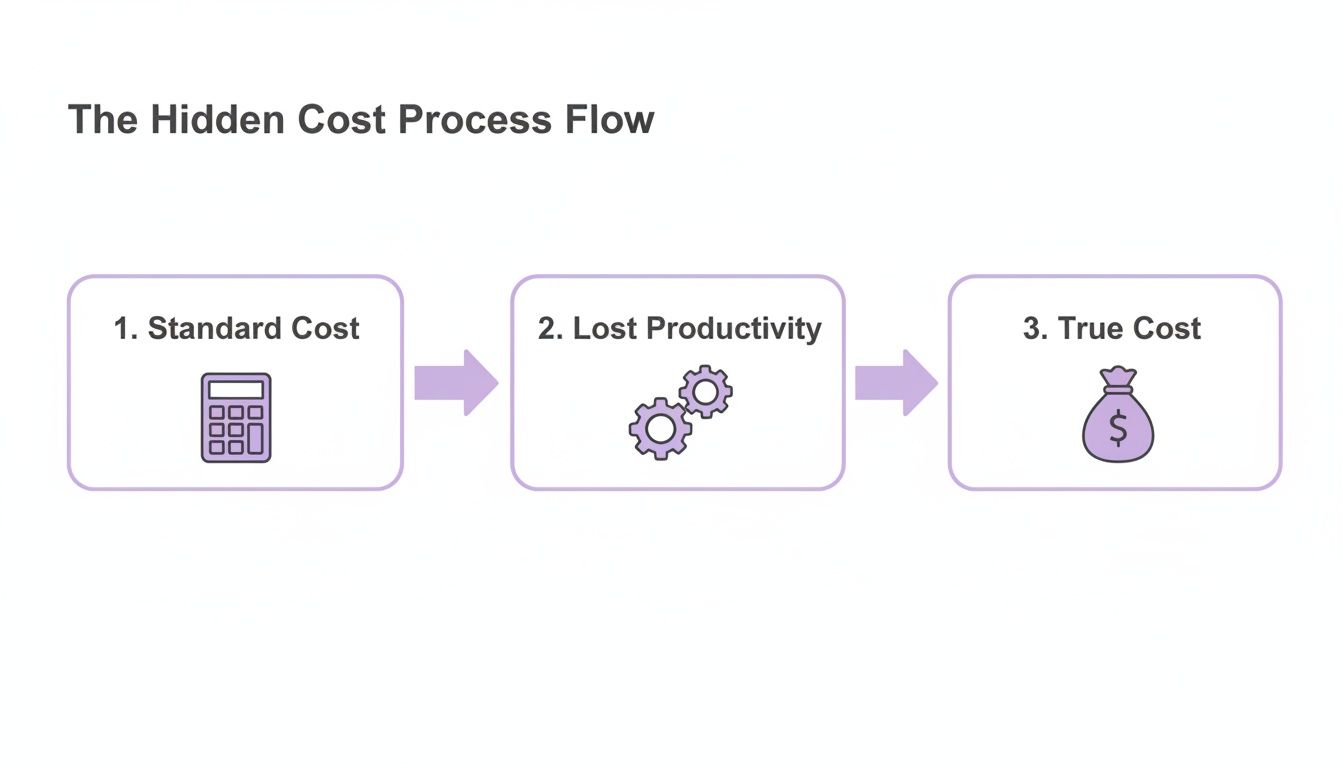
As you can see, your standard calculation is just the beginning. Lost productivity is the hidden multiplier that reveals your true cost.
We've built the exact spreadsheet we use internally to track this, refined over years of painful trial and error. There are no strings attached—no email signup, no weird macros. It’s a tool, not a marketing gimmick.
[Download The Unvarnished Truth CPH Calculator Spreadsheet Here]
Once you have it, start plugging in the numbers. Don't just estimate; dig into calendars and ask your team for real data. How long did that "quick" 30-minute screening call actually take? How many hours did the final interview panel burn through? Each entry adds to a truer, more terrifying total.
Calculating these soft costs is crucial, but it's only half the battle. If you're looking for ways to claw back that wasted time, check out our guide on how to reduce time to hire without sacrificing quality. It’s packed with strategies to stop the bleeding.
This isn't about creating a static report to file away. It's about building a living tool that helps you make smarter, faster decisions.
A calculator is just a fancy spreadsheet until you feed it real, messy data from the trenches. So, let's get our hands dirty and run the numbers for three distinct scenarios I've personally lived through.
This isn't textbook theory. This is a field guide showing how the "True CPH" changes dramatically depending on who you are, what you're hiring for, and how much pain you're willing to endure.
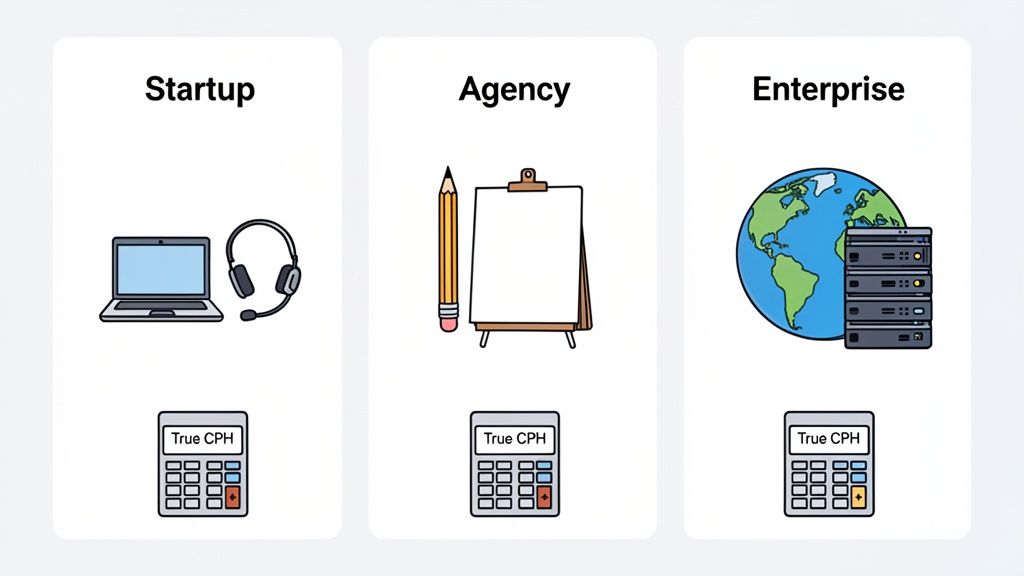
First up, the classic bootstrapped startup hiring its first remote customer support specialist. Every dollar counts, and your time is worth more than cash. The founder (that was me, in this memory) is the lead recruiter, interviewer, and onboarding specialist.
Hope you enjoy spending your afternoons fact-checking resumes, because that’s now your second job.
After crunching the numbers, the sticker price looked fine. But the True CPH came out to over $5,500. For a junior role, that was a gut punch.
The takeaway? For startups, time is the money. Every hour a founder spends hiring is an hour the company isn't growing.
Next, a scaling marketing agency desperate for a senior UX/UI designer. Client work is piling up, and the current team is stretched thin. They've been trying to hire for three months with no luck.
Here, a long "time-to-fill" isn't just an inconvenient metric; it's a direct threat to client relationships and revenue.
The True CPH for this role, once you factor in the agency fee and the massive productivity loss, soared past $38,000. The agency learned a hard lesson: dithering on a critical hire costs far more in lost revenue than any recruiter fee.
Finally, the established enterprise. They need a team of five specialized DevOps engineers for a new international product launch. They have a TA team and a big budget, but they're wrestling with the soul-crushing overhead of corporate bureaucracy.
The True CPH per engineer landed at an eye-watering $62,000. The lesson here is that at the enterprise level, inefficiency and bureaucracy are the biggest cost drivers, often dwarfing even six-figure salaries.
These scenarios highlight a universal truth. Global trends show median salaries climbing, with 47-54% of small businesses naming cost-per-hire their top metric as they struggle to find talent. With 52% losing top candidates to competitors, the stakes are enormous. You can explore more on these 2025 global hiring trends and their impact.
Your calculator has to reflect this reality, or you're simply flying blind.
So, you've built a calculator that tells the unvarnished truth. You’ve tallied up every hidden expense, from your lead engineer’s lost hours to the soul-crushing administrative overhead. Smart move.
Now, let’s talk about the one metric that can make that entire calculation irrelevant: Quality of Hire.
Frankly, obsessing over a low cost-per-hire is like celebrating that you bought a cheap car without checking if it has an engine. Hiring a cheap-but-wrong person isn't a bargain; it’s the most expensive mistake you can possibly make.
A bad hire is a ticking time bomb. It starts with poor performance, then spreads to team disruption and plummeting morale as your A-players get dragged down.
Eventually, it ends with the painful process of managing them out and starting the entire, expensive hiring cycle all over again. Experts estimate that fixing this one mistake can cost 3-4 times the employee’s annual salary. Your meticulously calculated $8,000 cost-per-hire just morphed into a $300,000 catastrophe.
I learned this the hard way. We once hired a senior marketer who looked brilliant on paper. We celebrated the low CPH, feeling like we’d gamed the system. But within six months, their toxic attitude had alienated half the department and driven a star performer to quit. The "savings" from that hire cost us our best team member and set our quarterly goals back by months.
This is where you have to connect the dots between a smart hiring process and actual business outcomes, not just a smaller number on an expense report. A slightly higher initial investment in a properly vetted, high-quality candidate pays for itself tenfold.
What does that look like?
Focusing purely on cost is a race to the bottom. Shifting your focus to quality is how you build a company that lasts.
A cheap hire saves you money this quarter. A quality hire makes you money for the next five years. The choice seems pretty obvious when you frame it that way.
It's not just my opinion from the trenches; the entire industry is waking up. The conversation is fundamentally changing from "How much did it cost?" to "How much value did we get?"
In a shocking but welcome shift, a recent State of Staffing Benchmarking Report reveals that quality of hire has officially overtaken cost per hire as the top ROI metric, with 31% of agencies prioritizing it. This highlights how a cost per hire calculator isn't just about crunching historical numbers anymore; it’s about forecasting long-term value, especially as 77% of organizations struggle to fill critical full-time roles. Discover more insights into why quality of hire is the metric that matters most.
This evolution is critical. It moves the goalposts from simply finding a candidate to finding the right candidate. A great way to start is by focusing on tangible abilities over resume fluff. You can learn more in our guide on what is skills-based hiring. It’s a powerful strategy for ensuring your "cost" translates directly into on-the-job "quality."
Alright, you’ve run the numbers. You’ve stared into the financial abyss that is your true cost per hire. Now what? Pour a stiff drink and accept defeat?
The real question is how to systematically dismantle that number, piece by piece, without sacrificing quality. This is where we stop measuring and start winning. Let's see what happens when we plug a smarter hiring model into the very calculator we just built.
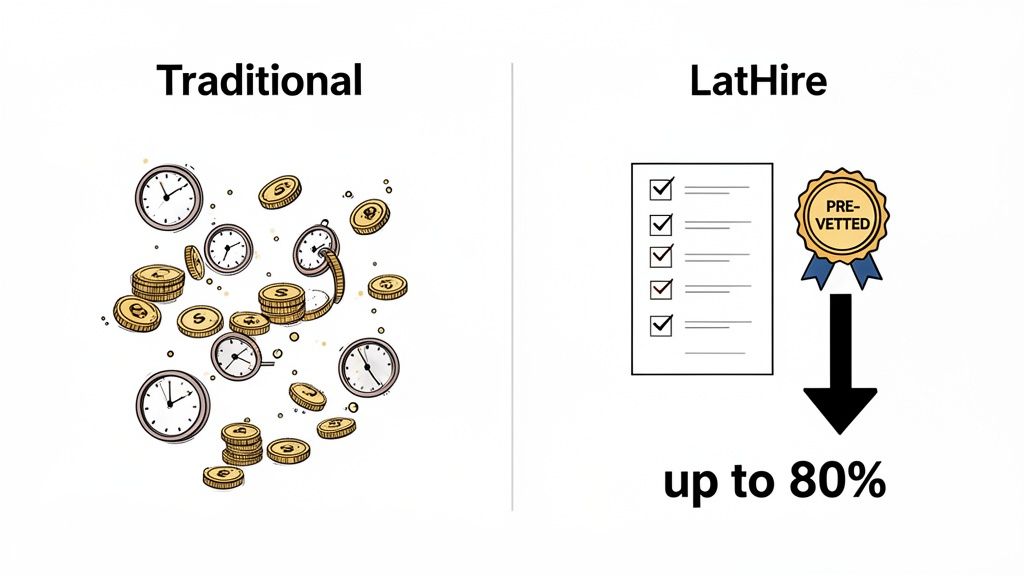
This isn’t about finding a cheaper alternative. It’s about adopting a fundamentally more efficient way to build a world-class team.
Let’s start with the most obvious line item: external sourcing costs. This is the money you burn on job board subscriptions, sponsored posts, and agency fees just to get a handful of decent resumes in the door.
It’s a spray-and-pray approach, and you’re paying for every single miss.
What if you could skip that entirely? With LatHire, you’re tapping into a pre-vetted talent pool of over 800,000 professionals. We’ve already done the sourcing. That expensive, time-consuming task of simply finding qualified people is gone.
Instead of paying to cast a wide net, you’re accessing a curated pond stocked with the exact fish you need. The cost of job board campaigns and agency retainers drops to zero.
Now for the big one: internal time cost. As we established, this is the silent killer—the hundreds of hours your most valuable people waste screening resumes and conducting interviews with candidates who were never going to make the cut.
This is where a better model combined with the right technology creates insane leverage. (Toot, toot!)
Our AI assessments and deep skills evaluations act as the world’s most ruthless filter. Before a candidate’s profile ever reaches you, we’ve validated their technical skills, language proficiency, and professional background. Your team only engages with the top contenders.
Let's put this into perspective:
Modern AI tools for talent acquisition are a key part of building an efficient hiring machine that reduces your cost per hire.
Finally, let's talk about the administrative quicksand: onboarding and international compliance. For any company hiring across borders, this is a minefield of legal fees, payroll setup costs, and HR headaches.
It’s complex, expensive, and a massive distraction from your core business.
We handle it. All of it. From cross-border HR and international payroll to benefits and legal compliance, it’s managed through our platform. You don't need to hire international law experts just to hire one person.
This doesn't just reduce your cost-per-hire inputs; it eliminates entire categories of expense and risk from the equation.
Let’s revisit our Scaling Marketing Agency from the previous section. They were looking at a $38,000 True CPH for a senior UX/UI designer.
Here's how that breaks down when we run the numbers again:
| Cost Component | Traditional Hire | LatHire Model | The Difference |
|---|---|---|---|
| Agency Fees | $20,000 | $0 | You keep your $20k. |
| Job Board Ads | $2,000 | $0 | No need to shout into the void. |
| Internal Screening Time | $10,000 | ~$1,500 | Your team gets 85% of their time back. |
| Compliance & Onboarding | ~$3,000 | Included | No lawyers, no paperwork nightmares. |
| Total True CPH | ~$35,000+ | ~$6,500 | An 80%+ reduction in total cost. |
The numbers don't lie. By targeting the biggest cost drivers—sourcing, screening, and compliance—you fundamentally change the economics of hiring. You stop bleeding money on inefficiency and start investing directly in talent.
This is how you build a talent pipeline that becomes a competitive advantage. If you're interested in proactive sourcing, check out our guide on how to build a talent pipeline. It's the key to making hiring a predictable, scalable part of your growth.
Alright, you've crunched the numbers and faced the music. But I know how it goes—once you start digging into a metric like cost per hire, more questions pop up. Let's tackle the big ones I hear all the time, with direct, no-fluff answers.
This isn't a one-and-done task. Think of it like a regular health check for your hiring engine.
If you're a high-growth company, you need to be running these numbers quarterly. Things change too fast to wait any longer. A quarterly review helps you spot dangerous trends, see if that new sourcing strategy is paying off, and adjust your budget before you get a nasty surprise.
For more stable organizations, an annual or semi-annual review might be enough. But honestly, quarterly is the gold standard for staying agile.
This is the classic "how long is a piece of string" question. The only honest answer is: it depends. A "good" CPH is completely relative to the role's seniority, the rarity of the tech stack, and your company's location.
A bootstrapped startup might celebrate a CPH under $5,000 for a junior developer. Meanwhile, a FAANG company could easily spend over $30,000 to land a senior AI specialist and consider it a bargain.
Chasing some universal "good" number is a fool's errand. The only benchmark that truly matters is your own. Your goal should be to make your process more efficient over time, not to hit a generic industry average that doesn't account for your unique situation.
Instead of obsessing over what others are spending, focus on your own performance. Aim to consistently improve your CPH quarter over quarter without letting quality slip. That's a real win.
Absolutely. In fact, that's one of its most powerful uses. Once you've established a reliable "True CPH" using a detailed model like ours, you can start forecasting your recruitment budget with terrifying accuracy.
Let's say your roadmap calls for hiring ten new engineers next quarter. Instead of pulling a number out of thin air, you can now confidently go to finance with a data-backed plan.
You’ll be able to budget for everything, including:
This shifts your approach from reactive spending to proactive financial planning. It’s the difference between telling your CFO, "I think we'll need this much," and showing them, "Based on our historical data, this is exactly what it will cost to hit our hiring goals." No more frantic, end-of-quarter budget scrambles.

