Let’s be honest. Your current hiring “process” is probably a Frankenstein's monster of frantic LinkedIn searches, gut-feel interviews, and a vague hope that the right person will magically appear. It’s held together with duct tape and desperation, and it’s costing you.
Improving your recruitment process isn't about small tweaks; it's about a fundamental shift. It's about digging in to find the real bottlenecks, writing job descriptions that actually sell the opportunity, and using technology to automate the soul-crushing tasks. Doing this frees up your team to do what they do best: engage with high-quality candidates who will actually move the needle.
It's costing you time, money, and—most importantly—the A-players you desperately need to grow. This isn't another fluffy lecture on "best practices." This is a pragmatic, in-the-trenches look at the real bottlenecks that cause great companies to make bad hires. I've been there, and the pain is real.
I've seen the same failure points in hundreds of companies, and they probably sound painfully familiar. It usually starts with bloated job descriptions that attract everyone and no one, followed by a screening process that feels like panning for gold in a river of mud.
This chaos leads to ghosted candidates, mismatched hires who churn in six months, and completely burnt-out hiring managers. We can fix this, but first, we need to stop pretending the problem doesn't exist.
To get a clearer picture, here’s a quick look at common recruitment pain points and the direct, no-nonsense solutions that address them at the source.
| Common Problem | Why It Sabotages Your Hiring | The Pragmatic Solution |
|---|---|---|
| Vague Job Descriptions | Weeks are wasted interviewing candidates who look good on paper but are a terrible fit for the actual role. | Write outcome-focused job descriptions that detail what a new hire will achieve in their first 30, 60, and 90 days. |
| Manual Screening Overload | Hope you enjoy spending your afternoons fact-checking resumes—because that's now your full-time job. Your best people are buried. | Use an AI-powered platform to automate resume screening based on predefined, non-negotiable skills and qualifications. |
| Inconsistent Interviews | Every interviewer asks different questions, turning your "process" into a lottery where personal bias, not skill, picks the winner. | Implement a structured interview process with a standardized scorecard and behavioral questions tied directly to the role’s core competencies. |
Once you see the patterns, you can start applying real fixes instead of just patching holes. This simple workflow shows the path from identifying the issue to implementing a real solution.
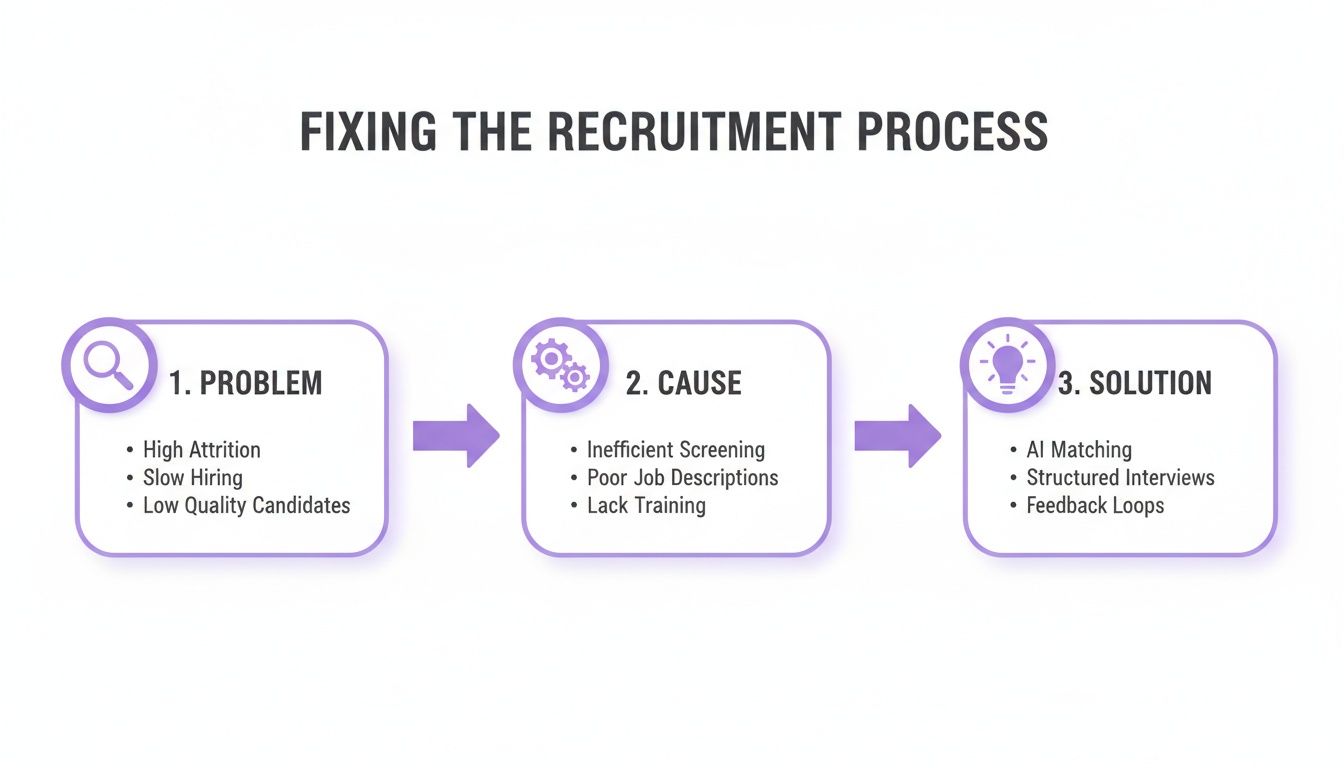
Fixing your process starts with correctly identifying the problem, understanding its root cause, and then applying a focused solution.
The painful truth is that most hiring failures aren't due to a lack of candidates. They're due to a lack of a coherent, repeatable system for identifying and engaging the right ones.
Forget theory for a moment. To truly learn how to improve your recruitment process, you have to start by acknowledging the painful reality of what's broken. The good news? Once you pinpoint the bottlenecks, you can apply targeted fixes that have an immediate impact. By understanding how to drastically reduce your time-to-hire, you can start winning back top candidates who are currently slipping through your fingers.
Let’s get to work.
Here's a hard truth: your job description isn't an internal HR document. It's a sales page. If it reads like a legal disclaimer cobbled together by a committee, you're only going to attract candidates who are desperate, not the ones you actually want.
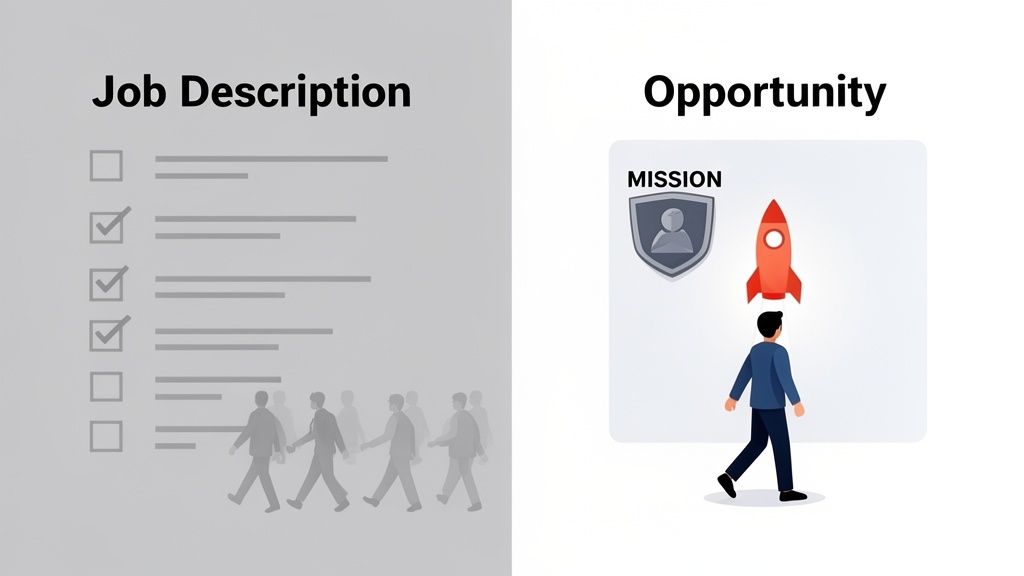
The best talent isn’t looking for a list of responsibilities; they're looking for a mission. They want to know what problems they'll be solving, who they'll be working with, and how their work will actually make an impact. Your job is to sell that vision, not just list bullet points.
This is a fundamental mindset shift for anyone serious about improving their recruitment process. You have to stop thinking like a hiring manager and start thinking like a marketer.
Most job descriptions read like an impossible laundry list. "Must have 10 years of experience with a technology that's only existed for five." Sound familiar? This approach doesn't just filter out unqualified people; it scares away brilliant, high-potential candidates who don't tick every single arbitrary box.
Instead of a wish list, focus on outcomes. What does success in this role look like after 30, 60, and 90 days? This tells a candidate what they'll achieve, not just what they'll do.
Here’s the difference:
See the difference? One is a chore. The other is a challenge. A-players live for a good challenge.
Top performers want to know two things: how they can grow and what the real challenges are. Your job post should speak directly to their ambitions. Where can this role take them? What skills will they master?
Equally important is brutal honesty. Is your codebase a mess? Say so. Is the team understaffed and fighting fires? Be upfront about it. This transparency acts as a powerful filter—it scares away the people who can't handle the heat and attracts the problem-solvers who thrive on it.
Your job description should repel the wrong people just as much as it attracts the right ones. Being candid about the tough parts is your secret weapon for finding candidates who are resilient and genuinely motivated.
This isn't just about attracting individuals; it's about building teams that can innovate. Globally, 85% of talent leaders prioritize diversity hiring to build more innovative teams. To get that talent, employer branding budgets have shot up 107% in five years. In the Americas, Brazil is leading with a 54% new executive outlook, signaling huge opportunities in nearshore talent pools like those LatHire taps into.
Ultimately, turning your job description into a compelling sales pitch is the highest-leverage activity in your recruiting toolkit. It sets the tone for the entire process and ensures that the people who apply are already bought into your mission.
To really sell the opportunity, recruiters can learn a lot from marketers. Consider different strategies for writing compelling LinkedIn posts for recruiters to see how powerful messaging can attract top talent.
Stop treating it as a chore. Treat it as your single most important piece of marketing copy. Because when you're competing for the best people on the market, it is.
If your whole sourcing strategy is just posting a job and waiting for applications, you're not really recruiting—you're just fishing with an empty hook. I'll be blunt: the best talent isn’t spending their days scrolling through job boards. They’re passive candidates, happily employed and too busy building amazing things to even notice your generic LinkedIn post.
This is where the real work of recruiting starts. To actually improve your process, you have to become a hunter, not just a gatherer. It means tracking down elite developers, marketers, and operators in places your competition isn't even bothering to look. Turns out there’s more than one way to hire elite talent without mortgaging your office ping-pong table.
Forget about the broad-stroke filters on LinkedIn. That's just table stakes now. The real gems are found in the online communities where they actively contribute, learn, and network. Your goal is to become a credible presence in these circles, not just another drive-by recruiter spamming inboxes.
So, where should you be looking?
The goal isn't to blast your job opening everywhere. It's to surgically place your opportunity in front of the exact right people, in a context where they're actually open to hearing about it.
Let's be honest, most company referral programs are broken. Tossing a one-time cash bonus out there is a nice gesture, but it rarely motivates people to consistently send you their best contacts. Why? Because the whole thing feels transactional, not relational.
A truly great referral program is built on three pillars:
Think about it this way: instead of hunting for needles in a haystack, a curated talent pool brings qualified, engaged professionals directly to you. This screenshot from the LatHire platform shows how you can instantly tap into a pool of pre-vetted candidates, skipping that painful outreach stage entirely.
This approach saves countless hours and gets you in front of the right people faster.
This shift toward proactive and smarter sourcing isn't just a nice-to-have; it's a global trend. For firms in the US and Canada, it means accessing elite AI engineers or UX designers from talent-rich regions without the administrative nightmare of cross-border hiring. While traditional screening used to take weeks, AI has flipped the script: skills-based hiring jumped to 81% adoption, prioritizing what someone can do over where they went to school, which naturally boosts the quality of hires. If you want to dive deeper into how the employment landscape is changing, you can explore the full Q1 2026 outlook and its key insights.
Finally, when you do find that perfect person, your first message has to be flawless. Generic, copy-pasted templates get archived on sight. If that's your strategy, I hope you enjoy talking to yourself, because that’s all you’ll be doing.
Your message needs to prove you've done your homework. Reference a specific project they worked on, a blog post they wrote, or a thoughtful comment they made in a community forum. Keep it short, make it personal, and focus on them, not you. A great outreach email isn't a job application; it's the start of a compelling conversation.
Let’s talk about the single biggest time-sink in the entire recruitment process: resume screening. It’s a soul-crushing, mind-numbing task, and if we're being honest, humans are notoriously bad at it. We’re biased, we get tired after sifting through 50 PDFs, and we absolutely miss the hidden gems buried in poorly formatted CVs.
It’s time to stop pretending your gut feeling is a reliable screening tool. It isn’t. It’s time to let the robots do the heavy lifting.
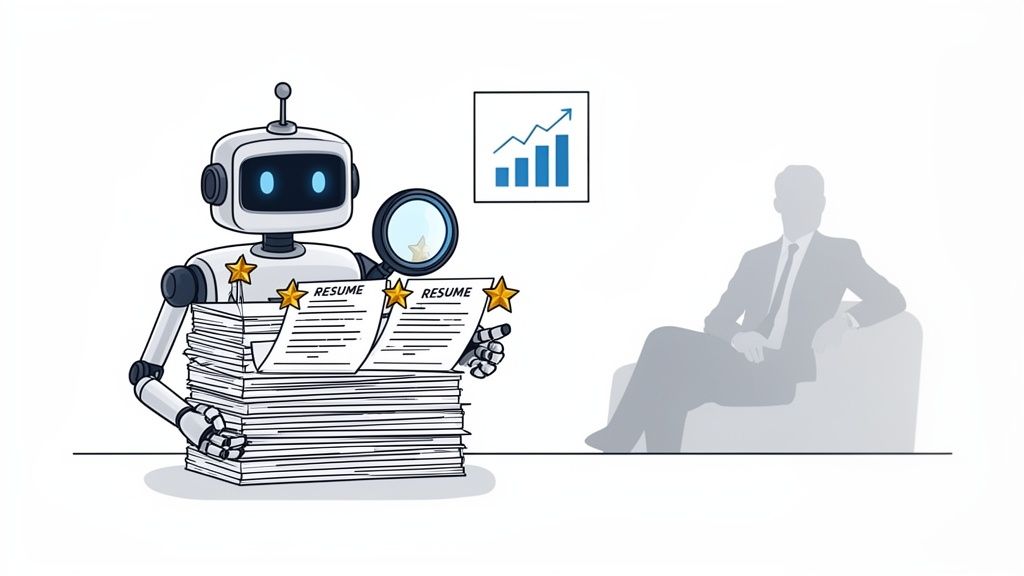
This isn't about replacing recruiters; it's about arming them with a ridiculously effective weapon. AI-powered screening is your competitive advantage, turning a chaotic, subjective mess into a consistent, unbiased, and brutally efficient machine. This is how you surface the top 5% of candidates in a matter of hours, not weeks.
Most people hear "AI screening" and think of their old Applicant Tracking System (ATS) that just filters for keywords. That’s like comparing a go-kart to a Formula 1 car. Basic ATS filtering is dumb. It looks for jargon and buzzwords, which means you’re probably screening out brilliant candidates who just didn't use the exact phrase you were looking for.
True AI-powered screening is different. It’s predictive. Platforms like LatHire use proprietary AI assessments not just to match keywords, but to actually validate skills and predict on-the-job performance. We’re not saying we’re perfect. Just more accurate more often. (Toot, toot!)
This is the critical difference: moving from a system that asks, "Does this resume say they can do the job?" to one that determines, "Can this person actually do the job?" One is guessing; the other is data.
This isn’t just a nice-to-have anymore; it's a survival tactic. Large employers are drowning in applications. Recent reports show 64% received over 50 applications per role, with 21% seeing more than 200. Yet, the number of truly qualified candidates hasn't kept pace, making for an incredibly noisy pipeline.
This is precisely where a platform like LatHire cuts through the chaos, using its AI to vet a pool of over 800,000 Latin American professionals before they even hit your inbox. You can read more about the latest global employment trends and insights to see just how crowded the market is getting.
One of the ugliest truths about manual screening is unconscious bias. We naturally gravitate toward candidates from familiar schools, companies, or backgrounds. AI doesn't care. It assesses every single candidate against the same objective criteria, creating a level playing field where skill is the only thing that matters.
To see what that looks like in practice, here's a side-by-side comparison.
| Metric | Traditional Manual Screening | AI-Powered Screening |
|---|---|---|
| Time Investment | 20+ hours per role. Hope you enjoy spending your afternoons fact-checking resumes. | ~1-2 hours per role. The AI does the grunt work; you engage with the top matches. |
| Bias Factor | High. Subject to human fatigue, personal preferences, and unconscious bias. | Extremely Low. Evaluates candidates based on pure skill and performance metrics. |
| Candidate Quality | Inconsistent. A lottery based on who reviewed the resume and when. | Consistently High. Surfaces the top performers based on data-driven assessments. |
Switching to an AI-driven approach isn't just about saving time; it's about making better, more defensible hiring decisions. You stop relying on flimsy proxies for talent and start measuring what actually counts. Our guide on AI-powered recruitment tools explains how this technology fundamentally changes hiring outcomes.
The goal here is simple: stop panning for gold in a river of mud. Use AI to build a system that delivers a shortlist of pre-vetted, high-potential candidates directly to your team. This frees you up to do the one thing the robots can't—build genuine human connections with the people who are actually going to drive your business forward.
Let’s get one thing straight: you might think you’re interviewing them, but the best candidates are absolutely, positively interviewing you. A clunky, disorganized, or disrespectful interview process is the single fastest way to lose an A-player to your competitor. It’s a flashing neon sign that says, "We're a mess."
If your screening has done its job, you're now talking to the cream of the crop. Your only task at this stage is to not screw it up. This means designing an interview experience that not only pinpoints the skills you need but also genuinely impresses every single person who participates.
For years, "tough" interviews meant asking ridiculous brain teasers like, "How many golf balls fit in a 747?" This doesn't measure intelligence; it measures a candidate's tolerance for pointless questions. We have to move past this.
A great interview process is structured to test for specific competencies with surgical precision. It should be a series of focused conversations, each designed to answer a different critical question about the candidate.
A well-designed interview doesn’t feel like an interrogation. It feels like a collaborative problem-solving session where both sides are trying to figure out if there's a match. Anything less is a waste of everyone's time.
Your goal is to collect data, not just "vibes." You need a framework that respects the candidate's time while giving your team everything it needs to make a confident, defensible decision. This isn't just good manners; it’s how you build a world-class recruitment engine.
A multi-stage process doesn't have to be a multi-week saga. You can get all the signal you need in a few focused steps, as long as each one has a clear and distinct purpose.
Here’s a battle-tested structure that just works:
This structured approach minimizes bias and ensures every candidate is evaluated against the same yardstick. We’re not winging it anymore.
The worst sin in recruiting is ghosting a candidate. Or worse, sending a generic, automated rejection email two weeks after their final interview. Swift, transparent, and respectful feedback is non-negotiable.
The global talent market is only getting fiercer. The World Economic Forum predicts a massive shift, with 170 million new jobs emerging by 2030, but also 92 million displaced. This churn demands adaptable talent in tech, green energy, and data—precisely the kind of professionals found in LatHire's pre-vetted pool of over 800,000. With 70% of the workforce expected to be remote at least five days a month, a positive remote interview experience is paramount. You can discover more insights about these hiring trends to stay ahead of the curve.
A great candidate experience turns every single applicant—even the ones you reject—into a brand advocate. They might not have been a fit for this role, but if you treat them with respect, they'll tell their network you're a class act. And in the long run, that’s worth more than any single hire.
You ran the gauntlet. You found the perfect candidate, they aced the interviews, and your team is ready to roll out the welcome wagon. So you fire off a generic offer letter and think the job is done. Wrong.
Getting a ‘yes’ is not the finish line. A weak offer or a chaotic onboarding experience can unravel all your hard work in an instant. Think of this final step as the landing; you can fly a perfect flight, but if you botch the landing, the whole thing was a failure.
Let’s be real: compensation matters. But if you’re leading with just the salary, you’re in a race to the bottom. Top talent isn’t just looking for a paycheck; they’re buying into a vision, a team, and a growth trajectory. Your offer should reflect that.
Instead of just sending a dry PDF, get on a call. Walk them through the entire package—not just the base salary, but the equity, the benefits, the growth opportunities, and most importantly, why you believe they are the perfect person for this mission. Frame it as an invitation, not a transaction.
The moment you extend an offer is your last, best chance to sell the opportunity. Make it personal. Make it compelling. Remind them of the exciting problems they’re about to solve.
The period between a candidate accepting an offer and their first day is a danger zone. It’s when competitor offers sneak in and second thoughts creep up. The antidote? A pre-boarding process that makes them feel like part of the team before they even have a company email.
What does that look like in practice?
To provide a seamless and personalized welcome, an AI onboarding assistant can revolutionize the new hire experience, making the process more efficient and engaging.
If you’re hiring internationally, this is where the real headaches begin. Navigating cross-border payroll, benefits, and legal compliance is a full-time job in itself—a soul-crushing one at that. One mistake can lead to massive fines or legal trouble.
This is where all-in-one platforms become non-negotiable. They handle the entire administrative backend, from ensuring local labor law compliance to managing international payroll. It’s the difference between scaling globally with confidence and getting buried in paperwork. Improving your recruitment process means eliminating these final-stage burdens.
This isn't just about efficiency; it's about retention. Strong onboarding is directly linked to better long-term success. Predictive analytics in recruiting, for instance, can reduce turnover by 50%, as data-driven matching ensures a better fit from day one. Platforms like LatHire cut hiring costs by up to 80% and time-to-hire by over 80%, aligning with global trends where 78% of companies are rethinking their talent strategies.
For more hands-on advice, check out our guide on the essentials of onboarding remote workers. It’s your playbook for making every new hire’s first impression a great one.
Alright, let's tackle some of the questions that always come up once we start digging into the hiring process. You've seen the playbook, but here are the straight-up answers to what's probably on your mind.
You’ll notice an immediate difference in candidate quality and engagement within weeks, especially after fixing your job descriptions and interview structure. It's almost instant. The moment you stop posting dry laundry lists of requirements and start selling the opportunity, better people just show up.
But for the big KPI shifts—like a meaningful drop in your time-to-hire or cost-per-hire—you’ll want to give it one or two full hiring cycles. That’s when the data really starts to tell a story. Of course, if you’re using an AI platform to handle the heavy lifting, you can slash that timeline. We’ve seen clients get a shortlist of perfectly matched candidates in as little as 24 hours.
Being reactive instead of proactive. Hands down, every time.
Most companies wait until a role is officially open to even start looking, which immediately puts them in a frantic scramble. That desperation leads to rushed decisions, overlooked red flags, and, you guessed it, bad hires.
The real game-changer that separates elite recruiting from the rest is building a continuous talent pipeline. Always be sourcing, even when you aren't actively hiring. Think of it as your bench strength.
I get this one a lot, but it’s a common misconception. Flip the question around: what’s the cost of a bad hire? Experts estimate it’s at least 30% of that person's first-year salary, and that's not even counting the countless hours your team wasted screening and interviewing them.
When you factor in the ROI from cutting hiring costs by up to 80% and drastically reducing your time-to-hire, AI-powered platforms are far more cost-effective than sticking with a broken manual process. It’s not really an expense; it’s an investment against your most expensive mistakes.