
If you’ve ever found yourself wrestling with a spreadsheet at 2 a.m., trying to decode state-specific tax withholdings, you know the promise of "seamless payroll" is a corporate fairytale. The reality is a mess of compliance headaches, fee structures more confusing than a cryptocurrency whitepaper, and software that looks like it was designed in 1998. Getting payroll wrong means angry employees and threatening letters from the IRS. It's the one part of the business that absolutely has to be perfect. Every. Single. Time.
This isn't just another generic list. I've been in the trenches, signed the contracts, and sat through the soul-crushing implementation calls. The process of figuring out how to calculate employer payroll taxes alone can feel like a full-time job, which is why leaning on one of the large payroll companies becomes less of a luxury and more of a survival tactic.
We're going to cut through the marketing fluff and give you a straight-up, no-BS comparison of the industry giants. You'll get a real-world look at who they’re actually best for, what their software really feels like to use, and where the hidden costs are hiding. Let’s find the right fit, so you can get back to building your business instead of running a back-office accounting firm.
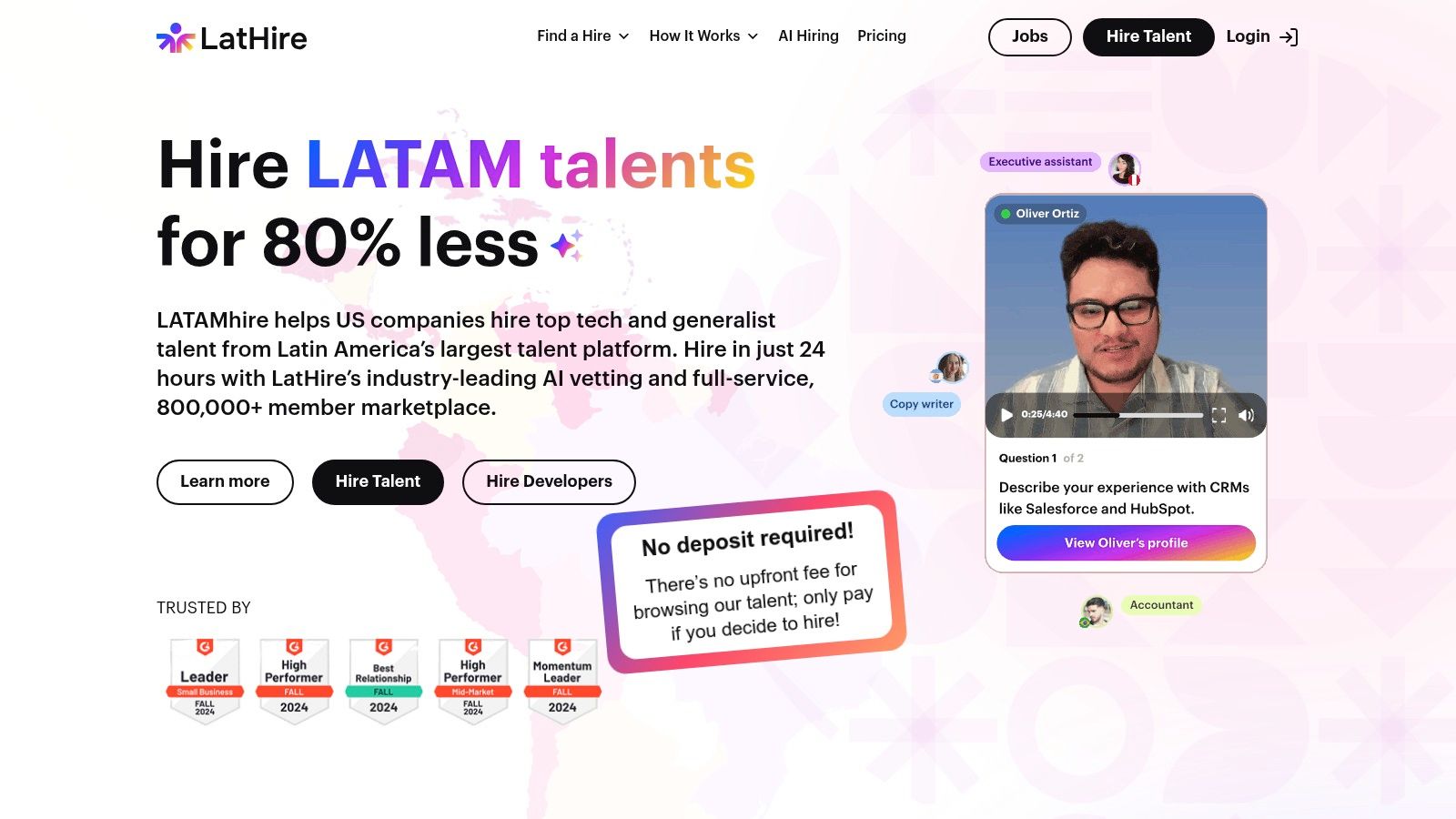
Alright, let's start with the curveball. LatHire isn't your typical payroll provider. Instead of just cutting checks, it’s an all-in-one AI hiring marketplace that connects US and Canadian companies with elite talent from Latin America. It reimagines the entire hiring-to-payroll pipeline by bundling sourcing, vetting, compliance, and international payroll into a single, streamlined platform. They don’t just process payroll; they solve the problem before it even becomes a headache.
The whole platform is built on a simple, powerful premise: hiring world-class international talent shouldn't require an army of lawyers and a Xanax prescription. You're not just buying a payroll service; you're accessing a pre-vetted talent pool of over 800,000 professionals and a system that handles the messy parts of cross-border employment, from contracts to compliance, at no extra cost.
What makes LatHire a standout choice is its integrated model. Traditional payroll companies show up after you’ve done all the hard work. LatHire flips the script.
Their proprietary AI, combined with actual human-led skills tests, surfaces the top 3% of candidates. This means you’re not sifting through endless, unqualified resumes; you’re getting a curated list of timezone-aligned pros ready to work. For a company trying to scale fast without mortgaging the office ping-pong table, this is a game-changer. You can find, interview, and hire a qualified candidate in as little as 24 hours. No administrative friction, no international hiring drama. (Toot, toot!)
| Pros | Cons |
|---|---|
| Speed and Scale: Access a huge, pre-vetted talent pool and get matched with candidates in as little as 24 hours. | Benefits Are Extra: Core HR and payroll are included, but benefits like health insurance are add-ons. |
| End-to-End Solution: Handles everything from sourcing and vetting to compliance and payroll, reducing admin burden. | Tiered Savings: The biggest cost savings are on generalist roles; senior tech talent is still a real investment. |
| Guaranteed Quality: A rigorous vetting process ensures you only see the top 3% of applicants. | |
| Timezone Alignment: All talent is based in Latin America, ensuring seamless collaboration during standard US work hours. |
LatHire is a no-brainer for North American companies that want to tap into the global talent market without the operational chaos. It’s particularly lethal for tech startups, marketing agencies, and SMBs looking to scale their teams with skilled, timezone-aligned professionals without breaking the bank. If you want to hire, onboard, and pay international talent through a single system, LatHire is a modern and compelling alternative to the old guard.
Website: lathire.com
ADP is the undisputed heavyweight champion of payroll. If payroll companies were characters in an old western, ADP would be the grizzled sheriff who’s seen it all. They’ve been around since before the internet was a thing, and their deep bench of services reflects that long-standing dominance. For businesses that see compliance as a non-negotiable, top-of-the-list priority, ADP is often the first and last stop.
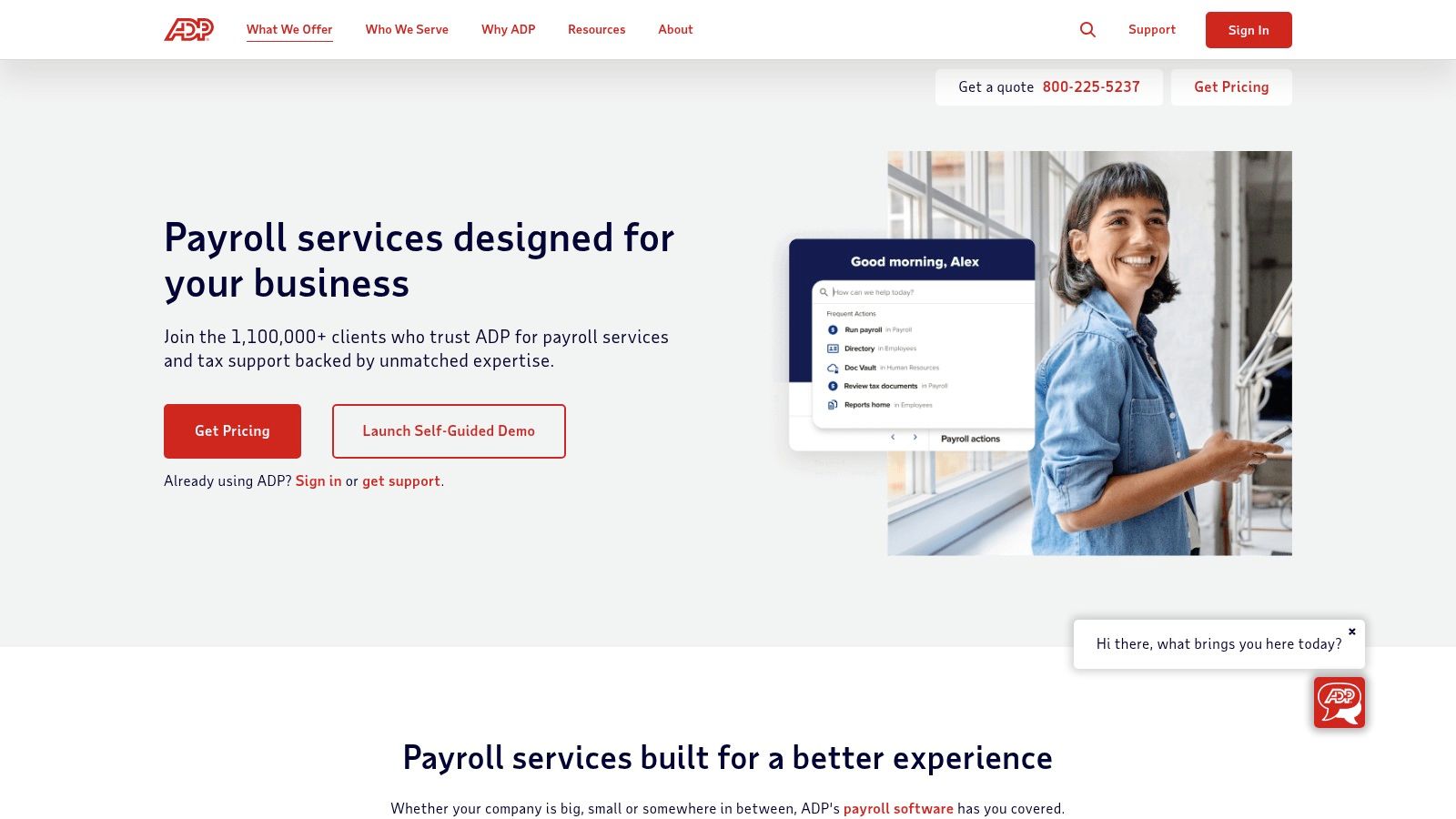
Their main strength is a tiered product line designed to grow with you. Small businesses start with RUN Powered by ADP. As you scale, you graduate to Workforce Now or TotalSource, which add sophisticated HR tools and even PEO services. This means ADP can handle your payroll from employee #1 to employee #10,000. It's the "one-stop-shop" pitch that appeals to founders who would rather focus on their product than on navigating state tax nexus rules.
ADP’s feature set is as comprehensive as you'd expect.
The $500 Hello. The big catch? Pricing. ADP operates on a quote-based model, which means you won't find a price list on their website. You have to talk to a sales rep, and the final cost can feel like a moving target once you start tacking on necessary add-ons.
| Pros | Cons |
|---|---|
| Unmatched compliance expertise and tax filing accuracy. | Opaque, quote-based pricing that can get expensive quickly. |
| Scalable platform that grows with your company. | The user interface can feel dated and clunky. |
| Extensive ecosystem of HR, benefits, and PEO services. | Customer support can be inconsistent; you might feel like a small fish. |
| Strong brand reputation and reliability. | Implementation can be slower and more complex than modern competitors. |
Ultimately, ADP is the go-to for established businesses that prioritize rock-solid compliance and want an all-in-one HR ecosystem. If you’re a fast-growing company in a highly regulated industry and you’ve got the budget, ADP provides peace of mind that few others can match.
Website: https://www.adp.com/what-we-offer/payroll.aspx
If ADP is the grizzled sheriff, Paychex is the friendly, well-connected mayor of small business town. They've built their empire by focusing on small to mid-sized companies, offering a more flexible, modular approach compared to the all-or-nothing enterprise giants. For businesses that want a single relationship for payroll, HR, and benefits without feeling like a tiny cog in a massive machine, Paychex makes a compelling case.
Their core strength is the Paychex Flex platform, a configurable system that lets you start with basic payroll and tack on services as you grow. Need time tracking? It's an add-on. Want to offer a 401(k)? You can bolt that on too. This "a la carte" model is a breath of fresh air for SMBs who don't want to pay for an entire HR battleship when all they need is a reliable payroll speedboat.
Paychex caters to the modular needs of growing businesses.
Like its peers, Paychex keeps its pricing under wraps. You’ll need to contact sales for a custom quote, but they're known for offering juicy introductory promotions that can sweeten the deal for your first year.
| Pros | Cons |
|---|---|
| Broad, modular services let you bundle payroll, HR, and benefits. | Pricing is quote-based and can climb as you add more services. |
| Frequent onboarding promotions can lower initial setup costs. | The sheer number of options can be overwhelming for new businesses. |
| Strong PEO option for companies seeking co-employment benefits. | The platform might be more robust than what very small startups need. |
| Reputable service with a national footprint and industry expertise. | Customer service experiences can vary depending on your support tier. |
Bottom line? Paychex is the pragmatic choice for the SMB that wants a one-stop-shop for its people operations. If you value flexibility and want to scale your HR stack piece by piece with a single, reliable vendor, Paychex has built its entire business around serving you.
Website: https://www.paychex.com/
Paycom’s big idea is to flip the traditional payroll process on its head. Instead of HR chasing down errors after a pay run, Paycom empowers employees to manage and approve their own payroll before it's processed. They call this "Beti" (Better Employee Transaction Interface), and it’s a compelling pitch for anyone tired of the endless cycle of post-payroll corrections. It’s less of a payroll service and more of a payroll philosophy.
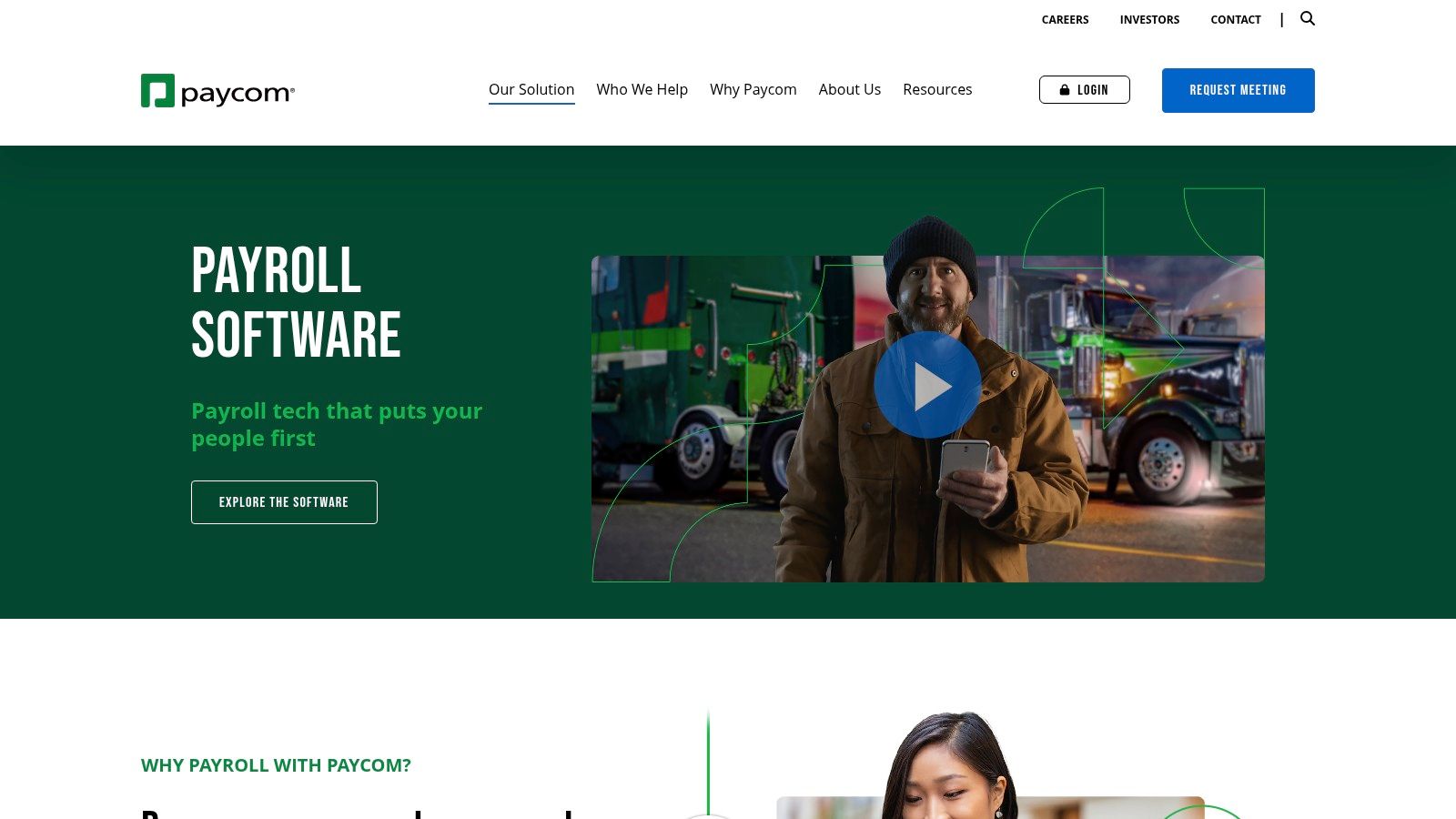
The entire system is built on a single-database architecture. This isn't just tech jargon; it means that when an employee updates their info, it propagates everywhere instantly. No more data sync issues that plague systems cobbled together from different modules. For mid-sized companies that have outgrown simpler tools but aren't ready for a full-blown enterprise behemoth, Paycom occupies a strategic sweet spot.
Paycom’s feature set is designed around its unified, employee-driven model.
Like its competitors, Paycom keeps its pricing under lock and key. No pricing page here. You’ll need to schedule a demo and speak with a sales rep to get a custom quote, which can be a hurdle for businesses that just want a straight answer.
| Pros | Cons |
|---|---|
| Innovative employee self-service payroll reduces HR's administrative burden. | Opaque, quote-based pricing makes it hard to budget without a sales call. |
| Single-database HCM architecture minimizes data errors. | Can be overly complex for very small businesses with simple needs. |
| High mobile adoption and user engagement. | Some users report a steep learning curve during implementation. |
| Dedicated support specialist model provides consistent service. | The sales process can feel pushy for those just exploring options. |
Paycom is a killer choice for mid-sized to large businesses that want to streamline their entire HR and payroll process into a single, cohesive system. If your goal is to reduce manual HR work and empower your employees, Paycom's unique approach is well worth a look.
Website: https://www.paycom.com/software/payroll/?utm_source=openai
Paylocity is the mid-market hero that decided payroll shouldn't just be about paying people; it should also be about engaging them. If other large payroll companies are the grizzled accountants, Paylocity is the cool HR manager who knows everyone’s name. They've built a robust platform with a distinct focus on the employee experience, making them a go-to for companies that want to blend back-office efficiency with front-office culture.
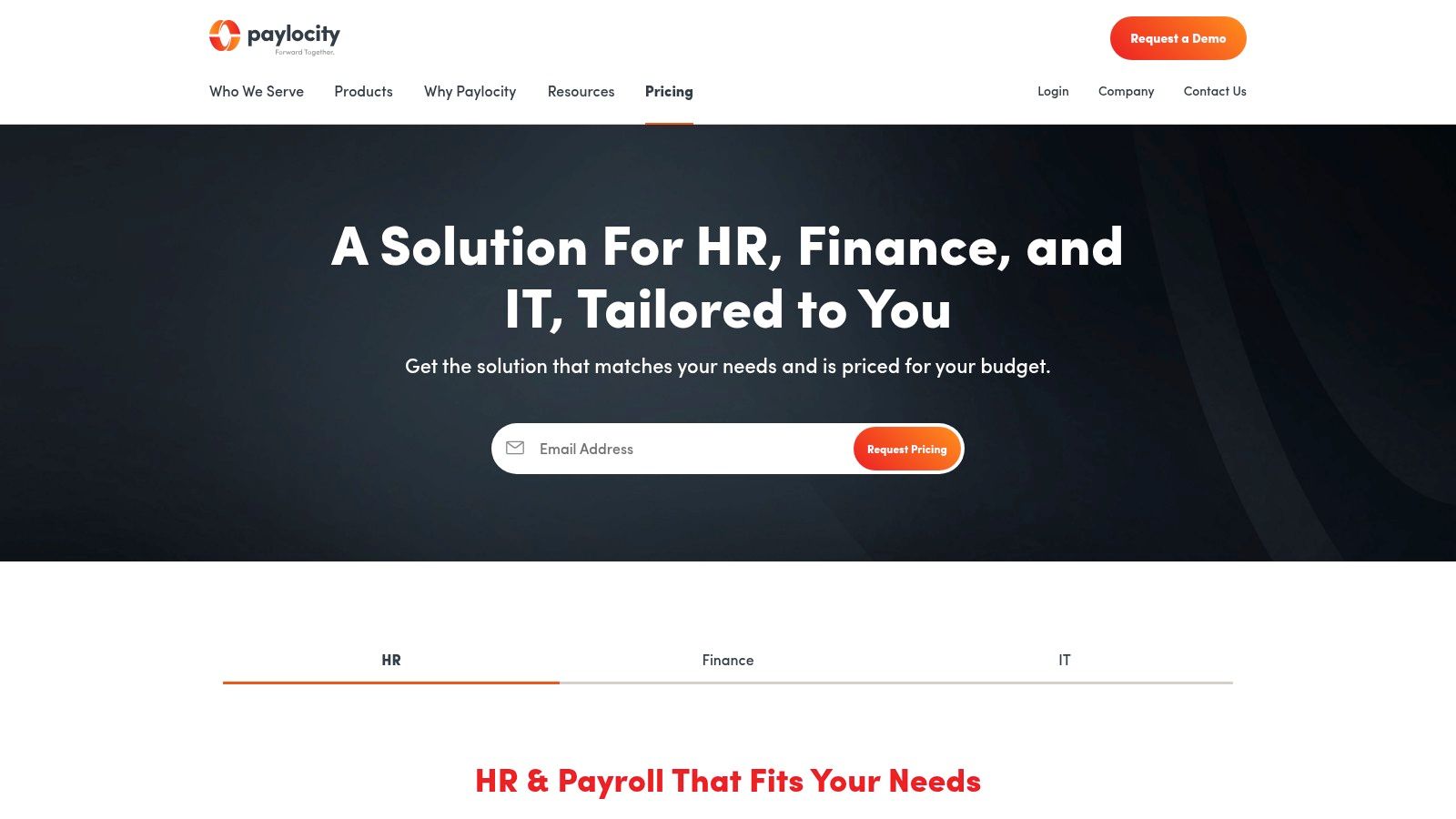
Their main play is a unified platform that handles payroll and tax filing while layering on tools modern workforces expect. Think social collaboration hubs, peer-to-peer recognition, and engagement surveys, all living under the same roof as your pay stubs. This integrated approach is a big draw for mid-sized companies that have outgrown basic payroll processors but aren't quite ready for an enterprise-level beast. It strikes a balance, offering serious functionality without the soul-crushing complexity.
Paylocity offers a feature set designed for the modern workplace.
So, how much does this friendly-faced functionality cost? You guessed it: it's a secret. Like its peers, Paylocity uses a quote-based model. You’ll need to connect with their sales team to get a custom price. No window shopping allowed.
| Pros | Cons |
|---|---|
| Balanced features for mid-market US companies with global expansion options. | Opaque, quote-based pricing requires a sales conversation. |
| Strong focus on employee engagement and modern HR tools. | Some advanced features may be sold as expensive add-ons. |
| Extensive integration marketplace simplifies connecting your tech stack. | Global payroll is handled via partners, which can add a layer of complexity. |
| Excellent mobile app and user-friendly interface. | Might be overkill for very small businesses with basic payroll needs. |
Paylocity is the perfect fit for a growing, people-focused company that needs more than just a number-cruncher. If you want your payroll system to also help you build a better company culture and you have the budget for a customized solution, Paylocity is one of the most compelling options out there.
Website: https://www.paylocity.com/pricing/?utm_source=openai
UKG is the payroll company you turn to when your operations are no longer simple. Think of them as the logistics expert for complex workforces. If your business involves multiple locations, shifting schedules, and hourly workers across different states, UKG has built a Human Capital Management (HCM) suite where payroll is just one powerful gear in a much larger machine. They are designed for mid-market and enterprise businesses that have graduated from simple payroll and now need a system that can handle serious complexity.
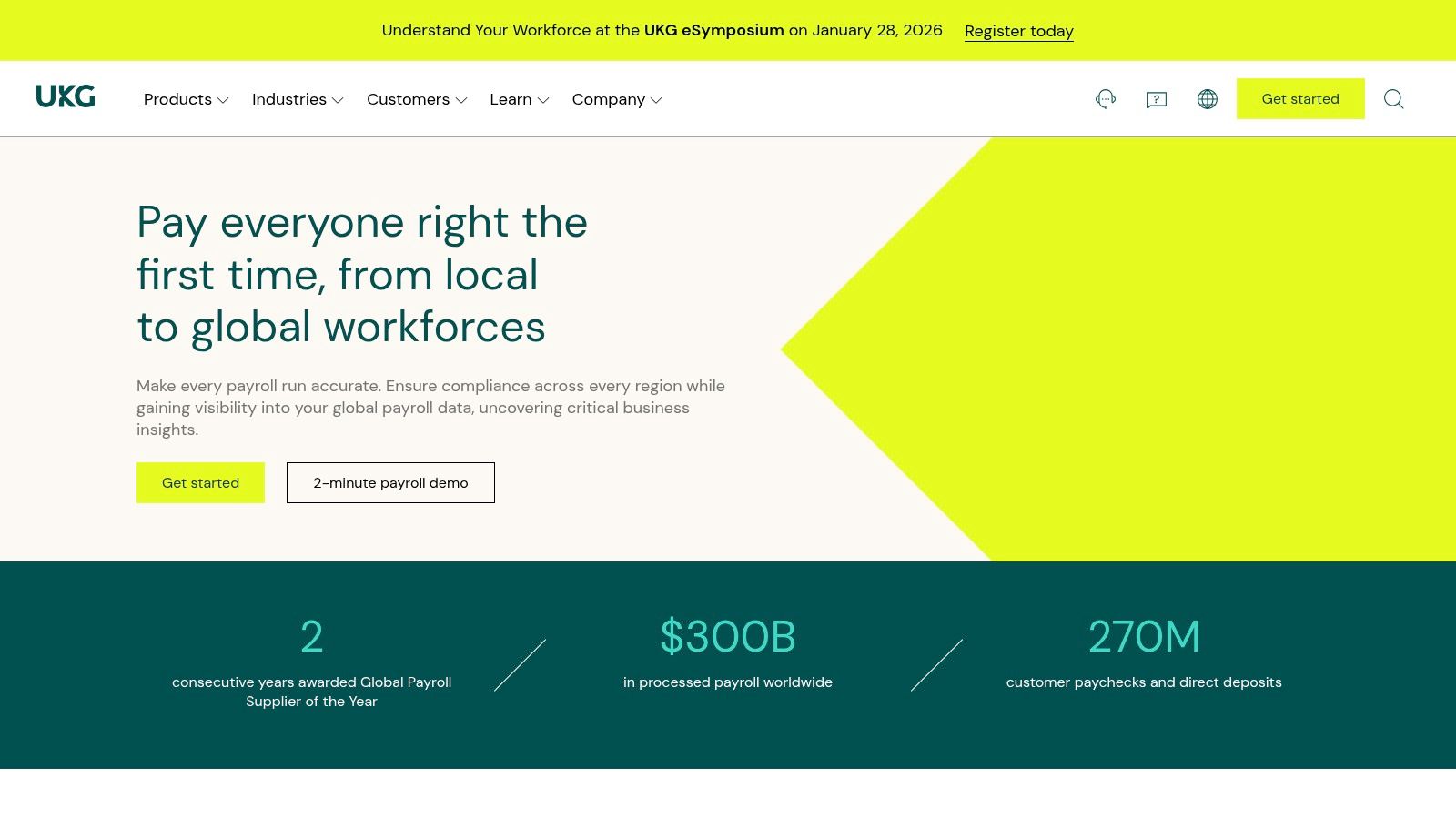
Their standout feature is continuous payroll processing. Instead of the mad dash to fix errors moments before the payroll deadline, UKG's system lets you validate data in real-time. This proactive approach catches errors early, turning payroll from a frantic two-day event into a smooth, ongoing process. This is a huge deal for organizations with intricate compliance needs or a global workforce, where a single mistake can have massive ripple effects.
UKG’s feature set is deeply integrated into its broader workforce management platform.
Like many enterprise-focused providers, UKG keeps its pricing behind a sales-led curtain. You won't find a price list on their site. You’ll need to schedule a demo and get a custom quote. Expect a significant investment.
| Pros | Cons |
|---|---|
| Excellent for mid-market and enterprise-level complexity. | Opaque, sales-led pricing model with no public information. |
| Continuous processing prevents last-minute payroll errors. | The depth of the suite can be overkill for small businesses. |
| Strong focus on compliance, analytics, and workforce forecasting. | Can be a more complex system to implement and learn. |
| Global capabilities to support multinational organizations. | Not the most agile solution for startups focused purely on payroll. |
UKG is built for established businesses that view payroll as a core component of their overall workforce strategy. If you’re managing complex schedules, multiple locations, and need deep analytical insight into your labor costs, UKG provides a powerful, unified platform that simpler solutions just can't match.
Website: https://www.ukg.com/products/payroll?utm_source=openai
Dayforce is the platform for businesses obsessed with real-time data. If other payroll systems are like getting a daily newspaper, Dayforce is a live news ticker. Its core philosophy revolves around a single, continuous calculation engine for time, pay, and HR, eliminating the batch processing that plagues older systems. For managers who want to know their exact labor costs right now, not at the end of a pay period, Dayforce is a game-changer.
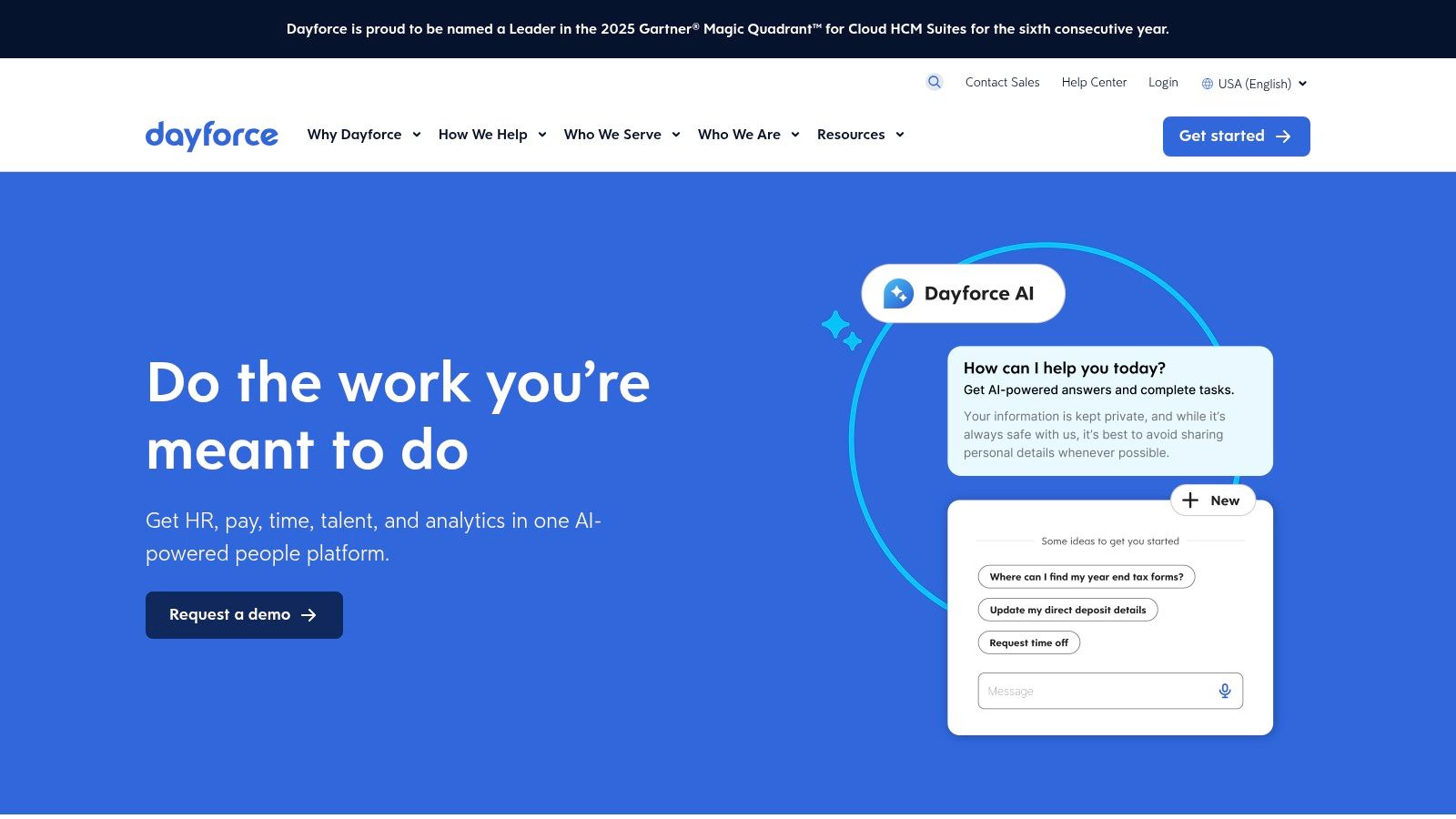
The main draw is its unified platform. Instead of having separate modules for time tracking and payroll that need to sync up (and inevitably break), Dayforce builds it all on one database. An employee clocks out, and payroll liability is updated instantly. This tight integration is a massive win for companies with complex workforces, like those in retail or manufacturing, where overtime is a constant headache. It’s built for organizations that view payroll not just as a back-office task, but as a strategic financial tool.
Dayforce’s feature set is designed around its unified data model.
Like its enterprise-focused peers, Dayforce doesn’t list its prices online. You’ll need to engage with their sales team for a custom quote. Expect pricing to be competitive for mid-market and enterprise clients, but likely overkill for a small startup.
| Pros | Cons |
|---|---|
| Single, unified platform reduces data errors and reconciliation headaches. | Pricing is quote-based and not publicly available. |
| Real-time payroll calculation offers unparalleled financial visibility. | The enterprise-level feature set can be complex for very small businesses. |
| Flexible managed services allow you to outsource payroll tasks as needed. | Can have a steeper learning curve compared to simpler, payroll-only tools. |
| Strong compliance framework and support for multi-country operations. | Implementation can be a significant project for larger organizations. |
Ultimately, Dayforce is for the data-driven enterprise that demands accuracy and real-time insight. If your business lives and dies by labor cost management and you’re tired of reconciling data between three different systems, Dayforce’s unified approach provides a level of clarity and control that’s hard to beat.
Website: https://www.dayforce.com/
| Solution | Implementation complexity | Resource requirements | Expected outcomes | Ideal use cases | Key advantages |
|---|---|---|---|---|---|
| LatHire | Low–Medium — turnkey matching or white‑glove service | Minimal internal HR; role‑based monthly fees; benefits/add‑ons extra | Very fast hires (as soon as 24h); validated talent; cost savings for generalist roles | Rapidly scale timezone‑aligned LatAm teams; startups/SMBs needing end‑to‑end international hiring | Large vetted pool, AI + human assessments, payroll & compliance handled |
| ADP | Medium–High — varies by product tier and integrations | Implementation support, IT/HR integration; quote‑based pricing | Reliable, compliant payroll and tax filing at scale | Organizations needing broad US compliance and scalable payroll (SMB→Enterprise) | Deep compliance expertise, broad ecosystem, PEO option |
| Paychex | Medium — modular onboarding depending on selected bundle | HR/payroll admin; optional PEO and benefits integrations | Consolidated payroll, HR and benefits under one vendor | SMBs and mid‑market wanting modular, bundled payroll + HR | Flexible modular plans, promotions, PEO availability |
| Paycom | Medium–High — single‑database HCM adoption needed | Training, change management, named support specialists | Fewer payroll errors, unified HCM data and strong automation | Mid‑sized to larger orgs seeking payroll automation and employee self‑service | Proactive payroll error detection, single‑database architecture, mobile focus |
| Paylocity | Medium — configuration and integrations for mid‑market | Integration efforts, HR/admin resources; partner network for global pay | Improved employee engagement, integrated payroll and reporting | Mid‑market companies needing engagement tools and integration catalog | Employee experience layer, broad integrations, global partner coverage |
| UKG (Ultimate) | High — enterprise suite with complex deployment | Significant implementation and ongoing support; enterprise budget | Continuous payroll processing, AI‑assisted compliance and forecasting | Large enterprises or multi‑site organizations with complex payroll needs | Enterprise compliance, real‑time analytics, optional managed payroll |
| Dayforce (Ceridian) | Medium–High — unified time/pay engine with optional managed services | Implementation or vendor‑managed payroll; time and payroll integration | Accurate time‑to‑pay reconciliation; scalable from software to managed payroll | Organizations needing tight time/pay integration and option to outsource payroll | Unified time/pay engine, tiered managed payroll, strong compliance support |
Alright, we’ve just toured the Mount Rushmore of large payroll companies. So, what’s the big takeaway?
The truth is, there's no single "best" payroll provider. The best one is the one that solves your specific headache without creating three new ones. Choosing the right partner isn't just about picking the one with the longest feature list; it's about aligning their core strengths with your company's DNA, budget, and five-year plan. Get this wrong, and you’re not just buying software; you’re buying yourself a part-time job managing a tool you secretly hate.
Let’s boil it down. After all that analysis, here’s the cheat sheet.
Feeling overwhelmed? Don’t be. Here’s how to move from analysis paralysis to a confident decision.
Ultimately, choosing a payroll partner is one of the most critical infrastructure decisions you’ll make. It’s the engine that ensures your team gets paid correctly and on time, every time. Whether you need the sheer power of an industry giant or the specialized, white-glove service of a partner like LatHire, the right solution is out there. Now go find it.

