A virtual job tryout is a pre-hire assessment that simulates the actual day-to-day tasks of a role. It lets candidates demonstrate skills in a realistic work environment before you ever make an offer. Think of it less like an interview and more like a test drive for the job. It’s your chance to see how someone actually performs, not just how well they write a resume.
Let’s be honest. You're drowning in a sea of perfectly crafted resumes that tell you almost nothing about who can actually get the job done. We've all been there—you hire the candidate with the flawless LinkedIn profile, only to discover they crumble under the slightest real-world pressure. It's an expensive, soul-crushing cycle.
The traditional hiring process is a coin toss. A game of hope and buzzwords. We scan for keywords, ask canned behavioral questions, and cross our fingers. This isn't just inefficient; it's fundamentally broken, especially for remote roles where you can't even rely on an in-person vibe check.
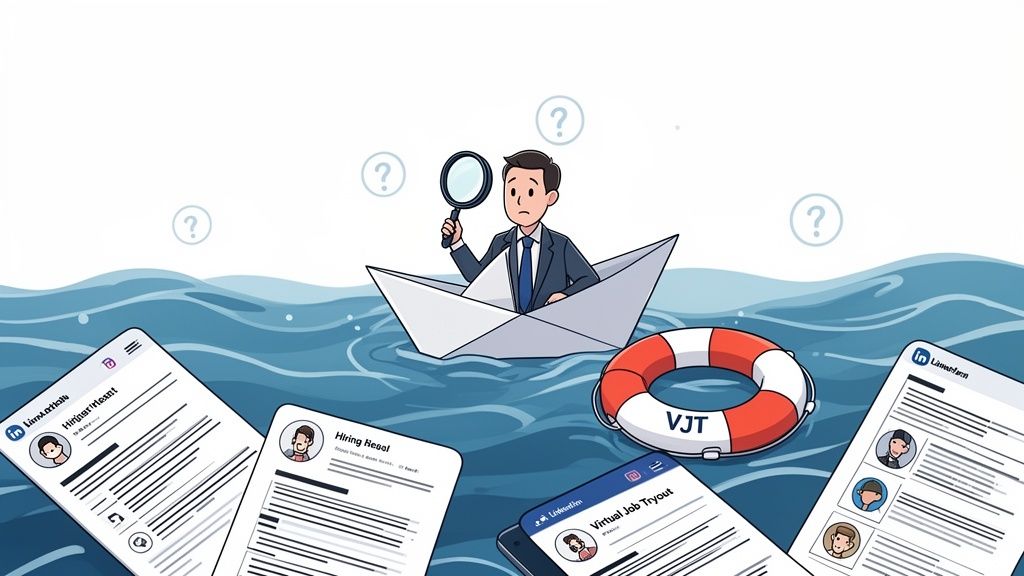
Hiring isn't just slow; it's a money pit. You’re paying recruiters, your team is sinking hours into screening, and you’re pulling your best people into endless interview loops. When you finally make an offer, you're just placing a very expensive bet that their resume wasn't a work of fiction.
The reality is, the pressure is on for job seekers to embellish their experience. Many are just trying to get past the automated systems, knowing that often your resume is being ignored unless it's perfectly optimized. They're forced to game the algorithm instead of just showcasing their true abilities. It’s a broken system that benefits no one.
You’re not just filtering out embellished skills; you’re trying to find real, raw talent. The problem is, your tools are built to find good storytellers, not great performers.
This leads to a predictable and painful outcome: the bad hire. They cost you more than just a salary—they drain team morale, stall critical projects, and create a vortex of missed opportunities that you can't even begin to quantify.
So, what's the alternative to mortgaging the office ping-pong table to cover recruiting fees? You stop guessing and start testing. This is where the virtual job tryout comes in, acting as the perfect antidote to this expensive headache.
Instead of asking a developer how they’d solve a complex problem, you give them a real, messy piece of code to debug. Instead of asking a marketer to talk about campaign strategy, you give them a dataset and ask for a quick brief.
This simple shift changes everything:
The goal is to move from a process based on claims to one based on evidence. For companies looking to scale quickly, finding top talent without the traditional administrative burden is a game-changer. You can learn more about building agile teams through our guide on flexible staffing solutions.
Think of it as a test drive for your next hire—a practical way to see how they handle the curves before you hand over the keys.
Alright, let's cut through the noise. A virtual job tryout (VJT) isn't another HR buzzword to ignore; it’s a work sample on steroids. Think of it as the difference between asking a chef to describe a delicious meal versus having them actually cook it for you. Which one gives you a better idea of their skills? Exactly.
Forget hypothetical interview questions like, "How would you handle a difficult client?" They’re useless. Everyone has a perfectly rehearsed answer. Instead, a virtual job tryout puts candidates into a simulated environment where they actually have to handle that client, right now, with the clock ticking. It’s a test drive, not a sales pitch.
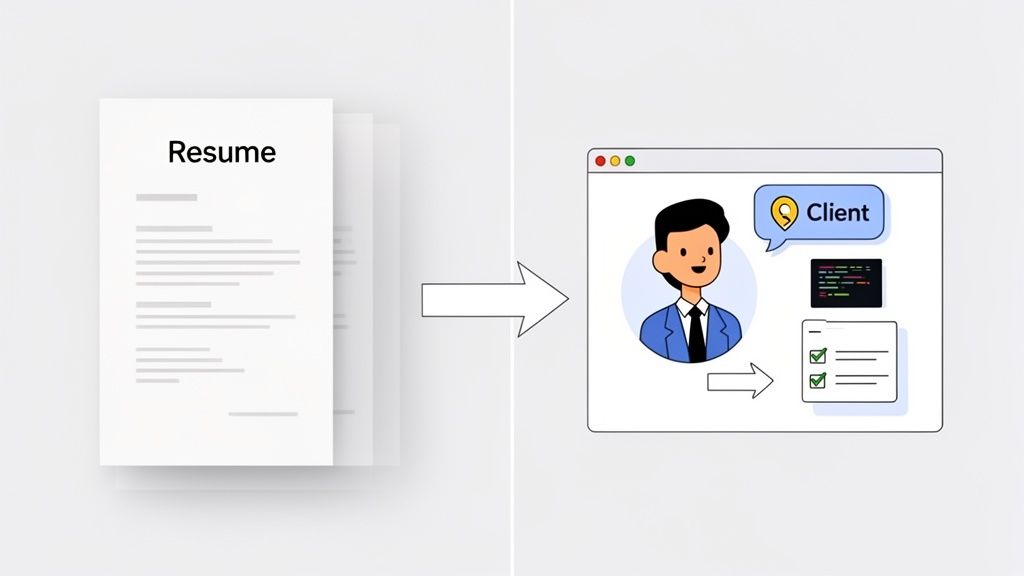
This isn't your standard skills test or one of those bizarre personality quizzes that asks if you’re more of a lone wolf or a team player. A well-designed VJT is a multi-layered simulation of the job itself.
It's composed of a few core ingredients that mirror the day-to-day grind:
This is where you stop reading what someone claims they can do and start seeing what they actually do under pressure.
The beauty of a virtual job tryout is that it measures the competencies resumes can only hint at—things like problem-solving, attention to detail, and communication when things get messy. It’s a predictor of performance, not a test of someone’s resume-writing skills.
A resume tells you where someone has been. A virtual job tryout tells you where they can go with your company.
Major retailers like Walmart and CVS have slashed turnover rates by using VJTs to give candidates a realistic job preview, allowing the wrong fits to self-select out before day one. This isn't just theory; companies using these simulations report achieving an 89% faster time-to-hire, cutting through massive applicant piles to connect top talent with interviewers almost instantly. You can discover more data-driven insights about these VJTs and their impact on hiring speed.
A traditional interview is a conversation. A virtual job tryout is an audition. And when you're building a team, you need performers, not just good conversationalists.
To really grasp the shift, let's put the old way head-to-head with the new. The differences are stark.
| Metric | Traditional Interview | Virtual Job Tryout |
|---|---|---|
| Focus | Self-reported skills, past experience | Demonstrated skills, future performance |
| Predictive Validity | Low (relies on conversation and recall) | High (measures on-the-job behavior) |
| Candidate Experience | Often stressful, feels like an interrogation | Engaging, provides a realistic job preview |
| Bias Potential | High (prone to interviewer's gut feelings) | Low (objective, standardized scoring) |
| Data Quality | Subjective, anecdotal notes | Objective, performance-based metrics |
As you can see, the VJT moves hiring from a game of guesswork to a data-backed decision, giving you a much clearer picture of who can actually deliver.
Let's talk numbers. Witty blog posts are great, but they don't keep the lights on. We've all felt the sting of a bad hire—it's not just the salary you flush down the drain. It's the drained team morale, the stalled projects, and the ghost of missed opportunities that haunts your P&L statement for months. It’s a slow, expensive bleed.
When you pitch a new hiring tool, it's easy for your CFO's eyes to glaze over. They hear "investment" and see "cost center." But a virtual job tryout isn't just another shiny object for HR. It’s a direct assault on the biggest money pits in your recruiting process, making smarter, data-backed decisions that show up on the bottom line.
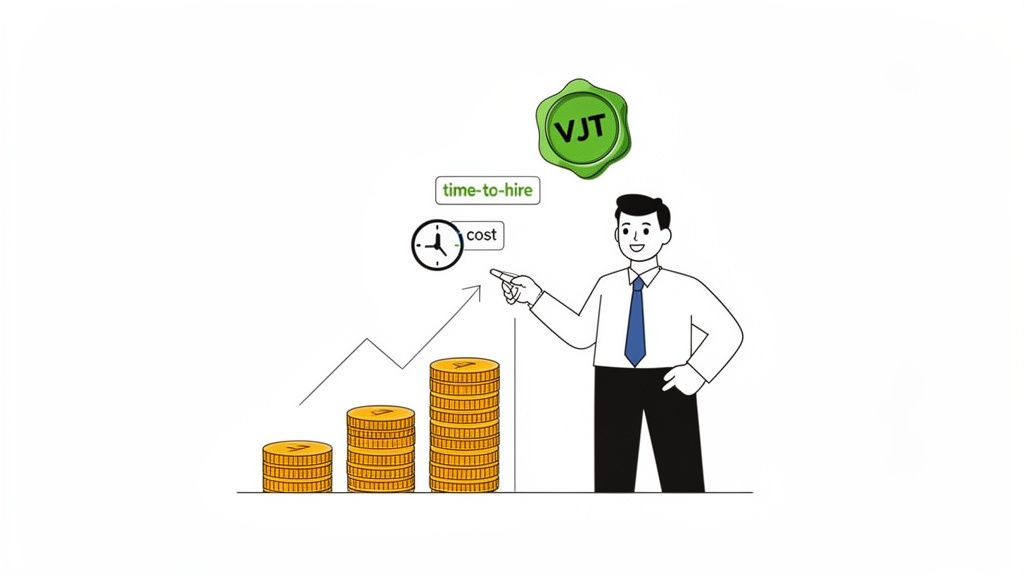
The most powerful feature of a VJT is its brutal honesty. It lets candidates experience the real job, warts and all. When someone faces a simulation of your most demanding customer or tackles a genuinely tricky technical problem, one of two things happens: they rise to the occasion, or they realize this isn't the role for them.
And that's a win-win. The wrong fits self-select out before you spend a dime on onboarding. You’re not just hiring someone who wants a job; you’re hiring someone who wants this job, fully aware of what it entails. The result? A workforce that actually sticks around.
The adoption of Virtual Job Tryouts by Fortune 500 companies highlights their massive impact. Some employers report saving over $500,000 annually just by pinpointing performers who are more likely to stay, directly lowering turnover because candidates get a real preview and opt out early if it’s not for them.
Time is money, and traditional hiring often moves at a glacial pace. Sourcing, screening, scheduling, interviewing—it’s a full-time job for multiple people. For a growing company, that lag time can be the difference between shipping a product and missing a market window entirely.
A virtual job tryout completely blows up that timeline. It replaces hours of manual screening and multiple interview rounds with a single, automated, asynchronous step.
Some studies show up to an 89% faster time-to-hire. That’s not an incremental improvement; it’s a total transformation of your hiring velocity.
Finally, let's talk cold, hard cash. Every hour your engineers, marketers, or managers spend in interviews is an hour they aren't building, selling, or leading. That’s a massive, and often hidden, cost. A VJT gives you those hours back.
Think about it this way:
For organizations dealing with a large influx of applicants, this efficiency is a game-changer. It’s a powerful tool for optimizing high-volume hiring processes, delivering substantial cost savings. It's simple math—fewer wasted hours and better hires mean a healthier bottom line. Your CFO will thank you.
Let's get one thing straight: a bad virtual job tryout is worse than no tryout at all. A poorly designed one feels like a pointless video game, frustrating your best candidates and leaving you with garbage data.
But a great one? A great one feels like the first day on the job. It's an authentic preview that can tell you more in 60 minutes than a dozen interviews ever could.
The secret isn't about flashy tech or complex algorithms. It's about relevance and realism. The tasks you design have to map directly to the core responsibilities of the role. You’re not trying to find who’s good at taking tests; you’re trying to find who’s good at the job.
This is where we move from theory to action. Designing an effective virtual job tryout is less about abstract psychology and more about deconstructing a role into its most critical, observable actions.
Before you write a single line of a simulation, you need to answer one question: What does success in this role actually look like on a Tuesday afternoon? Forget the job description fluff about being a "team-playing rockstar." Think about the concrete tasks that separate top performers from everyone else.
We call this a "job analysis," but don't let the HR term fool you. It's just a pragmatic breakdown.
Only after you’ve mapped these out can you start building a tryout that generates a real signal instead of just noise.
Okay, enough theory. Let's look at what this looks like in the real world for three common roles. Notice how each one focuses on a tangible work product, not just a process.
1. The Software Engineer Tryout
Forget abstract whiteboard problems that test someone's ability to recall algorithms under pressure. That’s a memory test, not a job test. A real engineering tryout should feel like a mini-sprint.
2. The Marketing Manager Tryout
Marketers are often great talkers. Your goal is to see if they can back it up with analytical thinking and clear communication. Don't just ask them to "pitch a campaign idea." Give them the raw materials to build one.
3. The Customer Support Rep Tryout
Anyone can claim to have "great communication skills." A virtual job tryout forces them to prove it when faced with a difficult situation.
These examples show that a powerful virtual job tryout doesn't require a Hollywood budget. It requires a deep understanding of the job and a commitment to testing for it directly. Want to dig deeper into the world of skills assessments? Check out our detailed guide on pre-employment skills testing for more ideas.
Alright, you’re sold on the idea. Now what?
Bringing in any new hiring tool can feel like trying to change a tire on a moving car. Everyone’s busy, candidates are in the pipeline, and the last thing anyone needs is a new piece of software triggering a full-blown operational meltdown.
Relax. This isn’t rocket science, but it does demand a smart plan. Think of this as your pragmatic, no-fluff guide to rolling out a virtual job tryout that actually works from day one—written by someone who’s seen it go right and, believe me, very, very wrong.
First things first: don't over-engineer this. The goal is to get a clear signal on a candidate's skills, not to build a perfect digital replica of your entire company. We’ve broken down the design process into three simple stages to keep you on track.
This visual shows the basic flow: map out the critical skills for the role, design a relevant simulation to test them, and then run a pilot before you go live.
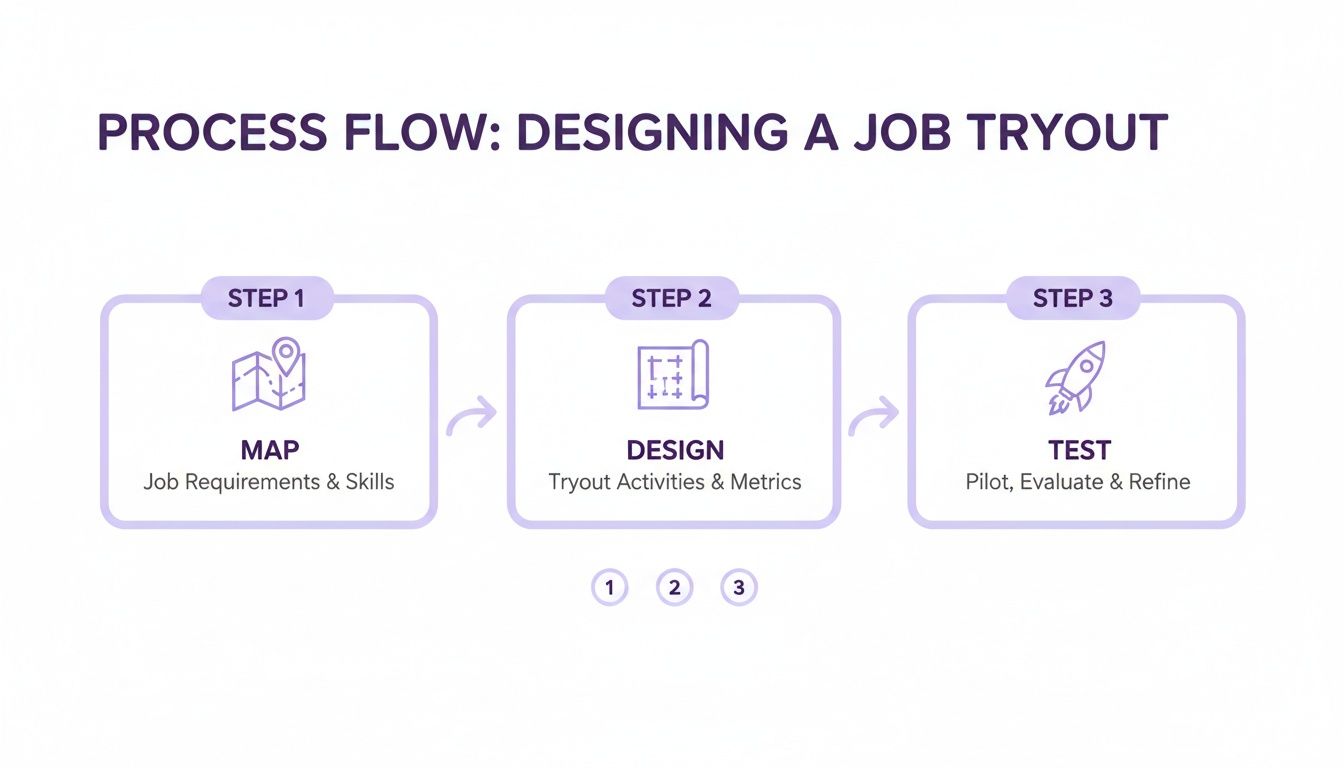
Following this process ensures you stay focused on what actually predicts on-the-job performance, instead of getting lost in unnecessary complexity. Here’s a checklist to guide you.
I've watched smart founders make some truly spectacular mistakes here. Let's make sure you’re not one of them. The biggest pitfalls aren't technical; they're almost always human.
The point of a virtual job tryout isn't to create a perfect simulation. It's to create a predictive one. Don't let the pursuit of perfection kill a perfectly good assessment.
Here are the classic traps you need to sidestep:
Getting this right can deliver an almost immediate return. Predictive hiring metrics from VJTs can lead to a staggering 89% reduction in time-to-hire, with some companies seeing yearly savings of over $500,000. It's a key reason why nearly 59% of organizations using virtual hiring elements are finding wider, more qualified talent pools. To see more on these trends, you can read the full analysis on virtual hiring practices.
We didn't just bolt a virtual job tryout onto our hiring process as an afterthought. We baked it into the very core of our AI-powered platform. This is where we explain why our approach is fundamentally different—it's not just another tool, but an integrated system designed to stop the madness of traditional hiring. (Toot, toot!)
Our platform weaves sophisticated skills evaluations and realistic job simulations directly into the candidate vetting workflow. It’s a complete shift from the old way of doing things. You can finally stop guessing based on resumes and start making decisions based on actual, observable performance.
When you get a match from our pool of over 800,000 Latin American professionals, you’re not just getting a polished resume. You’re getting a validated profile backed by hard data from a virtual job tryout. This isn't a maybe; it's a proven performer.
This completely eliminates the guesswork. You can connect with elite, role-ready talent in as little as 24 hours because the initial—and most painful—vetting has already been done. We’ve turned the interview from a fact-checking mission into a final confirmation of culture fit.
This is our not-so-secret sauce. We combine the predictive power of a virtual job tryout with AI matching, giving you a validated shortlist of candidates who can actually do the job.
A great virtual job tryout is only one piece of the puzzle. The real magic happens when it’s part of a seamless, end-to-end solution. That’s what we’ve built at LatHire.
Here's how we connect the dots for you:
This integrated approach is why we can cut hiring costs and time-to-hire by over 80%. It’s not just about finding talent; it's about finding the right talent, faster and with more confidence than you ever thought possible.
Instead of just talking to candidates, you get to see them in action. We believe that's a more respectful and effective way to hire. It's a philosophy that also extends to other modern hiring tools. For a different perspective, you might find it useful to read our guide on the pros and cons of one-way video interviewing.
Ultimately, we believe your hiring process shouldn't feel like a gamble. It should be a strategic advantage, and that starts by replacing outdated interviews with performance-based auditions.
Got questions? We've got answers. You're probably thinking a virtual job tryout sounds great in theory, but you have a few nagging thoughts about how it works in the real world. Let's cut through the noise with some direct, no-fluff answers to the most common queries we get from founders and hiring managers.
Not exactly, and that’s a good thing. A virtual job tryout isn’t meant to eliminate every conversation. Instead, it’s designed to replace the most broken parts of your process: the resume screen and the initial technical interviews. Those are the stages where you sink countless hours just trying to figure out if someone can actually do the job.
By front-loading the skills assessment, you ensure that anyone who makes it to a final interview is already qualified. This completely transforms the final conversation. Instead of grilling them on technical minutiae, you can focus on what really matters at that stage: culture fit, team dynamics, and long-term ambition. The interview becomes a confirmation, not an interrogation.
A VJT lets you audition for skill, so you can interview for fit. It’s about using the right tool for the right job at the right time in your hiring funnel.
This is a big one, and the answer is a resounding yes—when designed correctly. In fact, they are far more equitable than staring at a resume and making snap judgments based on a university name or a previous employer. Let's be honest, resume screening is a minefield of unconscious bias.
A virtual job tryout levels the playing field. It doesn’t care about a candidate's background, their gender, or where they went to school. It only cares about one thing: can they perform the core tasks of the job?
By making performance the primary data point, you strip away the subjective noise that so often leads to hiring the person you like the most instead of the person who will perform the best. It’s a powerful way to build a genuinely diverse team of top performers.
This is where a lot of companies go wrong. They either make the tryout too short to be useful or so long that it becomes a full-blown unpaid project—a great way to alienate your best candidates.
The sweet spot is typically between 45 and 90 minutes.
Anything shorter, and you're not getting a deep enough signal on their skills. Anything longer, and you'll see a massive drop-off rate, especially from top-tier candidates who have other options and respect their own time. The goal is to create a task that is complex enough to genuinely assess critical skills but concise enough to be completed in a single sitting. Respect the candidate’s time, and they’ll respect your process.