

Want to hire front-end developers without pulling your hair out? You have to ditch the old playbook. Forget sifting through mountains of résumés and sitting through interviews that go nowhere. The whole process is broken.
The smart approach is brutally simple: write an honest job description, find talent where they actually live online (hint: it's not LinkedIn), and test candidates with real-world coding challenges—not abstract brain teasers. This is how you cut through the noise and find developers who can actually ship code.
Let's be real. Trying to hire a front-end developer often feels like a full-time job you never wanted. You're drowning in a sea of identical LinkedIn profiles, trying to figure out if ‘React Ninja’ is a legitimate skill or just a quiet cry for help.
The traditional hiring process is a slow, expensive lottery. We've all been burned by the candidate who looked perfect on paper but couldn't build a simple component. Or the freelance "star" who ghosted you mid-sprint. It's a frustrating cycle that torches your time, your budget, and your will to live.
I'm not just venting here; this is the reality in the trenches. The global demand for front-end developers is exploding, with job postings growing around 15% annually since 2020. In major US tech hubs, a mid-level JavaScript developer can easily command a salary from $113,000 to $174,000, while seniors are pushing past $200,000. This competition creates a minefield for founders.
The real cost of a bad hire isn’t just the salary. It’s the lost momentum, the buggy code your team has to fix, and the crushing weight of starting the entire soul-sucking process all over again.
This visual breaks down the three main pain points—cost, time, and skill mismatch—that turn hiring into a gauntlet most of us would rather avoid.
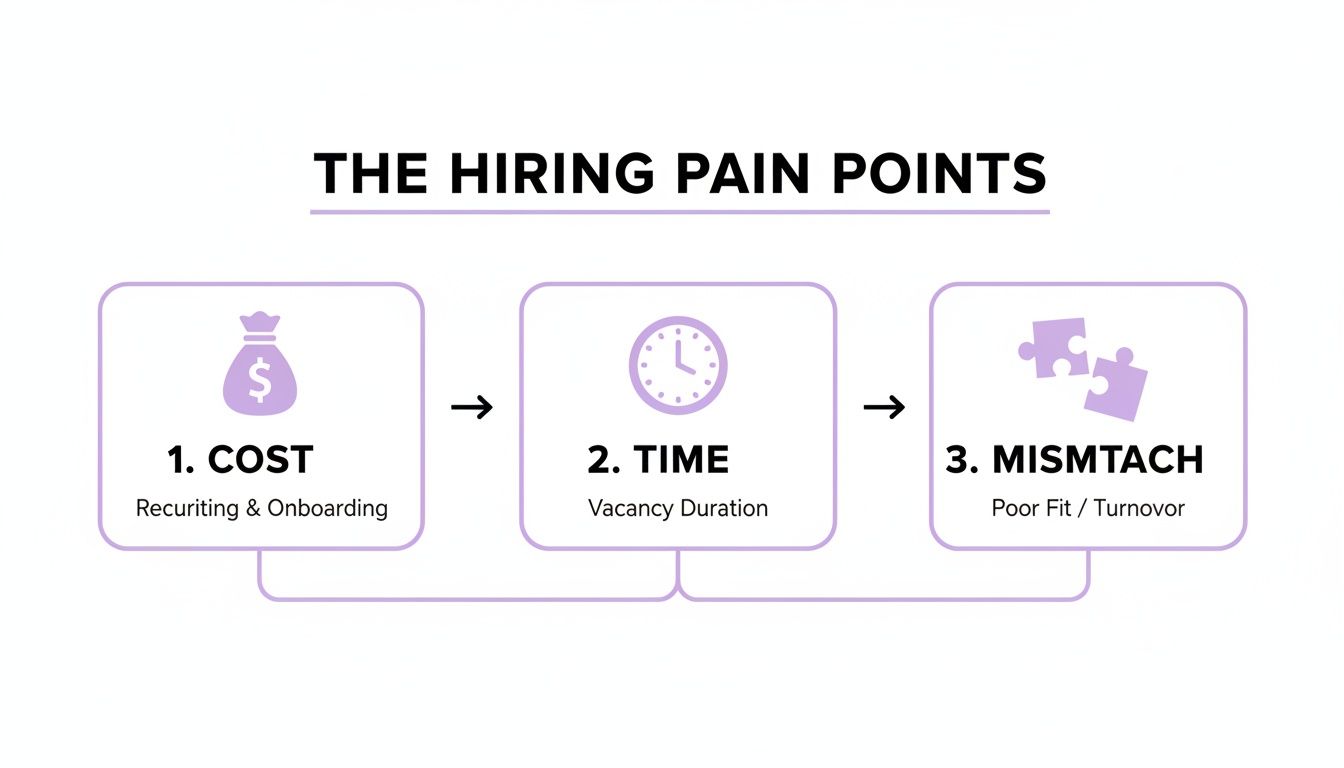
Each of these steps is a massive drain on resources. No wonder the conventional approach feels so broken.
Hope you enjoy spending your afternoons fact-checking résumés and running technical interviews—because that’s now your full-time job. Unless, of course, you find a different way.
To cut through the complexity of sourcing and hiring, especially given the market realities, you can turn to specialized platforms. For instance, services like Shorepod's hiring services are built specifically to handle these hurdles for you. We built it because we were sick of the old way.
Understanding these pain points is the first step toward building a smarter hiring system—one that doesn't require you to mortgage the office ping-pong table just to find someone who can finally center a div. It’s time to move past the old playbook and build a process that actually works.
Let's be honest, most job descriptions are a complete disaster. They read like a laundry list of every JavaScript framework ever invented, topped off with vague corporate fluff like "passionate team player" or "detail-oriented self-starter."
What’s the result? A flood of applications from everyone and absolutely no one who's right for the job. Your inbox becomes a black hole of résumés, and you’re left trying to figure out if that "React Ninja" has ever actually shipped a real product. It's time to stop writing wish lists and start crafting a job description that actually works as a filter.
Here’s the secret: great developers aren't looking for a list of technologies. They're looking for interesting problems to solve. The best way to attract the right person is to be brutally specific about the challenges they'll face on day one.
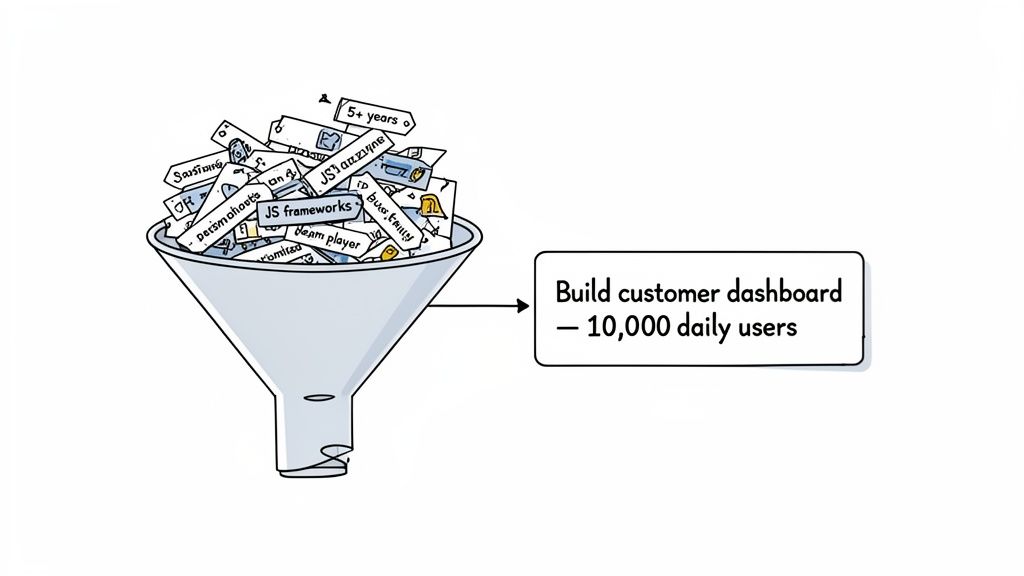
Instead of this nonsense:
Try describing the actual job:
See the difference? The first is a generic checklist. The second is an invitation to make a real impact. It speaks directly to a builder, not a box-ticker. This filters out the candidates who just want a paycheck and attracts the ones who want to solve your specific pains.
Now for the part that makes most hiring managers uncomfortable: be honest about your company. Are you a chaotic startup with a half-built product and lots of technical debt? Say it. Are you a more structured company with slower processes but more stability? Say that, too.
Your job description is your first and most important filter. Every vague or dishonest statement you make just creates more work for you later, forcing you to weed out mismatched candidates during interviews.
Don't paint a perfect picture nobody believes anyway. The right candidate will appreciate the transparency and see the challenges as an opportunity, not a red flag. Someone who thrives in a fast-paced, "build the plane as it’s flying" environment will be energized by that description, while someone who needs structure will self-select out. And that’s exactly what you want.
You can find more practical advice in our complete guide on how to create job descriptions that attract the right talent.
Finally, give candidates a clear picture of what success looks like. Forget abstract goals like "contribute to the team." Get specific. What do you expect them to accomplish in their first three months? This helps them visualize themselves in the role and gives you a concrete framework for evaluation.
A good "First 90 Days" plan might include:
This approach transforms your job description from a passive advertisement into an active recruiting tool. It saves you countless hours by ensuring that only the most relevant, engaged, and genuinely interested front-end developers make it to your interview stage.
If your entire sourcing strategy is posting a job on LinkedIn and praying for a miracle, you're doing it wrong. Let’s be blunt: the best front-end developers, the ones you actually want to hire, aren’t doomscrolling their LinkedIn feed hoping for your job ad to appear. They're too busy building interesting things.
They're contributing to open-source projects, hanging out in niche developer communities, and getting headhunted by people who know where to look. Posting and praying is a surefire way to attract the most desperate, not the most talented. You have to go where the real talent lives.
Think of it this way: a job board is a crowded public market where everyone is shouting. A niche community is more like a private club where the best practitioners are sharing insights and showing off their work. This is where you find the hidden gems before they ever hit the open market.
So, where should you be looking?
The signal-to-noise ratio on a job board is abysmal. You'll spend 90% of your time filtering out junk. In a niche community, that ratio flips. You're starting with a pre-vetted pool of engaged, passionate individuals.
This approach takes more effort than just hitting "post," of course. But the return on that effort is exponentially higher. You’re not just finding a candidate; you're finding a future leader.
Once you break free from the LinkedIn mindset, the next logical step is to break free from your zip code. The idea that the best talent lives within a 20-mile radius of your office is an archaic relic of a pre-remote world. The global talent pool is massive, and frankly, ignoring it is just bad business.
Hiring front-end developers from regions like Latin America isn't just a cost-saving measure—though the financial benefits are significant. It’s about accessing a deep well of highly skilled, ambitious professionals who are often working on the same cutting-edge technologies as their counterparts in Silicon Valley.
Why is this such a game-changer?
Hope you enjoy paying a $170,000 salary for a mid-level developer in San Francisco, because that’s the reality of staying local. Strategic global sourcing allows you to hire senior-level talent for a fraction of that cost without sacrificing an ounce of quality.
This isn't about finding "cheap" labor. It's about finding incredible value. It’s about realizing that talent is distributed evenly across the globe, but opportunity isn't. Your willingness to look beyond your borders gives you a massive competitive advantage when you hire front-end developers.
Alright, let's talk about the single most broken part of tech hiring: the technical interview. Can we finally agree to kill the whiteboard interview? Asking a brilliant developer to invert a binary tree on a whiteboard is like asking a master chef to cook a gourmet meal with nothing but a microwave and a packet of ketchup.
It's a performance. It's academic trivia. And it's a terrible predictor of how they'll actually perform on the job.
You'll watch someone sweat while they try to recall a sorting algorithm they haven't thought about since college, and it tells you absolutely nothing about their ability to build a responsive UI or debug a complex state management issue. It’s time for a better way.
The goal is simple: see how they think, how they structure code, and how they solve problems that look suspiciously like the ones they’ll face every single day.
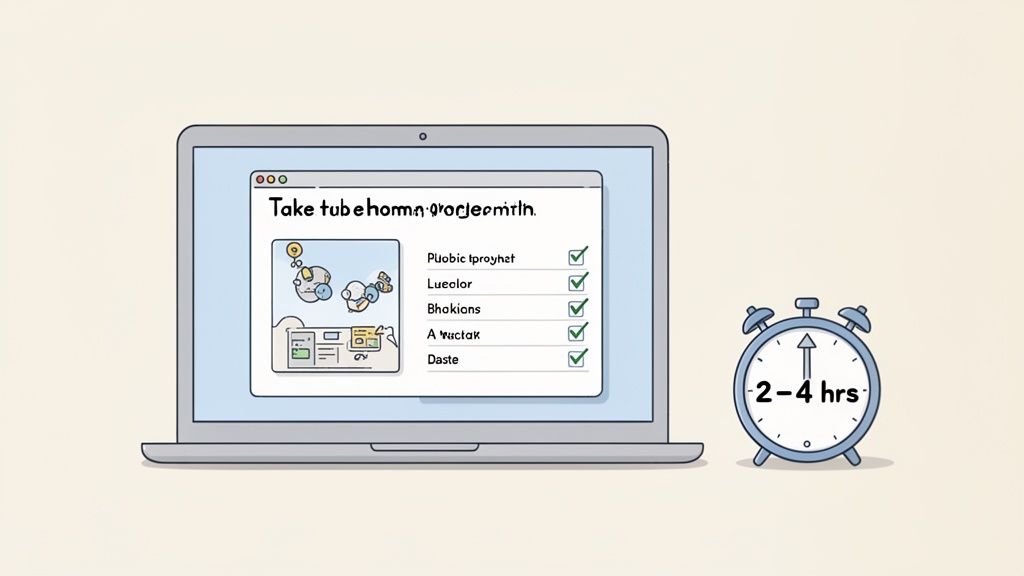
The answer is a practical, take-home project. But before you roll your eyes and picture a weekend-long coding marathon, let me be clear: this has to be respectful of the candidate’s time.
The sweet spot is a task that takes 2-4 hours, maximum. Anything longer, and you're just selecting for candidates who are unemployed or willing to sacrifice their personal life for your hiring process. The best people are busy. Respect that.
A great take-home test mirrors a small, self-contained piece of work they would actually do. It gives them a chance to work in their own environment, with their own tools, without someone breathing down their neck.
Here are the non-negotiables for a good take-home:
This approach gives you a real artifact to discuss during the next interview stage. It moves the conversation from abstract hypotheticals to concrete code. For a deeper dive, our guide on pre-employment skills testing covers how to design assessments that accurately predict job performance.
I've seen some truly awful take-home assignments in my day—vague prompts, impossible deadlines, and requests to build an entire application from scratch. To save you from making the same mistakes, here's a simple breakdown of what works and what will make your top candidates run for the hills.
| Attribute | Good Test (What to Do) | Bad Test (What to Avoid) |
|---|---|---|
| Scope | Build a single, well-defined component (e.g., a filterable list). | "Build a full-stack e-commerce app." |
| Time | Respectful of time (2-4 hours). | A weekend-long epic that requires 8+ hours. |
| Task | Simulates a real-world task (e.g., fetch and display data from an API). | An abstract algorithm puzzle disguised as a project. |
| Clarity | Clear instructions and a definition of success. | Vague requirements with no clear goal. |
| Focus | Evaluates code structure, problem-solving, and fundamentals. | Tests knowledge of obscure framework features. |
A good test is a conversation starter. A bad one is just a frustrating, unpaid chore. The difference determines whether you attract or repel the front-end developers you actually want to hire.
Once you get the project back, how do you evaluate it fairly? Don’t just "vibe check" the code.
Create a simple rubric to keep your assessment consistent and objective across all candidates. This also forces you to define what "good" actually looks like before you start reviewing.
Your rubric shouldn't be a 50-point checklist. Focus on the 3-5 things that actually matter for the role. Over-engineering your evaluation process is just another way to waste time.
Here’s a sample rubric you can adapt:
This simple framework prevents you from getting bogged down in stylistic debates ("I don't like where they put their curly braces!") and keeps the focus on what's important. It turns the technical test from a pass/fail exam into a powerful data point for making a smart hiring decision.
So, you’ve found a potential rockstar developer somewhere in Latin America. Awesome. Now what?
If your mind immediately jumps to international wire transfers, confusing tax forms, and trying to decipher local labor laws on the fly, just stop. The old way of hiring globally was a complete nightmare—a chaotic maze of contracts, compliance risks, and payroll complexities that could make even a seasoned CFO weep.
You could try to become an amateur international HR expert overnight. Or, you could just skip all that.
The $500 Hello: We actually paid a consultant $500 for a one-hour call just to figure out how to hire our first developer in Brazil. That call saved us weeks of headaches. We built LatHire so you never have to make that call.
We aren’t just another database of résumés you have to sift through. We’re your partner in building a global team, minus all the administrative headaches. We built an AI-powered platform designed to do one thing exceptionally well: match you with pre-vetted, elite talent from Latin America in as little as 24 hours.
Think of it as hiring a world-class developer with the ease of bringing on a local freelancer, but with all the security, compliance, and support of a full-time employee.
We’re not saying we’re perfect. Just more accurate more often. This is about focusing on what you do best—building your product—while we handle the rest.
We manage the entire lifecycle, from rigorous skills assessments and human-led profile verification to the nitty-gritty of international payroll, benefits, and legal compliance.
Let's talk numbers, because that's what really matters. For cost-conscious startups, paying US-market salaries can feel like trying to run a marathon with weights tied to your ankles. This is where a platform like ours completely changes the game.
We've seen companies cut their hiring expenses by up to 80% by connecting with Latin America’s pre-vetted talent pool of over 800,000 candidates. This includes front-end experts in React, Next.js, and modern UI/UX principles. By handling the heavy lifting, we also reduce the time-to-hire by over 80%, getting you the right person in days, not months. For a deeper look at salary data, you can explore more insights on front-end developer compensation.
This isn’t about finding "cheap" labor; it's about finding incredible value. You get access to senior-level talent that is perfectly aligned with your time zone for a fraction of what you’d pay in a major US tech hub.
Here’s what that practically means for you:
It’s the competitive advantage you get when you stop letting geography dictate your talent pool. If you're curious about the mechanics, you can also check out our guide on how to hire international employees the right way.
Ultimately, this is about building a smarter, more efficient system to hire front end developers. You skip the administrative drain and get straight to what matters: building a world-class team and shipping a fantastic product.
We get these all the time from founders trying to build out their teams. Here are the quick, no-fluff answers to the questions probably on your mind, especially when you’re looking to hire front-end developers across borders.
Honestly? You stop seeing it as a problem and start seeing it as a strategic advantage. Hiring from Latin America, for example, gives you a massive overlap with US business hours. It's not about finding someone willing to work at 3 AM; it's about smart, intentional scheduling.
We’ve learned to run our teams asynchronously. That means crystal-clear documentation, well-defined tasks in a project management tool like Jira or Asana, and trusting your team to deliver without someone looking over their shoulder. A few hours of daily overlap for key sync-ups and collaborative meetings is really all you need.
Yes, but it's not about whether they laugh at your jokes in the #random Slack channel. For remote teams, cultural fit boils down to a shared work ethic and communication style.
Those are the pillars of culture that actually matter. Everything else is just personality, and diverse personalities are what build stronger, more resilient teams.
Forget about finding someone you’d want to grab a beer with. Focus on finding someone you can trust to ship clean code when you’re not in the same room. That’s the only “fit” that truly impacts your bottom line.
This is a totally valid concern, but it has a simple solution: you have to vet for it. Any reputable hiring partner—ahem, like us—screens for professional English proficiency from day one. We’ve found that the top-tier talent in Latin America has invested heavily in their language skills precisely because they want to work with US companies.
Besides, clear, concise written communication is king in a remote setup anyway. As long as someone can articulate complex technical ideas clearly in writing and hold their own in a virtual meeting, you're golden.
Look, AI is an incredibly powerful tool. It's a fantastic copilot for a skilled developer. But an autonomous AI that can build, debug, and maintain a complex application from a vague product brief? We’re not there yet. And frankly, we’re not as close as the hype would have you believe.
Companies still need humans to guide the AI, catch its subtle (and not-so-subtle) mistakes, and handle the creative problem-solving it simply can't. So, no, don't put your hiring on hold waiting for Skynet to build your next feature. Your competitors certainly aren’t.

