

So, you're building a world-class team. Turns out there's more than one way to hire elite talent without mortgaging your office ping-pong table.
A remote staffing agency is supposed to be your strategic partner in this fight. They connect you with full-time, pre-vetted pros from around the globe, handling the messy stuff like sourcing, screening, and the nightmare of international payroll and compliance.
In theory, they let you tap into a global talent pool without the logistical headache. In practice? Well, that's where things get interesting.
Let's be real: the old way of hiring is a dumpster fire. You're trapped in a miserable loop—either paying insane salaries for local talent, doom-scrolling freelancer profiles at 2 AM, or trying to navigate Brazilian labor laws with a search engine and a prayer. It’s exhausting, expensive, and painfully slow.
The whole process feels rigged. You post a job and get buried under a mountain of applications, 90% of which are from people who clearly didn't even read the description. You then waste weeks wading through resumes, running interviews, and checking references, only to have your top candidate ghost you for a better offer.
Suddenly, your job isn't building a great company; it's being an unpaid, overworked recruiter.
The salary you pay is just the cover charge. The hidden costs are what really bleed you dry. We're talking about the countless hours your team loses to the hiring grind, the soul-crushing morale drain, and the opportunity cost of it all.
Every minute you spend on a dead-end interview is a minute you're not shipping product or talking to customers. This burnout is real, and it’s often tied to the struggle to simply improve developer productivity with the team you already have.
The market is already shifting away from these painful models. While fully remote job postings have dipped, hybrid roles are surging—projected to hit nearly 24% of new positions by Q2 2025, up from just 15% in 2023. It’s a clear signal that companies crave a blend of flexibility and control that traditional hiring just can’t deliver.
Here's the no-BS breakdown of your options.
| Hiring Aspect | The 'Do-It-Yourself' Grind | The Smart Agency Route |
|---|---|---|
| Sourcing | Posting on 10+ job boards, praying for a miracle. | Access to a curated, pre-vetted talent pool. |
| Screening | Manually filtering hundreds of "highly proficient" resumes. | Candidates are already technically and culturally vetted. |
| Time-to-Hire | 6-8 weeks, if you're lucky. | 1-2 weeks to get matched with qualified candidates. |
| Compliance | DIY legal research, crossing your fingers you don't get sued. | Full management of local contracts, taxes, and labor laws. |
| Cost | High recruiter fees, lost productivity, the price of a bad hire. | A transparent fee that saves you a fortune in salary and sanity. |
| Risk | High risk of a bad hire, compliance penalties, and team burnout. | Vetted talent and managed compliance. Your risk is near zero. |
The choice is simple: do you want to run a hiring operation, or do you want to run your business?
This isn’t about finding "cheap labor." It’s about finding brilliant, dedicated professionals who can actually move the needle. A good remote staffing agency promises a shortcut through the chaos. But how do you know if they're the real deal?
A great agency doesn't just find people; it solves your core hiring problems—cost, time, and compliance. It delivers vetted talent ready to integrate into your team, not just a list of names from a database.
The goal is to reclaim your time and build a world-class team, no matter where they live. With the right partner, you get access to strategic and flexible staffing solutions that fuel your growth, not drain it. It's about building a sustainable, global workforce without the burnout.
You've heard the pitch a thousand times: "Top 1% of talent, vetted and ready to go!" Sounds great, right? But if you've been burned before, you know to ask what’s really happening behind the curtain.
What does "vetted" actually mean? Is it a 15-minute vibe check over Zoom, or a grueling technical gauntlet that proves they can actually code?
Let’s be brutally honest. Most remote staffing agencies are just glorified resume databases. They play a numbers game, running a keyword search when your request comes in and blasting you with a dozen profiles, hoping one sticks.
Hope you enjoy spending your afternoons fact-checking resumes and running technical interviews—because that’s now your full-time job.
I’ve seen all the classic moves. There’s the infamous "bait-and-switch," where the rockstar developer you loved in the interview is suddenly "no longer available." But—surprise!—they have a less-experienced (and cheaper for them) replacement ready to go.
Then there’s the laughably weak screening. Their "technical vetting" is often a multiple-choice quiz a smart intern could ace. The result? You hire a C-player who looked great on paper but can't ship code to save their life. Three months later, you’re back at square one, only poorer and more pissed off.
This is the exact burnout cycle that ineffective hiring—whether you do it yourself or use a weak agency—drags you into.
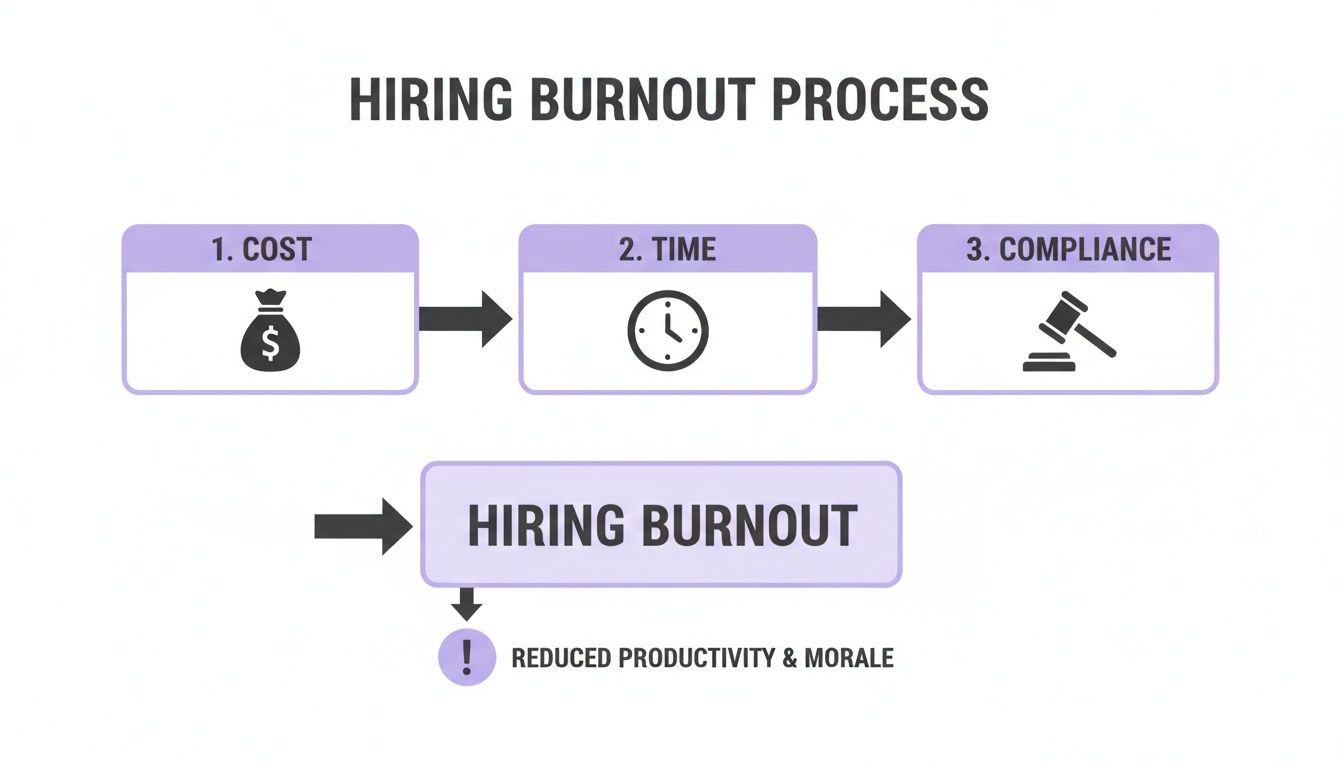
This isn’t just annoying; it’s a direct drain on your resources. The hidden costs, wasted time, and compliance headaches stall growth and torpedo team morale.
Worst of all are the communication black holes. You get ghosted for days, requests for updates vanish into the void, and you’re left wondering if they’re actually working on your role or just polishing their foosball trophies. It’s a frustrating, opaque system designed to benefit them, not you.
Thank God that broken model is dying. The best modern agencies aren't just resume farms; they're tech-enabled platforms. They understand that human bias and manual screening are the enemies of finding great talent at scale.
Instead of a recruiter's "gut feeling," these platforms use a smart mix of AI and human expertise to validate skills before a profile ever hits your inbox.
Here’s what that actually looks like:
The difference is simple: a traditional agency sells you a list of candidates, hoping one works. A modern platform delivers a shortlist of proven professionals, knowing they can do the job.
This tech-first approach isn't about shiny new toys. It’s about creating a reliable, repeatable process for finding top-tier talent. It means every candidate you see has cleared the same high bar, giving you the confidence to hire faster and with way less risk.
This shift transforms the remote staffing agency from a necessary evil into a genuine strategic partner. To learn more about how to evaluate these different types of agencies, check out our complete guide on what to look for in remote staffing agencies to avoid common pitfalls. The goal isn't just to fill a seat; it's to find the right person who will make a real impact on your business—reliably and without the drama.
So you've got the quotes. One agency wants 20% of salary, another a flat $5k per month, and a third is pushing a retainer. How do you possibly compare them?
It really comes down to this: how much do you enjoy surprise bills? Let’s break down the main pricing models and the sneaky fees hiding in the fine print.
Each has its place. But the real danger isn't the model itself—it's the hidden garbage fees. Currency conversion charges, local payroll taxes, and vague "administrative overhead" can inflate your bill without warning. You might not even notice a few percent here or there until you get an invoice that makes your eyes water.
I once reviewed a quote that looked fantastic. Tucked away in the terms was a 3% currency conversion fee I’d almost missed. Sneaky, right? That’s how they get you.
And don’t get me started on the "admin" or "overhead" line items. What does that even mean? Spoiler: it’s often their internal HR costs, compliance paperwork, and a nice little profit buffer, all passed on to you.
Pro Tip: Always budget for an extra 5-10% on top of the base agency fees to cover unexpected currency fluctuations and admin charges. It's a simple buffer that can save you a lot of headaches.
Now, let's talk total cost. A low headline rate is tempting, but if it comes with a half-baked compliance setup, you’ll pay for it later in fines and legal fees.
Here’s the kicker: paying a slightly higher fee for a fully managed payroll and legal stack often saves companies 20-30% in the long run by eliminating risk. You're not just comparing numbers; you're comparing the potential cost of audits, back-pay claims, and the time suck of managing cross-border HR yourself.
Let's run the numbers. You have two options.
At first glance, A looks like the winner. But once you add a 10% admin surcharge (common with budget providers) and factor in the sky-high risk of misclassification fines, Scenario B is the clear victor.
That hidden surcharge alone turns your 15% fee into an effective 25%—and that’s before you waste a single hour on payroll issues or lawyers.
| Cost Element | Scenario A (15%) | Scenario B (22%) |
|---|---|---|
| Base Agency Fee | 15% | 22% |
| Admin & Currency | 10% surcharge | 0% |
| Compliance Fines Risk | High | Low |
| Total Effective Rate | 25% | 22% |
The sticker price is never the full story. You have to look at the total cost of ownership.
When you account for payroll, local taxes, benefits, and currency fees, the math flips instantly. This is why a professional remote staffing agency that bundles compliance into its service delivers such a clear ROI.
Want to see the complete picture? Learn more about how an Employer of Record services in our detailed guide can help you get ahead of these hidden costs before they ever hit your balance sheet.
Smart companies would rather pay a fair, transparent price than scramble to cover unexpected legal bills. It’s about predictable budgeting that keeps your CFO happy and your devs coding, not filling out expense reports.
So, the next time you see a surprisingly low fee, ask what’s buried underneath. Transparency upfront beats surprise invoices every single time.
For years, the remote hiring conversation was all about Eastern Europe and Southeast Asia. Today, the smartest founders I know are quietly turning their attention south—to Latin America.
And this isn't about offloading grunt work. It’s about nearshoring critical roles to build tight-knit teams that operate on your schedule, share your work culture, and feel like they’re just down the hall.

The moment your team spans a 12-hour time difference, productivity dies. Your developer in Asia is signing off just as your US team is signing on. Cue the 10 PM stand-ups and feedback loops that take two days. It’s a nightmare.
Latin America solves this. With major hubs overlapping with EST, CST, and even PST, your daily check-ins happen in broad daylight. You can:
That overlap isn't a small perk. It’s a productivity multiplier that saves your team from burnout and keeps projects from stalling.
Yes, the savings are real. But this is value hunting, not bargain hunting. We’re talking about hiring two or three senior engineers in Brazil or Colombia for the cost of one in San Francisco. These aren’t junior devs; they’re seasoned pros who’ve built products for major global brands.
The numbers don't lie. Remote work in Latin America exploded from 3% pre-pandemic to a projected 30% by 2025—a 10x jump. Companies are reporting 30–70% savings on labor while accessing world-class talent. It's not just a trend; it's a fundamental shift in how smart companies build teams.
Over the past decade, cities like São Paulo, Mexico City, and Medellín have become legitimate tech hubs. Universities are churning out developers fluent in modern stacks, and English proficiency is remarkably high. This cultural alignment crushes the communication barriers that so often plague offshore teams.
You’re not just hiring a coder; you’re bringing on a creative problem-solver who understands your market, gets your jokes, and helps shape your company culture.
Key advantages include:
Nearshoring to Latin America gives you the cost benefits of global hiring with the synergy of a local team. It’s as close as you can get to having everyone in the same room—without the rent. For any founder trying to scale efficiently, it's an almost unfair advantage.
Choosing a remote staffing agency can feel like a leap of faith, but it doesn't have to be. You just need a battle plan. Forget the softball questions from their sales deck; it's time to go past the marketing fluff and find out what really makes them tick.
This isn't about finding a vendor. It’s about finding a partner who can accelerate your growth. The data is clear: companies with flexible remote policies saw 21% revenue growth over three years, crushing the 5% seen by on-site businesses. The right agency is your ticket to that growth. The wrong one is a fast track to wasted cash and crippling frustration. You can explore more about these powerful remote work findings and see for yourself.
Arm yourself with these. Their answers—and more importantly, how they answer—will tell you everything. Hesitation, vague responses, or slick pivots are giant red flags.
"Walk me through your exact vetting process, step by step. No buzzwords."
If they say, "We have a rigorous multi-stage process," push back. Hard. Ask for specifics. What technical assessments do they use? Who reviews them? Are there live coding sessions? A top agency will be proud to show you their playbook, not hide it.
"What’s your candidate replacement policy if things don't work out?"
This is non-negotiable. A confident agency will have a clear, no-fuss replacement guarantee for at least the first 90 days. If they get defensive or the policy is buried in legalese, it means they’re not confident in their own vetting. They expect churn.
"How do you handle IP protection and data security?"
This question separates the pros from the pretenders. A serious agency will have ironclad contracts, mandatory NDAs, and secure, encrypted systems. Vague answers like "we take security seriously" are worthless. Ask about specific protocols for device management and network security.
Beyond direct questions, you need an ear for the subtle warnings. I’ve learned to spot these from across a boardroom, and they’ve saved me from countless bad decisions.
It's easy to get charmed by a polished pitch. That's why I made this quick-reference table to help you spot the BS.
| Red Flag | What It Sounds Like | What It Really Means |
|---|---|---|
| The "Top 1%" Claim Without Proof | "We only work with the top 1% of talent." | It's a meaningless marketing slogan unless they can show you the data (assessment pass rates, performance metrics). |
| Pressure for a Quick Commitment | "This special offer ends on Friday!" | Their priority is closing a deal, not finding you the right long-term fit. |
| One-Size-Fits-All Solutions | "Here’s our standard package for developers." | They haven't bothered to understand your unique culture, tech stack, or goals. You're just a number. |
| Vague Vetting Process | "Our experts use a proprietary screening method." | They either don't have a real process or it's not impressive. A great agency is transparent. |
| No Clear Replacement Guarantee | "We handle issues on a case-by-case basis." | They aren't confident in their placements and don't want to be on the hook when one bombs. |
Think of this as your BS detector. If you hear these phrases, it's time to dig deeper or walk away.
The best agencies grill you as much as you grill them. They want to be absolutely sure they can deliver on their promises, and they’re not afraid to walk away if it’s not a good fit.
Choosing the right remote staffing agency is one of the most critical decisions you'll make when scaling. Don't leave it to chance. Use this checklist as your shield.
You did it. You found a great remote staffing agency, vetted the perfect candidate, and signed the contract. They start Monday. Now what?
Don't screw this up. This is the moment where so many companies drop the ball. They treat onboarding as a checklist: send the laptop, add to Slack, done. But those first 90 days are make-or-break, and a lazy integration is the fastest way to turn a star hire into a disengaged churn statistic.
A good agency’s role shouldn't end when the invoice is paid. But your job is to pull that new hire into the fabric of your company, making them feel like a core teammate, not just another face on a Zoom call.

Nobody wants to spend their first day getting a dozen Slack DMs asking, "Who do I talk to about the VPN?" A document dump isn’t onboarding; it’s a scavenger hunt. Effective remote onboarding is intentional, structured, and human.
Your goal for week one isn't productivity. It's connection and clarity.
Tools are for collaboration; culture is for integration. You can have the best project management software in the world, but if your remote hire feels like an outsider, their work will suffer. Real integration means treating them exactly like your in-office staff.
This isn’t about surveillance; it's about inclusion. Invite them to virtual team events. Give them a real voice in planning meetings. Make it clear there are pathways for growth. Remote shouldn't mean "stuck."
The difference between a contractor and a team member is ownership. When a remote hire feels a sense of belonging and sees a future with you, they stop just completing tasks and start solving problems. That’s the ROI.
Once your new hire is firing on all cylinders, the next challenge is keeping them engaged for the long haul. The dynamics are different when you can't just chat at the water cooler. This guide to managing remote teams effectively has some great, no-fluff insights for leaders building distributed teams.
At the end of the day, your remote staffing agency provides the talent. It’s on you to create an environment where they can thrive. Nail the integration, and you’ll unlock the full value of your investment, turning a great hire into an indispensable part of your future.
Alright, let's cut to the chase. You’ve made it this far, so a few key questions are probably rattling around in your head. Let's tackle them head-on. No fluff.
Think of it this way: a freelancer marketplace is a chaotic supermarket. You're the one sorting through thousands of options, deciphering fake reviews, and hoping you pick a good apple from a massive pile. It’s a gamble, and all the work is on you.
A real remote staffing agency is your personal shopper. We do the hard work upfront—vetting candidates with brutal honesty, running real-world skill tests, and giving you a curated list of pros who can actually do the job.
The best agencies also handle the messy backend stuff: international payroll, local benefits, and legal compliance. You're not just hiring a person; you're getting a complete, risk-free employment solution.
It’s the difference between buying a bag of parts and getting a fully assembled, road-tested engine.
This varies wildly, and it's a great way to spot an old-school agency. The old guard can still take weeks, sometimes months, to dust off their static database and send you a few resumes. It’s the same slow, painful process you’re trying to escape.
Modern, tech-powered platforms have a massive edge. By continuously pre-vetting and matching talent to requirements, we can often present you with qualified, available candidates in as little as 24 hours. The whole point is to slash your time-to-hire from a miserable quarter to just a couple of days.
Absolutely, and they are terrifying. This is the single biggest landmine in DIY international hiring. Misclassifying an employee as a contractor, failing to comply with local labor laws, or messing up payroll taxes can lead to crippling fines and legal nightmares. I've seen it happen. It's not pretty.
A full-service remote staffing partner solves this by acting as the “Employer of Record” (EOR). In simple terms, they put your hire on their local, legally compliant payroll. They handle all the contracts, taxes, and HR complexities. This completely de-risks the process for you, turning a massive legal liability into a simple, managed service.

