So, you're drowning in first-round phone screens. Your calendar looks like a game of Tetris gone horribly wrong, and you're starting to suspect that "coordinating schedules" is a special kind of corporate torture.
We've been there. An on-demand video interview is your way out. Think of it as a professional voicemail for job applications. Instead of trying to sync up for a dozen initial chats, you let candidates record answers to your questions on their own time. This simple shift doesn't just clear your calendar—it puts you back in control.
You've probably heard the buzz about "on-demand video interviews" and how they're supposed to be a magic bullet for your hiring headaches. Is it a genuine game-changer, or just another tech toy? For us, it became a lifesaver—but only after we figured out how to use it without scaring away great talent.
Think of it as the ultimate filter. Instead of blocking out 30 minutes for a call that you know is a "no" in the first five, you spend a few minutes watching their recorded answers. It's asynchronous, meaning you ask the questions now, and they answer whenever they’re ready. No back-and-forth, no scheduling gymnastics.
This isn't about replacing the human connection. It's about saving that high-value, real-time interaction for candidates who have already proven they're worth a deeper conversation.
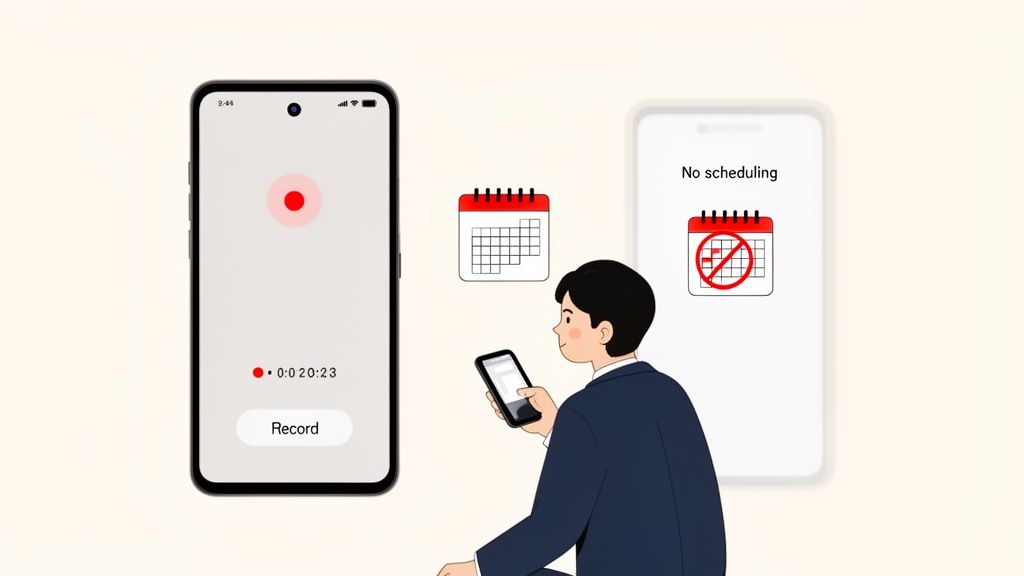
How does this actually work in the real world? It's brutally simple, which is why we love it.
This approach has become a staple for a reason. On-demand video interviews have slashed time-to-hire dramatically. In fact, a whopping 81% of recruiters now use video interviews in some form, with these one-way formats surging 67% since 2020. For startups scaling quickly, the right platform can cut hiring timelines and costs by over 80%. (Toot, toot!)
At first, it feels a bit… detached. Are you really getting a feel for someone if you’re not in the same "room"?
Yes and no. You’re not testing their ability to make small talk, but you are testing their ability to communicate clearly and concisely under a bit of pressure.
It’s the difference between a spontaneous chat and a prepared statement. Both tell you something valuable, but the on-demand interview reveals how a candidate structures their thoughts when they know they’re being evaluated. It’s a glimpse into their professional composure.
Of course, to get this right, you need the right tools. When you're ready to explore options, this guide on the best video interview platforms for seamless remote hiring is a great starting point. Mastering the platform and the process is key, which is why we've also put together some advice on essential online interview techniques.
To put it all in perspective, here's a quick, no-fluff comparison of where each interview format wins and loses in the real world of hiring.
| Factor | On Demand Video Interview (Asynchronous) | Live Interview (Synchronous) |
|---|---|---|
| Scheduling | No coordination needed. Candidates record on their own time. | The seventh circle of hiring hell. Requires finding a mutually available time slot. |
| Efficiency | Hyper-efficient. Review dozens of candidates in the time it takes to do a few live calls. | Time-consuming. Each interview is a dedicated, unmovable block of time. |
| Consistency | Standardized. Every candidate gets the exact same questions and format. | Can be all over the place. Questions and conversation flow vary from call to call. |
| Candidate Experience | Mixed. Offers flexibility but can feel impersonal or stressful for some. | More personal and engaging. Allows for real-time questions and rapport-building. |
| Best For | High-volume screening, initial qualification, assessing communication skills. | In-depth evaluation, culture fit assessment, late-stage interviews. |
Ultimately, these two formats aren't enemies—they're partners. Using an on-demand interview to screen a large pool of applicants ensures that the time you spend on live interviews is with highly qualified, genuinely promising candidates.
Alright, let's get real. The sales pitch for on-demand video interviews is always flawless, polished to a perfect shine. But what’s the day-to-day reality? Is it a hiring miracle or just a new way to create awkward, soul-crushing content?
Having been through the wringer with these tools, I can tell you it’s a bit of both. The upside is massive, but the pitfalls can swallow your hiring process whole if you’re not paying attention.
Let's start with the big win: efficiency. We used to spend entire weeks on first-round phone screens, most of which went nowhere. An on-demand video interview lets you reclaim that time with a vengeance. You can screen dozens of candidates in the time it takes to suffer through a few live calls.
This isn’t just a nice-to-have; for global hiring, it's a lifesaver. Trying to coordinate with a developer in São Paulo and a designer in Buenos Aires? Good luck. Asynchronous interviews obliterate time zone headaches.
But the real magic is the consistency. Every candidate answers the exact same questions under the same conditions. It’s the closest you’ll get to an apples-to-apples comparison in the messy world of hiring, leveling the playing field in a way that a free-flowing phone call never can.
Now for the dose of reality. Can you truly gauge personality from a pre-recorded video? It’s tough. You lose the spontaneous back-and-forth, the little moments of connection that tell you if someone will be a good teammate.
Then there’s the performance anxiety. We’ve seen brilliant candidates—people with stellar résumés and glowing references—completely freeze on camera. Their answers become stiff, rehearsed, and delivered with the enthusiasm of someone reading a ransom note. Are you testing their skills or their auditioning ability?
The awkward truth is that an on-demand video interview can filter out candidates who are fantastic at their jobs but terrible at performing for a webcam. You have to decide if that's a trade-off you’re willing to make.
This format can feel cold and impersonal. If you’re not careful, your first impression as a company isn’t one of excitement and opportunity, but of a robotic, faceless corporation. The candidate experience is paramount, and a poorly designed video interview can torpedo it from the start.
Here’s the part no one likes to talk about. While structured questions can reduce bias, the video format introduces a whole new set of potential judgments. Suddenly, you’re not just evaluating their answers; you’re subconsciously judging their home office, their bookshelf, or the cat that just jumped on their desk.
Does a messy background imply they’re disorganized? Does a high-end microphone mean they’re more professional? These are dangerous shortcuts our brains take, and they have nothing to do with a candidate's ability to code or manage a project.
Ultimately, the on-demand video interview is a powerful tool, but it's not a silver bullet. It’s a high-efficiency filter, but one that requires a thoughtful, human-centric approach to avoid alienating great candidates and amplifying hidden biases. It’s on you to use it wisely.
If your on-demand video interview feels like a robotic interrogation, you’ve already lost. Let’s be honest, most of these interviews are terrible. They’re boring, they’re generic, and they tell you almost nothing you couldn’t learn from a resume.
This is your playbook for creating an experience that candidates actually appreciate—or at least don’t actively despise. A great asynchronous interview should feel less like a test and more like the start of a real conversation.
The biggest mistake I see is teams asking questions a candidate can answer flawlessly with a quick search. "What are the core principles of Agile development?" Who cares? I want to know if they can apply those principles when the project is on fire and the client is changing their mind every five minutes.
Your questions need to be un-Googleable.
That second question digs for self-awareness, accountability, and real-world learning. No search engine can fake that for you.
Remember, this is often a candidate's first real interaction with your company culture. A series of black-and-white text prompts screams "we are a boring, bureaucratic company that enjoys standardized testing."
Don't be that company.
Record a short, friendly video of yourself or the hiring manager introducing the interview. Explain the process, thank them for their time, and maybe even crack a joke. It takes five minutes and instantly transforms a cold, automated process into a human one.
This simple touch shows you’re a team of actual people, not just an algorithm sifting through applicants. It sets the tone and encourages candidates to be more authentic in their own responses.
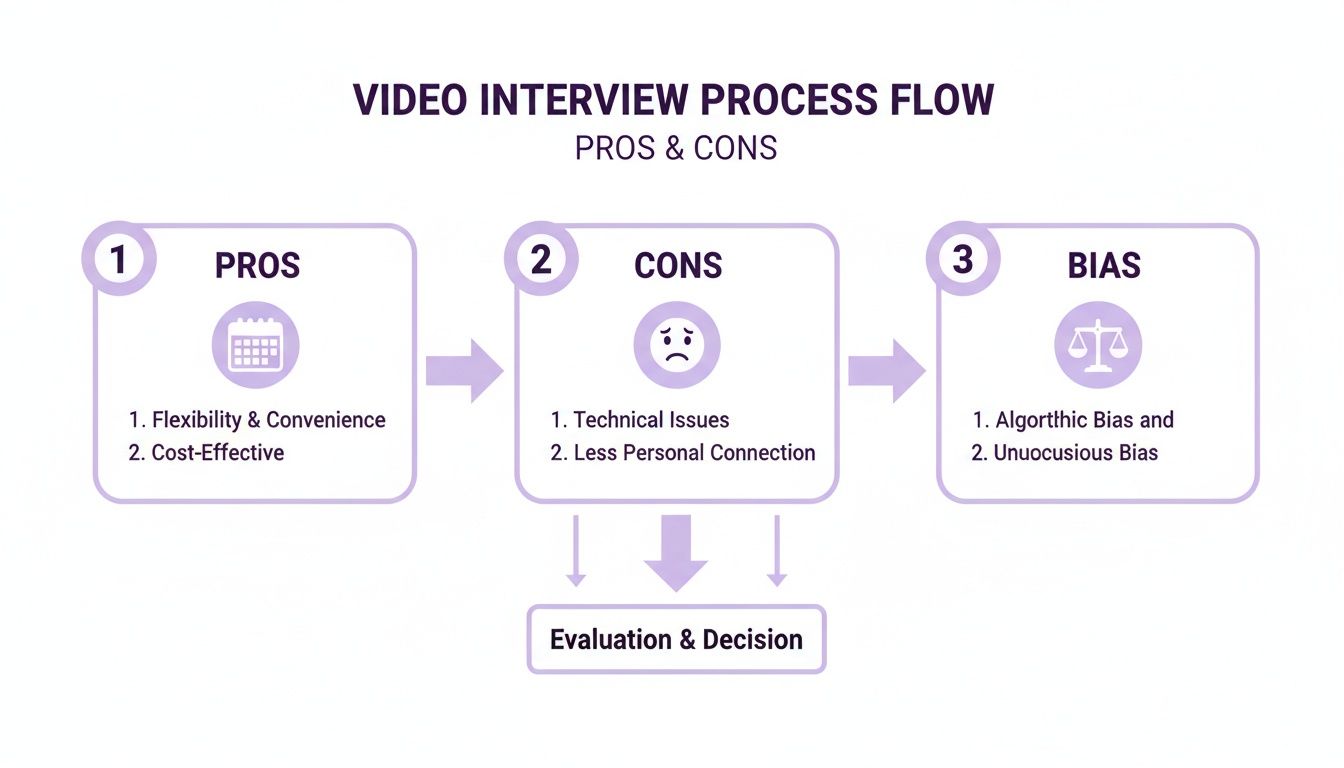
This flow highlights the constant tug-of-war between saving time, the awkwardness candidates might feel, and the biases you must actively fight.
Generic questions get you generic hires. The questions you ask a project manager should be worlds apart from those you ask a UX designer. Get specific and tactical.
For a Project Manager:
For a UX Designer:
For a Senior Developer:
Notice a pattern? They all ask for a story. Stories are packed with data about how a person thinks, acts, and collaborates.
An on-demand video interview should be a time-saver, not a homework assignment. Keep it concise. Three to five questions is the sweet spot. Anything more and you risk candidate drop-off and signal that you don’t value their time.
Also, be realistic with your time limits.
No one wants to sit through a seven-minute rambling answer. By designing a sharp, respectful, and insightful interview, you’re not just evaluating candidates better—you’re selling them on why they should want to work with you.
Here’s a hard truth you won’t find on the glossy product pages: the absolute last thing your team needs is another piece of software that doesn’t talk to your other tools. A standalone on demand video interview platform is a recipe for chaos. Hope you enjoy spending your afternoons manually updating candidate statuses and copy-pasting notes—because that just became your new full-time job.
Turns out there’s more than one way to hire without mortgaging your office ping-pong table for software that creates more problems than it solves.
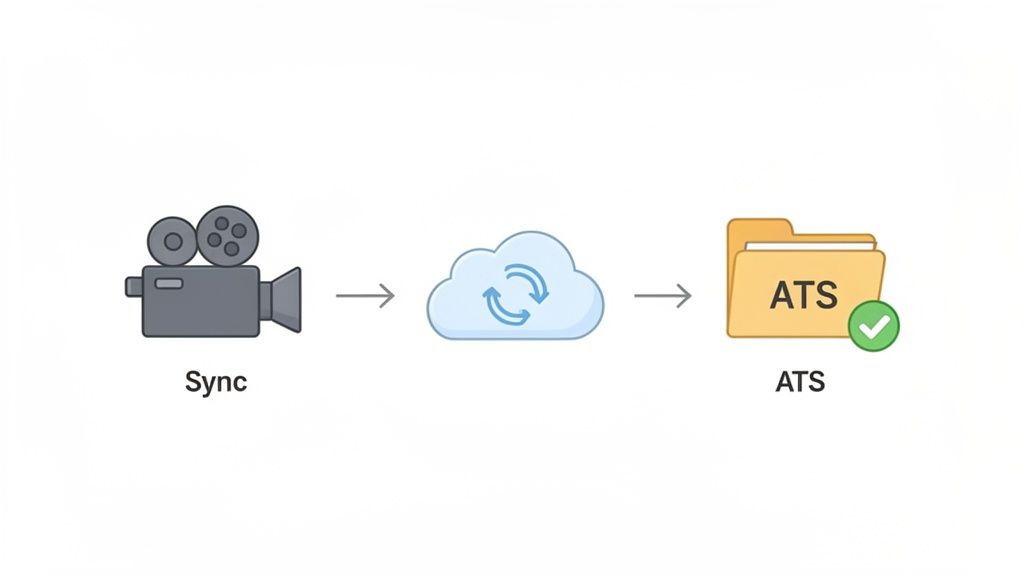
I've seen it happen too many times: a bad integration is actually worse than no integration at all. It gives you this false sense of security while critical candidate data gets lost and great people fall right through the cracks. Teams pay a premium for a "connected" system only to find out it’s just a glorified hyperlink.
That’s what I call the "$500 Hello"—it looks connected on the surface, but all it really does is wave at your ATS from a distance.
A truly seamless workflow should operate something like this:
How can you spot a bad integration before you’re locked into a year-long contract? Keep an eye out for these warning signs. They scream, "This is about to become your new nightmare."
The goal of technology is to eliminate work, not create new, more complicated work. If you have to build a multi-step manual process just to make two systems talk to each other, you haven’t bought a solution—you’ve bought a problem.
Here are the biggest red flags to watch for:
A unified system isn't just a time-saver; it’s a genuine competitive advantage. For teams evaluating their options, our in-depth recruitment software comparison can help you identify tools that genuinely connect with your existing workflow. Choose a platform that fits into your ecosystem like a missing puzzle piece, not one you have to hammer into place.
Let's be blunt for a moment. The second you ask a candidate to hit 'record', you're stepping into a minefield of legal and ethical challenges. This isn’t about being polite; it’s about avoiding a lawsuit that could cripple your company. Privacy laws like GDPR and CCPA aren't gentle suggestions—they have serious teeth and aren't afraid to bite.
Suddenly, you’re not just a recruiter anymore; you're a custodian of highly sensitive data. And that’s a title that should make you pause. Do you need their explicit permission before the camera starts rolling? The answer is a non-negotiable, resounding yes.
Think of candidate videos as sensitive personal information, because that's exactly what they are. You're capturing visual and audio data that can reveal a person's age, gender, ethnicity, and even potential disabilities. This is a goldmine for unconscious bias and a compliance nightmare waiting to happen.
Your first move must be to get your data-handling policies airtight.
The single biggest legal risk with an on demand video interview isn't a data breach; it's a discrimination claim. While these interviews can level the playing field, they can just as easily become a bias amplifier if you aren't extremely careful. The key to making them legally defensible is structure, structure, and more structure.
A standardized process is your best defense. If you can prove that every candidate received the same questions, was evaluated against the same criteria, and was reviewed by a trained team, you’re building a hiring process that’s fair, consistent, and legally sound.
This means you need a system that forces fairness into the equation.
Standardize Everything:
Every single candidate for a given role must get the exact same questions in the exact same order. No exceptions. This is how you remove the "gut feeling" element that so often leads hiring managers into legal hot water.
Use a Structured Rubric:
Your team shouldn't be evaluating candidates based on how much they "liked" them. Create a scoring rubric with clearly defined criteria (e.g., "Clarity of Communication," "Problem-Solving Approach") and have multiple reviewers score each video on their own before coming together to discuss. This approach forces a focus on job-related skills, not just charisma.
Staying compliant isn't about drowning in paperwork. It's about being intentional. By baking fairness and privacy into your process from the start, you ensure your slick, modern hiring method is also defensible and respectful.
So, your team is flying through interviews. The numbers on your hiring dashboard look fantastic. You’ve screened more candidates this quarter than you did in the last two combined. High fives all around, right?
Not so fast.
If you can't measure it, you can't improve it. And if the only thing you’re measuring is speed, you've completely missed the point. Are you just hiring faster, or are you actually hiring better? Those are two very different things.
The number of interviews completed is a classic vanity metric. It feels good, looks great on a report, but tells you nothing about the quality of your hires. It's like celebrating how many sales calls you made without checking if you actually closed any deals.
It’s time to track the metrics that separate real value from pure volume.
Honestly, the most important metric has nothing to do with the interview itself. It’s about what happens six months down the line.
How does the on-the-job performance of someone hired via video interview stack up against those hired the old-fashioned way? Pull up their first performance review. Are they meeting expectations? Or are you starting to see cracks you missed in their perfectly rehearsed video answers?
The ultimate test of any hiring process isn't how well a candidate interviews, but how well they perform. If your new hires from on-demand interviews are consistently outperforming your legacy hires, you've found a genuine strategic advantage. If not, you've just bought an expensive toy.
To truly get what separates a good answer from a great one, you have to dig into the details. To move beyond subjective impressions, consider exploring the best transcription software for interviews. Analyzing the specific language and phrases candidates use can reveal patterns you’d otherwise completely miss. We’re not saying we’re perfect. Just more accurate more often.
This isn't just about feeling good about your process. It's about proving this tool isn't just another budget line item. You need to build a simple framework to track its return on investment.
Start by comparing the performance ratings of hires from different sources. If you can show that video-screened candidates have a 15% higher performance score after their first year, you’ve got a powerful case to make. Combine that with the hours saved by your hiring managers—time they can now spend on high-value tasks—and you can put a real dollar amount on the tool's impact.
Of course, video interviews are just one piece of the puzzle. Our guide to pre-employment skills testing shows how combining different data points creates a much richer, more predictive candidate profile. This is how you build a system that doesn't just hire faster, but hires smarter.
Alright, let's tackle some of the common questions we hear from founders and hiring managers who are still on the fence about on-demand video interviews. No fluff, just straight answers from the trenches.
Honestly, some might. But most candidates, especially in tech-heavy roles, actually appreciate the flexibility. The real win for them is not having to burn a vacation day just for a first-round chat. It only feels impersonal if you make it that way. A cold, automated template and generic questions? Yeah, that’s going to feel like a soulless corporation. But a warm intro video from the hiring manager? That completely changes the vibe.
You can’t evaluate a handshake, but you can absolutely gauge communication clarity, enthusiasm, and problem-solving skills. The trick is to ask questions that force them to tell a story, not just recite a definition.
Don't ask, "Are you a good communicator?" Instead, try: "Tell me about a time you had to explain a complex technical issue to a non-technical stakeholder. How did you approach it?"
One is a simple yes/no question; the other reveals their entire thought process on video. It’s a powerful data point.
You can't eliminate it entirely, but you can make it incredibly difficult. Cheating is a symptom of a poorly designed interview, not a flaw in the format itself.
Here’s how to shut it down:
And frankly, if a candidate does manage to deliver a perfectly robotic, soulless answer, that tells you something important, too. You’re looking for authentic problem-solvers, not actors.