
A contractor termination letter is a formal document that officially ends the professional relationship between your company and an independent contractor. It confirms the termination date, outlines final payment details, and specifies requirements for returning company property. Think of it as your get-out-of-jail-free card for future legal headaches.
Let's be real—ending a contractor relationship is a headache nobody wants. It’s awkward, complicated, and feels like a distraction from the million other fires you’re fighting.
But treating it like a casual breakup text is the difference between a clean break and a legal mess that eats your runway for breakfast.
I’ve learned this the hard way. Early on, I thought a quick email was enough. "Hey, project's wrapped, thanks for everything!" It felt efficient. It was, until a month later when I got an invoice for work I never approved, followed by a tense email chain about intellectual property ownership.
Hope you enjoy spending your afternoons digging through old Slack messages—because that’s now your full-time job.
That generic email template you found on the second page of Google? It’s a liability masquerading as a solution. When things go south, that flimsy email won't protect you from the genuine risks of a poorly handled termination.
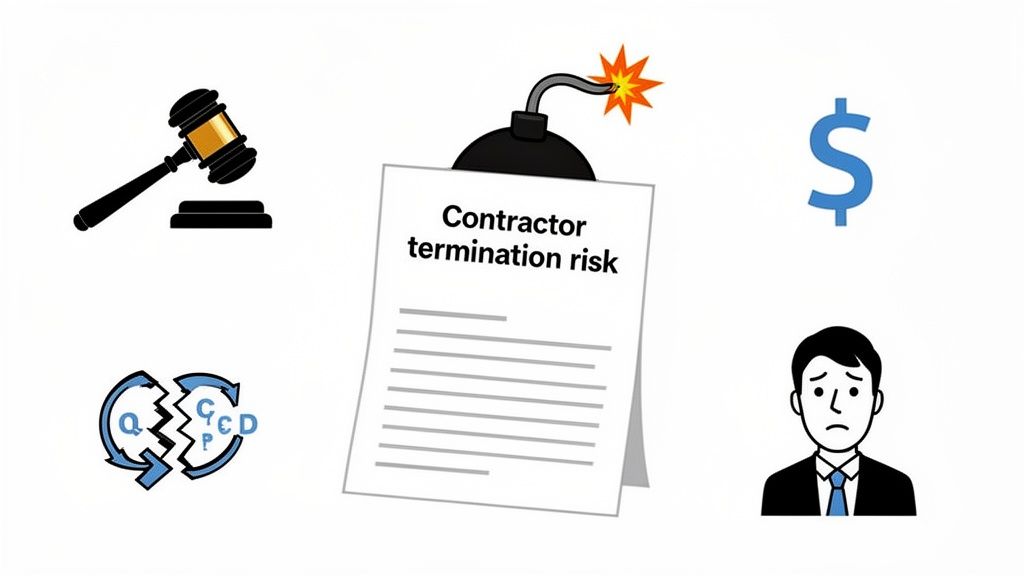
We’re not just talking about hurt feelings. We’re talking about tangible, company-killing threats:
Think of the contractor termination letter as your business pre-nup. It’s not about expecting the worst; it’s about creating a clear, legally sound framework that protects everyone when things don’t work out as planned.
This isn't just me being dramatic. In 2023 alone, U.S. employers faced over $400 million in penalties and settlements from employment disputes.
A staggering 58% of termination-related litigation stemmed from missing or unclear clauses in termination notices covering final pay, benefits, or IP rights.
As remote work becomes the norm, wrongful termination claims for remote workers have also spiked, with average settlements hitting $38,000 per case. Want to dive deeper? The financial impact of these disputes is why airtight documentation is non-negotiable.
To dodge the inherent dangers of improper contractor offboarding, consider how robust third-party risk management can protect your organization. This single document is your best defense against chaos, protecting everything from your codebase to your balance sheet.
Alright, let's move past the horror stories and get into what a contractor termination letter should look like. This isn't just a legal document; it's a tool. A carefully crafted piece of communication meant to close a chapter cleanly, professionally, and without leaving any expensive loose ends.
I’ve seen dozens of these letters. Some looked like they were scribbled on a napkin (don't do that), while others were 10-page monstrosities from lawyers who bill by the word. The best ones are always the same: clear, concise, and impossible to misinterpret. They aren't mean; they're just surgically precise.
Every termination letter needs a solid foundation. These might not be the most exciting parts, but skipping them is like building a house without pouring the concrete first. You're just asking for trouble.
Your letter absolutely must include:
This initial section sets the stage. It's the "it's not you, it's me… but also, here are the official details" part of the professional breakup.
This is where most disputes are born. Get this part right, and you'll sidestep 90% of the potential drama.
State exactly how the final invoice should be submitted, what period it should cover (e.g., "all work completed through October 26, 2024"), and the exact date it will be paid, according to your agreement's terms. Leave zero room for interpretation.
If your contract says you pay Net 30, then state the final payment will be processed within 30 days of receiving a valid final invoice. Reaffirming the terms you both already agreed to is your best defense against those "But I thought…" emails later.
Now we get to the good stuff—the sections that truly make your termination letter bulletproof. These clauses are your shield against future liabilities, from IP theft to data breaches. I learned to appreciate them after one particularly nasty offboarding where a contractor conveniently "forgot" to hand over a critical database.
Here are the must-haves:
When you're drafting the letter, having a grasp on breach of contract remedies is crucial for protecting your interests. It makes the letter much more enforceable. It's also smart to familiarize yourself with the specific legal considerations when hiring remote workers in LatAm or any other region, as local laws can add another layer of complexity.
Putting these elements together creates a document that is firm, fair, and final. It's not about being aggressive; it's about being undeniably clear.
Theory is one thing, but let's get real—you're here because you need a template you can use right now. You need a battle-tested contractor termination letter that solves your problem without creating a bigger one.
I've been in that seat more times than I care to remember. I've had to send the "we're changing direction" email, the "this just isn't working out" notice, and the much happier "project's complete!" message. Each situation is different and requires its own touch. A one-size-fits-all approach is just asking for trouble.
So, I'm sharing four templates I've honed over the years. Think of them as your cheat codes for the most common—and often most uncomfortable—termination scenarios. (Toot, toot!) I’ve added my own notes to each, like a co-founder looking over your shoulder.
The first step is always figuring out which path to take. This quick decision tree shows the flow from the moment you decide to terminate all the way through the final wrap-up.
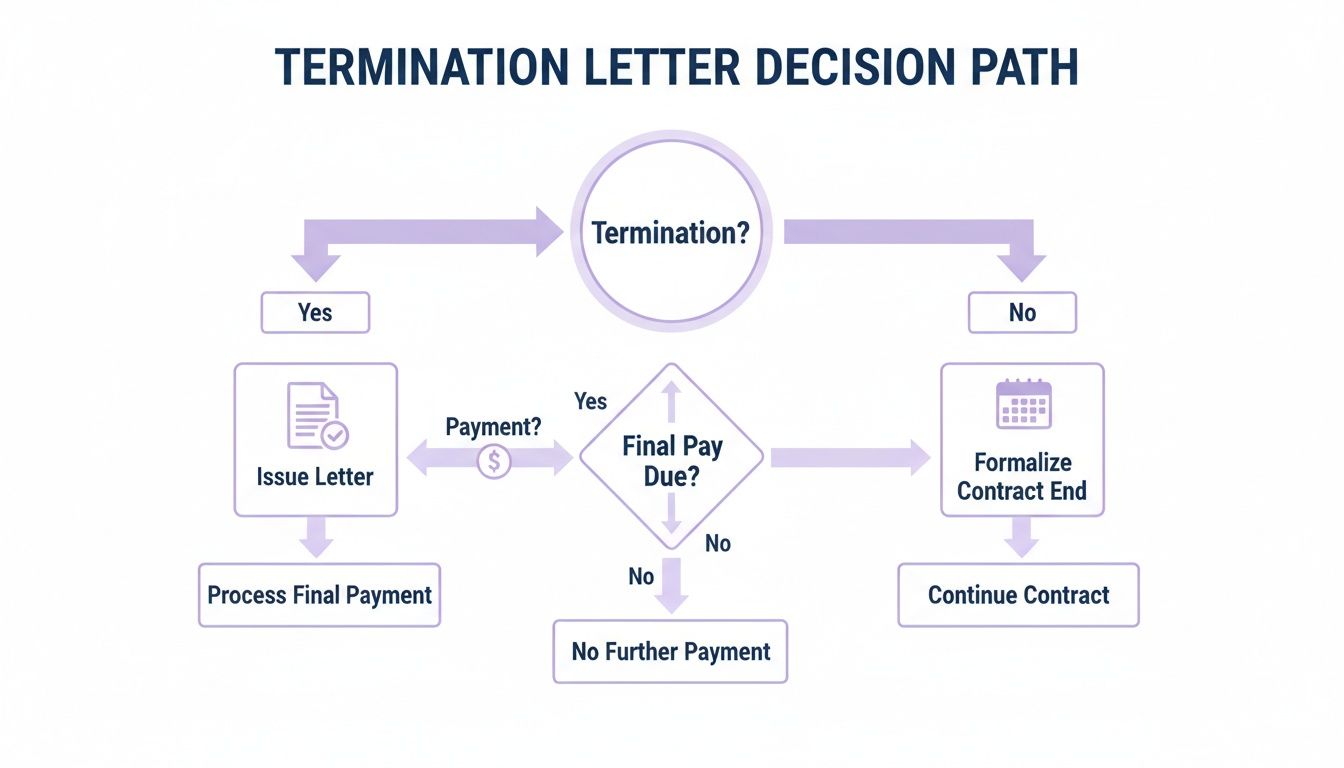
This visual makes it clear: no matter the reason for the split, it always funnels down to the same critical steps—issuing that formal letter and getting the final payment right.
Choosing the right template is half the battle. This table breaks it down.
| Scenario | Best Letter Type | Key Focus | Tone to Adopt |
|---|---|---|---|
| Contractor missed deadlines or delivered poor work. | Termination for Cause | Documenting specific contract breaches. | Formal, direct, and factual. |
| The project is finished as planned. | End of Contract Notice | Formalizing the successful conclusion. | Professional and appreciative. |
| Your company's needs or budget have changed. | Termination for Convenience | Exercising your contractual right to end early. | Respectful, clear, and strategic. |
| Both you and the contractor agree to part ways. | Mutual Termination Agreement | Creating a new agreement to dissolve the old one. | Collaborative and amicable. |
Using the correct template sets the right tone from the start and protects your business by aligning with the specific circumstances of the termination.
This is the one nobody wants to write. You use it when things have gone completely sideways—deadlines ignored, work quality is poor, or there's a clear violation of your agreement. The goal here is precision and zero ambiguity.
Your tone needs to be firm, formal, and strictly fact-based. This is no time for vague feedback or trying to soften the blow. You're creating an ironclad record that justifies the termination.
Why it's so tricky: This letter carries the highest risk of escalating into a legal dispute. Every claim you make must be backed by documented evidence, like emails, comments in your project management tool, or prior written warnings. Without proof, it's just your word against theirs.
Pro Tip: Keep it professional, never personal. Stick to objective failures tied directly to the contract. Phrases like, "Failure to meet the deliverable standards outlined in Section 3.2 of our agreement," are your best friends. Avoid subjective statements like, "I was disappointed with your work."
Here’s a sample structure:
Think of this letter as your shield. It must be direct and unemotional, showing a clear, documented pattern of performance issues.
This one's the easy one—the friendly handshake after a job well done. The contractor delivered, the project is finished, and now you’re just formalizing the end of the agreement.
The tone here should be professional but appreciative. You aren't burning a bridge; you're just closing a project loop.
Even when things end on good terms, don't skip the formal letter. It creates a clean record that the contract was fulfilled and officially closed, preventing any confusion about future work.
This is the classic "it's not you, it's us" letter. You're ending the contract, but not because of poor performance. It's because your company's needs have shifted—maybe you're pivoting, a project lost funding, or you're restructuring the team.
The tone should be respectful and direct. You need to be crystal clear that this is a business decision, not a reflection of the contractor's abilities.
Why it's tricky: You can only use this if your contract has a "Termination for Convenience" clause. If it doesn't, you could be in breach of contract yourself. This clause gives you the right to end the agreement for any reason, provided you give proper notice and compensation. For perspective, U.S. federal agencies terminated nearly 40,000 contracts for convenience in fiscal year 2024 alone due to shifting priorities.
A solid letter for this situation includes:
This letter is all about managing the relationship while exercising a contractual right. A little transparency (without oversharing your entire corporate playbook) goes a long way.
Sometimes, you both just know it’s not working. A mutual termination is the most collaborative way to end the relationship cleanly.
This isn't just a letter; it's a new, simple agreement. Both parties sign it, formally acknowledging that you both agree to dissolve the original contract.
The key elements are:
This approach is the most amicable by far and is fantastic for preserving professional relationships. It turns a potential conflict into a simple business decision.
So you’ve decided it’s over. Hitting ‘send’ on that termination letter feels like the final move. But if that’s your first step, you’re already behind.
Firing someone, even a contractor, without a game plan is like trying to defuse a bomb by randomly snipping wires. It gets messy, fast.
Before you even think about drafting that letter, you need a pre-flight checklist. This isn’t bureaucratic nonsense; it’s the series of calculated moves that turns a potentially explosive situation into a controlled, professional process.
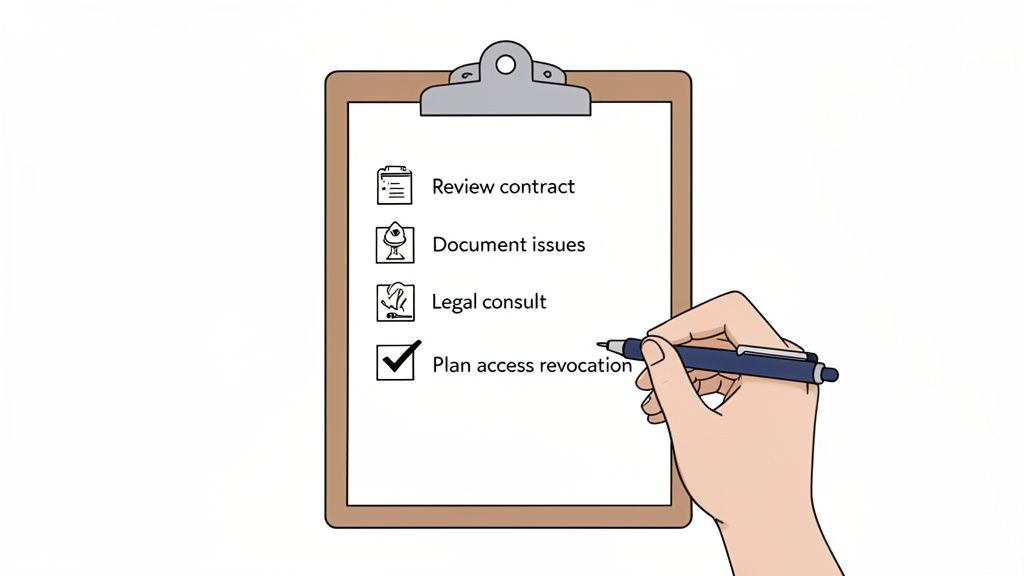
Remember that contractor agreement you both signed? The one you probably skimmed and filed away? It’s time to read it. I mean really read it.
That document is your rulebook. It dictates exactly how you can—and can't—end the relationship.
Look for these specific clauses:
This isn't just about covering your assets; it’s about understanding the game you’re playing. If you don't know the rules, you can't win.
If you’re terminating for cause, "they did a bad job" is not going to cut it. You need a paper trail of cold, hard evidence. Vague feelings of disappointment don't hold up in a dispute; documented facts do.
Start compiling your evidence now:
Think of it this way: you are building a case that is so clear, so well-documented, that the contractor has no logical choice but to accept it. This is about removing all ambiguity and emotion from the equation.
A lack of documentation is a common reason terminations get messy. A global review of contract terminations in the construction industry identified 42 distinct causes, with major issues being contractor shortcomings like poor workmanship and delays. Robust documentation helps avert these pitfalls.
Okay, you’ve reviewed the contract and gathered your proof. Now for the logistics. The moment you send that letter, a series of events must be triggered instantly. Don't get caught scrambling.
Your operational checklist must include:
This prep work isn't optional. It’s the foundation for a clean break and a key part of your overall contractor management best practices. Don't send that letter until every box on this list is checked.
You’ve got the letter. You’ve done the prep work. Deep breaths. Now comes the part that makes everyone's stomach turn—the actual conversation.
How you deliver this news matters almost as much as what’s in the letter. A clumsy delivery can turn a straightforward business decision into a dramatic, drawn-out mess. This is all about managing the human element without putting the business at risk.
Your goal isn't to make them happy. It’s to be clear, professional, and final. Remember, this is a notification, not a negotiation.
Who needs to be in the room? Keep it lean. The meeting should include you (or the contractor's direct manager) and maybe one other person from your team as a witness—an HR rep or a co-founder works. Any more than that turns it into a spectacle.
And please, if they're remote, do this over a video call. A termination email that just shows up in their inbox out of the blue is a coward's move and invites chaos. They deserve a direct conversation.
Here’s the game plan for the call itself:
This structure keeps the conversation under five minutes. The more you talk, the more you risk saying something you'll regret.
Your job is to deliver the message and point them to the document. The letter does the heavy lifting. Don't get drawn into a debate, a lengthy justification, or an emotional back-and-forth.
The call is over. Pop the Tums. Now, the real work begins. The moments right after the conversation are when things either go smoothly or fall apart completely.
Your immediate follow-up logistics should be a well-oiled machine:
This isn't just about being professional; it's about control. A controlled offboarding process prevents confusion, kills rumors, and ensures the transition is managed on your terms, not theirs.
The awkward call is over, and the contractor termination letter is sent. Champagne time? Not quite. The cleanup phase is where you slam the door shut on future risks.
Think of it this way: you just changed the locks on your house. Now you have to make sure you didn’t leave a window open. This isn’t about tying up loose ends; it’s about aggressively protecting your company from security gaps, intellectual property leaks, and operational chaos.
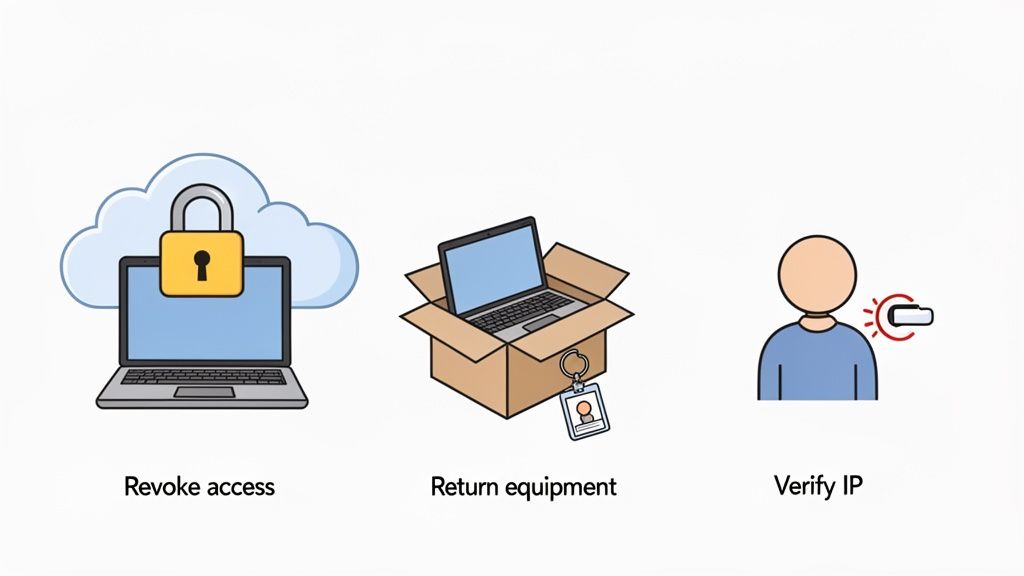
Your job is to make the break truly clean. The moment that call ends, your offboarding workflow should kick into high gear. This isn’t something you figure out on the fly; it needs to be a pre-planned, systematic process.
Your non-negotiable checklist should include:
This process has to be airtight. A recent government initiative that terminated over 11,500 contracts highlights just how critical precise offboarding is for asset recovery. Wrongful terminations can expose companies to claims for lost profits, underscoring the need for detailed letters that specify deficiencies unequivocally to avoid costly litigation.
This isn’t about being paranoid; it's about being professional. A clean break protects your assets and lets everyone move on without looking back.
Alright, let's tackle some of the common "what ifs" that pop up when you're in the hot seat. These are the gray areas and nagging questions that can keep founders up at night.
This is the classic standoff, and it happens more often than you'd think. If a contractor disputes their final pay, your first move is to pull out the original agreement and the termination letter you sent.
Your letter should have been crystal clear about the final invoice and payment details. If they're claiming you owe them for work you didn't approve or that was subpar, your documented evidence is your best friend. Respond professionally, pointing to specific contract clauses and the performance issues you recorded. Whatever you do, don't get emotional—stick to the facts.
Ah, the ghosting contractor. It’s frustrating, but you still need to follow a formal process to protect your business.
Send the contractor termination letter to their last known email and physical address. Use a method with delivery confirmation, like certified mail, to create a legal record that you made a good-faith effort to reach them. The letter should state that you're terminating the agreement due to their non-communication and failure to perform duties, which is a breach of contract.
Don’t just assume the contract is void because they disappeared. A formal, documented termination protects you from them reappearing months later with a surprise invoice or a legal claim. Always cover your assets.
Look, I get the temptation. Firing off a quick email feels fast and efficient. But a formal contractor termination letter, sent as a PDF attachment, is a much safer bet.
An email can feel casual and easily get lost in a crowded inbox. A formal letter, on the other hand, signals the seriousness of the action and serves as a standalone, official record. It’s cleaner, more professional, and harder to dispute later. Think of the email as the delivery truck, but the attached letter is the actual package.