
Let's be real. "Cultural diversity" is a term that's been beaten to death by HR departments and corporate PR. It’s no longer some "nice-to-have" checkbox on a compliance form—it’s a core driver of business performance. Companies with genuinely diverse teams don't just look better on paper; they innovate faster, solve problems more creatively, and consistently run circles around their homogenous competitors.
Most conversations about diversity are drowning in corporate jargon and stock photos of unnaturally happy teams. But building a genuinely diverse remote team isn't about hitting quotas or virtue signaling. It’s about gaining one of the most effective competitive advantages you can build.
It's messy. It's challenging. And it will absolutely unlock innovation your competitors can't touch.
So, forget the kumbaya moments for a second. This is a practical, founder-to-founder take on why prioritizing cultural diversity in the workplace is a strategic weapon, especially for startups aiming to outmaneuver bigger, slower rivals.

The whole DEI conversation got complicated, fast. To get the full picture, it's worth understanding the current issues surrounding DEI in the workplace. But we're not here to talk policy debates; we're here to talk about winning. That means moving beyond performative gestures and focusing on what actually drives results.
So, what does that actually look like?
The alternative is stagnation. You end up with a team that suffers from groupthink, blind spots you can't see, and an inability to connect with a rapidly diversifying customer base. That’s a death sentence for any ambitious company.
Still skeptical? Let’s talk numbers. This isn't about feeling good; it’s about financial performance.
For years, landmark analysis has shown that executive teams in the top quartile for ethnic and cultural diversity are 36–39% more likely to financially outperform those in the bottom quartile. That performance gap is widening, proving that diversity is an increasingly powerful competitive differentiator.
The question is no longer "Can we afford to invest in diversity?" It's "Can we afford not to?" When your competitors are tapping into global talent pools, sticking to local-only hiring is like bringing a knife to a gunfight.
Tapping into talent from high-growth regions like Latin America isn't just a cost-saving measure—anyone telling you that is missing the point. It’s a strategic move to infuse your company with world-class skills and fresh perspectives.
By committing to true diversity, you’re not just building a better culture; you’re building a more resilient, innovative, and profitable business. Mastering this starts with rethinking your approach from the ground up, which you can explore in our guide to inclusive hiring practices.
Let's be honest. Your local talent pool feels safe. It's comfortable. Hiring people who live down the street, went to the same schools, and grab coffee at the same spots is predictable.
It’s also the fastest way to build a team that thinks, acts, and innovates in a perfect, monotonous circle. You end up hiring résumés that look familiar, not perspectives that challenge you. You're building a monoculture.
And in a global market, monocultures don't just lose—they become irrelevant. The hard truth is that the absolute best person for your open role probably doesn't live within a 50-mile radius of your office. Sticking to your zip code isn’t just limiting; it’s a strategic blunder that costs you more than you realize in stagnant ideas and missed opportunities.
Think about your last "big idea" meeting. How many genuinely new thoughts hit the whiteboard? Or was it mostly slight variations of the same old approach? That’s the cost of sameness. When everyone on the team shares a similar background, they also share the same blind spots.
You can't solve new problems with old thinking. Bringing in talent from different cultural contexts—like the high-growth tech hubs in Latin America—isn't just about "outsourcing." It's about strategic team-building. It’s about injecting fresh perspectives and different problem-solving frameworks into your daily operations.
This isn’t just a theory; it's a brutal reality of the modern talent market.
Here’s something most founders miss: elite candidates are judging you on your commitment to diversity. It's no longer a bonus point on a corporate scorecard; it’s a non-negotiable for a huge chunk of the talent pool. They see a homogenous team and think "stale," "out of touch," or "not for me."
The best engineers, marketers, and operators want to work with other brilliant people, regardless of their passports. If you aren't looking globally, you're sending a clear signal that you aren't serious about finding the absolute best talent.
And the data backs this up. A solid 76% of job seekers say a diverse workforce is a key factor when they evaluate offers. For younger generations like Gen Z, who are now the most racially diverse generation in the U.S., multicultural teams are a baseline expectation, not a perk.
For high-growth startups that depend on top-tier remote talent, visibly committing to cultural diversity at the workplace is critical for both attracting and keeping the best people. You can find more insights on this in recent research covering workplace diversity statistics.
The bottom line? Your refusal to look beyond your city limits is actively repelling the very people you need to hire to win. Your talent pipeline isn't just limited—it's drying up because you're ignoring what top candidates actually want. It’s time to stop making excuses and start building a team that reflects the world you want to conquer.
Alright, enough with the high-level theory. Let's get into the nitty-gritty. You’re sold on the "why," but the "how" feels like trying to assemble IKEA furniture in the dark. Where do you even start building a team that doesn't all look and sound the same?
Spoiler alert: it’s not about adding a diversity statement to your careers page and calling it a day. This is about systematically re-engineering your hiring process from the ground up. Let's roll up our sleeves.
Your hiring process is probably biased. Don’t take it personally; most are. It starts with the very first document a candidate sees: your job description. It’s likely riddled with culturally specific jargon, biased language, and requirements that unintentionally filter out amazing global talent.
Think about phrases like "rockstar developer" or "sales ninja." In some cultures, that kind of language is a huge turn-off—seen as unprofessional or just plain weird. You’re accidentally selecting for a very specific personality type, not the best skills.
Here’s a quick-and-dirty audit to run on your next job post:
Fixing this is your first, cheapest, and highest-impact move. You’ll immediately widen your applicant pool without spending an extra dime.
This is the mental shift you need to make—from a small, local pond to a vast, global ocean of talent.
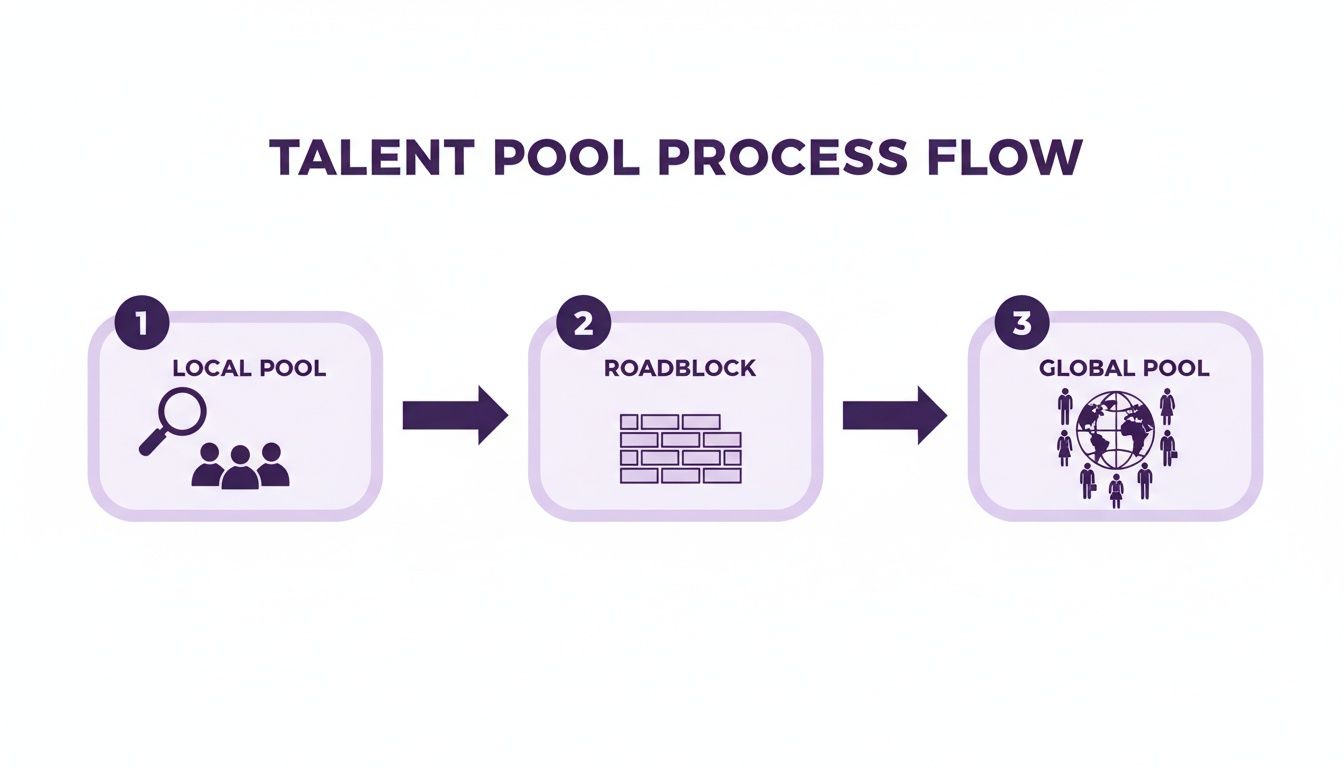
Breaking past the roadblock of "the way we've always done it" opens you up to a much richer, more capable, and diverse global talent pool.
Now, where do you find these people? If your only sourcing strategy is posting on LinkedIn and hoping for the best, you’re doing it wrong. Hope you enjoy spending your afternoons fact-checking resumes and running technical interviews—because that’s now your full-time job.
You need to go where the talent is, not where it’s most convenient for you to look. For us, that meant looking seriously at Latin America. The timezone alignment, incredible technical skills, and high English proficiency made it a no-brainer. But finding vetted talent was a nightmare of navigating local job boards and sketchy recruiters.
This is where platforms like LatHire become your unfair advantage. We built it to shortcut the chaos. Instead of you spending months trying to figure out who’s legit, you get access to a pre-vetted pool of professionals ready to work. This isn’t just about finding people; it's about finding the right people, faster.
The goal isn’t to become an expert in global recruiting. The goal is to hire the best person for the job, period. Anything that gets in the way of that—vetting, compliance, payroll—is a distraction you should delegate.
Of course, once you start building your global team, remember that managing remote teams effectively is what turns geographical distance into a strategic advantage.
Let's be real: your interview process is probably designed to find people you’d like to have a beer with, not the most competent candidate. You need a structured, objective process that evaluates skills, not cultural fluency or how well someone "vibes" with you.
First, standardize your questions. Every candidate for a role should get the same core set of skill-based questions. This helps you compare apples to apples, not apples to someone’s charisma.
Next, lean heavily on work simulations or practical tests.
This approach strips away a ton of unconscious bias. It doesn't matter if a candidate is more reserved or speaks with an accent if they can deliver brilliant work. It shifts the focus from presentation to performance. You also need to learn how to adapt your style; check out our guide on how to manage remote teams across different cultures for deeper insights.
Despite the clear advantages of looking globally, structural barriers persist. In the U.S., white Americans hold 76.5% of all jobs, while Black and Latino workers remain underrepresented in high-paying sectors. Globally, the numbers are just as stark, with women holding only about 10.6% of CEO roles in Fortune 500 firms.
These disparities show that hiring within homogenous networks simply reproduces inequality. Models that embrace cross-border hiring, like tapping into Latin America's skilled workforce, directly counter this by creating access to opportunity for under-tapped talent pools.
So you did it. You hired some brilliant people from different corners of the world. High-fives all around, right? Pop the champagne, post the announcement on LinkedIn, and wait for the innovation to just… happen.
Wrong. Hiring is the easy part. The real work—the part where 90% of leaders drop the ball—starts now. Managing a culturally diverse remote team is a minefield, and if you walk into it thinking a few extra emojis in Slack will solve everything, you’re in for a rough ride.
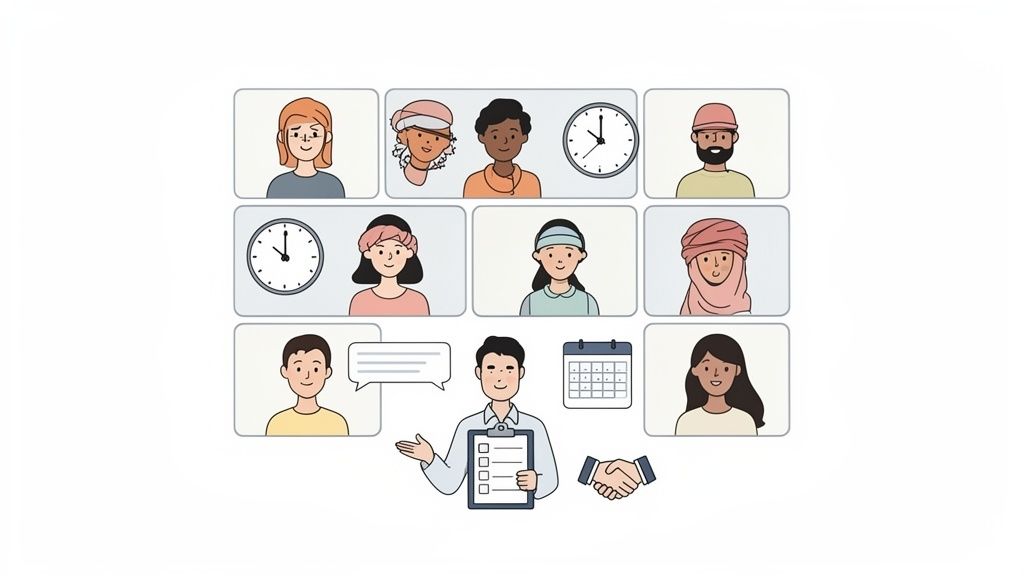
Your first big hurdle is communication. That joke that killed in your last all-hands? It just landed like a lead balloon with your new engineer in Bogotá. That direct, no-fluff feedback you’re so proud of? It just made your designer in Buenos Aires think they’re about to be fired.
Different cultures have wildly different communication norms. North Americans tend to be low-context and direct. In many Latin American cultures, communication is often higher-context, prioritizing relationship and harmony. A blunt "this isn't working" can feel aggressive and disrespectful.
This isn't about walking on eggshells. It's about developing a communication playbook that sets clear, universal expectations while leaving room for cultural nuance. The goal isn't to erase differences but to build a shared language for getting work done.
So, what does this actually look like in practice?
This is a continuous effort, not a one-time training session. For a deeper dive, our guide on cross-cultural communication in the workplace is your new best friend.
Quick question: Do you know when Carnival is? What about Día de los Muertos? If your company calendar only recognizes your own national holidays, you're sending a loud and clear message: "Your culture doesn't matter here."
Recognizing and respecting diverse holidays is one of the easiest, highest-impact things you can do. It's not just about giving people time off; it’s a signal that you see and value their whole identity.
Here's how to get it right:
This isn't about becoming an expert on every world festival. It’s about creating a system where everyone feels respected enough to honor their own traditions without feeling like an inconvenience.
Let’s be real. You can't just "grab a beer" with your team after a long week when they're scattered across five different countries. The spontaneous moments of connection that happen in an office don't exist remotely unless you deliberately create them. And no, another forced virtual happy hour isn't the answer.
Building genuine rapport is the glue that holds a diverse remote team together, especially when misunderstandings inevitably arise. If your team members see each other as complex human beings first and colleagues second, they'll give each other the benefit of the doubt.
Here are a few things that have actually worked for us:
Inclusive leadership in practice means fostering a remote culture where everyone feels they truly belong, not just that they're logging in from a different continent. It’s messy, intentional work, but it’s the only way to turn your diverse group of hires into a cohesive, high-performing team.
Alright, let's talk about the part of global hiring that makes founders sweat more than a missed payroll run. I’m talking about compliance, international payroll, and benefits. It’s the boring, unsexy stuff that will absolutely sink your global team if you ignore it.
Mortgaging your office ping-pong table is one thing; accidentally breaking international labor laws you didn't even know existed is a whole other level of catastrophe. This is where the dream of a diverse, global team meets the cold, hard reality of paperwork.
But don't worry. This is the pragmatic, bottom-line guide to navigating the administrative monster without needing a law degree and an accounting license.
I've heard it a dozen times. "Why not just pay our new developer in Brazil through PayPal? It's easy." This is, without a doubt, one of the fastest ways to get yourself into a world of legal and financial trouble.
Sending money via PayPal or Wise isn't employment; it’s a contractor payment. Misclassifying an employee as a contractor can lead to massive fines, back taxes, and forced benefit contributions. Every country has its own specific tests for determining employment status—things like who controls the work, who provides the tools, and the permanence of the relationship.
Guessing is not a strategy. What works in the U.S. is almost certainly illegal somewhere else. You'll quickly find yourself on the hook for things like mandatory "13th-month" salaries in countries like Colombia or Aguinaldo in Mexico—bonuses you never even budgeted for.
Don’t build your global expansion strategy on a payment app. The initial convenience will be dwarfed by the eventual compliance nightmare. You need a system that understands and respects local labor laws from day one.
This isn’t just about avoiding penalties, either. It’s about being a good employer. Proper employment ensures your team members get the social security, health, and retirement protections they’re entitled to under their local laws.
Offering a U.S.-centric benefits package to a global team is like handing someone a gift card to a store that doesn't exist in their country. It’s a nice gesture that’s completely useless in practice.
Your standard American health plan means nothing to someone in São Paulo. A 401(k) match is irrelevant to a designer in Medellín. To attract and retain top talent, your benefits need to be competitive and meaningful in their local context.
This means understanding the norms and expectations in each region:
Trying to manage this yourself is a full-time job. You’d need to become an expert in the social and legal fabric of every country you hire in. Who has time for that?
This is where the conversation turns to an Employer of Record, or EOR. Frankly, for most startups and SMBs, it’s the only sane way to hire internationally.
An EOR service, like the one we’ve built into LatHire, acts as the legal employer in the host country on your behalf. They handle all the messy, complicated stuff so you can focus on what you’re actually good at: running your business and managing your team.
Here's a breakdown of what an EOR takes off your plate:
Essentially, an EOR allows you to hire the best person for the job, anywhere, without having to set up a legal entity in their country. It’s the operational backbone that makes building a true cultural diversity at workplace program not just possible, but practical. It gives you the confidence to hire globally without fearing the unsexy stuff.
You've made it this far, so your head is probably swimming with ideas—and a healthy dose of "can I really pull this off?" That’s good. It means you’re taking this seriously.
Let’s tackle the big questions that are probably bouncing around your mind, the ones most HR guides conveniently sidestep.
Ah, the classic timezone terror. The fear is real: you'll be taking calls at 10 PM while your new hire in Buenos Aires is just starting their day. But the reality is much simpler if you stop trying to manage a remote team like a co-located one.
The answer isn't a complex web of color-coded calendars. It’s shifting to an asynchronous-first communication model. Your goal should be to have 80% of your work happen without needing everyone online at the same time.
Here’s how we do it:
Stop trying to force an office schedule onto a global team. It's a losing battle. Embrace async, and you'll find timezones become a feature, not a bug. Hello, 24-hour productivity cycle!
Let’s be blunt. If you’re asking this, you’re worried that different work styles or communication norms will slow things down. It’s a valid concern, but you're looking at the problem from the wrong angle.
Performance doesn’t drop because of diversity; it drops because of unclear expectations. When you hire a remote, multicultural team, you can no longer rely on implicit office cues or someone just "getting" what you mean. You have to be ruthlessly explicit about what success looks like.
Vague goals are the enemy of a high-performing global team. If "good work" is subjective, you're setting your team up for failure and yourself up for frustration. Your metrics need to be objective, measurable, and universally understood.
Instead of worrying about cultural differences, obsess over creating a culture of clarity. Define what "done" looks like. Set clear KPIs for every role. A well-defined goal is the same in any language. When you get this right, the variety of perspectives you gain will actually accelerate performance, not hinder it.
Cheaper? Maybe, if you only look at the initial salary number and ignore the massive opportunity cost of fishing in a tiny talent pond. Easier? Not a chance. Enjoy battling five other local startups for the same handful of senior engineers and then paying a premium for the privilege.
The local route feels "easy" because it's familiar. It's the path of least resistance. But building a great company isn't about doing what's easy—it's about doing what gives you the biggest competitive advantage.
Hiring globally through a platform like LatHire isn't about finding "cheap" labor. It’s about finding world-class talent that your local competitors simply can't access. It’s a strategic move to build a stronger, more resilient, and more innovative team without mortgaging your future to do it.
So, yes, it requires a different playbook. But the payoff isn't just a better bottom line—it’s a better company. And honestly, once you get the hang of it, you'll wonder why you ever limited yourself to a single zip code in the first place.

