
A best-practice recruitment process isn’t some slow, bureaucratic checklist. It’s a lean framework built for one thing: landing the right hire with speed and accuracy.
This means ditching the endless resume piles and vague, unstructured interviews. Instead, you build a system that scopes roles with precision, sources pre-vetted talent, relies on skills-based assessments, and makes decisions with objective data—all within weeks, not months.
Let’s be honest. Your current hiring process feels less like a strategic function and more like a second job you never wanted.
You’re drowning in look-alike resumes, stuck in back-to-back interviews that feel more like coffee chats, and watching your top candidates get snatched up by faster competitors. It’s a slow, expensive grind that tanks morale and rarely delivers the A-player you need.
If this feels familiar, it’s not you—it’s the playbook. The old-school method of "post and pray" is fundamentally broken, especially when you’re trying to hire elite talent across borders. Hope you enjoy spending your afternoons fact-checking resumes and running technical interviews, because that’s now your full-time job.
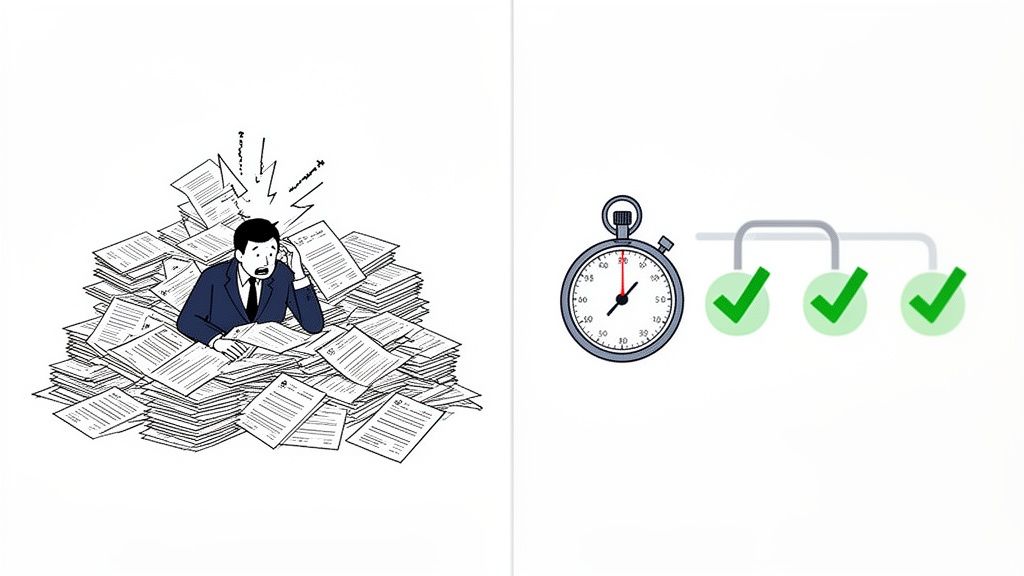
The good news? You don't have to mortgage the office ping-pong table to build a team of killers. A modern, best-practice recruitment process is designed to get the right person into the right seat, fast.
This isn’t about cutting corners; it's about being ruthlessly efficient. It means swapping gut feelings for data, replacing manual drudgery with smart automation, and focusing your precious time on the only thing that actually matters: evaluating a small pool of top-tier, pre-qualified candidates.
The goal is to design a system so sharp that your ideal candidate is accepting an offer before your competitors have even finished scheduling their first-round interviews. This is your intervention.
We’re going to walk through a battle-tested roadmap that does just that. This guide breaks down the core principles that separate winning hiring strategies from the ones that just drain your budget and your will to live.
We’ll focus on:
Whether you're hiring your next lead engineer or scaling a support team, this framework is your path forward. And for those navigating the complexities of remote work, understanding these principles is key to building a resilient team with flexible staffing solutions that adapt to your business needs.
This is how you stop playing the hiring lottery and start building a predictable talent engine.
Stop. Before you copy-paste that ancient job description you’ve been recycling since 2018, let's have a little chat. Most hiring fails right here, long before a single resume lands in your inbox. You’re looking for a person before you've truly defined the mission.
This isn’t about listing a dozen buzzwords or "required skills." It's about getting brutally honest about the problem you're hiring someone to solve. If you can't articulate the specific pain you're trying to eliminate, you're just throwing money at a symptom.

Forget the laundry list of qualifications for a moment. Instead, ask yourself and your team some tougher questions. What fire needs putting out right now? What metric is stubbornly refusing to move? What opportunity are you missing because nobody owns it?
This is the core of what we call a Success Profile. It's a simple, powerful document that becomes your single source of truth for the entire hiring process. It replaces vague desires ("we need a great marketer") with a concrete mission ("we need someone to reduce customer acquisition cost by 15% in six months").
This simple shift in thinking is what prevents you from hiring a brilliant engineer for a problem you don’t actually have.
Your Success Profile isn't a 10-page report. It's a one-pager that forces clarity. Think of it as a contract with yourself about what this role must accomplish.
Here’s what goes into it:
This isn’t just paperwork. It’s the blueprint that dictates your sourcing strategy, your interview questions, and your final decision. Every step of a best practice recruitment process links back to this profile.
Once you have this clarity, writing the actual job description becomes infinitely easier. You can even use AI tools to generate a first draft that's 80% of the way there, letting you focus on refining the mission, not agonizing over sentence structure. This is one of the most effective ways we've seen teams get from idea to a publish-ready post without the usual back-and-forth. For a deeper dive, check out our guide on how to create job descriptions that attract the right people.
Getting this right isn’t just a "nice to have." It’s the difference between a hire who transforms your business and one who just warms a seat. Take the time to be brutally honest upfront, and you’ll save yourself a world of pain later. It’s the foundational step that makes the rest of the process work.
Alright, you’ve defined the mission. Now comes the part where most hiring managers pour a strong coffee, open a hundred LinkedIn tabs, and slowly lose their will to live. Posting a job and praying for the best isn’t a strategy; it’s a lottery ticket, and the odds are terrible.
If your sourcing strategy begins and ends with a job board, you're not sourcing—you're fishing with a single, sad-looking worm in the middle of the ocean. The best candidates, especially in high-demand fields, aren't doom-scrolling job sites. They’re busy, they’re probably happy, and they need to be found. This is where a proactive approach is non-negotiable.
The traditional resume screen is a joke. Let's be real: it’s a glorified keyword-matching exercise that tells you more about someone's ability to write a resume than their ability to do the job. It’s a document designed to be embellished, and we all spend hours trying to decode it.
Hope you enjoy fact-checking someone's claim that they "led a team to 300% growth" when they were really just in the room when it happened. It’s an archaic process that favors good storytellers over actual doers.
We’ve got to stop treating resumes like sacred texts. They are marketing documents, full of half-truths and aspirational bullet points. The best practice recruitment process doesn't try to read tea leaves; it tests for skills directly.
This is where pre-vetted talent pools become an absolute game-changer. Imagine skipping the 300-application pile entirely and starting with a pre-qualified shortlist. This isn't a fantasy; it's how modern hiring platforms operate. They do the heavy lifting of vetting for technical skills, soft skills, and experience before a candidate ever lands on your radar. For anyone serious about building a high-quality team, our guide on how to build a talent pipeline is required reading.
This is where smart automation becomes your best friend. AI-powered platforms like LatHire can analyze your Success Profile and serve up a handful of perfectly matched, pre-vetted candidates in under 24 hours. Toot, toot! It’s the difference between hunting for a needle in a haystack and having the needle delivered to you by a very efficient robot.
Here's an example of how a platform can instantly surface top-tier, available talent.
This isn’t just a list of names; it’s a curated feed of candidates with validated skills and confirmed availability, ready for you to engage.
This approach isn't about replacing humans; it’s about augmenting them. In fact, a recent report highlighted that while 99% of hiring managers use AI in their process, 93% still insist on human involvement for the final decision. The sweet spot is a human-in-the-loop model where technology handles the high-volume, data-heavy tasks, freeing you up for high-touch, strategic evaluation. You can discover more insights about AI in hiring on Insight Global.
So, what does this look like in practice? Instead of manually digging through professional networks, you leverage a system.
When leveraging professional networks for outbound sourcing, understanding how to go about ethically finding emails from LinkedIn for recruiting, complete with compliant methods, is crucial to maintain best practices. But your goal should be to minimize this manual effort wherever possible.
This entire sequence—from defining the role to having a vetted shortlist—can be done in less than a week. The goal isn't just to be fast; it's to be accurate. You're replacing the resume-and-a-prayer model with a system that generates real, objective signals about a candidate's ability to succeed.
If your interviews feel like a friendly coffee chat, you’re doing it wrong. A great interview isn't about finding a new buddy; it's a structured, data-gathering exercise designed to predict future performance, not just measure how much you like someone. The goal is to walk away with clear, actionable signals, not a vague "good vibe."
Most interviews are just glorified small talk. They’re unstructured, inconsistent, and riddled with bias. The "tell me about yourself" opener is a classic time-waster that invites a well-rehearsed, useless monologue. It's time to replace this theatrical performance with a rigorous, evidence-based evaluation.
Your gut is a terrible hiring manager. It’s easily fooled by charisma, shared backgrounds, and a dozen other unconscious biases that have nothing to do with a candidate's ability to actually perform in the role. A best-practice recruitment process wages war on gut feelings.
We replace them with objective data points collected through a standardized framework. This means every candidate gets the same core questions, is evaluated against the same criteria, and is scored on the same scale. It might sound rigid, but it's the only way to be fair and, more importantly, accurate.
This structured approach is becoming essential. Globally, 76% of employers report difficulty filling roles, facing hurdles like too few applicants (60%) and intense competition (55%). In response, leading companies are shifting to skills-based hiring, with 85% now using these methods and over half dropping degree requirements. A systematic interview process is the engine that powers this shift, ensuring you identify true skill, not just pedigree. You can find more data about current recruitment challenges at escoffierglobal.com.
Before you even think about talking to a candidate, you need to build your scorecard. This document, derived directly from your Success Profile, is your North Star. It breaks down the role's core competencies into measurable signals.
Here’s how to put one together:
A calibrated scorecard is your best defense against "I just got a good feeling about them" feedback. It forces your panel to justify their scores with evidence, turning a subjective conversation into an objective analysis.
Your interview process should be a multi-stage diagnostic, not one long conversation. But for the love of all that is holy, keep it to three stages maximum. Anything more is a sign of indecision and flat-out disrespects the candidate’s time.
Here's a battle-tested three-stage framework:
This structure provides signals on motivation, past behavior, and present skill. For different approaches, especially in fields where you need to assess soft skills and ethical reasoning, you might find some good ideas in Confetto's article on Mastering MMI interview questions.
The final piece is calibration. Before the interviews start, get your panel in a room (virtual or otherwise) and walk through the scorecard together. Agree on what a "3" versus a "5" looks like for each competency. This single 30-minute meeting prevents the inevitable scenario where one interviewer’s "great" is another’s "meh," ensuring your data is clean and your final decision is defensible.
You did it. You’ve run the gauntlet of interviews, analyzed the data, and zeroed in on your top candidate. Now what? Welcome to the final—and often most treacherous—stage of the hiring process. This is where deals are won or lost, usually because of agonizing slowness and indecision.
This is no time for a victory lap. It’s time to move with overwhelming confidence. The best talent is always in motion, and every hour you spend dithering is an open invitation for a competitor to swoop in and steal your hard-won candidate.
The moment that final interview wraps up, the clock starts ticking. Your only mission is to get the entire hiring panel into a room—virtual or physical—and hammer out a go/no-go decision within 24 hours. No exceptions.
This isn’t a freewheeling debate club. It's a structured debrief centered on cold, hard data from the scorecard. Each panel member must show up prepared to share their scores and, more importantly, the specific evidence behind them.
The only question that truly matters is this: "Based on the evidence we gathered, does this candidate meet or exceed the bar for the competencies defined in our Success Profile?"
If the answer isn't a resounding "yes," it's a no. "Maybe" is just a slow no. Don't hire maybes—they become expensive, time-sucking problems down the line.
This disciplined approach forces clarity and instantly kills the vague, "I dunno, I just got a weird vibe" feedback that poisons objective decision-making.
Once you have a firm "go," it's time to put together an offer that’s impossible to ignore. A compelling offer isn’t just about salary; it’s a story about the candidate's future with your company. It needs to tie directly back to everything you learned about their personal motivations and career goals during the interviews.
Here’s what a best-in-class offer presentation looks like:
The speed of your process can’t be overstated. Global data reveals an average time-to-hire of a sluggish 40.1 days, with companies conducting an average of 5.5 interviews per hire. Every extra week you take dramatically increases the risk that your top choice accepts another offer. A world-class recruitment process aims to get from job definition to a signed offer in under three weeks. You can dig into more global hiring insights at Recruitee.com.
This is why a structured interview flow is so critical.
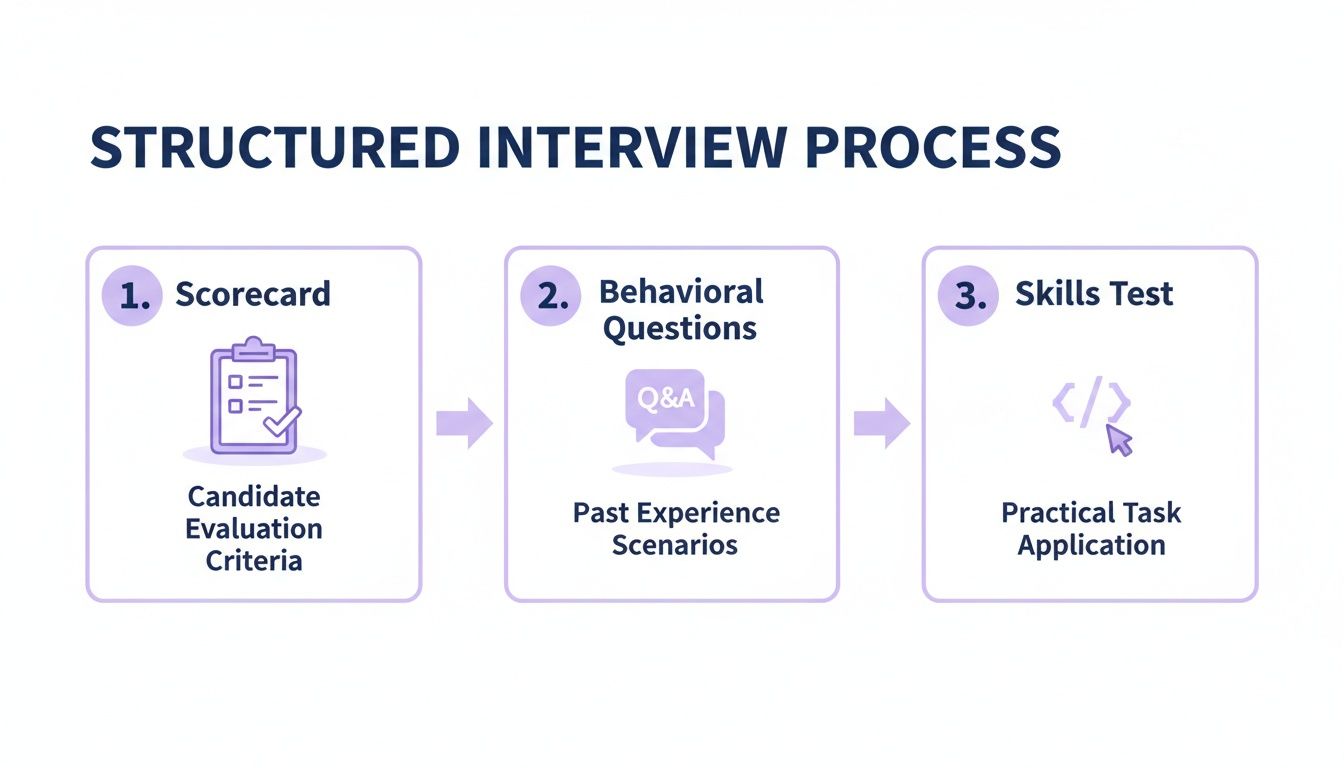
This approach ensures you gather objective data from scorecards, behavioral questions, and skills tests, which makes the final debrief faster and far more decisive.
To see just how much time and money this saves, let's compare the old way with a more modern, platform-driven approach.
| Hiring Stage | Traditional Process (The Grind) | Best Practice Process (The Accelerator) |
|---|---|---|
| Sourcing & Screening | 3-4 weeks: Manual sourcing on LinkedIn, sifting through hundreds of irrelevant résumés. | 1 week: Access a pre-vetted talent pool. AI matching delivers qualified candidates in days. |
| Interviews | 2-3 weeks: Disorganized, multi-round interviews with no clear structure or scoring. High risk of bias. | 1 week: Structured interviews using scorecards. Objective data collection for fast, fair decisions. |
| Decision & Offer | 1-2 weeks: Slow internal debriefs, "gut feel" decisions, and delayed offer letters. | 24-48 hours: Data-driven debrief. A compelling offer is extended immediately after the final interview. |
| Legal & Compliance | 4-8 weeks: Lawyers, accountants, and consultants trying to navigate foreign labor laws. | 1 day: Integrated Employer of Record (EOR) handles all contracts, payroll, and compliance in one click. |
| Total Time-to-Hire | 10-17 weeks (2.5 – 4 months) | < 3 weeks |
The difference is stark. While the old-school method gets bogged down in administrative quicksand, a best-practice approach cuts through the noise, saving months of work and ensuring you never lose your top candidate to a faster competitor.
For cross-border hiring, this is where things get really hairy. You’ve found a killer engineer in Brazil, but now you’re staring down a mountain of questions about local labor laws, payroll taxes, and statutory benefits.
Honestly? Don't even try to figure this out yourself. This is a classic founder trap that ends in a six-month administrative nightmare and, potentially, serious legal trouble.
The solution is an Employer of Record (EOR). An EOR acts as the legal employer in your new hire's country, handling the entire administrative stack: compliant contracts, local payroll, taxes, and benefits. Platforms like LatHire have this service built-in, turning an international compliance headache into a simple, one-click process.
This is how you close top global talent before they even get a chance to consider a counteroffer from their current boss. You move with speed, clarity, and a professional process that screams, "We have our act together."
You've made it this far, which means you’re serious about building a recruitment process that doesn't feel like you’re constantly fighting fires. But I get it—theory is one thing, and the real world is another.
Let's tackle some of the most common, and frankly, most important, questions we get from founders and hiring managers in the trenches. These are the "but what about…" moments that can derail even the best-laid plans.
So, let’s clear the air.
For most tech, marketing, or operational roles, you should be aiming for 2-3 weeks from job kickoff to a signed offer. That might sound insane if you’re used to the traditional slog, but it's absolutely achievable.
Anything longer than a month is a red flag. It means your process has a bottleneck somewhere, and you’re bleeding top candidates to faster, more decisive competitors. Speed isn’t about rushing; it’s about being ruthlessly efficient and respecting everyone's time.
Here's how that breaks down:
It’s an aggressive timeline, but a best-in-class recruitment process is built on momentum.
It’s not bad interviews or lowball offers. The biggest mistake, hands down, is having an undefined or inconsistent process. When every hiring manager runs their own ad-hoc playbook, you get a toxic cocktail of bias, inefficiency, and a nightmarish candidate experience.
The 'Success Profile' we talked about earlier is the cure. By defining the role's mission, key outcomes, and required competencies upfront, you create a standardized system. It's your single source of truth for the entire process.
This forces every interviewer to measure candidates against the same objective yardstick. It replaces "I like their vibe" with "They provided concrete evidence of achieving X, Y, and Z." It’s also your best defense if a hiring decision is ever challenged.
Consistency isn't sexy, but it's the foundation of every great hiring machine. It forces you to think critically about what you truly need before you start talking to people, which saves you from making incredibly expensive hiring mistakes down the line.
Honestly? Don't. Just don't even try to handle it yourself. This is the classic founder trap—you think you can save a few bucks by DIY-ing global compliance, and six months later you’re tangled in a legal and administrative mess that costs ten times as much to fix.
The best practice here is unequivocal: use an Employer of Record (EOR) service.
An EOR acts as the legal employer in your talent's home country. They manage everything from locally compliant contracts and payroll to taxes and benefits. You get all the upside of global talent without any of the soul-crushing administrative burden. Platforms like LatHire have this service built right in, so you can hire a brilliant developer in Colombia as easily as you would in your own city.
This is a great question, and the answer is: it depends entirely on how you use it. AI can be a powerful force for objectivity, or it can amplify hidden biases at scale. The key is using it for the right tasks.
Using AI to match a candidate's verified skills against the core competencies of a job is far more objective than a recruiter's gut feeling based on the font on a resume. It strips out irrelevant factors like university prestige or a familiar-sounding company name, reducing human bias at the top of the funnel.
However, AI should never make the final hiring decision. The best practice is a "human-in-the-loop" model. AI provides a high-quality, data-driven shortlist, and trained humans make the final, context-aware call. It's about augmenting human judgment, not replacing it.