Let's be real: the traditional screening process is a colossal waste of time. It’s a low-yield, high-friction dance of scheduling emails and repetitive phone calls that barely scratch the surface of a candidate's actual potential. It's the reason your hiring pipeline moves at a glacial pace.
And honestly? It's broken.
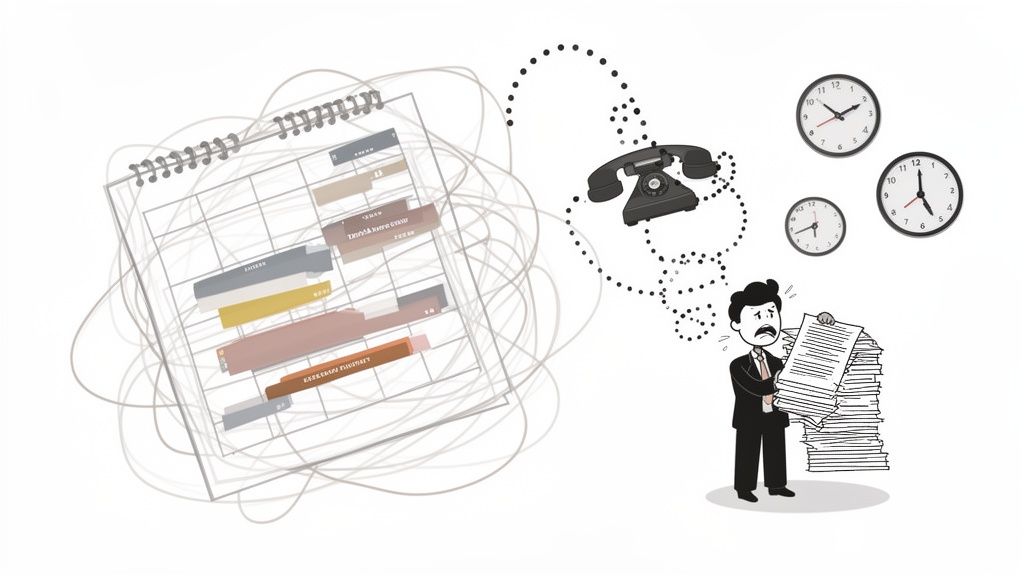
If you’ve ever found yourself asking the same five questions to ten different people in a single afternoon, you know the pain. That initial phone screen feels productive, but it’s really just a time sink disguised as due diligence. Hope you enjoy spending your days playing calendar Tetris—because that’s your full-time job now.
This isn't just an inconvenience; it's a competitive disadvantage. While you’re coordinating time zones and chasing down candidates who ghost you, your competitors are already making offers.
The true cost of a slow screening process isn't just the recruiter's salary. It's the compounding interest of inefficiency that slowly bleeds your company dry.
We're talking about the very real, very painful costs of:
This isn't about being lazy; it's about being strategic. The goal is to move from asking "Who's available Tuesday at 2 PM?" to "Who's the best fit for this role, right now?"
The entire song and dance is built on a faulty premise—that a 15-minute scheduled call is the best way to get a first impression. It’s not. It’s just the way it’s always been done. This is where a one way video interviewing process becomes the logical antidote to a fundamentally broken system.
When used correctly, it delivers serious results. Industry reports show teams cutting screening costs by 24–45% and slashing their review workload by up to 75%. The best part? They’re doing it with screening cycles that are over 36% faster.
This shift is about more than just technology; it's a mindset change. It acknowledges that the old way is not just inefficient but actively harmful to your ability to attract and hire the best people. Beyond video interviewing, it's worth exploring how chatbots in HR are transforming recruitment and support, offering a broader view of smart automation.
It's time to stop thinking about mortgaging your office ping-pong table for another recruiter and start fixing the process itself.
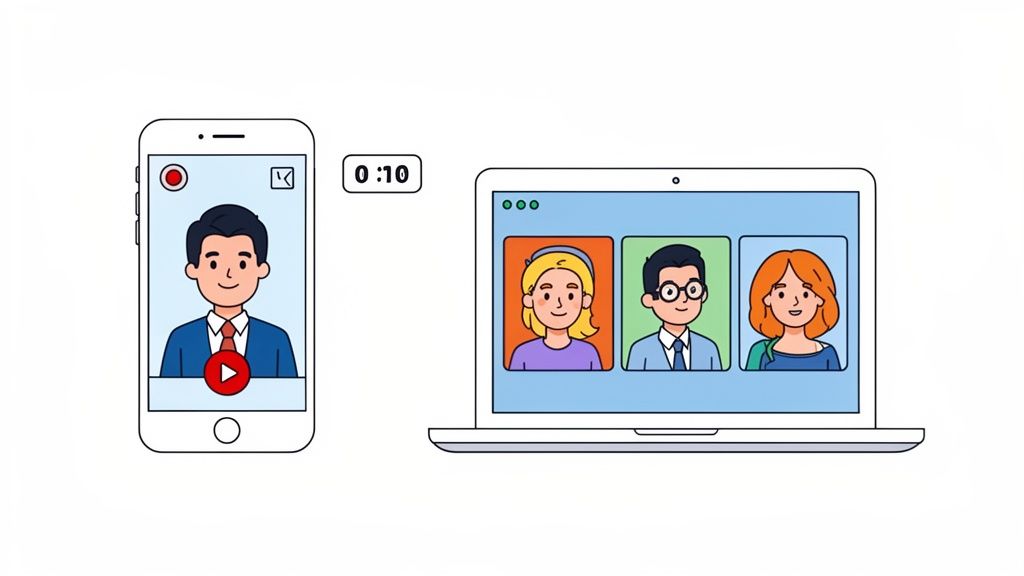
Alright, let's cut through the corporate-speak. A one way video interview is simple: you send a list of questions, and candidates record their answers on their own time. That’s it. No scheduling gymnastics, no awkward small talk.
Think of it less like a formal interview and more like a dynamic, video-based cover letter that actually reveals something useful. It’s like leaving a detailed voicemail instead of playing endless phone tag—one is efficient and packed with information, the other is a slow-motion productivity killer.
This isn't a live Zoom call where everyone pretends their internet is stable. The "asynchronous" part is its superpower. You send the prompts; they record when they're ready. This simple shift is what transforms your initial screening from a logistical nightmare into a streamlined, high-signal process.
The mechanics are straightforward. You decide on a handful of killer questions that probe for real skills, not just résumé buzzwords. Then, you set the rules of engagement.
This isn't some futuristic HR experiment. It’s a pragmatic tool for busy people who need to find great talent without sacrificing their entire week. It’s about getting to the core of a candidate’s communication skills and personality, fast.
The adoption of this method isn't a niche trend; it's a full-blown movement. After 2020, the use of video interviewing exploded, and it’s not slowing down. By 2024, surveys showed that up to 81% of recruiters were using video interviews in their hiring workflows, with the one-way format specifically rising by 67%. Discover more insights into these video interview statistics and why 93% of companies that made the switch plan to stick with it.
It's easy to lump all "video interviews" together, but that's a mistake. They solve completely different problems. One is for screening at scale; the other is for deep-dive conversations. Getting your head around these differences is key, so we've broken down some of the most critical online interview techniques for both formats in our guide.
Here's a quick breakdown of where each one shines (and fails).
| Feature | One Way Video Interview (Asynchronous) | Live Video Call (Synchronous) |
|---|---|---|
| Scheduling | Zero scheduling required. Send a link and wait for responses. | A nightmare. Requires back-and-forth emails and calendar coordination. |
| Consistency | Highly consistent. Every candidate gets the same questions and experience. | Inconsistent. Conversations can vary wildly based on interviewer mood or bias. |
| Time Investment | Low. Review 10 candidates in the time it takes to do 1-2 live calls. | High. Requires dedicated, uninterrupted blocks of time for each candidate. |
| Team Collaboration | Easy. Share links for review and feedback on your own schedule. | Difficult. Requires getting everyone on the same call at the same time. |
| Best For | Top-of-funnel screening to quickly assess a large pool of applicants. | Late-stage interviews to build rapport and dive deep with finalists. |
Looking at them side-by-side, the picture becomes crystal clear. One-way video is a top-of-funnel powerhouse designed for efficiency and fairness, while live calls are for building personal connections with your finalists. Using the right tool for the right stage is what separates a smooth hiring process from a chaotic one.
Let’s connect the dots. A one-way video interview isn't just a "cool feature" to add to your careers page. When used right, it becomes a must-have weapon in your hiring arsenal—an almost unfair advantage that helps you systematically out-hire your competition.
The real win here goes way beyond just saving a few hours on scheduling. It’s about making smarter, faster, and fundamentally less biased hiring decisions. It’s about moving from gut feelings to actual evidence.
When you ask every single candidate the exact same questions in the exact same format, you create a level playing field. Suddenly, you're not comparing who had a better phone connection or who was more charming on a Tuesday morning. You’re comparing apples to apples, based on the substance of their answers.
The old way is a mess of variables. One interviewer asks about a candidate’s hobbies, another dives deep into a specific project. By the end, you’re comparing notes that look like they came from two completely different conversations.
A structured one-way video interviewing process forces discipline. It makes you sit down and decide what actually matters for the role before you ever speak to a candidate.
This upfront thinking pays massive dividends by:
This shift from conversational chaos to structured evaluation is the first step in building a repeatable hiring machine instead of relying on luck. It’s how you start finding those hidden gems your competitors overlook.
Remember trying to schedule a call with a rockstar developer in Buenos Aires when your team is in San Francisco? The timezone chaos alone is enough to make you want to give up. Hope you enjoy your 7 AM and 9 PM calls, because that’s now your life.
Asynchronous interviews obliterate this problem entirely. It’s a game-changer for any company serious about building a remote or distributed team.
Your talent pool is no longer limited to who’s awake when you are. The best person for the job can record their answers at 3 AM their time, and your team can review them over coffee the next morning.
This isn’t just a convenience; it’s a strategic imperative. By removing the barrier of synchronous communication for initial screening, you instantly expand your access to a global talent pool. Companies that nail this can tap into markets their competitors can’t even reach.
Ultimately, hiring is about placing the right bets. A bad hire isn’t just a waste of salary; it’s a drain on team morale, a black hole for productivity, and a huge setback for your roadmap. The cost of getting it wrong is astronomical.
One-way video interviewing acts as your ultimate risk-reduction tool. By getting richer, more detailed insights at the very top of the funnel, you drastically reduce the odds of advancing the wrong people. You’re not just moving faster; you’re moving smarter.
You get to see how a candidate thinks, communicates, and presents themselves under a bit of pressure—all before you invest a single minute of your senior team’s time in a live call. That’s not just efficient. That's how you win.
This is the part where most companies crash and burn. If your brilliant idea for a one-way video interview is to just ask, "So, tell me about yourself," then congratulations—you’ve built a high-tech machine for collecting generic, rehearsed nonsense. You'll get the same canned answer they’ve given a hundred times before.
A great one-way video interview isn’t just about the technology; it’s about the psychology. You have to design questions that poke, prod, and pull out genuine insights that a résumé could never show. The goal is to get them off-script and see how they really think.
So, how do you do it? You stop asking questions that can be answered with a quick Google search and start asking questions that require actual brainpower.
The most powerful questions you can ask are rooted in reality. They’re not hypotheticals about what a candidate would do; they’re behavioral or situational prompts about what they have done.
Anyone can say they’re a "team player." Far fewer can describe a specific time they navigated a brutal team conflict without sounding like a politician.
This is your playbook for crafting questions that get real answers:
This approach forces candidates to pull from real experience. It filters out the smooth talkers from the actual problem-solvers. This is also where you can get a glimpse into their practical abilities, which is a key component of effective pre-employment skills testing.
Let’s get practical. Transforming your interview from a box-ticking exercise to a genuine talent filter starts with reframing your questions. Here’s a side-by-side look at how to level up your prompts.
| Instead of This (The Bad) | Ask This (The Good) | Why It Works |
|---|---|---|
| "What are your greatest weaknesses?" | "Describe a time a project you were on went completely off the rails. What was your specific role, and what did you personally learn from it?" | It forces self-awareness and accountability instead of a rehearsed, fake weakness like "I'm a perfectionist." |
| "Are you a team player?" | "Tell me about the most difficult team you’ve ever had to work with. What made it challenging, and how did you adapt your style to get results?" | It moves beyond a simple "yes" to uncover their real-world collaboration and conflict-resolution skills. |
| "Where do you see yourself in five years?" | "Looking at the responsibilities for this role, which part do you think you’ll excel at immediately, and which part will be your biggest learning curve?" | It's grounded in the actual job, revealing their self-perception, ambition, and honesty about their current skill set. |
See the difference? The "good" questions can't be faked. They require a story, a reflection, and a level of detail that only comes from genuine experience.
Finally, the structure you create around the questions is just as important as the questions themselves. Don’t just throw prompts at candidates and hope for the best.
A well-designed interview gives candidates the context they need to succeed while creating the constraints you need to evaluate them fairly.
Give them clear guardrails. For each question, specify:
This isn’t about tricking candidates; it’s about creating a standardized environment where you can fairly compare everyone. Get the questions right, and you'll be amazed at the clarity you gain.
Let's get straight to the big question: Do candidates absolutely hate this?
I get it. The thought of talking to a screen instead of a person feels a little… dystopian. But the fear that one-way video interviewing is automatically cold and impersonal just isn't true.
The short answer is no, candidates don’t hate it—if you don't mess it up.
A poorly designed, clunky, or thoughtless video interview will absolutely create a terrible experience. Then again, a chaotic, disorganized, and disrespectful traditional process is infinitely worse. Leaving a candidate hanging for weeks is far more insulting than asking them to record answers on their own schedule.
Flip the script for a moment and see it from their side. A well-designed asynchronous process can actually be one of the most respectful things you can offer a busy professional.
You're essentially telling them: "We value your time. You don't need to take a day off work, scramble to find a quiet space during your 9-to-5, or play scheduling Tetris for a 20-minute screening call."
Instead, they get to prepare and record their answers when they're at their best—whether that's 10 PM on a Tuesday or 7 AM on a Saturday.
A thoughtful, structured process signals that your company is organized, modern, and respects people's lives outside of work. A chaotic scheduling process signals… well, the opposite.
This isn’t about replacing human interaction. It's about making the eventual human interaction far more meaningful by saving everyone's time for the conversations that truly matter.
So, how do you design a one-way video interview that candidates actually appreciate? It all comes down to transparency and treating them like people. Here’s a no-nonsense checklist.
In the end, a candidate's experience is a direct reflection of your company's culture. A rushed, impersonal process—video or in-person—will always leave a bad taste. But a well-executed one-way video interview can set the stage for a positive relationship, showing that you're a company that gets things done efficiently and with respect.
So, you're sold on the concept. A one-way video interview is a killer tool for filtering candidates without burning out your team. But a great tool is useless if it’s just sitting in the shed. Its real power comes from how seamlessly it plugs into your entire hiring machine.
Let’s be blunt: if you’re manually emailing video interview links and then copy-pasting feedback into a spreadsheet, you’ve missed the point entirely. You’ve just traded one tedious task for another. The goal is to build an automated, elegant workflow that hums along with minimal intervention.
Think of it as an assembly line. A candidate applies, and your Applicant Tracking System (ATS) automatically triggers an email with a link to the video interview. No human touches it. They submit their answers, and the right people on your team get a notification to review—on their own time, of course.
The beauty of this system is that it creates momentum. Each step feeds the next, pushing only the most qualified people forward. It’s not just a funnel; it’s a flywheel that gets smarter and faster over time.
Here’s what that looks like in the real world:
This process is what slashes hiring time from months to mere days. It’s methodical, repeatable, and scales without you having to mortgage the office ping-pong table for more recruiters.
This infographic breaks down the essential steps to ensure this process respects the candidate's journey from start to finish.
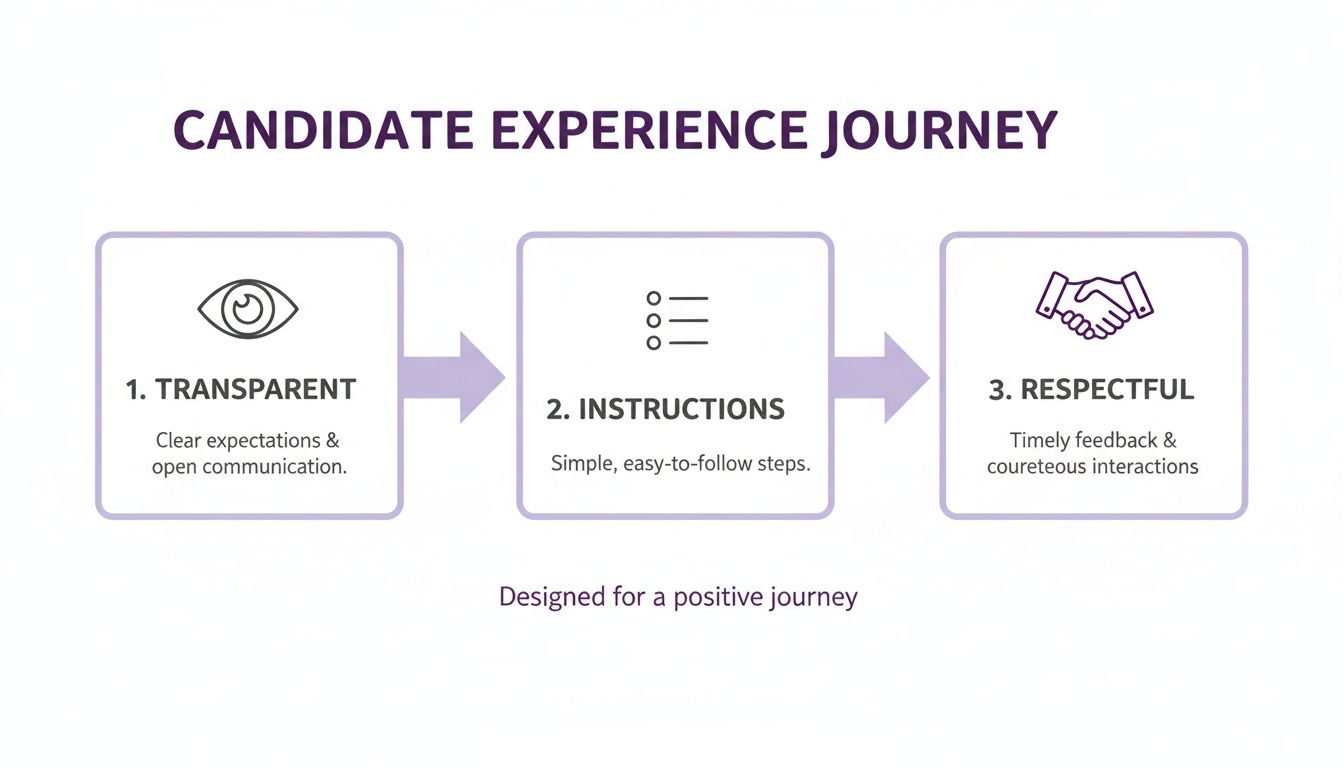
The visualization highlights that a positive experience hinges on transparency, clear instructions, and a respectful process, turning a potentially robotic step into a human-centric one.
Once you’ve nailed the workflow, you can start layering in other efficiencies. The technology that powers a one-way video interview—namely, transcription and AI analysis—has applications across your entire hiring process.
A one-way video interview isn't the finish line; it's the starting pistol for a smarter, more data-rich recruitment cycle.
For instance, the underlying transcription tech can be a lifesaver in other areas. Many teams now use tools that provide accurate recruiter phone screen transcription for later-stage calls, creating a searchable record of every important conversation. This allows for better collaboration and ensures no critical details are lost.
By integrating video screening as the powerful front door to your hiring process, you stop wasting time on low-value tasks. You free up your team to focus on what they do best: building relationships with the handful of finalists who have already proven they’re worth the investment. That’s not just efficient—it’s how you win.
Alright, let's tackle the nagging questions that are probably bouncing around in your head. I get it—adopting new tech can feel like a leap of faith, but the old way of sifting through hundreds of resumes just doesn't scale. Here’s a quick-fire round to clear up the most common concerns.
This is the big one, and for good reason. The short answer: yes, they are absolutely legal, but you have to be smart about it. The same rules that apply to any other interview—live, phone, or in-person—apply here.
The key is standardization. Because every single candidate answers the exact same questions under the same conditions, you’re actually creating a more consistent and fair process. This structure is a powerful tool for reducing the unconscious bias that can creep into less formal chats.
Just make sure your questions are laser-focused on job-related skills and steer clear of anything that could touch on protected characteristics like age, gender, or family status. It’s never the tool that’s illegal; it’s asking the wrong questions.
Honestly, this is less of a problem than you might think. If someone is going to the trouble of having an expert whisper answers off-camera for a top-of-funnel screening, they’re probably not the authentic, resourceful person you want to hire anyway.
The tight time limits for thinking and responding make it incredibly difficult to script a polished, natural-sounding answer on the fly. You can usually spot the cheaters. Their eyes will be darting off-screen, their answers will sound disjointed, and the whole thing just feels… off. A one-way video interview is a fantastic filter for authenticity. It’s hard to fake genuine passion or expertise when the clock is ticking.
Absolutely not, and it shouldn't. Thinking a one-way video interview can replace a deep-dive technical assessment or a final culture-fit conversation is a rookie mistake. It’s a screening tool, not a silver bullet.
Its job is to get the top 20% of applicants to the next round with 80% less effort. It's a powerful filter, not the finale.
Use it for what it's brilliant at: efficiently and fairly screening a large pool of candidates at the very top of your hiring funnel. This frees up your team’s valuable, synchronous time for the finalists who have already proven they’re serious contenders. Don't try to make one tool do everything—that's how you end up with a process that does nothing well.