
Let's be honest: no founder ever scribbled “master global tax withholding laws” on their whiteboard of startup dreams. So why are you still acting like it's your job?
Payroll outsourcing services exist to take that nightmare off your plate. They let a third-party expert handle everything from calculating pay to filing taxes, so you can get back to building the business you actually wanted to build.
Nobody gets into business to become a payroll expert. Yet, here we are.
It starts small—a few paychecks, maybe a simple tax form. Then you hire your fifth employee, then your tenth. Suddenly, you’re spending your Tuesday afternoons deciphering withholding codes instead of, you know, talking to customers.
Managing payroll in-house feels responsible at first. You think you’re saving money and keeping control. But what you’re really doing is giving a critical, high-risk function to someone who is most likely not a payroll professional. It’s like performing your own dental work to save a few bucks. Brave? Maybe. Smart? Absolutely not.
The hidden costs of DIY payroll stack up fast. It’s not just the hours you lose; it’s the compounding effect of that lost time. Every minute spent wrestling with payroll is a minute you’re not spending on product, sales, or closing that next big round of funding.
Consider the true drains on your resources:
You're essentially paying a premium—in your own time and opportunity cost—to perform a non-core function that experts can do better, faster, and with far less risk.
This isn’t just about offloading a chore. Opting for payroll outsourcing services is a strategic decision. It’s about reclaiming your most valuable asset—your focus—and redirecting it toward activities that actually move the needle. It's trading a recurring headache for a predictable, and surprisingly affordable, monthly fee.
The real question isn’t whether you can afford to outsource, but whether you can afford not to.
Let's clear the air. "Payroll outsourcing" isn't a one-size-fits-all magic wand. It’s more like walking into an ice cream shop—there are a few core flavors, and picking the wrong one will leave a bad taste in your mouth.
You’re probably staring down a barrel of acronyms: basic processors, PEOs, and EORs. Each one promises to solve your payroll headaches, but they do it in wildly different ways. Choosing the right one depends entirely on what you actually need, not what their sales team says you need.
To visualize the core pains driving this decision, we created a simple map showing how in-house payroll eats away at your most valuable resources: time, compliance, and growth potential.
This really nails it down—these aren't just administrative tasks. They are active roadblocks that keep your business from scaling efficiently.
Let's break down the solutions.
First up is the most basic option: the standalone payroll processor.
Think of this as the food delivery service for your payroll. You still have to do all the HR "cooking"—hiring, firing, managing benefits, and ensuring your employee handbook doesn't violate three different labor laws. The processor just picks up your finished meal (the payroll data you provide) and delivers it by cutting the checks and filing basic taxes.
They are great at one thing: processing payroll. But that's where it ends. You remain 100% the employer and carry all the legal weight and HR responsibilities on your shoulders.
Who's it for?
The big "gotcha" here is that you can quickly outgrow it. The moment you hire someone in another state—or worse, another country—this model starts to creak under the strain of new compliance rules you're solely responsible for.
Next, we have the Professional Employer Organization, or PEO. This is a big step up in service.
A PEO works on a co-employment model. Picture it as a shared commercial kitchen. You bring your own team and your own "recipes" (company culture), but you get to use their industrial-grade ovens, bulk ingredient discounts, and cleaning crew.
In real terms, the PEO becomes the "employer of record" for tax purposes, allowing you to access their larger group benefits plans (like health insurance) at better rates. They handle payroll, benefits administration, and some HR compliance, but you remain the day-to-day manager of your employees. You're still co-liable.
A PEO is a fantastic model for US-based companies looking to offer big-company benefits without the big-company price tag. But its power fades the moment your ambitions cross a border.
The critical limitation? PEOs are almost exclusively a domestic solution. They aren't built for the complexities of international employment law. Trying to hire someone in Portugal through your US-based PEO is a non-starter.
Finally, we arrive at the Employer of Record, or EOR. This is the five-star, full-service restaurant of payroll outsourcing.
With an EOR, you don’t just get help—you hand over the entire legal burden of employment. The EOR legally hires talent on your behalf in other countries, using their own local business entities so you don't have to set them up yourself.
They handle everything:
You find the talent and manage their daily work, while the EOR handles the rest. This model is built from the ground up for global, remote teams. It's the only scalable way to hire the best person for the job, whether they’re in Bogota or Berlin. For anyone serious about building a distributed team, exploring the nuances of global payroll services is the logical next step.
When you're building a distributed company, integrating these functions becomes key. If you're considering a comprehensive approach, exploring dedicated offerings like professional payroll bookkeeping services can provide an integrated solution for your financial needs, ensuring all your numbers line up perfectly.
Here’s a quick comparison of the three main payroll outsourcing models to help you identify the best fit for your business.
| Feature | Standalone Payroll | PEO (Co-Employment) | EOR (Employer of Record) |
|---|---|---|---|
| Legal Employer | You | You & PEO (Co-employers) | EOR |
| Core Service | Payroll & Tax Filing | Payroll, Benefits, some HR | Payroll, Benefits, HR, Legal Compliance |
| Best For | Small, single-location businesses | US-based SMBs seeking better benefits | Companies hiring globally |
| Benefits Access | Your own plans | PEO's large-group plans | EOR's country-specific statutory plans |
| Geographic Scope | Limited, typically domestic | Domestic (US-focused) | Global |
| Compliance Risk | Fully on you | Shared responsibility | Fully on the EOR |
This table makes the distinctions crystal clear. If you're a simple, local business, a standalone processor might be enough. If you’re a growing US company wanting better benefits, a PEO is a solid choice. But if your vision is global, an EOR is the only model that truly scales.
Let's talk about the real cost of outsourcing payroll—the numbers that don't make it onto the glossy pricing page. If you think the price is a simple per-employee-per-month fee, I've got some bad news. I’ve learned the hard way that the sticker price is just the opening bid in a much more complicated negotiation.
The truth is, many providers nickel-and-dime you with fees you never saw coming. It’s a classic move. They lure you in with a low base rate, knowing they’ll make their real money on the back end with a flurry of charges for things you thought were, well, part of the service.
Before you sign any contract, you need to become a pricing detective. That advertised monthly fee is almost always just the starting point. I've seen it all, from the classic setup fee to charges for tasks that are absolutely fundamental to running payroll.
Here's the kind of stuff they love to hide in the fine print:
It’s a minefield out there. You have to press sales reps on what “all-inclusive” actually means. Then get it in writing.
So, how do you figure out if outsourcing is actually worth it? You have to weigh the provider's bill against the "soft costs"—the ones that are silently killing your productivity and exposing you to massive risk.
This isn’t just about the invoice versus an in-house person's salary. It's about a total cost of ownership that most founders completely ignore until it’s way too late.
The real calculation isn't what you pay for outsourcing. It's what you pay when you don't. Think six-figure compliance penalties, hours of your own time squandered on administrative tasks, and the opportunity cost of not building your actual business.
Let’s be brutally honest about the costs of DIY payroll:
When you add it all up, the predictable monthly fee for a good payroll partner starts to look like a bargain. The key is finding one with transparent pricing that doesn’t treat every single interaction as a chance to send you another invoice. Make them show you the total cost, not just the bait.
Hiring internationally is a massive win—until you slam headfirst into the brick wall of cross-border compliance. Trust me, I’ve hit that wall. It hurts.

Paying someone in another country isn't like sending a wire transfer. It’s a completely different universe of rules. Suddenly, you're juggling different currencies, obscure tax laws, mandatory benefits, and labor regulations that seem to change with the weather.
This isn’t about fear-mongering; it's about being brutally realistic. The assumption that you can just “figure it out” is the single most expensive mistake a founder can make when going global.
I’ve either made these mistakes myself or watched friends make them. They are painful, expensive, and entirely avoidable. Don't be the cautionary tale your friends talk about over coffee.
Here’s where things go sideways fast:
These aren't edge cases. They are the standard operating procedure in most of the world. Each country has its own unique minefield of rules you're expected to know intimately.
Hope you enjoy spending your afternoons fact-checking international labor law—because that’s now your full-time job. Or, you could get smart about it.
This is precisely the problem that a modern Employer of Record (EOR) is built to solve. An EOR isn't just a processor; it's your local legal and HR entity on the ground. They're the ones who have already navigated the minefield, so you don't have to.
An EOR takes on the legal liability of employment. They know the difference between statutory and customary benefits in France, they understand termination protocols in Colombia, and they ensure every paycheck is 100% compliant with local law.
Think of it this way: instead of trying to become an expert in dozens of different legal systems, you partner with someone who already is. They put your new hire on their locally compliant payroll, manage all the statutory withholdings, and ensure the employment contract will actually hold up in court.
You get to manage your team member's day-to-day work, while the EOR handles the legal and financial scaffolding that keeps the whole thing from collapsing. For companies serious about building a global team without the accompanying legal headaches, this isn't a luxury; it's a necessity. We've even put together a comprehensive payroll compliance checklist to help you understand the sheer scope of what's involved.
The bottom line is simple. You can either spend your time and capital becoming a mini-multinational law firm, or you can focus on building your product and let an expert handle the risk. The choice seems pretty obvious to me.
Let’s be honest. Choosing a payroll provider isn't like picking out new office snacks. You’re handing over the keys to one of the most critical, sensitive parts of your business. A mistake here doesn’t just mean a late paycheck; it means a total breakdown in trust with your team.
This is your battle-tested checklist for vetting potential partners, and it goes way beyond a simple feature comparison. Forget the slick marketing PDFs. This is about asking the tough questions that separate a genuine partner from a glorified data-entry clerk.
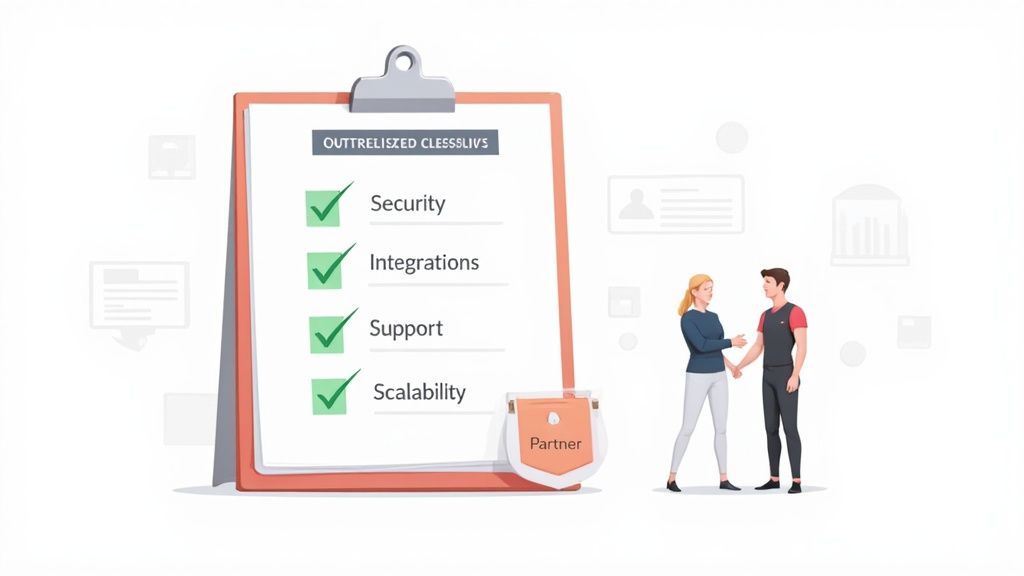
Every provider will tell you they can run payroll. That’s table stakes. The real test is what happens when things get complicated—because they always do.
Start with these non-negotiables:
Here’s my favorite test: ask about their customer support. Are you getting a real human who understands the urgency of a payroll issue, or a chatbot that just lobs knowledge-base links at you?
A payroll problem is a five-alarm fire. You need a dedicated account manager or a responsive expert who picks up the phone—not a ticket number in a queue that gets answered in 48 hours.
When payroll goes wrong on a Friday afternoon, the quality of your provider’s support team becomes the only thing that matters. Don’t underestimate its importance.
The decision gets even more critical when you start hiring internationally. Many payroll outsourcing services that are great domestically are completely out of their depth with global compliance. You can't just bolt on an international module and call it a day.
This is where you need a true global partner, often an Employer of Record (EOR). As our guide on what is an Employer of Record explains, this model is built from the ground up to handle the legal, tax, and HR complexities of hiring across borders. A true EOR has local entities and on-the-ground expertise, ensuring your international team is hired and paid in full compliance with local laws.
This choice is exploding in popularity for good reason. The global payroll outsourcing market is projected to hit USD 16.87 billion by 2030, with smaller businesses being a key driver as they seek enterprise-level tools to navigate complex regulations.
Ultimately, remember that this isn't just a software purchase; you're entering a long-term relationship. As you evaluate options, keep in mind that success hinges on solid vendor management best practices. Find someone who acts less like a vendor and more like an extension of your own team.
Alright, let's wrap this up. We’ve pulled back the curtain on the jargon, the hidden costs, and the different ways you can hand off payroll. So, what’s the real takeaway for a founder who’s tired of being a part-time accountant?
It boils down to a simple truth: running payroll yourself is a false economy. You might think you're saving a few bucks, but you’re paying dearly in other ways—with your own time, your team's focus, and by shouldering a huge, unnecessary compliance burden. It's a low-value task with incredibly high-stakes consequences. The goal isn’t just to cut checks; it’s to make payroll a strategic non-issue.
This isn't just a summary; think of it as your playbook. It's time to stop getting lost in endless feature comparisons and start focusing on the few decisions that truly matter. Forget asking, "Who has the slickest dashboard?" and start asking the questions that will determine your reality a year from now.
Your next steps should be guided by three non-negotiable principles:
At the end of the day, there's one red flag that overrules all others: a provider that sells you a tool instead of a solution. A tool just automates a task you still have to manage. A real solution takes the entire problem off your plate.
The right partner doesn’t just process your payroll. They own the compliance, absorb the legal complexity, and give you back your most valuable resource—your time. Anything less is just a more expensive version of the headache you already have.
The bottom line is simple. Stop being your company’s amateur payroll clerk. It’s time to make the strategic choice to hand this critical function over to an expert whose entire business is built on getting it right, every single time.
Your team will thank you, your investors will thank you, and your future self—the one closing deals instead of chasing down tax forms—will definitely thank you.
We get it. Handing over your payroll feels like a big step. We’ve compiled the questions we hear most from founders in the trenches, with the kind of straight answers you won't get from a sales brochure.
The honest answer? It’s all over the map. You’ll see everything from a simple per-employee-per-month fee to complex tiered pricing. But the real cost isn't on the sticker—it's buried in the fine print.
Be wary of those lowball offers. They often hide extra charges for setup, year-end tax forms, or those inevitable off-cycle pay runs. The right question isn’t "What's your price?" but "What is the total, all-in cost with absolutely zero surprises?" Get that in writing.
This is the one that trips everyone up, so let's clear the fog.
A PEO (Professional Employer Organization) basically puts your team into a larger group to get better US-based benefits. Think of it as joining a big buying club for health insurance. The catch? You're in a co-employment relationship, which means you still share the legal liability, and it's almost exclusively a domestic solution.
An EOR (Employer of Record) is your specialist for hiring abroad. They become the full legal employer for your talent in other countries, shouldering 100% of the compliance risk. If you're hiring outside your home country, an EOR is the only model that truly works without you having to open a foreign entity.
Absolutely. In fact, you should. A good payroll partner handles the administrative and legal headaches, not the day-to-day leadership of your team. You still set the strategy, manage performance, and build the culture.
They handle the "how" of compliant employment so you can focus on the "what" and "why" of their work. Think of them as your operational backbone, not your team's new boss.
Their job is to make the legal and financial side of employment invisible, freeing you up to actually lead. If a provider ever tries to meddle in your team's daily workflow, run. That's a huge red flag and a sign they don't understand their role in the partnership.