
Let's be honest—the moment you desperately need a new hire was probably three weeks ago. Now you're scrambling, staring down a traditional hiring process that moves at a glacial pace. It feels like you’re sending a message in a bottle and just hoping a qualified candidate washes ashore.
This is where contract staffing services completely change the game.
You know the pain. You post a job opening and get buried under 200 applications. Hope you enjoy spending your afternoons fact-checking resumes and running technical interviews—because that’s now your full-time job. It’s slow, expensive, and a massive gamble.
Turns out there’s more than one way to bring elite talent on board without mortgaging your office ping-pong table.
Hiring a full-time employee is a marriage, complete with long-term financial commitments and a messy divorce if things don’t work out. The wrong fit doesn’t just drain your budget; it kills team morale and torpedoes project timelines. You’re paying for benefits, payroll taxes, and onboarding, all before you even know if they’ll deliver.
This isn't just a hunch; it's a massive market shift. The global contract and temporary staffing market has exploded to an estimated $500 billion, and it's projected to grow another 7% annually through 2033. This isn't a fad. It's businesses worldwide waking up and choosing agility over archaic, rigid hiring models. You can dive deeper into the boom with this market research report.
Think of contract staffing as talent-on-demand. It’s about surgically adding top-tier professionals to your team precisely when you need them, for exactly how long you need them. No drama, no long-term baggage.
This model isn't about finding a temporary warm body to fill a seat. It's a strategic move to gain a competitive edge. It lets you:
By embracing contract staffing, you stop reacting to hiring needs and start proactively building a dynamic, scalable workforce. It's one of the most effective flexible staffing solutions for companies that need to move fast without breaking the bank.
Deciding how to build your team can feel like a high-stakes choice. You have the traditional Full-Time Employee (FTE) model—the long-term, “let’s get married” commitment. Then you have Managed Services, where you hand over an entire function and just cross your fingers.
And sitting right in that sweet spot between them? Contract staffing.
Let’s cut the jargon. An FTE is a massive investment, locking you into salary, benefits, payroll taxes, and a potentially messy breakup if things don't pan out. Managed Services often feels like a black box; you give away the keys and lose direct control over the people actually doing the work.
Contract staffing, on the other hand, gives you expert skills exactly when you need them, without all the long-term baggage. Think of it like this: hiring an FTE is like buying a car. It's a huge commitment. Contract staffing is like calling a high-end Uber—it gets you exactly where you need to go, right now, with zero fuss.
This simple decision tree helps show when each path makes the most sense.
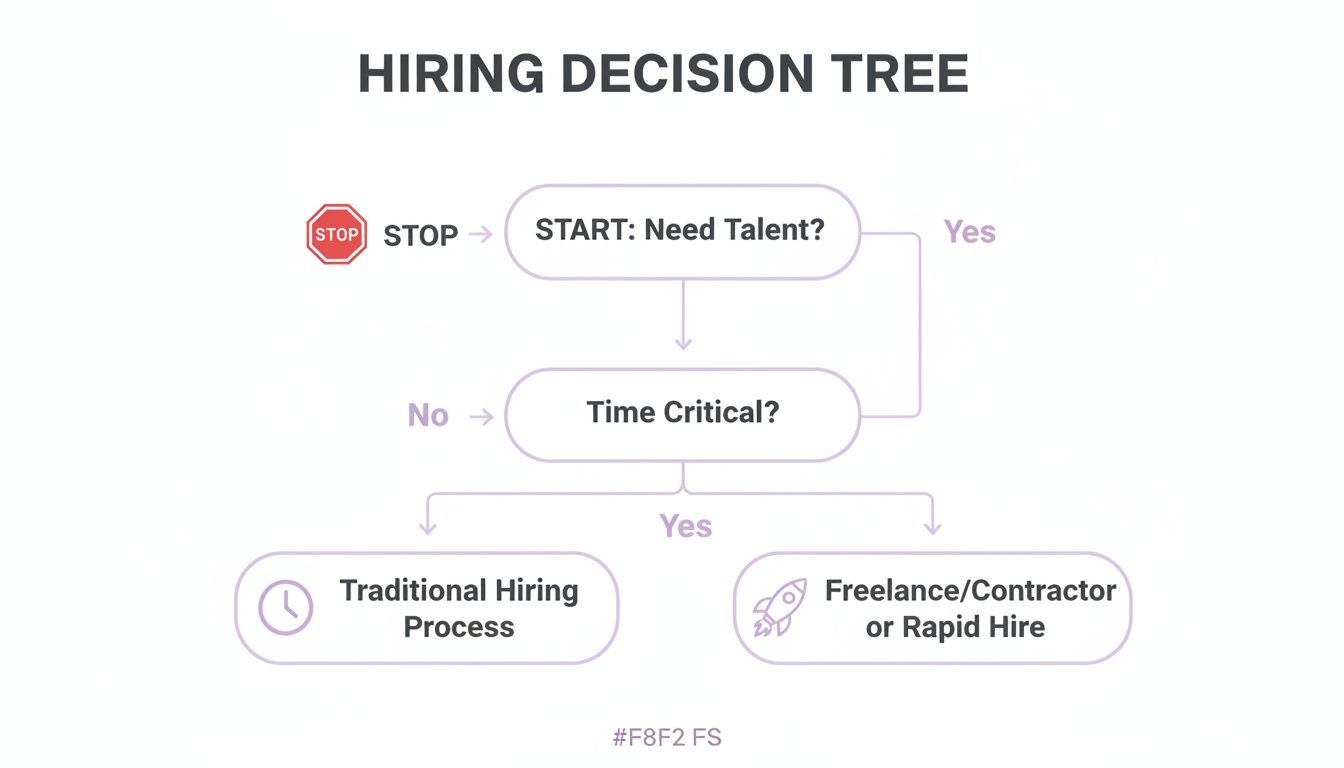
The flowchart makes it crystal clear: when you need to move fast, traditional hiring just can’t keep up with the agility contract staffing provides.
To really get the full picture, you have to look past the hourly rate. The true cost of an employee goes way beyond their salary. We're talking about benefits, insurance, equipment, and the hidden drain of a slow, clunky hiring process.
These decisions are even more critical when you’re just starting out. If you’re figuring out how to build your team from scratch, you can find some great guidance on hiring your very first employee that lays a solid foundation.
To make things simple, here’s a no-fluff breakdown of how these models stack up against each other in the real world.
Every hiring model comes with its own set of trade-offs in speed, cost, and control. This table breaks down what you're really signing up for with each option.
| Factor | Full-Time Hire (FTE) | Contract Staffing Services | Managed Services |
|---|---|---|---|
| Speed to Hire | Glacial. 4-8 weeks on average, often longer for specialized roles. | Fast. Can place pre-vetted talent in days or a few weeks. | Varies wildly. Weeks to months for setup and knowledge transfer. |
| Cost Structure | High upfront and ongoing costs (salary, benefits, taxes, overhead add 30-40%). | Predictable hourly or project-based rate. No hidden overhead. | Fixed monthly fee or project price. Can be costly with less transparency. |
| Flexibility | Low. Scaling up or down is slow, expensive, and legally complex. | High. Easily scale your team based on project needs. | Low. Locked into long-term contracts with a rigid scope of work. |
| Control | High. You have direct management over the employee and their work. | High. The contractor integrates directly with your team, reporting to you. | Low. You manage the outcome, not the people or the process. |
As you can see, contract staffing offers a unique blend of speed and control that’s hard to find elsewhere.
So, which model solves your problem today versus your five-year plan?
Full-time hires are for your core, long-term functions—the roles that literally define your company's DNA. Managed Services can work for standardized, non-core functions like an IT helpdesk, but just be prepared to give up control.
Contract staffing is your strategic lever for growth, speed, and specialization. It's for that critical project that can't wait, the niche skill your team is missing, or that rapid scaling phase where you need to move faster than everyone else.
It delivers a level of precision the other models just can't match. It’s also important to know the finer details; while they sound similar, there are key differences when you compare staff augmentation vs. consulting, which helps you refine your strategy even further.
Ultimately, contract staffing services provide a powerful middle ground, giving you the exact expertise you need, without the permanent overhead you don't.
So, when do you actually pull the trigger on a contractor instead of posting yet another job ad that gets you a hundred resumes and zero qualified candidates? Let's get tactical. Forget the high-level theory; this is about specific situations where contract staffing services aren't just a good idea—they're the only logical move.
Think of it as your strategic playbook for deploying on-demand talent, letting you outmaneuver slower competitors who are still stuck in the endless cycle of traditional hiring.
We’ve all been there. A critical project has a hard deadline, your team is already running on fumes, and the finish line seems to be moving further away. Your only options are burning out your best people or missing the deadline. Neither is a great look.
This is the classic scenario for contract staffing. You can bring in a specialist—a senior developer, a project manager, a data analyst—to inject immediate momentum and expertise. They hit the ground running, help you cross the finish line, and then gracefully exit. No long-term overhead, just a project saved from the brink.
What happens when you need a very specific, very rare skill set, but only for the next six months? Maybe it’s a cybersecurity expert who understands FedRAMP compliance or a machine learning engineer with experience in natural language processing.
Good luck finding that person on a standard job board in less than a quarter. With contract staffing, you tap into a curated network of specialists who thrive on this kind of focused, high-impact work. You get the exact expertise you need, for the exact duration you need it, without committing to a full-time salary for a skill you won’t need in a year.
Business is never a straight line. You have seasonal peaks, unexpected client wins, or temporary gaps from things like parental leave. Trying to manage these fluctuations with full-time hires is a recipe for disaster—you’re either overstaffed during lulls or understaffed during sprints.
This is where you use contractors like a volume dial for your workforce. You can scale up instantly to handle a surge in demand and then scale back down just as quickly, maintaining perfect operational balance. It’s the ultimate flexible workforce strategy.
This approach is fast becoming the new normal. Globally, 64% of employers plan to ramp up their use of contract pros in the coming years, contributing to a massive US staffing market worth over $198 billion. It’s a clear signal that agility is the new currency, a trend highlighted in these insights on key staffing industry trends.
Sometimes you’re just not sure if a new role is truly necessary. Will a full-time "Growth Marketer" actually generate enough ROI? Do you really need a dedicated DevOps engineer right now?
Hiring a contractor lets you test the waters without taking a massive plunge. You can bring someone in for three to six months to validate the role, define its responsibilities, and prove its value. If it's a massive success, you have the option to convert them to a full-time employee. If not, you’ve gained valuable data without the painful process of letting a permanent hire go.
It’s the smartest way to de-risk your headcount growth. Of course, once they're on board, you'll want to follow some contractor management best practices to ensure a smooth and productive engagement.
Hiring internationally sounds great in a strategy meeting. It’s all big-picture thinking and untapped talent pools. Then reality hits you late at night while you’re trying to decipher German labor laws or figure out Brazilian payroll taxes. Suddenly, you’re an accidental expert in global compliance, and it’s not a title you ever wanted.
Let's be blunt: going global on your own is a minefield. You’re one wrong move away from misclassifying a worker in Spain, violating local employment standards in Canada, or creating a permanent establishment tax nightmare in the UK. Hope you enjoy that adrenaline rush, because it’s a daily part of the DIY approach.
This is where a strategic partner offering contract staffing services isn’t just a nice-to-have—it’s your shield.

So you’ve found the perfect developer in Argentina. Awesome. Now, how are you going to pay them legally? What about benefits? Are you compliant with their local 13th-month salary laws? A spreadsheet and a prayer are not an international payroll system.
Trying to DIY this stuff leads to some predictable, painful outcomes:
It’s an administrative vortex that pulls you away from your actual job: running your business. The global talent maze requires more than just a map; you need a guide who has walked the path a thousand times.
This is where a concept called Employer of Record (EOR) comes into play, and it’s simpler than it sounds. Think of an EOR as your in-country legal and HR department, ready to go on day one. You find the talent anywhere in the world, and the EOR handles the rest.
An EOR legally employs talent on your behalf in their home country. They manage all the compliance, payroll, and benefits administration, while the professional works for you, integrated into your team just like anyone else.
It's the ultimate "have your cake and eat it too" solution for global hiring. You get access to a worldwide talent pool without ever having to set up a foreign legal entity or become an expert in international labor law. All the risk and administrative burden? It’s on their shoulders, not yours.
When navigating the global talent maze, understanding the unique needs of a flexible workforce, such as digital nomads, is increasingly vital. An EOR structure is perfectly built to support these modern work arrangements, ensuring compliance no matter where your talent is based.
This isn’t about outsourcing paperwork. This is a strategic growth decision. By using a contract staffing partner with EOR capabilities, you fundamentally change how you scale your company.
You can now:
The world is full of brilliant people. A modern approach to contract staffing services means you can finally hire them without drowning in complexity. It’s about turning a massive, intimidating world into your personal talent pool.
Picking a contract staffing firm can feel like swiping through a dating app. Every profile looks great, promising the “best talent” and “seamless integration.” But how do you spot the real deal from the partner who will ghost you the second an invoice is paid?
Let’s be honest: most firms look identical on paper. They all claim to have a proprietary process and a secret pool of unicorn candidates. To see past the slick sales pitch, you need to ask the questions that make them squirm a little.
Forget asking, “What’s your process?” You’ll just get a rehearsed answer about their “rigorous multi-step vetting methodology.” It’s meaningless corporate-speak.
Instead, get to the heart of what matters when things inevitably go sideways. A great partner isn’t one where nothing goes wrong; it’s one that knows exactly how to fix it when it does.
The Litmus Test Question: "Tell me about a time a placement failed in the first 30 days. What happened, and how did you make it right for the client?"
Their answer tells you everything. Do they blame the client or the candidate? Or do they own the mistake and describe a clear, client-focused solution? You're looking for accountability, not a perfect record.
Anyone can match keywords on a resume. That’s low-skill work. You need a partner who digs deeper, validating skills and vetting for the intangibles that truly determine success on a remote team.
Ask them to get specific:
A quality partner doesn't just forward you a pile of resumes and hope one sticks. They curate. They should be able to defend every single candidate they send, explaining why that person is a specific fit for your team and your problem.
So, what happens after the contract is signed and the person starts working? A low-quality firm disappears. A true partner stays engaged, because their job isn't just placing someone—it's ensuring the entire engagement is a success.
Here’s how to check what you're really getting:
Finding the right contract staffing services provider is about finding a partner who solves problems, not one that just sells you resumes. They should reduce your administrative burden, not add to it. Ask the hard questions, and you’ll quickly separate the pros from the pretenders.
Every staffing agency on the planet will tell you they have the "best" talent. It’s a tired line, and frankly, it’s meaningless. What actually matters is finding the right person—someone who can jump in and contribute on day one without weeks of coddling and hand-holding.
That’s the real challenge, isn't it?
At LatHire, we’re obsessed with the details that separate a good hire from a great one. We don't just match keywords on a resume; that’s the lazy way out. We vet for technical depth, genuine problem-solving ability, and the kind of cultural fit that doesn't show up on a LinkedIn profile. It's a massive global market, and finding the needles in the haystack is our entire game.

You can’t automate trust. That’s why our process is a hybrid of smart technology and even smarter people. Yes, we use AI to source and screen thousands of candidates for baseline skills, but that’s just the first gate. The real work is done by human experts.
Here’s a look under the hood:
This double-layered approach means by the time a profile lands in your inbox, it's not a gamble; it's a carefully considered recommendation.
Let's talk real-world results, not just process. A fast-growing SaaS company came to us with a familiar problem. Their product roadmap was ambitious, but their engineering team was stretched thin. They’d spent two months trying to hire senior developers and had nothing to show for it but a pile of résumés and a looming product delay.
They were stuck.
We jumped in and, within 10 days, had three highly qualified senior engineers from our LatAm network vetted and ready to start. The result? They scaled their team 3x faster than they could have on their own, hit their product launch deadline, and avoided a very costly delay. (Toot, toot!)
The US stands as the world's largest staffing market at a whopping $198.17 billion, and the global market hits $650 billion. That's a lot of companies searching for talent. The difference is finding a partner obsessed with accuracy, not just volume. You can check out more details about these massive global staffing industry trends and see the scale of the challenge.
We're not saying we're perfect. No one is. But we are relentlessly focused on one thing: delivering the right talent, faster. Our blend of technology and human expertise is built to cut through the fluff and connect you with professionals who can make an immediate impact. It’s how modern contract staffing services should work.
Alright, let's cut through the noise. When you're considering a big shift like using contract staffing services, you're going to have questions. Here are the straight, no-fluff answers to the ones that come up most often, based on our time in the trenches.
Forget the traditional hiring timeline that drags on for months. A sharp contract staffing firm should have curated, pre-vetted profiles in your inbox within 48-72 hours for common roles. Speed is the entire point.
For a super-niche, find-me-a-unicorn specialist, it might take a week or two. Be extremely wary of anyone promising a perfect, highly specialized candidate in 24 hours. They’re likely just blasting you with resumes they haven’t properly vetted, turning their problem into your problem.
This is the beauty of the contract model. You're not locked into a long-term commitment that requires a painful, legally complicated exit strategy. A bad fit isn't a disaster; it's just a data point.
Any staffing partner worth their salt will offer a satisfaction guarantee. If the individual isn’t working out within a set period—say, the first couple of weeks—the firm should replace them at no extra cost to you.
This completely de-risks the hiring decision. You get to validate a candidate's skills and team chemistry in a real-world setting, without the headache and overhead of managing out a permanent employee who didn't live up to their resume.
This is the most common misconception, and it comes from looking at the wrong number. Yes, a contractor's hourly rate will look higher than an FTE's salary broken down by the hour. But that's a misleading comparison. It's like comparing the price of a restaurant meal to the cost of raw ingredients, ignoring the chef, kitchen, and electricity.
You need to look at the Total Cost of Ownership (TCO). For a full-time employee, you have to pile on another 30-40% on top of their base salary for things like:
Contractors cover their own benefits and taxes. When you factor in the TCO and the incredible flexibility to scale the engagement up or down as needed, contractors are often far more cost-effective for projects, temporary needs, and periods of rapid growth.