
Think outsourcing digital marketing is just a get-out-of-chores card? Think again. It’s the strategic pivot you pull when you’re done burning the midnight oil and ready for lift-off. Swap the Frankenstein mash-up of CEO/PPC/Copywriter for a lean, expert-powered machine that actually moves the needle.
Tired of mortgaging your office ping-pong table just to hire one specialist? Let’s be real. You considered outsourcing after your latest 14-hour marathon juggling CEO, content strategist, and PPC analyst. Founder’s curse, right? We’re wired to do it all—until it stops being a badge of honor and starts being a straight-up bottleneck.
This isn’t another bland benefits list. This is your founder’s cheat sheet for the “uh-oh” moments when you realize your time’s better spent closing deals than wrestling Google Ads. If any of these resonate, it’s time to have the talk with yourself.
Here’s your founder’s cheat sheet:
You’re not outsourcing tasks; you’re outsourcing the mental load of algorithm updates, platform quirks, and industry fads. It’s an investment in sanity and scale.
Outsourcing digital marketing isn’t giving up control—it’s handing the keys to pro drivers so you can floor it.
Congrats, you’ve admitted you can’t do it all. Now don’t pick wrong and end up lost in Strategy Swamp. Here are the four main routes—each has its day in the sun, but only one is your golden ticket.
Sharpshooter style: one task, one expert. Need a landing page? A month of social posts? A killer email drip? Freelancers hit targets fast.
Picture a five-star cruise: all decks, all shows, one bill that’ll make you gulp. They promise SEO, PPC, content, social—the works. You get breadth but pay for overhead. And after the pitch, your account might end up with a junior crew.
Imagine a high-skill satellite office in your time zone, minus the Silicon Valley salary. That’s nearshore. Platforms like LatHire tap vetted Latin American talent so you get in-house control without the US price tag.
When runway is tight but growth is non-negotiable, many agencies choose solutions tailored for marketing agencies that bolt right into their delivery model.
Think tandem bike: your in-house marketing lead steers, outsourced talent pedals. You keep brand vision and strategic control, outsource the grind. Just know your in-house manager becomes a traffic cop between two worlds.
| Model | Best For | Typical Cost Structure | Level of Control | Key Pro | Biggest Red Flag |
|---|---|---|---|---|---|
| Freelancer | Task-specific work | $50–$150/hr | High | Fast deliverables | Lack of unified strategy |
| Full-Service Agency | End-to-end coverage | $5,000–$50,000+/month | Medium | One-stop-shop convenience | Junior execution & overhead fees |
| Nearshore Team | Cost-effective scaling in the same time zone | 20–30% cheaper than in-house | High | Seamless team integration | Potential language/process quirks |
| In-House Hybrid | Companies with internal leadership but lean execution | Salary + vendor fees | Very High | Full brand stewardship | Managing dual operations |
Pick based on control, budget, and speed. Be honest about what your business needs right now.
Outsourcing digital marketing isn't just offloading tasks—it’s a core growth strategy. The market is already at $25.4 billion and roaring toward $74.76 billion by 2034, growing 11.4% annually. Over 53.7% of outsourcing spend now funnels into digital marketing, with North America grabbing 38.6% of that.
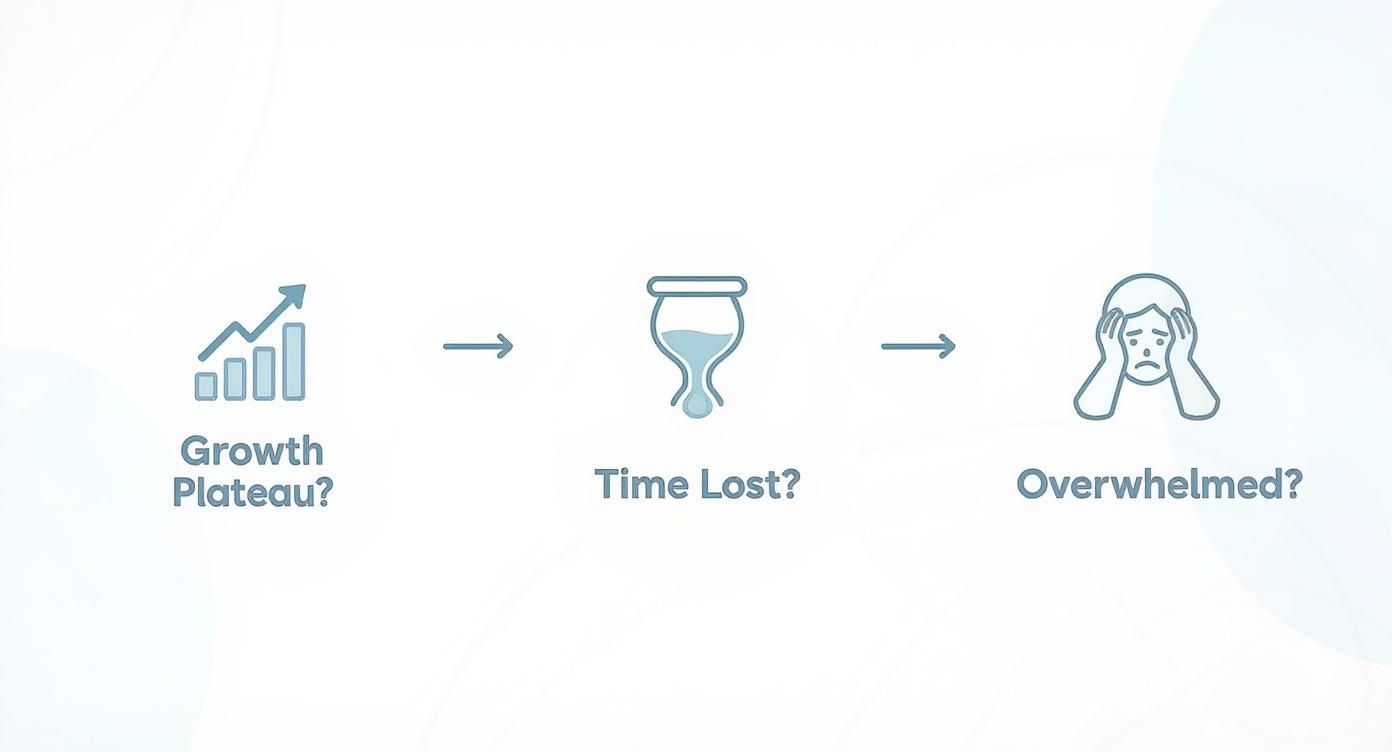
Most founders call in help because they’ve hit a plateau, are drowning in tasks, or are straight-up overwhelmed. Rarely is it a bad product—it’s usually thinly spread resources.
If nearshore feels like the Goldilocks option, LatHire handles vetting so you skip freelance roulette and agency overhead without sacrificing talent.
Ready for more depth? Compare staff augmentation vs consulting and decide with data, not gut feels.
Let’s talk dollars. You’re not into hand-wavy “it depends” answers, so neither am I. Time to see how outsourcing digital marketing stacks up against the in-house money pit.

Brace yourself. To build a lean in-house team, you need at least:
Add benefits + overhead (30%), and you’re staring at $250K+ per year for junior-to-mid roles. Want senior experts? Double it. That’s before you spend on tools or ad budgets.
Outsourcing digital marketing flips the script: a full senior-level team often costs less than one mid-level hire in a big city.
Remember: it’s not salary vs. retainer. It’s opportunity cost. Every dollar wasted on overhead is a dollar that isn’t fueling growth.
The magic happens in places spreadsheets can’t fully capture:
Enterprise-Level Tools on Day One
Your CFO balks at a $1,500/mo SEO platform. An agency or nearshore partner already has every premium tool baked into their fee.
Unfair Speed to Market
Your new in-house hire spends three months on learning curves. Outsourced teams fire off test campaigns in two weeks. That’s a competitive edge.
Deep Bench of Specialists
Your generalist might dabble in Google Ads. Can they architect a B2B LinkedIn funnel or launch a TikTok blitz for niche audiences? Outsourcing means experts for every channel.
On average, an in-house team costs $250K–$500K yearly. Outsourcing slashes that to $20K–$200K. And ROI? Email alone delivers $36 back for every $1 spent.
To master ROI tracking, dive into how to measure marketing ROI the right way.
Stop treating outsourcing as a line item. It’s a capital-efficient engine for real, measurable growth.
Choosing a digital marketing partner is high-stakes—and shockingly easy to screw up. Buckle up: your future ROI depends on your BS detector.

Forget “process” and “tools.” Everyone’s got slick slides. Ask the hard stuff:
“Tell me about a campaign you totally tanked. What went wrong, what did you learn, and how did you patch things up?”
If they dodge that, they’re either lying or green. I’ll back someone with scar tissue over a spotless portfolio any day.
Other must-ask queries:
| Area of Scrutiny | Green Flags | Red Flags |
|---|---|---|
| Contracts & Terms | Flexible terms, 90-day out-clauses, clear scope | Ironclad multi-year contracts with no easy exit |
| Expectations & Promises | Data-backed projections; under-promise/over-deliver | “#1 on Google guaranteed!”—if it sounds too good, it is |
| Expertise & Transparency | Simple explanations, admits unknowns, shares failures | Hides behind jargon or “secret sauce” |
| Team & Communication | Meet your actual account team; clear cadences | Handed off to a junior you’ve never met |
| Industry Experience | Niche case studies (B2B SaaS, DTC) | Portfolio all over the place |
Trust and alignment beat price wars every time. Find a partner obsessed with your growth—just like you are.
Signed, sealed, delivered. Now for the brutal truth: those first 90 days will make or break your ROI. A misstep now is a train wreck later.
Lose the fluff. This month is a speed run to context and alignment.
Silence and Slack inundation are both killers. Aim for rhythm, not noise.
A 30-minute weekly sync and a 60-minute monthly review beat a thousand random pings.
Over 50% of U.S. companies now outsource content strategy, while global digital ad spend surges past $790 billion (73% of all ad budgets). Nail integration with trust and transparency, not micromanagement. For a deeper dive, see perfecting your process for onboarding remote workers.
Outsourcing isn’t a magic wand. I’ve seen agencies ghost you post-check, freelancers vanish before launch, and “brilliant” strategies implode in real life. Learn from founders who’ve got the scars.
First month: audits, audits, audits. Month two: your champion is “no longer with the company,” and you get a rookie. Six-month contract. Ouch.
Dodge It: Vet the actual team. Insist on meeting everyone. And never sign without a 90-day out-clause.
“Could you just do a quick graphic?” Suddenly they’re redesigning your homepage and billing you for it.
Dodge It: Craft a razor-sharp Statement of Work with “What’s Included” and “What’s Not.” Set an out-of-scope quoting process.
A clear SOW is your shield, not a constraint.
You wanted qualified leads; they delivered eyeballs. Traffic is up 20%; pipeline is crickets.
Dodge It: Agree on primary KPIs that drive revenue: CPA, MQLs, ROAS. If they balk, they’re not your partner.
Ranges are wild. A freelance copywriter might be $75/hr, while a full-service agency could ask for $25K/mo. Don’t chase the cheapest—chase value. Nearshore teams via LatHire give you senior talent at U.S. metro rates minus the sticker shock.
Picking the lowest bidder. Price wars end with broken deadlines and subpar work. Nearly as bad: skipping crystal-clear goals. If victory isn’t defined, you’ll never know if you’ve won.
Got marketing leadership in-house? Outsource specialized tasks—SEO, content, paid ads—and run a hybrid. No leadership? Outsource the entire strategy and execution to a partner you trust. Otherwise, you’re just paying for chaos.
Onboarding and approvals. Your outsourced crew should be your brand’s champion. Give them brand guidelines, origin story, access to key players, plus a non-negotiable content approval workflow. Pros will embrace this structure—it’s how they deliver on-brand firepower.
Now go forth, pick the right model, vet like your growth depends on it (because it does), and integrate like a pro. Outsourcing digital marketing is your secret weapon—stop treating it like a budget line, and start treating it like the growth engine it can be.