Let's be real. The idea of outsourcing probably came up after a 14-hour workday or during a budget meeting that felt more like a hostage negotiation for your office coffee machine. You need help, but the world of business process outsourcing providers feels like a minefield littered with jargon and hollow promises.
So you've decided you'd rather run your business than run yourself into the ground. Smart move. Now what?
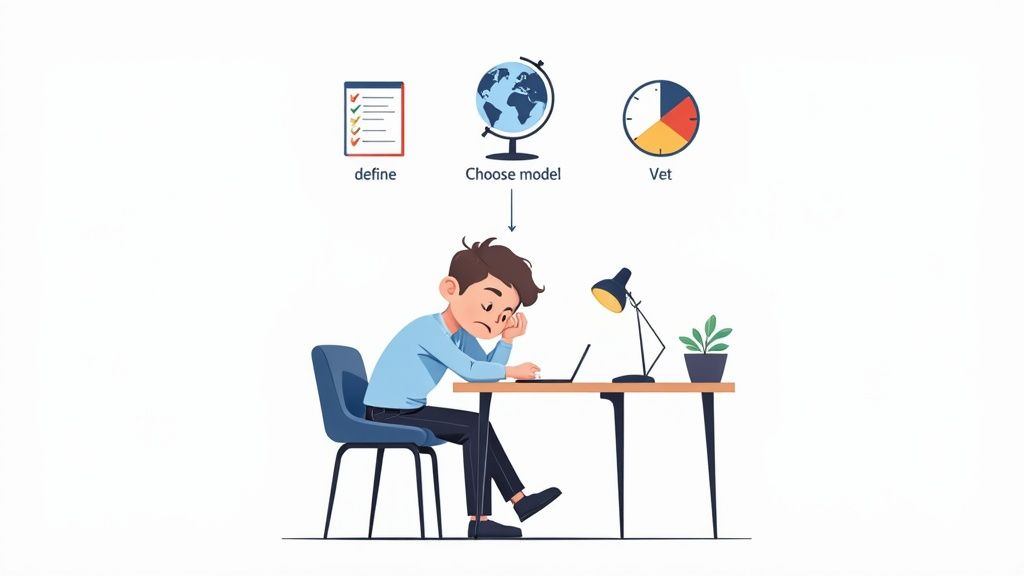
This is where we cut through the noise. We’ll start by unpacking what BPO actually is—not the dry textbook definition, but what it means for a founder trying to scale without mortgaging the office ping-pong table.
At its core, business process outsourcing is just contracting a specific business task, like customer support or payroll, to a third-party company. The goal? To offload work your team either can't do, shouldn't do, or does inefficiently. It frees you up to focus on what actually moves the needle. Simple, right?
You're not just hiring "a company." You're picking a specific model and a service type, and believe me, getting this wrong is an expensive mistake. I've made it. Let's make sure you don't.
First, let's talk about location. Your options generally fall into three buckets:
Think of it this way: Choosing a BPO model is like picking a commute. Onshore is walking to the office next door—convenient, but pricey. Nearshore is a quick train ride—efficient and affordable. Offshore is a red-eye flight—it’s cheap, but you might show up exhausted and completely out of sync.
Beyond where your team is, you'll need to decide what kind of work you’re outsourcing. This is usually split into two main categories.
Back-office outsourcing covers the internal engines of your business—the stuff that keeps things running but doesn't directly face the customer. This includes things like:
Front-office outsourcing, on the other hand, involves handing over customer-facing tasks. Your brand reputation is on the line here, so choosing the right partner is absolutely critical. Common examples include:
Getting these basic distinctions down is the first step. You're not just looking for "help"; you're looking for a specific type of partner in a specific location to handle a specific function.
The global BPO market is massive—projected to hit USD 525.23 billion by 2030—and it's filled with providers ready to take your money. We're here to make sure you give it to the right one. You can explore more about these market projections to get a deeper dive into the numbers.
Every BPO provider’s website paints a beautiful, glossy picture. It’s a world of seamless integration, massive cost savings, and a team of hyper-efficient experts working diligently while you sleep. But let’s be honest—the reality is a whole lot messier.
I’ve seen it all, and it's not always pretty. It’s time to get brutally honest about what you’re actually signing up for. We’ll break this down into the good, the bad, and the downright ugly.
Look, there’s a reason the BPO market is exploding. When it works, it really works. The upsides are significant, and they’re the shiny objects that get us all to sign on the dotted line in the first place.
Here’s what you’re hoping for:
This is the dream. Your business hums along, more efficient and profitable than ever. But dreams can turn into nightmares if you’re not careful.
This is where the glossy brochures end and reality begins. The "Bad" isn't necessarily a deal-breaker, but it’s the constant, grinding friction that can make you question your life choices.
You’ll likely run into communication breakdowns that make you want to tear your hair out. A simple request gets lost in translation across a 12-hour time difference, turning a five-minute fix into a two-day ordeal.
Then there are the cultural mismatches. It’s not about language; it’s about work ethic, communication styles, and understanding nuance. You might find yourself explaining your business model for the tenth time, wondering if anyone is actually listening. Productivity grinds to a halt not because of incompetence, but because your teams are operating on completely different wavelengths.
It's death by a thousand paper cuts. Each issue is small, but they add up until you’re spending more time managing your outsourced team than doing your actual job.
Now for the really nasty stuff. The "Ugly" is what happens when a bad partnership goes nuclear, costing you money, customers, and your sanity. These are the landmines you need to watch out for.
The $500 Hello. Hidden fees are a classic trap. That low hourly rate you celebrated suddenly balloons with "setup charges," "platform fees," and other nonsense you never saw coming. Your cost savings evaporate, and you find yourself locked into a contract that’s bleeding you dry.
Even worse is the security risk. Handing over sensitive data to a third party is an act of faith, and that faith is often misplaced. Cybercriminals are increasingly targeting BPO providers as a backdoor into their clients' systems. A single breach at your provider can expose your entire operation, leading to devastating financial and reputational damage.
And the ugliest part? Realizing your "dedicated team" is just a revolving door of freelancers. There’s no consistency, no institutional knowledge, and zero loyalty. You're constantly retraining new people who vanish after a few weeks, leaving your projects in total limbo. It’s the outsourcing equivalent of a ghost town. Spotting these red flags early is the only way to avoid the battle scars.
Alright, you’ve decided to take the plunge. Now for the next big decision: the ‘where.’ This isn't just about picking a spot on a map; it's a strategic choice that dictates cost, communication, and your overall sanity.
This is the classic Nearshore vs. Offshore cage match.
Let’s get one thing straight: anyone who tells you there’s a single "best" option is trying to sell you something. The right choice depends entirely on your business, your budget, and how much you enjoy 3 AM conference calls.
Offshore outsourcing—think hubs like the Philippines or India—is the model that built the BPO industry. Its promise is simple and incredibly seductive: massive cost savings. You can hire skilled professionals for a fraction of what they’d cost stateside, a powerful motivator when you're watching every dollar.
But that savings comes with a price, and it's usually paid in time and frustration.
A 12-hour time difference isn't just an inconvenience; it's a fundamental shift in how your business operates. Quick questions become 24-hour sagas. Emergency fixes? Hope you're a night owl. This model can work wonders for tasks that can be done asynchronously, like data entry or overnight transaction processing. But for collaborative work that requires real-time feedback? You’re signing up for a world of pain.
Then there’s nearshore, which typically means partnering with providers in Latin America. The value proposition here is balance. You still get significant cost savings compared to hiring domestically, but without sacrificing your workday.
The biggest win is time zone alignment. Your nearshore team works when you work. A question asked at 10 AM gets an answer at 10:05 AM, not the next business day. This simple fact is a game-changer for agility and team cohesion.
Cultural affinity is another understated benefit. While not identical, the business cultures are often more similar, reducing the friction that can plague offshore relationships. The trade-off? The savings might not be as jaw-droppingly dramatic. You’re paying a slight premium for convenience and control. For a deeper dive, check out our guide on the nuances of nearshore vs offshore outsourcing.
Choosing between these models is like deciding between a cheap, long-haul flight and a slightly more expensive direct one. One gets you there for less, but the other saves you from the jet lag that ruins the first three days of your trip.
For a founder trying to move fast, this cheat sheet breaks down the practical differences that actually matter.
| Factor | Nearshore (e.g., Latin America) | Offshore (e.g., Southeast Asia) |
|---|---|---|
| Cost Savings | Significant (30-50% vs. US) | Maximum (50-70%+ vs. US) |
| Time Zone | Highly aligned (0-3 hours difference) | Heavily misaligned (8-12+ hours) |
| Communication | Real-time, seamless collaboration | Asynchronous, delayed responses |
| Cultural Fit | High affinity, fewer misunderstandings | Moderate to low, requires more adaptation |
| Talent Pool | Strong and growing, especially in tech | Massive and well-established |
| Management | Easier oversight and control | Requires more structured, hands-off management |
The bottom line? Offshore is a pure cost play, ideal for tasks you can "set and forget." Nearshore is a strategic partnership, built for roles that need to feel like a true extension of your home team.
This infographic gives you a quick visual breakdown of the good, the bad, and the ugly realities of outsourcing.
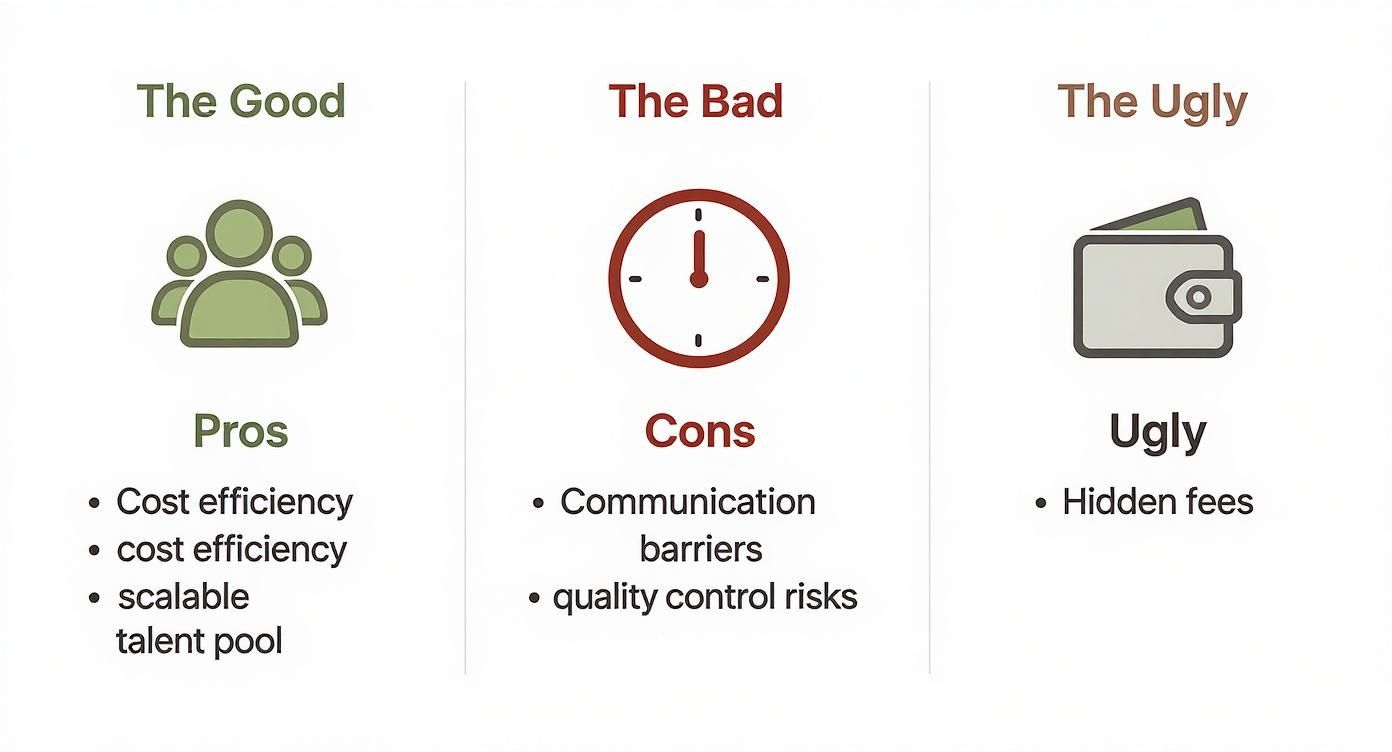
The visualization makes it clear: while talent and cost savings are the carrots, time zone issues and hidden fees are the sticks you need to watch out for.
Ultimately, the choice is yours. Are you optimizing purely for the lowest possible cost, or are you willing to invest a bit more for smoother collaboration and better control? There’s no wrong answer, but going in blind is the fastest way to make an expensive mistake.
You’ve picked a model, you’ve set a budget, and now comes the fun part: sitting through a dozen mind-numbing sales demos. Every single one of the business process outsourcing providers will show you the same slick PowerPoint, promising the same amazing results. It's a soul-crushing exercise in corporate bingo.
Or, you could skip the fluff and start asking the questions that actually matter.
This isn’t about just checking boxes. It’s about stress-testing a potential partner before you hand over the keys to a critical part of your business. Forget the canned questions and use this battle-tested checklist to see who’s for real.
First, let's cut through the surface-level nonsense. The sales team is trained to tell you exactly what you want to hear. Your job is to poke holes in their story.
Instead of asking, “What’s your methodology?” try this:
“Walk me through your recovery process from your last major service failure. What went wrong, how did you communicate it to the client, and what specific steps did you take to prevent it from happening again?”
Their answer—or their panicked silence—will tell you everything you need to know about their transparency and problem-solving skills. A great partner has scars and isn't afraid to show them. A weak one will pretend they’ve never made a mistake.
Here are the core areas you need to hammer them on:
Every provider will promise you "bank-level encryption" and "robust security protocols." That means nothing. In today's environment, BPO providers are prime targets for cybercriminals looking for a backdoor into your company.
When compiling your vendor vetting checklist, it's essential to assess the BPO provider's commitment to robust cybersecurity practices to safeguard your operations and data.
Drill down with specific, pointed questions:
These aren't just technical questions; they're fundamental business continuity questions. Proper vendor management best practices demand you go this deep. Your company's reputation could depend on their answers.
Choosing a partner based on a glossy brochure is a recipe for disaster. This checklist is your shield. Use it.
Welcome to the jungle. This is where BPO providers make their real money—not just on the service, but on confusing pricing models and iron-clad contracts designed to benefit them, not you. It’s often intentionally opaque, littered with landmines that can make you feel like you need a law degree just to understand your monthly invoice.
Getting this part wrong is the difference between a strategic partnership and a financial black hole. Let’s demystify this mess. Think of this as your pre-negotiation briefing to avoid getting taken for a ride.
Most BPO providers will push one of a few core pricing models. None are inherently "good" or "bad," but one is likely very, very bad for you. Your job is to figure out which one before you sign.
Here are the usual suspects:
Don't just accept the first model they offer. Push back. Make them justify why a particular model is the best fit for your project, not just their billing department.
The price they quote you on the sales call is almost never the price you’ll actually pay. I hope you budgeted for extras, because they’re coming. I’ve been burned by every single one of these.
Keep an eye out for these common hidden costs:
These fees are rarely volunteered. You have to ask—pointedly and repeatedly. Get every single potential cost itemized in writing before you sign anything.
Now for the legal document designed to lock you in. You have to scrutinize these clauses, or you'll live to regret it.
Sometimes, the complexity of managing an outsourced team, especially regarding local labor laws and payroll, becomes its own hidden cost. Understanding the role of an Employer of Record can clarify how to handle this, ensuring compliance doesn't become another contract trap.
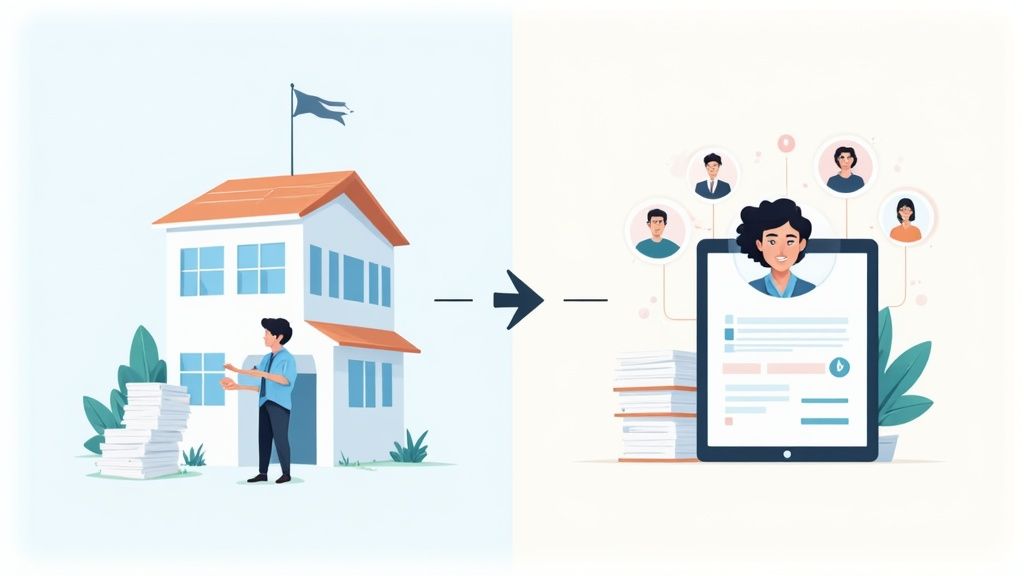
After navigating the minefield of long-term contracts, endless vetting calls, and mysterious hidden fees, you might be thinking, "There has to be a better way." And you’d be right.
The old-school BPO model, with its heavy overhead and clunky layers of management, is starting to look like a flip phone in an iPhone world. It feels dated.
The traditional BPO promise was simple: trade direct control for cost savings. But founders today are tired of that trade-off. Why should we have to sacrifice direct communication and agility just to access a global talent pool? The whole model is built on being a middleman, and middlemen add complexity, not value.
Enter the modern alternative: a new breed of AI-powered hiring platforms. Imagine getting all the benefits of a global team—the cost savings, the specialized skills—without the baggage of a traditional BPO provider.
This isn't just a new coat of paint on an old business model; it's a fundamental shift in how we build teams. These platforms use smart technology to solve the very problems that have plagued outsourcing for decades. Instead of a sales rep, you get a matching algorithm. Instead of a black box of talent, you get transparent, pre-vetted candidate profiles.
This is the great unbundling of BPO. You’re no longer forced to buy a bloated, all-in-one service package. You can directly access the talent you need, when you need it, without the bureaucratic nonsense.
You get direct access to elite professionals who have already been screened. You get transparent pricing. Most importantly, you get the speed and flexibility to scale your team without getting tangled in a year-long contract that feels impossible to escape.
So, what's the real difference in practice? Let's break it down.
Even the old guard sees the writing on the wall. The industry is evolving, with traditional providers now racing to integrate AI into their services. For example, a look at Firstsource's Partnership to Redefine Customer Conversations with AI shows how established players are adapting to stay relevant.
This isn't just outsourcing anymore; it's intelligent, on-demand team building. Technology is finally delivering on the original promise of BPO, but without all the headaches.
I get it. The world of business process outsourcing providers is a maze of confusing terms and slick salespeople. Let's cut through the noise and get straight to the questions you're probably asking yourself.
Think of it this way: hiring a freelancer is like calling a plumber to fix one leaky faucet. You show them the problem, they fix it, and they're gone. Simple, transactional.
Partnering with a BPO provider, on the other hand, is like hiring a general contractor to oversee all the plumbing for a new building. They’re not just fixing one leak; they’re bringing the strategy, the team, and the accountability for the entire system. It’s about offloading the whole process, not just a single task.
If a provider throws a price at you without a deep dive into your business, that's a huge red flag. Pricing is all over the map. It swings wildly depending on the service model (offshore is usually cheapest), the skills you need (a data entry clerk costs far less than a certified accountant), and how complex the work is.
Don’t get reeled in by the "$5 per hour" trap. That’s just the hook. Always demand a full cost breakdown—setup fees, software, management overhead—before you even consider signing anything.
This is where the old way and the new way really part company. A traditional BPO can take months to get off the ground. You’re looking at endless sales calls, drawn-out contract negotiations, and a clunky onboarding process. It’s a marathon.
Modern hiring platforms, however, are built for speed. Since the talent is already vetted and ready to go, you can often find and match with qualified candidates in a matter of days, not quarters. You get to skip the entire vendor selection song and dance and jump straight to building your team.

