
Outsourcing your IT project management isn't just a line item on a budget sheet. It's a strategic call to bring in a hired gun, cut down operational drag, and get projects out the door faster—all without the soul-crushing headache of direct hiring. Turns out there’s more than one way to get elite help without mortgaging your office ping-pong table.
Let's be real. The idea of outsourcing IT project management looks fantastic in a PowerPoint presentation but feels terrifying in practice. You're probably picturing a total loss of control, wrestling with impossible time zones, and dealing with project managers who are more ghost than guide. I've been there.
Before we jump into the "how," let's get brutally honest about the "why" and the "what." Is your current system a well-oiled machine that just needs more gas, or are you patching a sinking ship with duct tape and good intentions?

This isn't some fleeting trend; it’s a seismic shift in how companies operate. Global spending on IT outsourcing is expected to climb to $519 billion, a massive 22% jump in just a few years. And with 92% of G2000 companies already outsourcing some part of their IT, it’s obvious the initial hesitation is a thing of the past.
The conversation about outsourcing usually kicks off with an "aha" moment. Or, more often, an "oh no" moment. See if any of these sound painfully familiar:
Outsourcing isn't waving a white flag. It's a strategic offensive to reclaim your team's focus and get your company's momentum back. It's deciding to stop playing defense against administrative quicksand.
This all comes down to a frank assessment of where you are right now. This isn't just about saving a few dollars; it's about getting your focus back. To get a better sense of the big picture, it's worth exploring how top outsourcing companies that transform operations efficiently build these kinds of partnerships.
Hold off on diving into a sea of vendor websites all promising the moon. First, you need to get your own house in order. A fuzzy plan will only land you a fuzzy partner.
Ask yourself these questions, and be brutally honest:
Getting clear on these points turns a desperate search for "help" into a targeted hunt for the right solution.
Alright, let's talk strategy. This is a fork in the road, and the path you choose will define your entire outsourcing experience. Too many companies treat this decision like picking an item off a menu, but it's much more fundamental. You're deciding on an operating model for your project.
Get this right, and you're set up for success. Get it wrong, and you’ll spend months wondering why your project is stuck in the mud.
The two main avenues for IT project management outsourcing are staff augmentation and managed services. I like to think of it this way: are you hiring a single, highly-skilled mercenary to join your ranks, or are you contracting an entire private army to win the war for you?
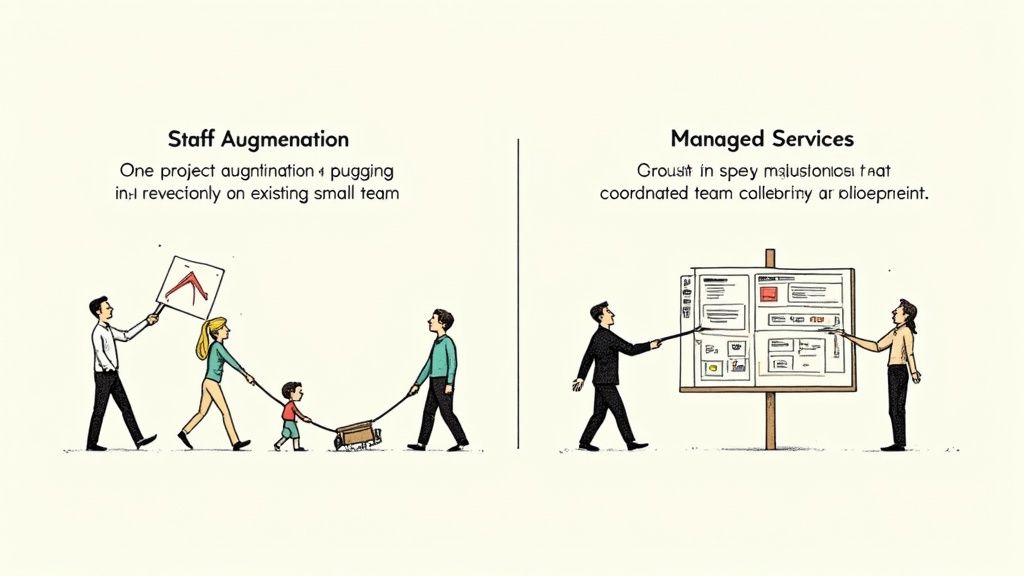
Staff augmentation is beautifully straightforward. You've already got a team, a process, and a project plan. You’re just missing a key player—let's say, a senior project manager with specific SaaS experience.
With this model, you bring in a single expert who plugs directly into your existing structure. They use your tools, join your daily stand-ups, and report to your leadership. You’re still the general calling the shots.
This approach is perfect when you have a solid foundation but just need more firepower or a specific skill set you don’t have in-house. It’s about adding capacity, not offloading responsibility. You get maximum control, managing the PM just like any other team member. The trade-off? You're still the one on the hook for the project's ultimate success or failure. The outsourced PM is there to execute your strategy, not create one from scratch.
Managed services is a completely different beast. You aren't just hiring a person; you're handing over an entire outcome. You define the objective—"Launch this new software feature by Q4 with a budget of X"—and the managed services provider figures out how to make it happen.
They bring their own project manager, their own team, their own processes, and often their own tools. You're buying a result, not just a resource. It can feel like a black box at times, but a highly effective one if you choose the right partner. This model is for when you're overwhelmed and need a team to take a whole project off your plate, from strategy all the way through execution.
The core difference is accountability. With staff augmentation, you own the outcome. With managed services, the vendor owns the outcome. Choose wisely.
This shift isn't just a niche trend; it's becoming a core business strategy. Spending on outsourcing as a share of IT budgets jumped by a staggering 45% in just one year, according to recent industry reports. Companies are struggling to find and keep top talent, and outsourcing offers a powerful solution. To dig deeper into these trends, you can check out the latest insights on how businesses are adapting.
There’s no magic answer here, just the right answer for your specific situation. To make it clearer, let's break down the two models side-by-side.
Think of this table as a quick gut check. Where do your needs fall?
| Factor | Staff Augmentation (The Mercenary) | Managed Services (The Private Army) |
|---|---|---|
| Control | High. You direct the PM's daily tasks and own the overall project strategy. | Low. You define the 'what' and 'why'; the vendor determines the 'how.' |
| Cost Structure | Typically a time-and-materials model (e.g., hourly or monthly rate). | Often a fixed price for a specific outcome or a monthly retainer for ongoing service. |
| Integration | Deeply integrated into your team, culture, and workflows. | Operates as a separate, external team with defined points of contact. |
| Ideal Use Case | You need to fill a specific skills gap or add bandwidth to a well-defined project. | You lack the internal expertise or resources to manage an entire project or function. |
After reviewing the table, the choice should be getting clearer. If you're still on the fence, ask yourself one simple question:
"Do I have a project management problem, or do I have a results problem?"
If you have a solid process but are just short-handed, you have a project management problem. Staff augmentation is your answer. But if you lack the process, the people, and the time to get the result you need, you have a results problem. Go with managed services.
For a deeper dive into how these models compare to other advisory roles, our guide on staff augmentation vs consulting breaks it down even further.
Welcome to the vendor jungle. Finding the right partner for your IT project management outsourcing can feel a lot like swiping through dating apps—an endless parade of shiny profiles, slick promises, and a high potential for epic disappointment.
Let's be blunt. Most vendor websites are useless. They’re a highlight reel of their greatest hits, conveniently ignoring the projects that went off the rails. Your job is to get behind the curtain and see the real machinery, not just the polished facade.
The vetting process starts the moment you make first contact. You can learn almost everything you need to know from that initial call if you listen for what they don't say.
I’ve seen enough of these pitches to spot the warning signs from a mile away.
These aren't just minor quirks; they're symptoms of a deeper problem. A vendor who isn't transparent in the sales process will be a black box when they have your money.
Your goal during the interview process isn't to be liked; it's to be informed. You need to ask the uncomfortable questions that reveal their true character and capabilities.
Here are a few of my favorites:
A vendor's reluctance to discuss failure is the biggest predictor of future failure. You're hiring a partner to solve problems, not pretend they don't exist.
Getting this right involves more than just good interview questions; it requires a systematic approach. For those looking to build a robust framework, our detailed guide on vendor management best practices provides a playbook for creating and maintaining strong partnerships.
Feeling exhausted just reading this? I don't blame you. The traditional vendor search is a grueling, time-sucking nightmare. You can spend months vetting agencies only to end up with a mediocre partner locked into a long-term contract.
This is where a platform-based approach changes the game entirely.
Think about it. Instead of you doing all the legwork, a platform like LatHire does the heavy lifting for you. We’ve already vetted thousands of professionals, checking their technical skills, project histories, and communication abilities. We're not saying we're perfect. Just more accurate more often.
We handle the entire sourcing and vetting process. You don’t have to guess if a candidate is good; they've been pre-qualified. You don’t have to worry about international payroll, compliance, or benefits. It’s all handled. You just get to interview a shortlist of top-tier candidates who match your needs and are ready to go.
This isn't just about saving time. It's about de-risking the entire process of IT project management outsourcing. You get the expertise of a specialized agency with the flexibility and direct relationship of a staff augmentation model—the best of both worlds, without the sanity-draining search. (Toot, toot!)
You did it. You found your unicorn, signed the contract, and sent the welcome email. Job done, right?
Not even close. This is the exact moment where most outsourcing relationships begin their slow, painful death by a thousand miscommunications. The first 90 days aren’t a grace period; they're the entire foundation. Mess this up, and you’ll spend the next year wondering why nothing gets done.
We’re not talking about just adding them to a few Slack channels and hoping for the best. We need a rigorous, structured onboarding and governance plan that leaves zero room for ambiguity. This is your playbook for accountability from day one.
Forget the week-long, drawn-out orientation. Your new project manager needs to be effective immediately, and that starts with absolute clarity. Before they even think about touching a single task, they need a "Read Me" file for your company.
This isn't just about logins and software access. It's about deep context.
A huge part of this playbook is integrating your outsourced team seamlessly. For more detailed steps, this comprehensive guide to onboarding remote employees is packed with actionable tips that go way beyond the basics.
"Let's just sync up when we need to" is a recipe for disaster, especially when you're working across different time zones. You need a predictable, non-negotiable communication rhythm. This isn't about more meetings; it’s about having better, more effective ones.
An outsourced PM left in the dark will either do nothing or do the wrong thing. Both are expensive. Your job is to provide relentless, structured clarity.
Our go-to cadence looks something like this:
Finding a great vendor is just as systematic as onboarding them. This simple flow breaks down the core stages.
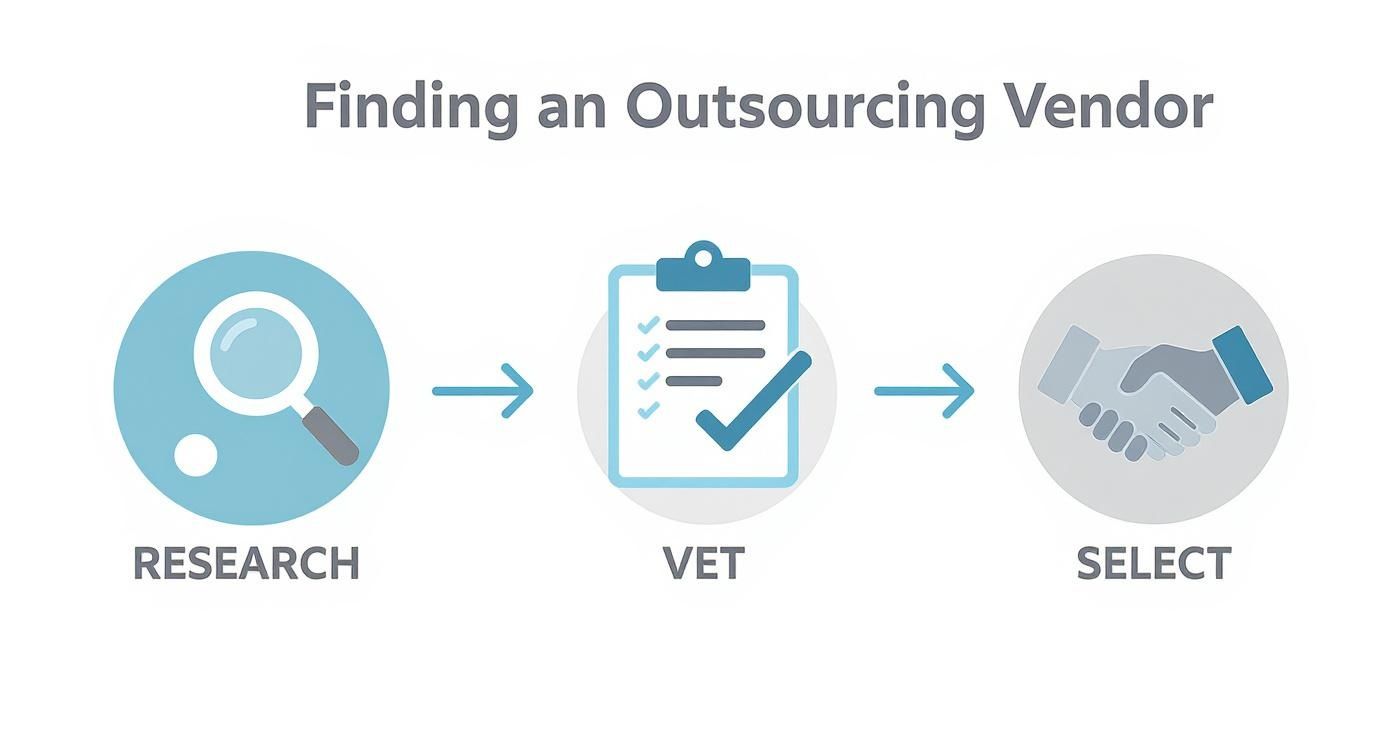
Just as you need a clear process for finding talent, you need a defined playbook for making them successful once they're on board.
Forget vague goals like "improve efficiency." You need concrete, measurable metrics that truly define success. Your SLAs (Service Level Agreements) and KPIs (Key Performance Indicators) are your contract for what "good" actually looks like.
Start with a few key metrics that tie directly to business value. For example:
These aren't just numbers to glance at on a dashboard; they form the core of your governance model. They turn subjective feelings about how a project is going into objective data, which is the only language that really matters.
This structured approach is a cornerstone of effective IT project management outsourcing. For a deeper dive, our guide on https://lathire.com/onboarding-remote-workers/ offers more strategies to ensure your new hires hit the ground running.
Alright, let's talk about the elephant in the room: money. Cost savings are usually the headline act for IT project management outsourcing, but they’re also the perfect camouflage for some of the biggest traps.
That unbelievably low hourly rate you found? It’s often a Trojan horse. It gets inside your walls, and then out come the hidden fees, the shoddy work that needs constant rework, and the communication black holes that cost you more in lost time than you ever "saved" on the invoice.
This isn't about the number on the proposal; it’s about the true, all-in cost of getting the job done right.
I learned this the hard way. Early on, I hired a PM who was an absolute steal on paper. In reality, I spent ten hours a week just managing him. My "savings" were instantly vaporized by my own time, which was far more valuable.
The sticker price is a lie. Your real cost is a blend of several factors:
The cheapest option is almost always the most expensive. You’re not buying hours; you’re buying an outcome. A great outsourced PM who costs 50% more but requires zero hand-holding and delivers on time is an incredible bargain.
This financial calculus is driving major shifts in the market. The global IT outsourcing scene is projected to hit $731 billion by 2025, and it’s not just because of simple labor arbitrage anymore. While 59% of companies still cite cost reduction as a prime motivator, the smart ones are looking at the bigger picture.
To get a handle on the numbers shaping this trend, you can explore the complete 2025 software outsourcing guide and see how efficiency is redefining value.
Beyond the obvious budget overruns, outsourcing comes with a unique set of financial risks. Ignoring them is like walking through a minefield blindfolded.
Let’s get specific. Here are the big three financial risks and the pragmatic ways to defuse them before they blow up your P&L.
1. The Scope Creep Cancer
This is the silent project killer. A small, "easy" feature request here, a minor tweak there, and suddenly you're six months behind schedule and double the original budget.
2. The Intellectual Property Heist
You're handing over sensitive information—code, customer data, strategic plans. What happens if your vendor's security is leaky, or worse, if a disgruntled employee walks away with your trade secrets?
3. The "Vendor Lock-In" Trap
Your outsourced PM becomes so embedded in your processes and systems that leaving them would be catastrophic. They know this, and suddenly their renewal rates start climbing.
It’s not all doom and gloom. The financial benefits of smart IT project management outsourcing go way beyond just a lower salary. These are the upsides that don't get enough attention but make a huge impact on your bottom line.
Ultimately, managing the bottom line in outsourcing is a game of total cost of ownership. Look past the hourly rate and analyze the entire financial equation. That’s how you turn outsourcing from a cost center into a strategic financial weapon.
Alright, let's get into the weeds. By now, you’re probably either nodding along vigorously or you’ve got a healthy dose of skepticism. Both are good. Being on the fence just means you're asking the right questions.
Over the years, I’ve heard every possible concern about IT project management outsourcing. Here are the big ones, with the straight-up, no-fluff answers I wish someone had given me years ago.
Short answer: you don’t. At least, not in the traditional sense. You can't replicate your in-office, ping-pong-table culture with someone thousands of miles away. It feels forced and never really works.
Instead, you have to intentionally build a new, inclusive remote culture. This isn’t about scheduling awkward virtual happy hours. It's about deliberate, consistent communication and treating your outsourced PM like a core part of the team, not just a line item on an invoice.
Culture doesn't happen by accident, especially across continents. It requires real intention. They won't feel like part of the team if you treat them like a temporary contractor.
Oh, this is my favorite game. It’s called "Spot the Hot Air." The red flags are usually waving right in your face on the very first call, if you know what to look for.
First, watch out for vague, buzzword-heavy answers to specific process questions. If you ask, "How do you handle scope creep?" and they hit you with, "We have a very agile and collaborative approach," you should politely end the call. A pro will immediately detail their change request process, documentation standards, and re-estimation workflow.
Second is the classic talent "bait and switch." The super-sharp senior PM who rocks the sales call is mysteriously "unavailable" for your project. You must insist on interviewing the actual human being who will be managing your work. No exceptions.
A vendor’s refusal to give you direct access to the talent is the biggest red flag of all. It means they’re either hiding something or they don’t trust their own people. Either way, you lose.
Finally, pay close attention to their contract flexibility. If they’re unwilling to discuss trial periods, clear performance-based clauses, or straightforward exit terms, it’s a bad sign. It means they aren’t confident in their ability to deliver and want to lock you in before you realize what you’ve actually bought.
This is the classic "DIY vs. buying a complete system" debate. A local freelancer can feel like the easier, more direct path, but it often comes with its own special brand of headaches.
With a freelancer, you’re not just the client; you're also the manager, the HR department, and the compliance officer. You’re handling the 1099s, the payments, and all the associated risk. And what happens if they get a better full-time offer and vanish mid-project? Good luck. You’re back to square one, holding a half-finished project and a fresh wave of panic.
Outsourcing through a reputable partner or a platform like LatHire offloads that entire administrative and legal nightmare. You aren’t just hiring a person; you're investing in a complete support system.
That system typically includes:
For a small, one-off task, a freelancer can be a perfectly fine choice. But for a critical, ongoing function like project management, the stability and safety net of a managed outsourcing model is almost always the smarter long-term play. It's the difference between buying a car part and buying a whole car that comes with a warranty.