

You need top-tier developers, but Bay Area salaries make your budget scream. So, you look at a map, squint a little, and think, "There has to be a better way."
Good news. There is. It’s called nearshore outsourcing: hiring elite talent from neighboring countries to get the skills you need without the communication chaos or the sticker shock.
Turns out there’s more than one way to hire elite developers without mortgaging your office ping-pong table. The old playbook gave you two choices: pay a fortune for local talent (onshore) or send your project halfway around the world (offshore) and pray it doesn’t get lost in translation.
Nearshore outsourcing is the third, smarter option. It’s the strategic sweet spot.
Here’s the deal: you delegate projects to a team in a nearby country, usually one that shares a similar time zone. For U.S. companies, this means looking south to Latin America's booming tech hubs. For European businesses, it's Eastern Europe. This simple geographic shift solves the biggest headaches that come with traditional outsourcing.
The infographic below breaks down the three main outsourcing models, showing how nearshore bridges the gap between onshore and offshore.
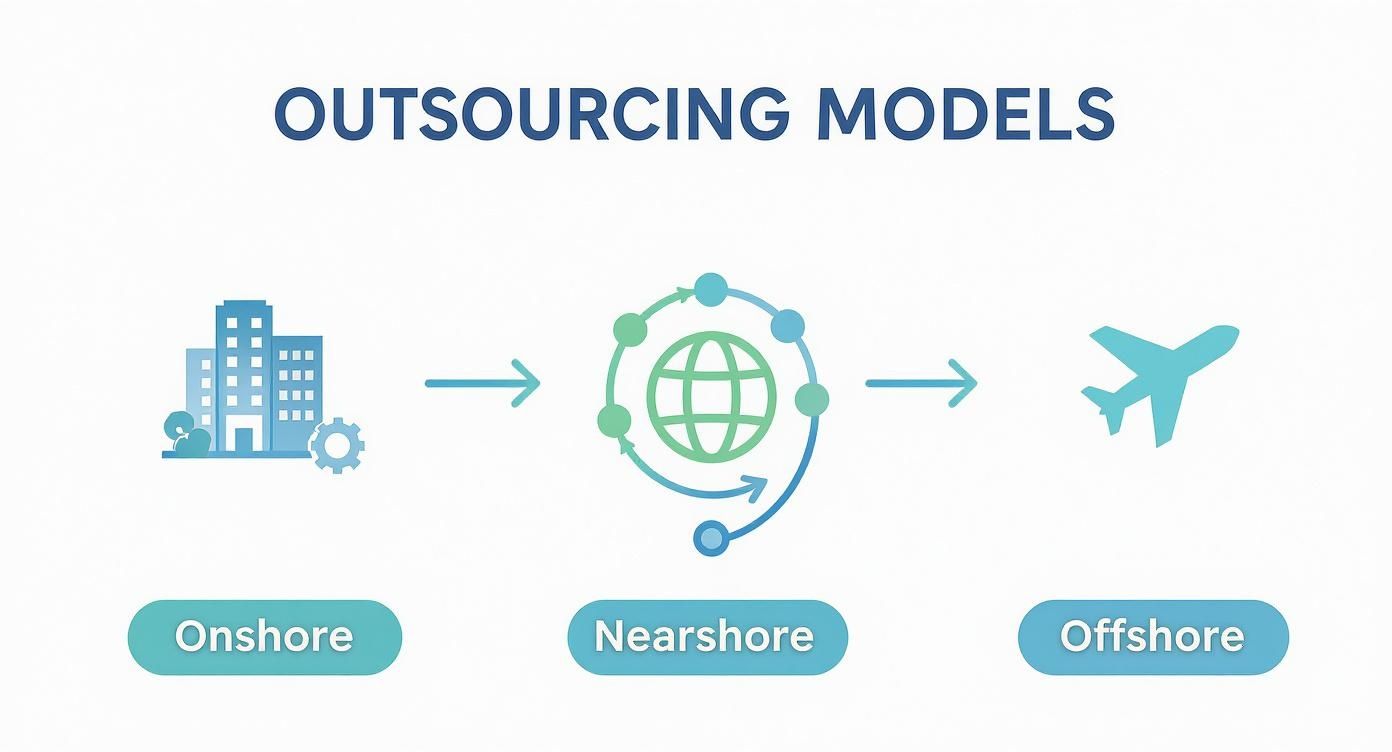
This visual highlights how nearshore outsourcing balances cost, collaboration, and cultural alignment, making it a uniquely practical choice.
To put it all into perspective, here’s a simple table comparing the core differences between each model. No fluff.
| Model | Time Zone Alignment | Cost Savings | Cultural Overlap | Best For |
|---|---|---|---|---|
| Onshore | Perfect | Low | High | Projects needing constant, in-person collaboration. (And deep pockets.) |
| Offshore | Poor (8-12 hr gap) | High | Low | Cost-sensitive projects that can be managed asynchronously. (Good luck.) |
| Nearshore | High (0-3 hr gap) | Medium | Medium-High | Teams that need real-time collaboration without the insane price tag. |
As you can see, nearshore strikes a practical balance, offering the best of both worlds for most growing tech companies.
The real magic of nearshore isn’t just about the map—it’s about momentum. When your team is only one or two time zones away, you get something priceless: real-time collaboration.
No more 3 a.m. stand-up meetings. No more waiting 12 hours for an answer to a simple question. Problems get solved in minutes, not days.
Nearshore outsourcing is less about finding cheap labor and more about finding a high-value extension of your team. It's the difference between a hired hand and a genuine collaborator who actually gets your business.
This model is exploding for a reason. The nearshore outsourcing market is on track to hit $2.67 billion as more companies catch on. In fact, 90% of companies report better outcomes with nearshore teams, achieving an 80% project success rate compared to just 60% with offshore models. Teams working nearshore also complete projects 40% faster and face 75% fewer communication problems.
Beyond logistics, nearshore teams often share a closer cultural affinity. They’ve grown up watching similar movies, using the same apps, and understanding the same business etiquette. This means less gets lost in translation.
You’re not just hiring someone who can write code; you’re hiring a teammate who gets it from day one. This cultural overlap eliminates the friction that can quietly kill a project's budget and timeline.
The process of finding and integrating this talent is crucial. For a detailed guide on securing top-tier remote talent efficiently, it's worth exploring strategies on how to hire remote developers flawlessly. Ultimately, it’s about building a cohesive unit, not just managing a vendor.
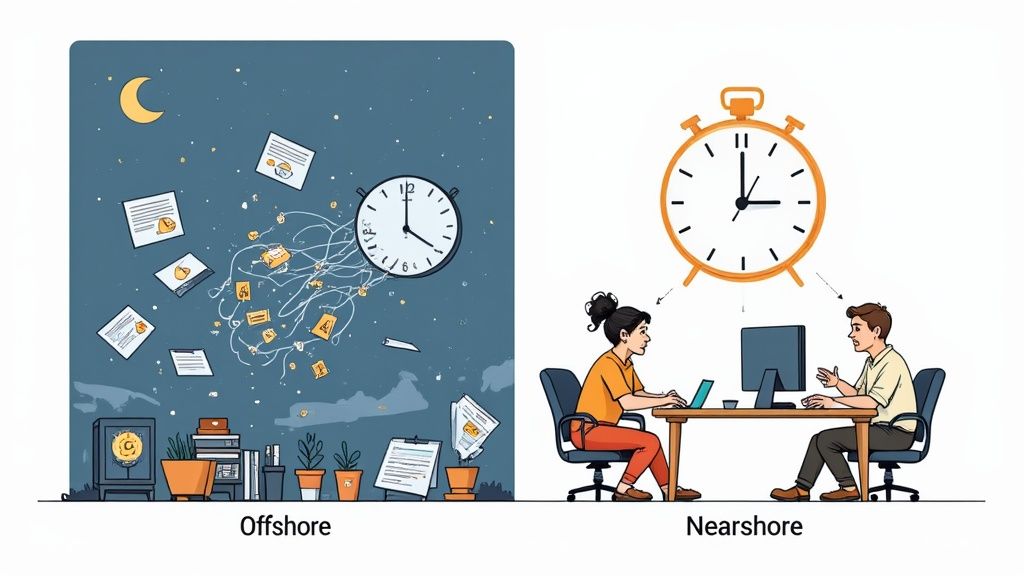
On paper, going offshore looks like a brilliant financial move. The hourly rates are rock-bottom, the talent pool seems limitless, and you feel like you've just hacked the system.
But let's talk about the costs that don't show up on the invoice.
I’m talking about the productivity tax you pay every single day. The one that comes from having a team on the other side of the planet, where your morning is their midnight. It’s a slow-motion crawl that can kill a project’s momentum before it ever gets off the ground.
Remember agile? That fast-paced, collaborative process you love? Try running a sprint when your team’s workday ends just as yours begins.
That urgent bug fix you found at 10 AM? You’ll be lucky to get a response by the time you’re heading home. A quick question that would take five minutes on a call morphs into a 24-hour email chain.
The real cost of offshore isn’t measured in dollars per hour; it’s measured in lost momentum. Companies can lose up to 20% of project momentum due to the communication breakdowns inherent in massive time zone gaps.
This isn't a minor inconvenience; it's a fundamental breakdown in how modern teams are supposed to work. You end up managing a process instead of building a product.
Then there’s the cultural gap. It's not just about holidays and customs—it’s about unspoken rules, communication styles, and shared context. When that's missing, things get messy. Fast.
I've seen teams spend weeks building the wrong feature because of a subtle misunderstanding. A simple "yes" might mean "I hear you" rather than "I agree and understand the requirements."
These aren't just frustrating moments; they’re expensive ones. Each round of rework, each delayed launch, and each clarification meeting adds up. The initial cost savings start to look a lot less attractive when you're paying for the same work three times over.
For a deeper dive into how these factors play out, our detailed comparison of nearshore vs offshore models breaks down the true cost of ownership.
This is where nearshore outsourcing completely changes the game. It’s not about finding the absolute cheapest labor on the planet. It's about finding the best value.
Instead of a productivity-killing 12-hour gap, you get a 1-3 hour difference. Your urgent morning message gets a thoughtful reply before lunch, not the next day. This shared context means your team understands the nuances of your market, your customers, and maybe even your jokes.
Here’s what that practically means for your bottom line:
When evaluating the financial implications of global talent, it's useful to look into articles discussing optimizing offshore company setup for software and IT development companies, as these can reveal broader economic considerations beyond just labor costs. The goal isn't just to cut an expense line; it's to make a smarter investment.
The choice is simple. You can fight against time zones and cultural divides, or you can build a high-performing, integrated team that operates on your clock. It's the difference between a high-maintenance headache and a strategic advantage.
Alright, so you’re sold. You're tired of the offshore timezone tax and the sticker shock of hiring onshore. But where exactly is this promised land of nearshore talent?
The answer really depends on where you're sitting. For US-based companies, the answer is overwhelmingly Latin America. For businesses in Europe, it’s typically Eastern Europe. These aren't just low-cost destinations; they are thriving tech ecosystems pumping out world-class engineers who are tired of working on boring projects for local conglomerates.
Think of cities like Medellín, São Paulo, and Mexico City as the new Silicon Valleys—just without the absurd cost of living and the soul-crushing traffic. Seriously.
These regions have poured resources into STEM education, creating a deep pool of developers skilled in everything from React and Python to complex AI frameworks. But here's the part that really matters: they offer a strong cultural alignment with North American and European work styles.
They watch the same Netflix shows, use the same apps, and understand the nuances of Western business etiquette. This isn’t just about finding someone who can write clean code; it’s about finding a teammate who "gets it" from day one. You won't have to explain a pop culture reference or why a feature needs to feel intuitive for a U.S. user. They already know.
So, where should you actually be looking? For North American companies, a few heavy hitters consistently stand out:
The big takeaway? Nearshore isn't about finding a single country. It's about tapping into a continent-wide network of tech ecosystems, each with its own unique strengths. Your job is to find the one that fits your company's DNA.
Ultimately, this isn't about throwing a dart at a map. It’s a strategic decision to build a team that feels less like a vendor and more like the folks in the next room. That means finding a location where the talent is strong, the culture aligns, and the workday actually overlaps with your own. For most of us in the U.S., that search begins and ends in Latin America.
The shift to nearshoring isn't just another buzzword on a PowerPoint slide; it's a strategic correction. Founders and CTOs are tired of the old outsourcing playbook. We’ve all been burned by the promise of rock-bottom offshore rates, only to pay for it with our sanity, our schedules, and endless rounds of rework.
The truth is, we’ve learned the hard way that the cheapest option is rarely the best value. This isn't just a trend; it's a market-wide correction back toward common sense.
Agile development is non-negotiable for any serious tech company. But you can’t "sprint" effectively when half your team is asleep. The entire philosophy is built on quick feedback loops, daily stand-ups, and collaborative problem-solving.
Offshore models shatter that philosophy. A 12-hour time difference turns your fast-paced environment into a slow-motion relay race, with the baton passed just once every 24 hours. Good luck with that.
Nearshore outsourcing fixes this by default. With teams in Latin America, you're looking at a 0-3 hour time difference. This means your daily stand-ups are actual conversations, not pre-recorded messages. Pair programming is a reality, and a critical bug gets fixed in hours, not days.
This isn’t a small perk; it’s the entire foundation of a high-performing, integrated team. When you can hop on a quick call to resolve ambiguity, you eliminate the friction that secretly kills budgets and timelines.
Let's be blunt: the goal isn't just to fill a seat with someone who can write code. It's to find an A-player who drives your product forward—someone who can challenge your assumptions, contribute to the product vision, and take ownership.
That’s where the talent argument comes in. Latin America's tech scene is mature and exploding. Universities are producing world-class engineers who aren't just code monkeys; they’re strategic thinkers who have worked on complex projects for global companies. They can lead a project, not just follow a ticket.
This shift in mindset is happening across the board. The numbers show that North American companies are catching on fast, with about 80% actively considering or adopting nearshore software development. It's a clear signal that leaders want more than just lower labor costs; they want efficiency and cultural alignment. Given that software development makes up 64% of all outsourced services, this is a massive change in how smart companies build their teams. Discover more insights about this growing trust in the nearshore development model.
Finally, let's talk about something that's hard to quantify but easy to feel: cultural fit. When your remote team communicates directly, understands your business context, and even gets your dry sense of humor, everything just moves faster.
You spend less time explaining the "why" behind a feature because they already get the market you're serving. You avoid the painful miscommunications that lead to building the wrong thing. This shared context is a massive—and often overlooked—advantage.
It’s the difference between managing a vendor and leading a team. Here’s how that breaks down:
Choosing nearshore isn’t about pinching pennies. It's a deliberate move to build a stronger, more cohesive, and more effective team. It’s an investment in speed, quality, and collaboration—the things that actually determine whether you win or lose.

So, you're sold on the idea. You see the value, you're tired of onshore sticker shock, and the offshore time-zone tax is a non-starter. Now what?
You could dive headfirst into LinkedIn, sift through foreign job boards, and hope to strike gold. Spoiler alert: you’ll likely spend the next three months drowning in mismatched resumes, conducting awkward video calls over patchy internet, and trying to decipher unfamiliar payroll laws.
Hope you enjoy spending your afternoons fact-checking resumes and running technical interviews—because that’s now your full-time job.
Or, you can partner with someone who actually does the heavy lifting for you. This isn't just about finding a recruiter; it's about finding a genuine partner who understands the terrain and has already built the network.
Let's be brutally honest about the options. You can either become an international hiring expert overnight, or you can work with one.
Think of it like this: you can try to build your own house by watching YouTube videos, or you can hire an expert general contractor who already knows the best plumbers, electricians, and how to avoid having the whole thing collapse. Both get you a house, but one involves a lot more sleepless nights.
A specialized nearshore partner doesn’t just forward resumes. They are your boots on the ground, vetting candidates not just for technical skill, but for communication, cultural fit, and that hard-to-define quality of actually caring about the work.
When you're looking to build a nearshore team, you're really at a fork in the road. One path is a grind that consumes your time and energy; the other is a structured process designed for efficiency. The trade-offs are pretty stark when you lay them out.
| Hiring Step | The 'Do-It-Yourself' Grind | The Partner Advantage |
|---|---|---|
| Sourcing Talent | Scrolling through thousands of profiles on platforms not built for your needs. | Access to a pre-vetted, curated talent pool of top-tier professionals. |
| Vetting Skills | Designing and conducting technical tests and code reviews on your own time. | Candidates have already passed rigorous technical and soft-skill assessments. |
| Cultural Fit | Guessing about work ethic and communication styles from a 30-minute video call. | Deep understanding of local work culture ensures a smoother integration. |
| Legal & Payroll | Navigating complex international labor laws, contracts, and payment systems. | All compliance, contracts, and payroll are handled for you. Period. |
| Onboarding | Spending weeks getting a new hire up to speed on tools, processes, and culture. | A streamlined process that gets your new team member productive, faster. |
The DIY approach looks cheaper on the surface, but the hidden costs in your time, energy, and potential hiring mistakes are enormous. It's a classic case of being penny-wise and pound-foolish.
We built LatHire around this very principle. We saw founders wasting precious time trying to be international HR experts instead of building their products. We’re not a faceless database that spits out keyword matches; we're a dedicated team that connects you with elite, pre-vetted Latin American talent ready to integrate from day one.
Toot, toot! A little self-promotion, but we’ve earned it.
We handle the entire stack—contracts, compliance, and international payroll—so you can skip the administrative nightmare and get straight to building. For companies ready to scale intelligently, we have a complete guide on how we help you build dedicated nearshore development teams. It’s about giving you leverage, not another to-do list.
The choice is yours: do you want to be a recruiter or a founder?
Let's be honest. The debate over whether to bring in outside talent is over. The real question now is how you’re going to do it, because the old playbook is completely broken.
If you stick with only hiring locally, you’re basically entering a bidding war for a tiny pool of overpriced developers in a market that's beyond saturated. You'll spend a fortune and still might not find the right people. Having to mortgage the office ping-pong table just to land one senior engineer isn't a sustainable growth strategy.
And what about going offshore? That usually means accepting radio silence and time zone chaos as part of the deal. Sure, the hourly rates look good on paper, but you pay for it in project delays, endless rework, and the soul-crushing feeling of managing a team that’s always 12 hours ahead or behind.
There’s a third way. The smart way.
Nearshore outsourcing is the grown-up solution to this dilemma. It gives you the cost-efficiency you need without forcing you to give up the real-time collaboration your projects depend on. It’s the perfect blend of value and velocity.
You get immediate access to a massive, untapped pool of world-class engineers who are hungry to become a real part of your team. These aren’t just hired guns; they’re product-builders who operate in your time zone and share your drive.
The choice is no longer between expensive-and-fast versus cheap-and-slow. Nearshore gives you a third option: cost-effective and collaborative, creating a competitive advantage without the operational headaches.
This isn’t about shaving a few dollars off an hourly rate. It’s about building a high-performing, tightly integrated team that works when you work.
Stop fighting for the scraps of local talent and forget about those pre-dawn offshore stand-ups that feel more like séances. The engineers you’ve been looking for are just a short flight away, ready to help you build something amazing.
Here’s what that actually looks like:
The answer isn't to try harder at a hiring process that's fundamentally flawed. It's to change the game entirely. It’s time to stop searching and finally start building.
We get these questions a lot. I get it—the pitch sounds good, but you're wondering where the catch is. So, let’s get straight to it. Here are the unvarnished answers to the most common queries about making nearshore outsourcing actually work.
Stop thinking of them as "the outsourced team." That’s step one. They are your team, just with a better view. Effective management boils down to full, genuine integration.
Treat them exactly like your local hires:
Because the time zones are aligned, you can run the same agile ceremonies you would with an in-house team. The goal is integration, not just delegation.
For the top tier of tech talent? It's a non-issue. The best engineers in Latin America have been working in English their entire careers. It's the language of code, of documentation, and of global business. They know it’s a prerequisite for landing the best projects.
We’re not talking about textbook English, either. We’re talking about the fluid, professional communication skills needed to debate a complex technical approach or clarify a fuzzy user story. Any reputable partner vets for this obsessively, so you’re not just getting a coder—you’re getting a collaborator. It’s one of the first things we screen for.
Absolutely. This isn’t the Wild West. Nearshore developers and agencies operate under the same international security protocols as any top-tier software firm. They live and breathe NDAs, data privacy policies, and IP protection.
In my experience, security risks are about process, not geography. A sloppy onboarding process is a vulnerability, whether the developer is in Dallas or Bogotá.
Most nearshore professionals are already accustomed to working with US and European clients. That means they’re familiar with standards like SOC 2 and GDPR. The security framework is just as robust as hiring locally, provided you partner with someone who takes compliance seriously.
On the surface, offshore models will almost always win on the initial hourly rate. But that's a sucker's bet. You're not buying hours; you're buying progress.
While an offshore firm might dangle a $25/hour rate, the hidden costs of communication delays, constant rework, and management overhead can easily push the "effective" rate to $60/hour or more.
Nearshore might start at a higher rate, say $50/hour, but that price reflects massive gains in productivity. You get real-time problem-solving and fewer errors from miscommunication. The total cost of ownership is almost always lower because you get the right product built, faster, with far fewer headaches. You’re paying for value, not just a block of time.

